Software developers need processors that handle compilation tasks, virtual machines, Docker containers, and IDE operations without breaking the bank. The CPU landscape has shifted significantly since 2024, with AMD's latest Ryzen 7000X3D and 9000-series chips bringing improved cache architecture and energy efficiency to the development workbench. This guide compares six processors across budget, mid-range, and high-performance tiers, all from AMD's reliable AM4 and AM5 socket families. Whether you are building a lightweight development box or a powerhouse for heavy multithreading workflows, these chips offer genuine value for professional software engineers and hobbyist developers alike.
Quick Verdict
Best Overall: AMD Ryzen 7 9700X (8 cores, 16 threads, excellent compilation speed and multitasking)
Best Value: AMD Ryzen 5 8400F (6 cores, 12 threads, reliable performance at entry price)
The Ryzen 5 8400F serves junior developers, students, and anyone building a budget-conscious development machine for web applications, Python scripts, and lightweight framework work. This six-core, twelve-thread processor ships without integrated graphics, which brings a modest cost saving and makes it ideal when paired with an existing GPU or when graphics acceleration is unnecessary. The AM5 socket ensures access to current-generation motherboards, motherboards with modern I/O including PCIe 5.0, and a path to future upgrades within the same platform. With a 65W thermal design power, cooling costs remain minimal and electricity bills stay reasonable during long coding sessions.
Performance lands in the sweet spot for continuous integration pipelines and moderate multithreading scenarios. A 3.9 GHz base clock and 5.0 GHz boost clock handle most interpreted languages well, whilst the 22 MB cache proves adequate for small to medium codebases. Developers working with Node.js, Python, Go, and Rust will find compilation and test execution responsive. This chip shines when running Docker containers alongside your IDE without noticeable slowdowns. The trade-off versus higher-core-count chips appears only in demanding scenarios: simultaneous builds of very large C++ projects, heavy virtualisation, or professional video rendering alongside development tasks.
Verdict: The Ryzen 5 8400F balances affordability with enough performance for early-career developers and hobbyist projects, making it an easy recommendation for those upgrading from older hardware or starting a new build without deep pockets.
Pros
- Lowest cost entry point to AM5 platform and current-generation motherboards
- 65W TDP keeps cooling costs and noise to a minimum
- Handles six concurrent threads per core well, ideal for Docker and development tools
Cons
- No integrated graphics; requires discrete GPU for display output
- Lower boost clock and smaller cache than newer 9000-series alternatives
The Ryzen 5 9600X brings the latest architecture into the mid-range bracket, making it an excellent fit for full-stack developers, backend engineers, and teams running continuous integration servers. Six cores and twelve threads utilise Zen 5 improvements, delivering faster single-thread performance for IDE responsiveness and a 3.9 GHz baseline that punches well above its weight. The integrated Radeon graphics allow standalone operation without an external GPU, simplifying builds and reducing system complexity. At 65W TDP, this processor consumes identical power to its F-series sibling but includes a graphics chipset, providing unexpected flexibility for developers who occasionally need display output without purchasing additional hardware.
The headline advantage lies in the boosted 5.6 GHz peak and expanded 32 MB cache, which accelerates both single-threaded compilation tasks and multithreaded parallel builds. Development workflows involving Java application servers, Python data science libraries, and containerised microservices see noticeably faster iteration cycles compared to earlier-generation six-core parts. The AM5 socket and modern BIOS support mean access to PCIe 5.0 storage interfaces, allowing developers to move large binary artifacts and test datasets quickly between environments. For teams running centralised Git operations and large dependency downloads, the PCIe 5.0 SSDs make a tangible difference in development velocity.
Verdict: The Ryzen 5 9600X represents the best-in-class six-core solution for developers wanting modern architecture benefits without stepping into the eight-core premium tier, particularly those who value integrated graphics and current-gen platform features.
Pros
- Zen 5 architecture delivers single-thread speed gains essential for IDE and editor responsiveness
- Integrated Radeon graphics eliminate need for separate GPU in standalone scenarios
- 32 MB cache provides meaningful speedup for compilation tasks versus Ryzen 5 8400F
- 5.6 GHz boost ensures bursty workloads complete quickly
Cons
- Still limited to six cores; not ideal for heavy parallel builds or large-scale virtualisation
- Integrated graphics consume some die space and thermal headroom under sustained load
The Ryzen 5 7600 occupies a curious middle ground: an older AM5 platform processor with integrated graphics, available at a slight discount to the newer 9600X. This six-core, twelve-thread chip suits developers who prioritise low system cost over architectural modernity, or those working on minimal budgets in emerging markets where older silicon remains readily available. Zen 3 architecture still delivers reliable performance for web frameworks, cloud SDKs, and traditional enterprise development workflows. The 5.3 GHz boost clock and 32 MB cache place it between the 8400F and 9600X in raw capability, though it lacks the Zen 5 refinements that improve single-thread latency.
The integrated Radeon graphics provide practical value, and the 65W TDP ensures compatibility with compact cooling solutions and passive systems for silent development environments. For developers building static content generators, conducting terminal-based development, or running lightweight development servers, the 7600 remains more than sufficient. However, the choice between the 7600 and 9600X comes down to budget: if prices are similar, the 9600X offers better single-thread performance and future-proofing. The 7600 only makes sense when considerably cheaper, as AM5 motherboards cost the same regardless of whether you buy this older chip or a new-generation alternative. Availability continues to shrink, making stock uncertain in many regions.
Verdict: The Ryzen 5 7600 represents a solid prior-generation option suitable for cost-conscious developers, but only when significantly discounted relative to the 9600X.
Pros
- Integrated graphics support standalone operation and desktop display output
- 65W TDP and low cost appeal to developers with restricted power budgets
- Stable, reliable Zen 3 architecture with proven track record
Cons
- Older Zen 3 architecture loses single-thread performance versus Zen 5 counterparts
- Decreasing stock and motherboard compatibility as hardware vendors move to newer platforms
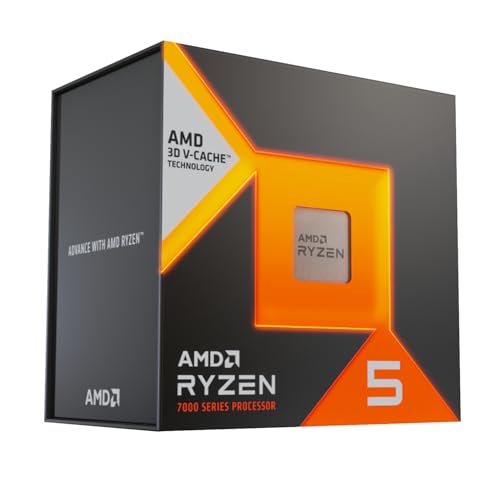
The Ryzen 5 7500X3D introduces the 3D V-Cache technology to the six-core budget segment, stacking 96 MB of ultrafast cache atop traditional architecture. This specialised design targets specific workloads: developers working with large-scale in-memory datasets, those running memory-intensive profiling and debugging tools, or teams benchmarking algorithms where cache efficiency dominates performance. The AM4 socket places it on an older platform, but 3D V-Cache delivers tangible benefits for particular development scenarios. The 3.7 GHz base and 5.0 GHz boost perform adequately, but the exceptional cache hierarchy is the main attraction.
For most conventional software development, the 96 MB cache provides marginal real-world gains compared to cheaper six-core alternatives. The cache advantage shines when developing high-frequency trading systems, numerical simulation libraries, or database query optimisation tools where memory bandwidth and cache hierarchy dominate runtime. The 105W TDP differs from the 65W standard, requiring slightly more robust cooling and drawing more electricity over time. The AM4 socket limitation means access to older motherboards with potentially less modern I/O features, though PCIe 4.0 support remains adequate for most development scenarios. Unless your specific workload derives measurable benefit from extreme cache capacity, the premium over a standard six-core processor becomes difficult to justify.
Verdict: The Ryzen 5 7500X3D suits niche development scenarios where cache efficiency is measurably critical; general-purpose developers see minimal practical benefit and pay a premium for unused capability.
Pros
- Exceptional 96 MB cache accelerates memory-intensive algorithms and profiling workloads
- Delivers measurable speedup for specific compiler and optimisation scenarios
Cons
- Higher 105W TDP increases cooling costs and system power consumption
- AM4 socket lacks modern I/O features found on current-gen AM5 platforms
- Premium price applies only to niche workloads; general-purpose developers gain little
The Ryzen 7 5800 XT steps into eight-core territory, addressing developers managing complex multithreaded applications, heavy virtualisation, and simultaneous development environments. Eight cores and sixteen threads accommodate parallel builds of large C++ projects, running multiple virtual machines for cross-platform testing, and maintaining responsive IDE performance whilst background services execute. The AM4 socket connects to proven, mature motherboards with reliable BIOS support and abundant availability in the used market. At this price, the 5800 XT represents a meaningful step up from six-core parts, but delivers genuine practical improvements for serious development workloads.
The 3.8 GHz base clock and 4.7 GHz boost provide solid all-core performance for sustained multithreading scenarios. The 36 MB cache proves adequate for most codebases, and the eight-core configuration means compilation tasks distribute effectively across parallel build systems. Developers working with Kubernetes clusters locally, running Docker Compose with numerous services, or managing heavy CI/CD pipelines experience considerably reduced wait times. The 105W TDP requires proper case ventilation and cooling investment, but remains within typical budget for enthusiast-class development systems. This processor particularly suits backend engineers, infrastructure developers, and teams building distributed systems where local testing often involves multiple concurrent services.
Verdict: The Ryzen 7 5800 XT provides genuine productivity gains for developers managing complex multithreaded workloads, making it the sweet spot for professional-grade development machines with moderate budgets.
Pros
- Eight cores enable genuine parallel build acceleration for large projects
- Sixteen threads handle Docker, Kubernetes, and CI/CD simulation without performance degradation
- Mature AM4 platform with abundant used market availability and stable BIOS support
- Excellent value for multithreaded development versus newer AM5 alternatives
Cons
- 105W TDP requires adequate cooling and increases long-term electricity costs
- Older Zen 3 architecture shows single-thread latency disadvantage versus newer parts
The Ryzen 7 9700X represents the best-overall choice for professional developers and teams prioritising modern architecture, future-proofing, and genuine performance leadership. Eight cores and sixteen threads utilise Zen 5 improvements, delivering single-thread responsiveness essential for IDE operations whilst maintaining exceptional all-core performance for parallel compilation and heavy virtualisation. The AM5 socket provides access to cutting-edge motherboards with PCIe 5.0, next-generation memory technologies, and a clear upgrade path to future Ryzen processors. At 65W TDP, this processor achieves remarkable efficiency for an eight-core chip, consuming identical power to most six-core alternatives whilst delivering nearly two times the parallelism.
The 3.8 GHz base and 5.5 GHz boost clock ensure snappy editor responsiveness when switching between files or triggering inline code analysis, whilst all eight cores working together finish large build tasks in genuinely minimal time. The 40 MB cache accommodates substantial codebases, and Zen 5 cache hierarchy improvements mean faster cache-resident working sets compared to prior generations. Developers managing microservices architectures, those running extensive test suites with parallel test runners, and teams building high-performance systems libraries will see tangible daily time savings. The modest power envelope makes this processor suitable for long development sessions without excessive heat or noise, a practical consideration for open-plan offices or home working environments.
Verdict: The Ryzen 7 9700X stands as the best overall processor for serious software development, balancing raw performance, architectural modernity, platform longevity, and exceptional power efficiency into a single compelling choice.
Pros
- Eight cores with Zen 5 single-thread improvements deliver both parallelism and IDE responsiveness
- 65W TDP is exceptional for an eight-core processor; enables efficient long development sessions
- AM5 platform ensures access to current-gen features and future upgrades
- 5.5 GHz boost accelerates bursty compilation tasks and IDE operations
Cons
- Premium price exceeds mid-range six-core alternatives by a meaningful margin
- Eight cores unnecessary for developers working exclusively on lightweight projects
Buying Guide
Selecting a development processor hinges on four primary factors: the scale of projects you compile, the number of virtual machines or containers you run simultaneously, your budget, and your platform upgrade philosophy.
Compilation and Build Speed: Six-core processors suit most web framework development, mobile app SDKs, and lightweight backend services. Eight-core parts significantly accelerate large C++ projects, Rust compilation, and parallel test execution. If your build takes under two minutes on a six-core system, your bottleneck likely lies elsewhere (storage I/O, network dependencies); if build times exceed five minutes, eight cores deliver meaningful daily time savings.
Virtualisation and Container Workloads: Running Docker Compose with five or more services, local Kubernetes testing, or concurrent virtual machines for cross-platform development justifies eight cores. Six-core processors handle two to three concurrent services with acceptable responsiveness; beyond that, contention increases and responsiveness degrades noticeably.
IDE and Single-Thread Performance: Modern IDEs (Visual Studio Code, IntelliJ, Xcode) benefit from higher single-thread clock speeds when parsing code, executing linters, and rendering real-time diagnostics. Zen 5 architecture (9600X, 9700X) provides measurable latency improvements versus Zen 3 (7600, 5800 XT). If you spend significant time in an IDE, the single-thread improvements justify the cost of newer architecture.
Platform and Future Upgrades: AM5 socket processors provide access to upcoming Ryzen 9000-series and beyond, ensuring you can upgrade to higher-core counts later without a full motherboard replacement. AM4 processors face platform EOL within one to two years, limiting upgrade options. Budget builds may tolerate AM4 closure; professional setups benefit from AM5 longevity.
Cooling and Power Efficiency: 65W processors enable silent operation with passive cooling or small tower coolers, essential for home offices and quiet environments. 105W processors require active cooling and generate noticeable heat. Long development sessions (six to eight hours) favour lower TDP parts due to accumulated heat and electricity costs.
The AMD Ryzen 7 9700X stands as the best overall choice for professional software development in 2025. Eight cores with Zen 5 architecture deliver the productivity gains developers genuinely need when managing complex projects, multiple containers, and responsive IDE performance. The exceptional 65W TDP ensures efficient, quiet operation during long sessions, and the AM5 platform guarantees future-proofing and access to cutting-edge motherboard features. The modest premium over six-core alternatives translates to measurable daily time savings through faster compilation, reduced virtualisation contention, and snappier code analysis operations.
For budget-conscious developers and students, the Ryzen 5 8400F provides reliable entry-level performance without unnecessary expense. The Ryzen 5 9600X offers the best six-core compromise, balancing modern architecture, integrated graphics, and reasonable cost. The Ryzen 7 5800 XT suits developers already committed to AM4 platforms or those finding used stock at compelling discounts. Unless your workload derives specific, measurable benefit from extreme cache capacity (7500X3D) or legacy platform compatibility (7600), focus on the Ryzen 7 9700X as your primary choice and the 9600X as your affordable alternative. Both deliver the balance of performance, efficiency, and modernity that professional development demands.