Competitive FPS gaming puts unique demands on a processor. Unlike cinematic single-player titles, games such as Counter-Strike 2, Valorant, Apex Legends, and Rainbow Six Siege hammer a handful of fast cores at sky-high clock speeds, and the CPU becomes the primary bottleneck long before the GPU does at lower resolutions. Since last year, AMD's Zen 5 architecture has arrived on AM5, pushing single-core performance further than ever, while the Ryzen 7 9800X3D has reset expectations for what a gaming CPU can do with its expanded 3D V-Cache. Intel's Raptor Lake Refresh remains competitive at the top end, though power draw and platform costs have pushed many buyers toward AMD. Whether you are building a budget 240 Hz rig on AM4 or chasing every last frame on a flagship setup, this guide covers the five best processors for competitive FPS gaming right now, with clear advice on who each one suits.
Quick Verdict
Best Overall: AMD Ryzen 7 9800X3D. Its combination of Zen 5 IPC, enormous 3D V-Cache, and class-leading 1080p frame rates makes it the single best gaming CPU available in 2025. Best Value: AMD Ryzen 5 9600X. It delivers Zen 5 performance on the modern AM5 platform at a price that undercuts most of its rivals, making it the smartest spend for players who want next-generation architecture without a premium price tag.
Spec Comparison
The Ryzen 7 9800X3D is, without qualification, the best gaming CPU AMD has ever made, and it sits at the top of every credible competitive FPS benchmark published since its launch in late 2024. It combines the new Zen 5 architecture, which brings roughly a 16 percent IPC uplift over Zen 4, with AMD's second-generation 3D V-Cache technology. The result is a processor that stacks 64 MB of additional SRAM directly on top of the compute die, bringing total cache to 104 MB. In latency-sensitive games, that enormous cache dramatically reduces the number of times the CPU has to reach out to slower system RAM, which translates directly into higher average frame rates and, crucially, higher minimum frame rates.
For competitive FPS players, minimum frame rates matter more than averages. A dip below your monitor's refresh rate during a firefight is far more damaging than a momentary spike. The 9800X3D consistently delivers 1 percent low frame rates that rival or exceed the average frame rates of competing processors in titles such as CS2, Valorant, and Apex Legends at 1080p. Its boost clock of 5.7 GHz is the highest AMD has achieved on a 3D V-Cache part, addressing a previous criticism that V-Cache chips sacrificed clock speed for cache size.
The platform requires DDR5 memory and an AM5 motherboard, which adds cost compared to AM4 builds. A decent B650 board and 32 GB of DDR5-6000 will add to your total outlay, but the platform is future-proof through at least one more generation of AMD CPUs. The 120W TDP is modest for a flagship chip, and the processor runs cool enough under a mid-range 240mm AIO or a high-end air cooler. No cooler is included in the box, so budget accordingly.
This processor suits any serious competitive FPS player who wants the absolute best gaming performance available today and intends to keep their system relevant for three or more years. It is overkill for casual play but a genuine investment for anyone competing at a high level or streaming while playing.
Verdict: The 9800X3D is the undisputed king of competitive FPS CPUs in 2025. If budget allows, buy it without hesitation.
Pros
- Highest 1 percent low frame rates of any gaming CPU currently available
- Zen 5 IPC combined with 3D V-Cache delivers a double performance advantage over Zen 4 V-Cache
- 65W base TDP keeps thermals manageable despite flagship performance
Cons
- Requires an AM5 motherboard and DDR5, pushing total platform cost significantly higher
- No bundled cooler, adding further to build cost
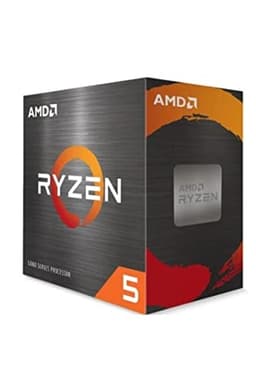
The Ryzen 5 9600X is AMD's entry point into the Zen 5 generation, and it punches well above its price bracket in competitive FPS scenarios. Six cores and twelve threads might sound modest in 2025, but competitive shooters are rarely well-threaded workloads. CS2, Valorant, and Rainbow Six Siege all rely heavily on single-threaded performance and fast cache access, both of which the 9600X delivers in abundance thanks to Zen 5's architectural improvements.
The 9600X boosts to 5.4 GHz and carries 38 MB of combined cache. In practice, it trades blows with Intel's Core i5-13600K and AMD's own Ryzen 7 7700X in gaming benchmarks, while drawing only 65W under load. That low power draw means you can pair it with a budget cooler and a mid-range B650 motherboard without worrying about thermal throttling. The integrated Radeon graphics are a useful fallback for troubleshooting but are not intended for gaming use.
One important consideration is the AM5 platform requirement. While DDR5 memory has dropped considerably in price since 2023, a complete AM5 build still costs more than an equivalent AM4 system. The trade-off is platform longevity: AM5 will support future Ryzen processors, so upgrading to a 9800X3D or its successor becomes a simple CPU swap rather than a full rebuild.
The 9600X suits competitive FPS players on a mid-range budget who want modern architecture, low power consumption, and a clear upgrade path. It is particularly well suited to players running 1080p at 240 Hz or 1440p at 165 Hz, where the CPU will not be the limiting factor with a capable GPU such as an RTX 4070 or RX 7800 XT. Content creators who also game will find the six-core count slightly limiting for heavy rendering tasks, and those players may want to step up to the Ryzen 7 9700X instead.
Verdict: The best value AM5 gaming CPU available today. It brings Zen 5 performance to a price point that makes it accessible to the majority of competitive players.
Pros
- Zen 5 architecture delivers genuine generational IPC improvements over Zen 4 at a competitive price
- 65W TDP makes it one of the most efficient high-performance gaming CPUs on AM5
- AM5 platform ensures a clear upgrade path to future AMD processors
Cons
- Six cores can feel limiting for simultaneous streaming and gaming at high quality settings
- AM5 platform adds cost compared to budget AM4 alternatives
The Ryzen 7 9700X occupies an interesting position in AMD's 2025 lineup. It offers eight Zen 5 cores and sixteen threads at a 65W TDP, making it one of the most power-efficient eight-core processors ever released. For competitive FPS gaming, the additional two cores over the 9600X provide a meaningful buffer for background tasks, streaming software, and Discord without eating into the frames available to your game. The 5.5 GHz boost clock and 40 MB of cache keep it competitive in latency-sensitive titles.
In straight gaming benchmarks at 1080p, the 9700X typically sits within five to eight percent of the 9800X3D in average frame rates, though the gap widens in 1 percent lows where the V-Cache chip's enormous cache advantage becomes apparent. For players who are not chasing absolute maximum frame rates but want a fast, efficient, and versatile processor, the 9700X represents an excellent middle ground between the value-focused 9600X and the premium 9800X3D.
The 65W TDP is genuinely impressive for an eight-core chip. It means the 9700X runs cool and quiet under a mid-range tower cooler, and it will not stress a mid-range power supply. Overclocking headroom is limited by AMD's Precision Boost algorithm, but the processor is already well-optimised out of the box, so manual tuning is rarely necessary. Pairing it with fast DDR5-6000 memory in dual-channel configuration will extract the best gaming performance.
The 9700X is the right choice for competitive FPS players who also do content creation, video editing, or 3D rendering on the side. The eight cores handle multi-threaded workloads considerably better than the 9600X, while the gaming performance remains excellent. It is also a sensible pick for players who want to future-proof their build without spending the premium required for the 9800X3D.
Verdict: A well-rounded AM5 processor that balances gaming performance, multi-threaded capability, and exceptional power efficiency. Ideal for players who do more than just game.
Pros
- Eight Zen 5 cores at just 65W TDP, making it one of the most efficient gaming CPUs available
- Strong multi-threaded performance suits streaming, content creation, and gaming simultaneously
- Within striking distance of the 9800X3D in average frame rates at a lower price
Cons
- Costs noticeably more than the 9600X for a modest gaming performance gain in most FPS titles
- Lacks 3D V-Cache, so 1 percent low frame rates trail the 9800X3D by a visible margin
Buying Guide
Single-core performance is what matters most
Competitive FPS games are among the most CPU-bound workloads in gaming, but they scale primarily with single-core speed rather than core count. A processor with six fast cores will almost always outperform one with twelve slower cores in CS2 or Valorant. When comparing chips, look at boost clock speeds and, more importantly, independent gaming benchmarks that measure 1 percent low frame rates at 1080p. Average frame rates can be misleading because they smooth over the momentary dips that are most disruptive during fast-paced gameplay.
Cache size matters more than you might expect
AMD's 3D V-Cache technology has demonstrated clearly that large on-chip cache reduces the frequency with which the CPU must fetch data from slower system memory. In latency-sensitive games, this translates directly into smoother frame delivery and higher minimum frame rates. Even without 3D V-Cache, processors with larger L3 caches tend to perform better in gaming than their clock speeds alone would predict. This is one reason why AMD's Zen 4 and Zen 5 chips consistently outperform Intel's similarly-clocked offerings in pure gaming workloads.
Platform choice: AM4 vs AM5
AM4 offers lower upfront costs thanks to cheap DDR4 memory and affordable motherboards, but the platform is now closed with no further CPU generations planned. AM5 requires DDR5 memory and a newer motherboard, but it supports future Ryzen processors, meaning your next CPU upgrade can be a simple socket swap. For anyone building a new system today, AM5 is the more sensible long-term investment unless budget constraints make it genuinely unaffordable.
Memory speed and configuration
All modern AMD processors benefit significantly from fast dual-channel memory. On AM4, DDR4-3600 in two sticks is the sweet spot. On AM5, DDR5-6000 in dual-channel is the recommended configuration for gaming. Running a single memory stick in single-channel mode can reduce gaming performance by ten to fifteen percent, so always install memory in pairs. Check your motherboard's QVL list to ensure compatibility with your chosen memory kit.
Cooling requirements
Most of the processors reviewed here have 65W TDPs and are manageable with a decent mid-range air cooler. The Ryzen 7 9800X3D runs at up to 120W under gaming load and benefits from a 240mm AIO or a high-end tower cooler such as a Noctua NH-D15 or be quiet! Dark Rock Pro 5. The Ryzen 5 5600X ships with a Wraith Stealth cooler that is adequate for stock operation, though a modest aftermarket cooler will keep temperatures lower and fan noise quieter. Avoid running any processor without adequate cooling, as thermal throttling will reduce gaming performance below the chip's rated specifications.
Do you need more than six cores?
For pure competitive FPS gaming, six cores is sufficient. The games that matter in this category do not scale meaningfully beyond six to eight threads. However, if you also stream your gameplay, edit video, or run other demanding background tasks, eight cores provide a useful buffer. The Ryzen 7 9700X and 9800X3D both offer eight cores and handle mixed workloads considerably more comfortably than six-core alternatives.
For competitive FPS gaming in 2025, the AMD Ryzen 7 9800X3D is the clear overall winner. Its combination of Zen 5 architecture, 3D V-Cache, and a 5.7 GHz boost clock produces the highest 1 percent low frame rates of any processor currently available, and those minimum frame rates are precisely what separates smooth, consistent competitive play from stuttery, frustrating sessions. The platform cost is higher than AM4 alternatives, but for a player who is serious about their performance, the investment is justified. The AMD Ryzen 5 9600X takes the best value award, bringing Zen 5 IPC to a price point that the majority of competitive players can justify, with the added benefit of AM5 platform longevity. Between these two chips, almost every competitive FPS player will find their ideal processor.