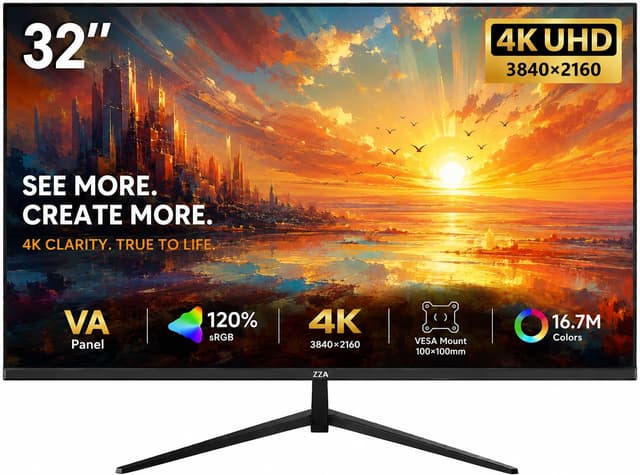
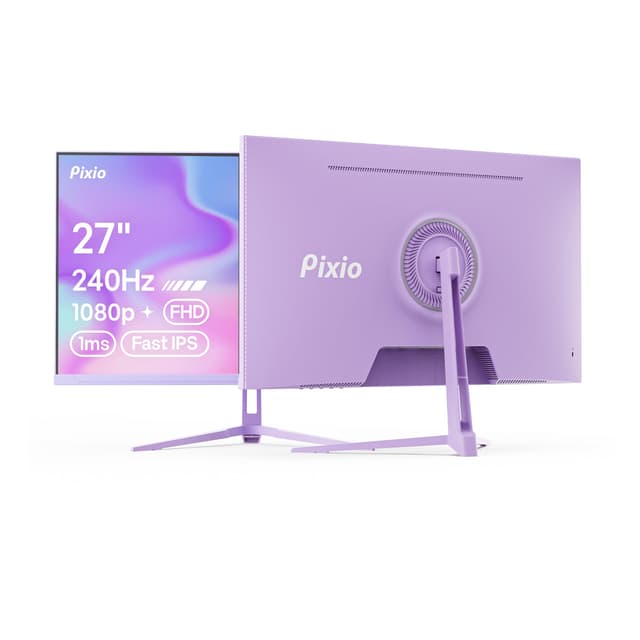
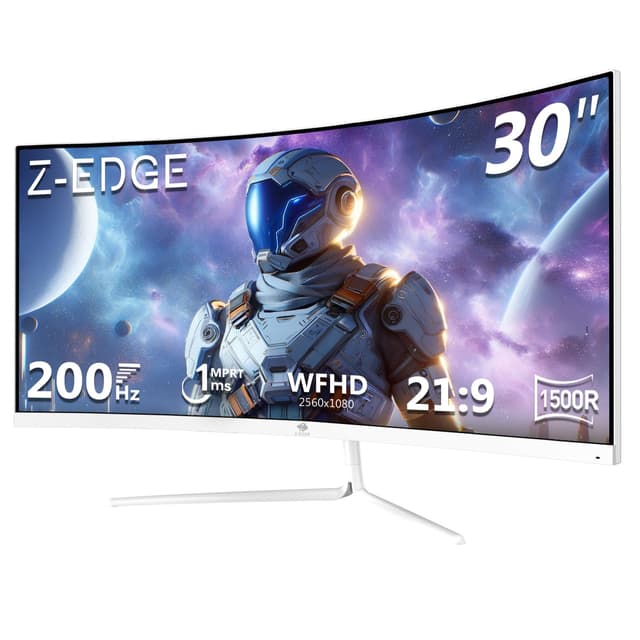
If you are upgrading from a 60Hz panel for the first time, or simply want a faster screen without spending a fortune, the sub-£200 bracket has never been more competitive. In 2025 the sweet spot has shifted: monitors that would have two years ago now sit comfortably under the £200 ceiling, and several options exceed the 144Hz baseline entirely, hitting 180Hz, 200Hz or even 240Hz. This guide is aimed at PC gamers on a budget, students who also game, and home-office workers who want smoother scrolling and lower input lag without breaking the bank. You do not need a flagship GPU to benefit from a higher-refresh panel, and even mid-range cards like the RTX 3060 or RX 6700 XT can push enough frames to make 144Hz or above feel transformative. We have selected six monitors from this price band, covering curved ultrawide, flat 27-inch, and compact 24-inch options, so there is something here regardless of desk space or use case.
Quick Verdict
Best Overall: Z-Edge 27 Inch 240Hz QHD IPS Monitor. At under £200 it delivers QHD resolution, a 240Hz IPS panel, and dual DisplayPort connections, making it the most well-rounded pick in this price range.
Best Value: AOC Gaming C32G2ZE 32-Inch Curved 240Hz. A 31.5-inch curved VA panel with a 240Hz refresh rate under £100 is remarkable, and it suits gamers who prioritise screen size and speed over pixel density.
The Z-Edge 27-inch QHD IPS is the pick that genuinely surprises at this price point. Offering a 2560x1440 resolution on a 27-inch IPS panel with a 240Hz refresh rate and 1ms response time, it punches well above its weight. For context, QHD at 240Hz on an IPS panel would have cost close to £400 just two years ago, so landing this combination under £200 in 2025 is a real milestone for budget gaming monitors.
This monitor suits competitive gamers who do not want to sacrifice image quality for speed. The IPS panel means colours are accurate and viewing angles are wide, making it equally capable for creative work, casual browsing, and long gaming sessions. The 2560x1440 resolution gives noticeably sharper visuals compared to 1080p at 27 inches, where individual pixels can become visible at close viewing distances. Text rendering is crisp, which matters if you are using this as a dual-purpose work and play screen.
The port selection is generous for the price: two HDMI inputs and two DisplayPort outputs mean you can connect a PC and a console simultaneously without swapping cables. The audio out jack is a useful addition for headset users who prefer to route audio through the monitor. The stand offers basic tilt adjustment, which is typical at this price, though the monitor is VESA-compatible if you want to mount it on an arm.
In terms of gaming performance, 240Hz on an IPS panel delivers the kind of smooth, tear-free motion that VA panels at this speed sometimes struggle with due to slower pixel transitions. Ghosting is minimal, and fast-moving scenes in titles like Valorant or CS2 look clean. FreeSync support helps if your GPU output dips below the panel's maximum, preventing screen tearing without needing to cap your frame rate manually.
The one area where budget shows is in HDR performance. The panel does not have local dimming, so HDR content looks only marginally better than SDR. For a monitor at this price, that is expected and forgivable, but worth knowing if HDR quality is a priority for you.
Verdict: The best all-round monitor in this price bracket, combining QHD resolution, 240Hz IPS speed, and a practical port layout into a package that is hard to beat under £200.
Pros
- QHD 2560x1440 resolution on a 27-inch IPS panel at under £200
- 240Hz refresh rate with 1ms response time for competitive gaming
- Dual HDMI and dual DisplayPort inputs for multi-device setups
Cons
- HDR implementation is basic with no local dimming
- Stand only offers tilt adjustment, no height or swivel
The AOC C32G2ZE is a 31.5-inch curved VA panel running at 240Hz with a 1ms MPRT response time, and it sits under £100. For anyone who wants a large, fast gaming screen on a tight budget, this is one of the most compelling options available in the UK right now. The 1800R curvature wraps the screen around your field of view, which works particularly well at 31.5 inches where a flat panel can feel slightly overwhelming at close range.
This monitor is best suited to gamers who prioritise screen size and refresh rate over pixel density. At 1920x1080 on a 31.5-inch panel, the pixel density is around 70 PPI, which is noticeably lower than a 24-inch 1080p screen. If you sit close to your monitor, you may notice individual pixels in fine text or detailed textures. However, for gaming from a normal desk distance, this is less of an issue, and the sheer size of the screen creates an immersive experience that smaller panels simply cannot match.
The 240Hz refresh rate is the headline figure, and on a VA panel it is achieved using MPRT (Moving Picture Response Time) processing rather than native pixel response. This means motion clarity is excellent for fast-paced games, though some users may notice slight haloing in very dark scenes, which is a known characteristic of VA technology. AMD FreeSync support helps keep gameplay smooth even when your frame rate fluctuates.
The port selection covers the basics: one HDMI and one DisplayPort, which is sufficient for most single-PC setups. There is no USB hub, which is a reasonable omission at this price. The stand is functional with tilt adjustment, and the monitor is VESA-compatible for arm mounting.
Colour accuracy is solid for gaming, with good contrast ratios typical of VA panels. Dark scenes in games like Elden Ring or Cyberpunk 2077 look punchy and detailed, which is one area where VA genuinely outperforms IPS at the same price point.
Verdict: An outstanding value pick for gamers who want a large, fast curved screen without spending much. The lower pixel density is the only real trade-off at this price.
Pros
- 31.5-inch curved screen at under £100 is exceptional value
- 240Hz refresh rate delivers smooth, competitive-ready gaming
- High contrast VA panel produces deep blacks for immersive dark scenes
Cons
- 1080p on a 31.5-inch panel results in low pixel density, noticeable up close
- VA panel can exhibit haloing in high-contrast dark scenes
Buying Guide
Is 144Hz on a monitor good?
Yes, 144Hz is a significant upgrade over 60Hz. The difference is immediately noticeable when moving your mouse across the screen or panning the camera in a game. Motion appears smoother, input lag is reduced, and fast-moving objects are easier to track. For competitive gaming, 144Hz is widely considered the minimum worthwhile refresh rate, and many professional esports players use 240Hz or higher. For casual gaming and everyday use, 144Hz is more than sufficient and represents a meaningful improvement over the 60Hz panels that ship with most budget monitors.
Can the human eye see 144 FPS?
This is a common question, and the answer is nuanced. The human visual system does not have a fixed frame rate limit in the way a monitor does. Research suggests that most people can perceive differences in motion smoothness well above 60 FPS, and some studies indicate sensitivity up to and beyond 240 FPS in certain conditions. In practice, most people can clearly see the difference between 60Hz and 144Hz, and many can distinguish 144Hz from 240Hz, particularly in fast-paced games. The improvement is most noticeable during rapid mouse movements and in games with high frame rates.
Do I need a powerful PC for a 144Hz monitor?
You need a PC capable of producing enough frames to make use of the higher refresh rate. A 144Hz monitor running at 60 FPS will look identical to a 60Hz monitor at 60 FPS. To benefit from 144Hz, you ideally want your GPU to produce 100 FPS or more consistently in your chosen games. For 1080p gaming, mid-range GPUs like the GTX 1660 Super, RX 6600, or RTX 3060 are capable of hitting 144 FPS in many titles. For 1440p at 144Hz or above, you will want something closer to an RTX 3070 or RX 6700 XT. FreeSync support, available on most monitors in this selection, helps by synchronising the monitor's refresh rate to your GPU's output, reducing tearing even when frame rates fluctuate.
Does 144Hz reduce eye strain?
Higher refresh rates can contribute to reduced eye strain in some users, primarily because smoother motion requires less effort from your eyes to track. However, the panel type and backlight technology have a more significant impact on eye strain than refresh rate alone. IPS panels generally offer better colour accuracy and wider viewing angles, which can be more comfortable over long sessions. Some monitors include flicker-free backlights and low blue light modes, which are more directly linked to eye strain reduction than refresh rate. If eye comfort is a priority, look for monitors with these certifications in addition to a high refresh rate.
Why is 144Hz so popular?
144Hz became the standard gaming refresh rate because it represents a practical balance between performance and hardware requirements. When 144Hz monitors first became widely available, they were accessible to gamers with mid-range GPUs, unlike 240Hz panels which required very powerful hardware to use effectively. The jump from 60Hz to 144Hz is large enough to be immediately noticeable to almost everyone, which made it a compelling upgrade. In 2025, 144Hz is now the baseline rather than the premium tier, with 180Hz, 200Hz, and 240Hz options available at similar prices, but the 144Hz threshold remains the reference point that most buyers use when evaluating gaming monitors.
Panel type: VA vs IPS vs Fast IPS
Panel type is one of the most important decisions when buying a gaming monitor. VA panels offer the best contrast ratios, typically 3000:1 or higher, which produces deep blacks and vivid colours in dark scenes. They are well-suited to single-player and cinematic games. The trade-off is slower pixel response times, which can cause ghosting in very fast-moving scenes, though technologies like Rapid VA and MSI's implementation reduce this significantly. IPS panels offer wider viewing angles, better colour accuracy, and faster pixel response times, making them the preferred choice for competitive gaming and content creation. Fast IPS panels push response times down to 1ms, matching or exceeding TN panels while retaining the colour and viewing angle advantages of IPS. For most buyers, an IPS or Fast IPS panel at 144Hz or above is the safest all-round choice, while VA panels are better for users who prioritise contrast and immersion over raw motion clarity.
Resolution and screen size
At 24 inches, 1920x1080 is a sharp and practical resolution that is easy to drive at high frame rates. At 27 inches, 1080p starts to show its limitations in terms of pixel density, and 1440p becomes the preferred choice for clarity. Ultrawide monitors at 3440x1440 offer a unique experience but demand more from your GPU. Match your resolution choice to both your screen size and your GPU's capabilities to get the most from your monitor.
The Z-Edge 27-inch 240Hz QHD IPS monitor is the overall winner of this roundup. Combining a 2560x1440 resolution with a 240Hz IPS panel, 1ms response time, and dual HDMI plus dual DisplayPort connectivity at under £200 is a genuine achievement, and it suits the widest range of buyers: competitive gamers, casual players, and dual-purpose work-and-play users alike. The image quality is a step above 1080p alternatives, and the IPS panel ensures consistent colours and viewing angles that VA panels at this price cannot always match.
For those on a tighter budget, the AOC C32G2ZE is an extraordinary value pick. A 31.5-inch curved 240Hz VA panel for under £100 is difficult to argue against if screen size and refresh rate are your priorities and pixel density is less of a concern. The KOORUI G2411P earns a mention for competitive gamers who want a compact Fast IPS screen at 200Hz, and the AOC CU34G2XPD is the pick for anyone who wants to step into ultrawide gaming without spending beyond the £200 ceiling.