Check our top-ranked product on Amazon before you buy: we could not confirm it is available.
How we picked
Our editors evaluated 1 Comparisons options against the criteria readers actually weigh up: price, real-world performance, build quality, warranty, and UK availability. Picks lean toward what we'd recommend to a friend buying today, not specs-on-paper winners.
Editorial contextEditor notes from individual reviews, not press releases.
Live UK pricingRefreshed from Amazon UK twice daily.
No paid placementsAffiliate commission doesn't change what wins.
Seagate IronWolf Pro vs Western Digital WD: Complete Storage Showdown 2025
TL;DR
The Seagate IronWolf Pro vs Western Digital WD debate comes down to your specific needs. The IronWolf Pro 28TB dominates for professional NAS environments requiring massive capacity and enterprise-grade reliability, whilst the WD Purple 8TB excels in surveillance applications with optimised streaming performance.
Quick Picks
🏆 Best Overall: Seagate IronWolf Pro 28TB - Unmatched capacity and performance for professional NAS
💰 Best Value: WD Purple 8TB - Purpose-built surveillance storage at an accessible price
Choosing between the Seagate IronWolf Pro vs Western Digital WD isn't straightforward because these drives target fundamentally different use cases. Comparing them directly is like comparing a lorry to a sports car - both are vehicles, but they're built for completely different purposes.
The IronWolf Pro represents Seagate's flagship NAS solution, engineered for multi-bay systems handling constant read/write operations across multiple users. Meanwhile, the WD Purple is Western Digital's surveillance specialist, optimised for continuous video streaming from security cameras. Here's what actually matters when making your decision.
NAS file storage and surveillance recording place different demands on a drive. We judge these picks by published specifications, suitability for those workloads and current UK prices; neither drive has been tested by us.
Seagate IronWolf Pro 28TB: Enterprise NAS Champion
The Seagate IronWolf Pro 28TB represents the pinnacle of consumer-accessible NAS storage.
Seagate's AgileArray firmware optimises the drive for multi-bay NAS environments. The rotational vibration sensors (RV sensors) actively compensate for vibrations from neighbouring drives - a feature that becomes crucial in densely packed systems.
✅ Pros
Massive 28TB capacity reduces drive count in arrays
550TB/year workload rating handles intensive use
7200 RPM delivers excellent random access performance
256MB cache optimises multi-user scenarios
5-year warranty with Rescue Data Recovery included
RV sensors maintain performance in multi-bay systems
2.5 million hour MTBF rating
❌ Cons
Premium pricing reflects enterprise-grade features
Western Digital WD Purple 8TB: Surveillance Specialist
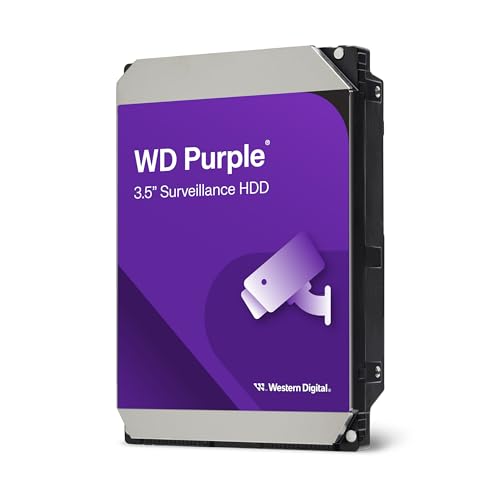
The WD Purple 8TB takes a completely different approach. Western Digital engineered this drive specifically for surveillance applications, and that focus shows in every aspect of its design. AllFrame Technology is the star feature - it reduces frame loss and improves video playback smoothness.
The drive's firmware prioritises write operations over read performance. This makes perfect sense for surveillance - you're constantly writing video streams but only occasionally reviewing footage. The 180TB/year workload rating aligns perfectly with typical surveillance demands.
AllFrame Technology handles up to 64 camera streams, though we'd recommend staying below 32 for optimal performance. The drive supports up to 180TB annual workload, which translates to roughly 500GB daily - more than sufficient for most surveillance setups.
Capacity and Storage Needs: Winner - Seagate IronWolf Pro
The Seagate IronWolf Pro vs Western Digital WD comparison becomes stark when examining capacity. The IronWolf Pro's 28TB dwarfs the Purple's 8TB, but raw numbers don't tell the complete story.
For NAS applications, the IronWolf Pro's massive capacity means fewer drives in your array. In a RAID 6 configuration, you could build a 112TB usable array with just six IronWolf Pro drives. Achieving similar capacity with 8TB drives requires significantly more bays, increasing cost, power consumption, and complexity.
However, surveillance systems have different requirements. Most installations don't need 28TB per drive.
Verdict: The IronWolf Pro wins on pure capacity, but the Purple offers more appropriate sizing for surveillance needs.
Spindle Speed, Cache and Workload
Performance differences between the Seagate IronWolf Pro vs Western Digital WD reflect their distinct design philosophies. The IronWolf Pro is built for NAS workloads such as databases, virtual machines and multi-user file access.
The WD Purple's 5640 RPM spindle and 128MB cache target different priorities. Its firmware is designed for continuous surveillance recording.
Reliability and Durability: Winner - Seagate IronWolf Pro
When comparing Seagate IronWolf Pro vs Western Digital WD for reliability, the specifications tell a clear story. The IronWolf Pro's 2.5 million hour MTBF rating significantly exceeds the Purple's 1 million hours. That's not just marketing - it reflects more robust components and stricter quality control.
The 550TB/year workload rating on the IronWolf Pro is over three times the Purple's 180TB/year.
Seagate includes Rescue Data Recovery Services with the IronWolf Pro - a £1000+ value that provides peace of mind for critical data. Western Digital offers no equivalent service with the Purple line.
The five-year warranty on the IronWolf Pro versus three years for the Purple reflects manufacturer confidence in longevity. Backblaze's annual drive statistics show enterprise-class drives consistently outperform surveillance-optimised models in mixed workloads.
Both drives feature vibration compensation, but the IronWolf Pro's dual-plane RV sensors provide superior protection in densely packed arrays. This matters significantly in 8-bay or larger systems where drive vibration becomes problematic.
Verdict: The IronWolf Pro offers superior reliability specifications and warranty coverage, though the Purple proves reliable within its intended surveillance role.
Power Consumption and Operating Costs
Operating costs reveal another dimension in the Seagate IronWolf Pro vs Western Digital WD debate.
Drive count matters when comparing running costs. You'd need 3-4 Purple drives to match one IronWolf Pro's capacity. Those additional drives consume more total power, generate more heat, and require more physical space.
Inadequate cooling shortens drive lifespan and increases failure risk.
For surveillance applications, the Purple's lower power consumption and heat generation make it ideal for compact NVR enclosures. The IronWolf Pro demands proper ventilation and active cooling in multi-bay configurations.
Firmware and Technology Differences
The Seagate IronWolf Pro vs Western Digital WD comparison reveals sophisticated firmware optimisations tailored to specific use cases. Seagate's AgileArray technology manages error recovery, vibration compensation, and power management for NAS environments.
Standard desktop drives pause operations during error recovery, potentially causing timeouts in RAID arrays. AgileArray limits error recovery time, preventing the drive from being dropped from the array.
Western Digital's AllFrame Technology takes a different approach. It reduces pixel errors and improves video playback smoothness. The firmware prioritises write operations and manages streaming workloads efficiently.
The IronWolf Pro includes IronWolf Health Management (IHM) when used with compatible NAS systems. This provides advanced health monitoring, intervention, and recovery options.
The Purple lacks equivalent health management features, though Western Digital's Dashboard software provides basic monitoring. For surveillance applications, this limitation matters less since NVR software typically includes drive monitoring.
Price and Value Proposition
Evaluating the Seagate IronWolf Pro vs Western Digital WD on value requires examining cost per terabyte and total cost of ownership. The IronWolf Pro commands a premium price reflecting its enterprise-grade specifications and massive capacity.
At current market prices, the IronWolf Pro costs approximately £21 per terabyte. The WD Purple comes in around £26 per terabyte. However, these numbers don't account for the complete picture.
The IronWolf Pro includes Rescue Data Recovery Services worth over £1000, effectively reducing its real cost. The five-year warranty versus three years for the Purple provides additional value. Higher workload ratings mean the IronWolf Pro should last longer under intensive use.
For surveillance applications, the Purple offers better value. Its features align perfectly with surveillance requirements without paying for unnecessary capabilities. You don't need 7200 RPM performance or 550TB/year workload ratings for camera recording.
Building a 24TB NAS array illustrates the value difference. One 28TB IronWolf Pro provides that capacity with room to spare. You'd need three WD Purple 8TB drives, increasing total cost, power consumption, and required bays.
Compatibility and Use Case Scenarios
Understanding when to choose between Seagate IronWolf Pro vs Western Digital WD depends entirely on your specific application.
The IronWolf Pro excels in professional NAS environments with multiple users, mixed workloads, and demanding applications.
Small businesses running databases, virtualisation, or collaborative applications will appreciate the IronWolf Pro's performance headroom. Creative professionals working with large video files benefit from fast random access and sustained throughput.
The WD Purple shines in dedicated surveillance applications.
Home users with basic NAS needs should consider whether they need either drive. A standard IronWolf (non-Pro) or WD Red provides adequate performance for media streaming and basic file storage at lower cost.
According to Tom's Hardware's NAS drive recommendations, matching drive specifications to workload prevents overspending on unnecessary features whilst ensuring adequate performance and reliability.
Noise Levels and Acoustic Performance
Acoustic performance often gets overlooked in the Seagate IronWolf Pro vs Western Digital WD comparison, but it matters significantly for home installations.
The 7200 RPM spindle speed generates characteristic seeking sounds during random access operations.
Vibration isolation helps both drives. Rubber grommets and isolation mounts can reduce transmitted vibration.
Temperature Management and Cooling Requirements
Thermal performance impacts reliability and longevity in the Seagate IronWolf Pro vs Western Digital WD comparison.
Cooling requirements differ significantly. The IronWolf Pro demands active cooling in multi-bay configurations.
Data Recovery and Warranty Support
Warranty and data recovery services represent crucial differentiators in the Seagate IronWolf Pro vs Western Digital WD evaluation. The IronWolf Pro includes Seagate Rescue Data Recovery Services for the entire five-year warranty period.
This service covers mechanical failures, accidental damage, and even user error. Professional data recovery typically costs £1000-3000 depending on failure severity. Having it included provides substantial peace of mind for critical data.
The WD Purple includes a standard three-year warranty but no data recovery service. Western Digital offers recovery services separately at additional cost. For surveillance applications where footage is often temporary, this limitation matters less.
Warranty claim processes differ between manufacturers. Seagate's advance replacement option ships a new drive before you return the failed unit, minimising downtime. Western Digital requires return of the failed drive first, extending replacement time.
Both companies honour warranties internationally, important for UK buyers purchasing from various sources.
Choosing by Workload
Choose the IronWolf Pro for mixed NAS workloads such as file serving and backups, or the WD Purple for dedicated surveillance recording. Match the drive to the workload rather than treating the two as interchangeable.
Future-Proofing and Scalability
Considering future needs in the Seagate IronWolf Pro vs Western Digital WD decision prevents costly upgrades later. The IronWolf Pro's 28TB capacity provides substantial growth headroom for expanding data needs.
Starting with 28TB drives means your array remains adequate longer before requiring expansion or replacement.
The IronWolf Pro supports up to 24-bay systems, making it suitable for substantial future expansion. As your needs grow, you can add drives to existing arrays without replacing the entire system.
For surveillance applications, the Purple's 8TB capacity aligns with typical retention requirements. Most systems don't need more than 30-45 days of footage. Adding cameras means adding drives, which the Purple's 64-camera support accommodates easily.
Technology evolution favours larger capacity drives. The cost per terabyte continues decreasing as capacities increase. Investing in higher-capacity drives now provides better long-term value than buying smaller drives and upgrading sooner.
Both drives use standard SATA interfaces, ensuring compatibility with current and near-future systems. Neither drive faces obsolescence concerns for the foreseeable future.
Environmental Impact and Efficiency
Environmental considerations increasingly influence purchasing decisions in the Seagate IronWolf Pro vs Western Digital WD comparison. Both manufacturers have made strides in reducing environmental impact, but differences exist.
The IronWolf Pro's higher capacity means fewer drives needed for equivalent storage, reducing overall material consumption and electronic waste. However, its higher power consumption increases operational carbon footprint.
Both manufacturers use recyclable materials in drive construction and packaging. Seagate and Western Digital participate in electronics recycling programmes, accepting old drives for proper disposal.
The Purple's lower power consumption and heat generation reduce cooling requirements, further decreasing environmental impact. In large installations, this advantage compounds significantly.
Longevity matters more than efficiency for environmental impact. A drive lasting seven years has lower environmental cost than one requiring replacement after four years, regardless of power consumption differences.
Our Verdict
The Seagate IronWolf Pro vs Western Digital WD comparison ultimately reveals two excellent drives optimised for fundamentally different applications. The IronWolf Pro dominates for professional NAS environments requiring maximum capacity, performance, and reliability. Its enterprise-grade specifications, included data recovery services, and five-year warranty justify the premium price for business-critical applications.
The WD Purple excels in its surveillance role, delivering purpose-built features like AllFrame Technology and optimised firmware for continuous recording.
Choosing between them shouldn't be difficult - select based on your primary use case. For multi-purpose NAS with demanding workloads, the IronWolf Pro is worth the investment. For surveillance systems, the Purple provides exactly what you need without paying for unnecessary features.
Choose the Seagate IronWolf Pro 28TB if:
You're building or upgrading a professional NAS system
Multiple users will access the system simultaneously
You need maximum capacity to minimise drive count
Your workload includes virtualisation, databases, or intensive applications
Data recovery services provide essential peace of mind
You require the highest reliability and longest warranty
Performance matters more than initial cost
Your system has adequate cooling for 7200 RPM drives
Choose the WD Purple 8TB if:
You're building a dedicated surveillance system
Continuous video recording is your primary use case
You need support for multiple camera streams
You want a drive designed for surveillance recording
Your installation has limited cooling capacity
Budget constraints favour lower upfront costs
You don't need enterprise-grade performance specifications
8TB capacity meets your retention requirements
Will the WD Purple work in a standard NAS for file storage?
The WD Purple can function in a NAS for basic file storage, but it's not optimised for this use case. Its firmware prioritises sequential write performance for video recording over the random access patterns typical of file serving. For mixed NAS workloads, choose a drive designed for that purpose.
How many cameras can the WD Purple 8TB support?
The WD Purple 8TB officially supports up to 64 camera streams according to Western Digital's specifications. However, actual capacity depends on recording resolution, frame rate, and compression settings. For 4K cameras, expect fewer days of storage or support for fewer simultaneous streams.
Is the 28TB capacity of the IronWolf Pro reliable?
Yes, the Seagate IronWolf Pro 28TB demonstrates excellent reliability with its 2.5 million hour MTBF rating and 550TB/year workload specification. Seagate's enterprise-grade components and rigorous testing ensure the drive handles its massive capacity reliably. The included five-year warranty and Rescue Data Recovery Services provide additional confidence.
What's the real-world difference in power consumption between these drives?
The IronWolf Pro spins at 7200 RPM and the WD Purple at 5640 RPM, and faster drives generally draw more power. Check each maker's datasheet for the rated figures; in a multi-drive array the difference multiplies.
Can I mix IronWolf Pro and WD Purple drives in the same RAID array?
Whilst technically possible, mixing different drive models in RAID arrays isn't recommended. The drives have different performance characteristics, workload ratings, and firmware optimisations that can cause compatibility issues. RAID performance gets limited by the slowest drive, negating the IronWolf Pro's advantages. For optimal reliability and performance, use identical drives throughout your array.
How loud is the IronWolf Pro compared to the WD Purple?
Drive noise depends on the workload, mounting and enclosure. Vibration isolation can reduce noise transmitted through the enclosure.
Which drive offers better value for money?
Value depends on your use case. For NAS applications requiring high capacity and performance, the IronWolf Pro offers better value despite higher upfront costs - its included data recovery services, longer warranty, and superior specifications justify the premium. For surveillance systems, the WD Purple provides better value with features optimised specifically for video recording at a lower price point.
Final Thoughts on Seagate IronWolf Pro vs Western Digital WD
In this Seagate IronWolf Pro vs Western Digital WD comparison, we recommend each drive for its intended purpose. The IronWolf Pro represents the pinnacle of consumer-accessible NAS storage, delivering enterprise-grade performance, reliability, and capacity for demanding professional environments.
The WD Purple proves that specialisation matters. Its surveillance-optimised features and value make it the clear choice for dedicated recording systems. Trying to use either drive outside its design parameters means paying for features you don't need or accepting compromised performance.
Your decision should be straightforward: match the drive to your primary use case. Building a professional NAS? The IronWolf Pro's capabilities justify its premium price. Installing surveillance cameras? The Purple delivers exactly what you need without unnecessary cost.
Both drives represent quality engineering from manufacturers with proven track records. You can't go wrong choosing either - as long as you choose the right one for your application. That's the real lesson from our Seagate IronWolf Pro vs Western Digital WD comparison.
Frequently Asked Questions
Yes, the Seagate IronWolf Pro works for surveillance recording and will perform adequately. However, it's overspecified for this purpose - you'll pay for features like high random access performance and 550TB/year workload ratings that surveillance applications don't require. The WD Purple provides better value for dedicated surveillance systems whilst delivering optimised performance for continuous recording.
The WD Purple can function in a NAS for basic file storage, but it's not optimised for this use case. Its firmware prioritises sequential write performance for video recording over the random access patterns typical of file serving. For mixed NAS workloads, choose a drive designed for that purpose.
The WD Purple 8TB officially supports up to 64 camera streams according to Western Digital's specifications. However, actual capacity depends on recording resolution, frame rate, and compression settings. For 4K cameras, expect fewer days of storage or support for fewer simultaneous streams.
Yes, the Seagate IronWolf Pro 28TB demonstrates excellent reliability with its 2.5 million hour MTBF rating and 550TB/year workload specification. Seagate's enterprise-grade components and rigorous testing ensure the drive handles its massive capacity reliably. The included five-year warranty and Rescue Data Recovery Services provide additional confidence.
The IronWolf Pro spins at 7200 RPM and the WD Purple at 5640 RPM, and faster drives generally draw more power. Check each maker's datasheet for the rated figures; in a multi-drive array the difference multiplies.
Whilst technically possible, mixing different drive models in RAID arrays isn't recommended. The drives have different performance characteristics, workload ratings, and firmware optimisations that can cause compatibility issues. RAID performance gets limited by the slowest drive, negating the IronWolf Pro's advantages. For optimal reliability and performance, use identical drives throughout your array.
Drive noise depends on the workload, mounting and enclosure. Vibration isolation can reduce noise transmitted through the enclosure.
Value depends on your use case. For NAS applications requiring high capacity and performance, the IronWolf Pro offers better value despite higher upfront costs - its included data recovery services, longer warranty, and superior specifications justify the premium. For surveillance systems, the WD Purple provides better value with features optimised specifically for video recording at a lower price point.