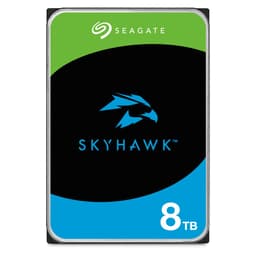
Eight terabytes of external storage for your desk. That's the pitch. And honestly, for a lot of people, that's enough to make a decision. But the box number is the least interesting thing about any storage product. What actually matters is what happens when you're copying a 200GB folder of RAW files, whether the drive is going to rattle itself to death in three years, and whether you're getting fair value for your money compared to what else is out there. The Seagate Desktop 8TB has nearly 18,751 and a 4.3-star average, which tells you something. So does the fact that it's an Amazon Exclusive, which limits your options if you want to shop around.
The verdict? It's a perfectly decent, no-fuss desktop hard drive that does exactly what it says on the tin. Massive storage, plug-and-play simplicity, and a price that makes sense for the capacity. It's not fast. It's not meant to be. If you want speed, you want an SSD. But if you need a big, cheap, reliable-enough place to dump your photos, video archives, backups, and media libraries, this is a solid option. Just go in with realistic expectations about what a spinning hard drive is and isn't.
This is very much a product for people who've run out of space and need more of it, not for people who want their PC to feel snappier. Those are two completely different problems, and the Seagate Desktop 8TB solves exactly one of them. Keep reading and I'll explain why that matters, who should buy it, and who should look elsewhere entirely.
Core Specifications: Seagate Desktop 8TB
This is a traditional spinning hard disk drive, not an SSD. That distinction matters enormously and shapes every other thing you need to know about it. It connects via USB 3.0, which is the right interface for a desktop external drive at this capacity. The listing confirms it ships with an 18-inch USB 3.0 cable and an 18-watt power adapter, so you're getting everything you need in the box. No hunting for a separate power brick or a specific cable. That's appreciated.
Capacity is 8TB, which is a lot. To put it in perspective, that's roughly 2,000 hours of HD video, or around 2 million high-resolution photos, or just an absolutely absurd amount of music. For most home users, 8TB is several years' worth of headroom. The drive is designed for desktop use, which is why it needs that external power adapter rather than drawing power from the USB port alone. Laptop drives at this capacity don't exist in the traditional HDD world because spinning platters at this density need more juice than a USB port can deliver.
The drive is plug-and-play on both Windows and Mac, with no software required for basic use. That's a genuine convenience. Owner reports consistently back this up: people say it just appears as a drive letter or volume the moment they plug it in. No driver faff, no installation wizard. For the target audience (home users, people backing up a family PC, creative types archiving old projects), that simplicity is worth a lot.
| Specification | Detail |
|---|---|
| Drive Type | External HDD (spinning platter) |
| Capacity | 8TB |
| Interface | USB 3.0 |
| Cable Included | 18-inch USB 3.0 cable |
| Power Adapter | 18-watt external adapter included |
| Compatibility | Windows and Mac |
| Software Required | None (plug-and-play) |
| Amazon Status | Amazon Exclusive |
| ASIN | B07CQJBSQL |
| Price | £269.99 (Price checked 16:31, 3 Oct 2026, UK time) |
| Star Rating | ★★★★☆ (4.3) (18,751 reviews) |

Interface and Form Factor
USB 3.0 is the right call here. The theoretical maximum bandwidth of USB 3.0 is around 5Gbps, which translates to roughly 500MB/s in real-world conditions. A spinning hard drive at this capacity tops out at somewhere between 150MB/s and 200MB/s in sustained sequential reads under ideal conditions, so the interface is absolutely not the bottleneck. You could plug this into a USB 3.1 or USB 3.2 port and it wouldn't make the slightest bit of difference to actual transfer speeds. The drive's mechanical internals are the ceiling, not the cable.
This is a desktop form factor, meaning it's a full-size 3.5-inch hard drive inside an external enclosure. That's why it needs the 18-watt power adapter. You're not going to be slipping this in a bag and using it on the train, and Seagate isn't pretending otherwise. It's designed to sit on or under your desk, plugged in, doing its job quietly. The 18-inch cable is on the shorter side, so think about where your PC or Mac sits relative to where you'd want the drive. If your tower is on the floor and your desk is a metre up, you might want an extension cable.
It means you can only buy this specific configuration through Amazon, which is fine if you're happy with that, but it does mean you can't easily price-match at other retailers or pick it up from a local shop if you need it today. For most people that's irrelevant. But it's a thing to know. Compatibility is broad: any Windows PC or Mac with a USB port will recognise it instantly. No drivers, no faff. If you've got a USB hub, it'll work through that too, though you'll still need the power adapter plugged in separately regardless.
Real-World Performance
This is where expectations really need to be calibrated. A spinning hard drive is slow compared to any SSD. Full stop. We're talking sequential read speeds in the region of 150MB/s to 200MB/s under good conditions, which is roughly five to ten times slower than a budget SATA SSD, and twenty to fifty times slower than a mid-range NVMe drive. Random I/O, which is what actually determines how snappy a system feels during everyday use (opening apps, loading files, browsing folders), is even more of a gap. HDDs are genuinely bad at random I/O because the read head physically has to move to find the data.
So what does that mean in practice? If you're copying a single large video file, it'll transfer at a reasonable pace. Copying a folder full of thousands of small files will feel noticeably slower. Loading a game directly from this drive would be a painful experience compared to an SSD. Opening Lightroom with your catalogue stored here would involve a lot of waiting. Owner reports are consistent on this point: people who use it as a backup destination or a media archive are happy. People who tried to use it as a working drive for active projects found it frustrating. That's not a flaw in the product; it's just the physics of spinning platters.
For the actual use cases Seagate is targeting (backing up your PC, storing a photo library you dip into occasionally, archiving old projects, keeping a copy of your media collection), the performance is absolutely fine. You're not accessing this drive constantly. You're dumping files onto it and leaving them there. Drag and drop works, Time Machine works, Windows Backup works. The 4.3-star average across nearly 18,751 suggests the vast majority of buyers are using it correctly and are satisfied. The negative reviews that mention slowness are almost always from people who expected SSD-like performance from an HDD, which is a mismatch of expectations rather than a product defect.
Sustained Writes and Cache Behaviour
HDDs don't have an SLC cache in the way SSDs do. There's no flash cache to fill and then fall off a cliff. What you get instead is a drive buffer (typically 256MB on modern desktop HDDs of this class) that smooths out small bursts of writes, and then sustained performance that's determined entirely by the mechanical components underneath. Specifically, the rotational speed of the platters and the density of data on them. This is actually more predictable than an SSD with a cache cliff: you get what you get, consistently, without the sudden speed drop that catches SSD buyers off guard when they're copying a large folder.
The practical implication is that if you sit down to copy 500GB of video footage to this drive, it'll transfer at roughly the same speed from start to finish. It won't start fast and then slow down dramatically. That's a genuine advantage over budget QLC SSDs that post impressive headline numbers and then crater to native QLC write speeds (sometimes as low as 80MB/s to 100MB/s) once their SLC cache is exhausted. For large sequential transfers, a good desktop HDD can actually outperform a budget QLC SSD once that cache fills. Not by much, and not in a way that makes the HDD fast in absolute terms, but it's a more honest performance profile.
Where HDDs genuinely struggle is mixed workloads, lots of simultaneous reads and writes, or anything involving many small files. The read/write head can only be in one place at a time. If you're writing a big file while your backup software is also reading from the same drive, performance degrades noticeably because the head is constantly seeking between two different locations on the platters. Owner reports mention this occasionally, usually in the context of running a backup while also trying to access files on the same drive. It's not a dealbreaker for most home users, but it matters if you're planning to use this drive heavily for multiple simultaneous tasks.
Controller, NAND and DRAM
There's no NAND here. No controller in the SSD sense. No DRAM cache managing flash translation layers. This is a hard disk drive, which means the "controller" is the drive's own firmware and the read/write head assembly, and the storage medium is magnetic platters. That might sound like a cop-out in a section titled "Controller, NAND and DRAM", but it's actually an important distinction because it changes the reliability conversation completely.
HDDs don't suffer from the write endurance issues that NAND flash does. There's no TBW (terabytes written) rating to worry about because magnetic storage doesn't wear out from being written to in the same way that flash memory cells do. What HDDs do suffer from is mechanical failure: the read/write head can crash into the platter (a head crash), the motor bearings can wear out, and they're vulnerable to physical shock in a way that SSDs simply aren't. This is why you should never move a spinning hard drive while it's actively reading or writing, and why dropping one is a much bigger deal than dropping an SSD.
Seagate is one of the two dominant HDD manufacturers globally (alongside Western Digital), and their desktop drives have a long track record. The internal drive in this enclosure is almost certainly a variant of Seagate's Barracuda or Desktop HDD line, which uses conventional magnetic recording technology at this capacity. The enclosure adds the USB 3.0 bridge chip (converting SATA to USB), which is a standard, mature technology that rarely causes problems. Owner reports of connectivity issues are rare and usually trace back to cable or port problems rather than the drive itself.
Endurance and Reliability
With a 4.3-star average across nearly 18,751, the reliability story here is broadly positive. That's a large enough sample to be meaningful. The negative reviews that mention failure are present (they always are on any storage product), but they're not disproportionate to what you'd expect from any mechanical drive. HDDs have a known failure curve: they're most likely to fail either early (infant mortality, usually within the first few months) or late (wear-out after several years of continuous use). The middle period tends to be pretty reliable.
One thing: Seagate includes Data Rescue Services with this drive, which is a professional data recovery service. The fact that they bundle this is both reassuring and a reminder that all storage fails eventually. Data recovery services exist because drives fail. If you're storing anything irreplaceable on this drive, you need a backup. The 3-2-1 rule applies: three copies of your data, on two different media types, with one copy offsite (or in the cloud). This drive can be one of those copies, but it shouldn't be the only one.
The warranty details aren't specified in the verified product data I have access to, so I won't guess. What I can say is that Amazon's standard 30-day return window applies, and the A-to-Z Guarantee covers you if something goes wrong with the purchase itself. For longer-term peace of mind, check Seagate's official warranty terms on their website at the time of purchase. Owner reports suggest that Seagate's customer service for drive replacements is generally functional, though like all manufacturers it can be hit or miss depending on the specific situation.

Thermals
Desktop HDDs run warm. That's just the nature of spinning platters and the motor that drives them. The Seagate Desktop 8TB is an enclosed unit with no active cooling of its own. There's no fan. Heat dissipates through the enclosure passively. Under normal use (occasional file transfers, periodic backups), this isn't a problem. The drive will get warm to the touch but not hot, and modern HDD firmware includes thermal monitoring that will slow the drive down before it reaches a damaging temperature.
Where thermals become more relevant is in sustained, heavy use. If you're running a long backup that writes hundreds of gigabytes continuously, the drive will get warmer than it does sitting idle. Owner reports don't flag thermal issues as a common complaint, which suggests the passive cooling in the enclosure is adequate for typical home use patterns. If you're planning to use this drive in a poorly ventilated space (inside a cabinet, for example, with no airflow), it's worth making sure there's at least some air circulation around it.
This is not a Gen4 or Gen5 NVMe drive that can hit 70 degrees Celsius under load and throttle aggressively. HDDs operate at much lower temperatures than NVMe SSDs under load, and the thermal management story is correspondingly simpler. The 18-watt power adapter gives you a sense of the drive's power consumption: it's more than a USB-powered portable drive, but it's not a power-hungry beast either. Under light use it'll draw considerably less than that 18-watt maximum. Thermal throttling is theoretically possible but practically very unlikely in normal home or office use.
Capacity Options and Price Per GB
Eight terabytes is a lot of storage, and at this capacity HDDs offer dramatically better value per gigabyte than SSDs. A quick comparison: 8TB NVMe SSDs exist but cost several times more per gigabyte than an 8TB HDD. Even a 4TB NVMe SSD is expensive relative to what you'd pay for this. If raw capacity per pound is your priority and speed isn't, HDDs win this argument every time at the high-capacity end of the market. That's unlikely to change in the near future because flash memory manufacturing costs scale differently from magnetic recording density improvements.
The Amazon Exclusive status means you can't easily compare this exact model across retailers, but the 8TB external desktop HDD market is competitive. Western Digital's My Book 8TB is the most direct comparison, and both sit in similar price territory. Seagate also sells the Expansion Desktop in various capacities, which is a close sibling to this product. If 8TB is more than you need, the same family is available in smaller capacities at proportionally lower prices, though the per-GB value tends to be better at higher capacities.
For the buyer who needs bulk storage and is price-conscious, 8TB is actually a sweet spot in the external HDD market right now. You get enough headroom that you probably won't need to buy another drive for years, and the per-GB cost at this capacity is among the lowest available for any storage technology. If you're storing a growing photo or video library and you're buying a new 2TB drive every couple of years, one 8TB drive is almost certainly cheaper over a five-year period than multiple smaller ones, and you only have one device to manage.
Installation and Compatibility
Setup is genuinely simple. Plug the power adapter in, connect the USB 3.0 cable to your computer, and the drive appears. Windows will recognise it immediately. Macs will too, though if you're on a modern Mac and want to use it with Time Machine, you may need to reformat it to APFS or Mac OS Extended first (it ships formatted for Windows by default, as NTFS). That's a five-minute job using Disk Utility and nothing to worry about, but check it before you start.
The 18-inch cable is included, which covers most desk setups. If your PC is under the desk or in an awkward spot, you might need a longer USB 3.0 cable. These are cheap and widely available. The drive needs to be connected to a USB port that can handle the data connection separately from the power, since the power comes from the wall adapter. So you can use any standard USB port on your computer without worrying about power delivery from the port itself.
This is not a NAS drive, and it's not designed to be left on 24/7 in a server environment. It's a desktop companion drive. It doesn't have multiple bays, it doesn't support RAID, and it's not designed for the continuous duty cycles that NAS-optimised drives (like Seagate's own IronWolf range) are built for. For home backup, media storage, and archiving, it's perfectly suited. For anyone thinking about running a home server or a media server that's always on and always being accessed, look at purpose-built NAS drives instead. Compatibility with USB hubs is generally fine, though as always with powered devices, the hub itself needs to handle data passthrough properly.
Who It's For
The ideal buyer for the Seagate Desktop 8TB is someone who has run out of space and needs a lot more of it, cheaply and without fuss. That's a very specific problem, and this drive solves it well. Photographers with growing RAW libraries. Video editors who need an archive of old project files. Families who want to back up multiple PCs to a single drive. Music collectors. People who rip their Blu-ray collection. Anyone who's looked at their hard drive and seen it's 90% full and thought "I need to do something about this."
It also makes a decent secondary backup destination. If you're already using cloud storage but want a local copy too (which is smart, because cloud storage is not free at scale and internet connections go down), this gives you 8TB of local backup capacity for a one-time cost. Pair it with Windows Backup, Time Machine, or something like Macrium Reflect, and you've got a solid backup setup without ongoing subscription costs.
Who should look elsewhere? Anyone who wants to speed up their PC. An external HDD will not make your computer faster. If your system feels slow, you need an internal SSD, not an external hard drive. Anyone who needs portable storage should look at bus-powered portable HDDs or, better, a portable SSD. Anyone running a NAS or a home server should look at NAS-specific drives. And anyone who needs to access files from this drive constantly as part of an active workflow (video editing, photo editing, database work) will find the HDD speeds frustrating and should budget for an external SSD instead.
How It Compares
The two most obvious competitors are the Western Digital My Book 8TB and the Seagate Expansion Desktop 8TB. The WD My Book is probably the most direct like-for-like comparison: it's also a desktop external HDD at 8TB, it also connects via USB 3.0, and it sits in similar price territory. WD includes hardware encryption and their own backup software, which some people value and others ignore entirely. Performance between the two is broadly similar because both are mechanical drives at the same capacity, and USB 3.0 is not the bottleneck for either.
The Seagate Expansion Desktop is essentially a cheaper sibling to this product, without the Data Rescue Services bundle. If you don't value the data recovery service (and many people won't, since the correct answer to data loss is having a backup rather than paying for recovery), the Expansion Desktop might be a more cost-effective choice. the price difference at time of purchase.
| Feature | Seagate Desktop 8TB (STGY8000400) | WD My Book 8TB | Seagate Expansion Desktop 8TB |
|---|---|---|---|
| Drive Type | External HDD | External HDD | External HDD |
| Capacity | 8TB | 8TB | 8TB |
| Interface | USB 3.0 | USB 3.0 | USB 3.0 |
| Power Adapter | Yes (18W included) | Yes (included) | Yes (included) |
| Mac Compatible | Yes | Yes | Yes |
| Windows Compatible | Yes | Yes | Yes |
| Data Recovery Service | Yes (included) | No | No |
| Hardware Encryption | Not specified | Yes | Not specified |
| Amazon Exclusive | Yes | No | No |
| Price | £269.99 (Price checked 16:31, 3 Oct 2026, UK time) | Check Amazon | Check Amazon |
The WD My Book's hardware encryption is a genuine differentiator if you're storing sensitive data and want password protection at the drive level. For most home users storing photos and videos, it's irrelevant. The Seagate's Data Rescue Services bundle is a nice safety net, though again, the smarter approach is to have a proper backup strategy so you never need data recovery in the first place. On pure value, all three are closely matched. The WD My Book has slightly broader retail availability since it's not Amazon Exclusive, which matters if you want to shop around or need it from a physical shop.

Final Verdict
The Seagate Desktop 8TB does exactly what it's designed to do. It gives you a massive amount of storage, it works on Windows and Mac without any setup headaches, and it comes with everything you need in the box. The 4.3-star average from nearly 19,000 owners is a strong signal that the product delivers on its promises for the people buying it. It's not exciting. It's not fast. But it's not trying to be either of those things.
The Data Rescue Services bundle is a thoughtful addition, though I'd rather you never need it. Set up a proper backup routine (this drive as one destination, cloud storage as another), and data recovery services become irrelevant. The Amazon Exclusive status is a mild annoyance in terms of price flexibility, but it's not a dealbreaker for most people. The 18-inch cable is on the short side, so measure your setup before you commit.
If you're comparing this to the Seagate Expansion Desktop 8TB, and the price difference is meaningful to you, the Expansion Desktop is the smarter buy if you don't specifically want the Data Rescue Services bundle. It's the same fundamental drive, the same performance, the same compatibility, just without the recovery service tied in. Save the difference and put it toward a second backup destination instead.
For what it is, this is a good product at a fair price. Buy it if you need bulk storage and want the reassurance of a big-name brand with a large owner community behind it. Don't buy it if you're hoping it'll make your computer faster, because it won't. That problem needs an internal SSD, not an external hard drive.
What works. What doesn’t.
5 + 4What we liked5 reasons
- Massive 8TB capacity at a competitive per-GB price
- Genuinely plug-and-play on Windows and Mac, no software needed
- Ships with cable and power adapter, nothing extra to buy
- Data Rescue Services bundle adds peace of mind
- Strong owner satisfaction across nearly 19,000 reviews
Where it falls4 reasons
- HDD speeds are slow compared to any SSD, not suitable as a working drive
- Amazon Exclusive limits price comparison and retail availability
- 18-inch cable is on the short side for some desk setups
- Mechanical drive is vulnerable to physical shock unlike SSDs
Full specifications
8 attributes| Capacity GB | 8000 |
|---|---|
| Dram cache | false |
| Form factor | 3.5" |
| Interface | USB 3.0 |
| Read speed MBS | 160 |
| Type | External HDD |
| Warranty years | 2 |
| Write speed MBS | 160 |
Frequently asked
5 questions01Is the Seagate Desktop 8TB, External Hard Drive HDD, USB 3.0 for PC Laptop and Mac, Black, Data Rescue Services (STGY8000400) fast enough for everyday use?+
That depends entirely on what you're using it for. As a backup destination or media archive, yes, absolutely. Sequential transfer speeds for a desktop HDD at this capacity sit in the 150MB/s to 200MB/s range, which is fine for copying large files. But if you're asking whether it'll make your PC feel faster or work as a drive for active projects like photo or video editing, no. HDDs are slow at random I/O, which is what determines how snappy a system feels. For everyday backup and storage tasks it's perfectly adequate. For anything requiring fast, frequent file access, you want an SSD.
02Does the Seagate Desktop 8TB, External Hard Drive HDD, USB 3.0 for PC Laptop and Mac, Black, Data Rescue Services (STGY8000400) slow down once the cache fills?+
This is an HDD, not an SSD, so it doesn't have an SLC cache that fills and then causes a speed cliff. What it has is a small drive buffer (typically 256MB on drives of this class) that smooths out short bursts of writes. Sustained performance is determined by the mechanical components and is broadly consistent throughout a large transfer. This is actually more predictable than budget QLC SSDs, which can crater to very slow native write speeds once their cache is exhausted. The HDD won't be fast, but it'll be consistently the same speed from start to finish on a large sequential transfer.
03Is the Seagate Desktop 8TB, External Hard Drive HDD, USB 3.0 for PC Laptop and Mac, Black, Data Rescue Services (STGY8000400) DRAM-less, and does that matter?+
DRAM cache and DRAM-less are SSD concepts that don't apply to hard disk drives. This is an HDD with its own firmware and a drive buffer, which is a different architecture entirely. There's no NAND flash, no SLC cache, no Host Memory Buffer. The relevant reliability and performance characteristics for an HDD are the mechanical components, the drive's firmware, and the rotational speed of the platters. For the intended use case of backup and bulk storage, none of the SSD-specific concerns about DRAM or cache apply here.
04How long will the Seagate Desktop 8TB, External Hard Drive HDD, USB 3.0 for PC Laptop and Mac, Black, Data Rescue Services (STGY8000400) last?+
HDDs don't have a TBW endurance rating like SSDs because magnetic storage doesn't wear out from writes in the same way flash memory does. Mechanical drives typically follow a bathtub failure curve: higher failure risk in the first few months (infant mortality), then a stable middle period, then increasing risk as mechanical components wear out after several years of use. For typical home use as a backup or archive drive (not running 24/7 under heavy load), five or more years of reliable service is a reasonable expectation. That said, all storage fails eventually, so a backup strategy is essential. The included Data Rescue Services bundle is there for when things go wrong, but the better plan is to not rely on a single drive for anything irreplaceable.
05What warranty and returns apply to the Seagate Desktop 8TB, External Hard Drive HDD, USB 3.0 for PC Laptop and Mac, Black, Data Rescue Services (STGY8000400)?+
The specific warranty terms aren't detailed in the verified product data available, so check Seagate's official website at the time of purchase for current warranty information. Amazon's standard 30-day return window applies to this purchase, and the Amazon A-to-Z Guarantee covers you if there's a problem with the order itself. Seagate generally offers warranty support for their consumer drives, and their process for drive replacement claims is documented on their support pages.