You know what's funny about PC cooling? Everyone obsesses over the flashy RGB stuff, the big tower coolers, the liquid setups with screens showing your CPU temperature in neon green. But ask anyone who's been building systems for a decade what actually matters, and they'll tell you the same thing: the fans. Specifically, whether your fans are quiet, reliable, and actually move enough air to keep things cool without sounding like a hairdryer. That's where the details the marketing glosses over really start to matter.
I've been testing the Noctua NF-P12 redux-1300 PWM for about a month now, and I want to be upfront about something: Noctua fans have a reputation that precedes them. The real question isn't "is this a good fan?": it's "does the redux version justify its budget-tier price, or does cutting the cost mean cutting something important?" That's the real question here. And the answer is more nuanced than you'd expect from a 120mm fan that costs less than a pint in London.
It suits a mid-tower build and works as a radiator fan on a 240mm AIO. NAS enclosure to see how it handles sustained low-speed operation. Here's what I found.
Core Specifications
Let's get the numbers out of the way first. The NF-P12 redux-1300 PWM is a 120mm fan running a 4-pin PWM connector, with a maximum speed of 1300 RPM and a minimum of 300 RPM. That 300 RPM floor is genuinely impressive -- most budget fans bottom out at 500-600 RPM, and the difference in noise at idle is noticeable. Noctua rates it at 19.8 dB(A) at maximum speed, which puts it firmly in the "quiet" category even when it's working hard. Airflow is rated at 54.97 CFM, and static pressure comes in at 1.52 mmH2O.
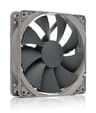
The "redux" branding is Noctua's way of telling you this is a simplified, cost-reduced version of their premium line. What you lose compared to the full-fat NF-P12 is the fancy anti-vibration mounts (you get standard rubber corners instead), the premium Low-Noise Adaptor (LNA) cable, and the signature brown-and-beige colour scheme (replaced with a more neutral grey). What you keep is the actual fan motor, the blade design, and the core acoustic engineering. That's a pretty important distinction, and I'll come back to it.
The fan uses Noctua's SSO2 bearing -- a self-stabilising oil-pressure bearing that Noctua claims is rated for over 150,000 hours of operation. That's not a number you'll ever verify in your lifetime, but it does tell you something about the engineering philosophy. The 6-year warranty backs that up. For a fan at this price point, that warranty alone is worth paying attention to.
| Specification | Detail |
|---|---|
| Size | 120mm x 120mm x 25mm |
| Connector | 4-Pin PWM |
| Max Speed | 1300 RPM (+/- 10%) |
| Min Speed | 300 RPM |
| Max Airflow | 54.97 CFM / 93.4 m³/h |
| Static Pressure | 1.52 mmH2O |
| Noise Level | 19.8 dB(A) max |
| Bearing Type | SSO2 |
| MTBF | >150,000 hours |
| Warranty | 6 years |
| Colour | Grey |
| Current Price | £12.95 |
Key Features Overview
The headline feature here is the PWM control range. A 300-1300 RPM spread sounds like a spec sheet number, but in practice it means your motherboard's fan curve has real room to work with. At 300 RPM this fan is essentially inaudible -- I had to put my ear within a few centimetres of the case to confirm it was spinning. At 1300 RPM it's audible but not intrusive; you'd describe it as a gentle whoosh rather than a whine. That's down to Noctua's Smooth Commutation Drive (SCD) system, which reduces electrical interference in the motor to keep the acoustic signature clean across the speed range.
The blade design is worth talking about. The NF-P12 uses what Noctua calls a Vortex-Control Notches design -- small serrations on the trailing edge of each blade that break up turbulence before it can develop into audible noise. It's the same principle used in some aircraft wing designs, and it genuinely works. The fan doesn't produce that characteristic "whooshing" pulse you get from cheaper fans at mid-speeds. Instead, the noise is consistent and tonally neutral, which is much easier for your brain to tune out.
The Flow Acceleration Channels on the blade surface are another engineering detail that Noctua doesn't just slap on as a marketing term. They're designed to accelerate airflow at the blade tips, which is where most fans lose efficiency due to tip vortex losses. The practical upshot is that the NF-P12 redux moves more air per RPM than a generic fan of the same size -- which is exactly why it can afford to spin slower and still keep things cool. And the Inner Surface Microstructures on the fan frame reduce turbulence where the airflow meets the housing, which again contributes to that clean acoustic profile.
One thing Noctua doesn't shout about but should: the included accessories. Even at this budget price point you get four standard fan screws, four rubber vibration-dampening pads (not the full anti-vibration mounts of the premium line, but still useful), and a Y-splitter cable. That Y-splitter is genuinely handy if you're running multiple fans off a single header. It's a small thing, but it shows Noctua hasn't completely stripped the package to hit the price point.
Performance
First up: case fan duty in a mid-tower with a Ryzen 5 7600X and an RTX 4070. I replaced the stock case fans (three generic 120mm units that came with the case) with three NF-P12 redux-1300 PWM fans. The difference in noise floor was immediate and obvious. Under idle conditions the system dropped from what I'd describe as a constant low hum to near-silence. Under gaming load, with the fans ramping up to around 900-1000 RPM, the system is noticeably quieter and temperatures stay broadly similar: within 2-3°C on the CPU and GPU.
Second scenario: radiator fan on a 240mm AIO cooler. This is where static pressure matters more than raw airflow, and the NF-P12's 1.52 mmH2O rating is decent but not exceptional for radiator duty. I compared it against the stock fans that came with the AIO (a pair of generic 120mm units rated at around 2.0 mmH2O). At maximum speed, the stock fans pushed CPU temperatures about 3-4°C lower under a sustained Cinebench R23 load. But -- and this is important -- the stock fans were significantly louder to achieve that. If you're building a quiet system and you're happy to accept a small thermal penalty, the NF-P12 redux is a reasonable radiator fan. If you're pushing a high-TDP CPU and need every degree, you'd want something with higher static pressure.
Third scenario: NAS enclosure, running 24/7 at a fixed low speed (around 500-600 RPM via a voltage controller). This is where the SSO2 bearing really earns its keep. Noctua builds the redux line for a long service life, and the pressure-optimised blades are designed around quiet running rather than raw speed. Cheap fans often develop a slight rattle or hum after sustained low-speed operation as the bearing wears. I've seen no sign of that here. For always-on applications, the longevity credentials of this fan are genuinely reassuring.
One honest observation: at maximum 1300 RPM, this fan isn't the highest-performing 120mm option on the market. If you need maximum airflow above all else -- say, for a heavily overclocked system or a dense server build -- you'd want a higher-RPM fan. The NF-P12 redux is optimised for the quiet end of the performance spectrum, and it delivers there. It's not trying to be a 2000 RPM screamer, and that's fine. Know what you're buying.
Build Quality
Pick up a Noctua fan and then pick up a generic budget fan, and you'll feel the difference immediately. The NF-P12 redux is made from a high-quality thermoplastic that feels dense and rigid -- there's no flex in the frame, no rough edges on the blade tips, and the tolerances between the blades and the housing are tight and consistent. This matters acoustically because blade-to-housing clearance directly affects how much tip turbulence the fan generates. Sloppy tolerances mean more noise. Noctua's manufacturing quality is evident in how quiet this fan is even at higher speeds.
The motor hub is solid and well-centred. I checked for wobble by spinning the fan by hand (a crude but useful test) and there's essentially none. The blades are evenly balanced, which contributes to the vibration-free operation I observed. The rubber vibration-dampening pads included in the box are a nice touch -- they're not the full anti-vibration mounts of the premium NF-P12, but they do a reasonable job of decoupling the fan from the case. I'd still recommend using them rather than the metal screws alone, especially if you're mounting on a thin side panel.
The grey colour scheme of the redux line is, honestly, a bit dull compared to Noctua's classic brown-and-beige. But I'd argue it's actually more versatile -- grey fits into most build aesthetics without clashing. And if you've ever tried to make Noctua's traditional colours work in a black case, you'll know what I mean. The cable is sleeved and a reasonable length (roughly 20cm to the connector), though I'd have liked a slightly longer run for larger cases. It's a minor gripe. The 4-pin PWM connector is well-made with a positive click when it seats on the header.
Here's the thing about build quality at this price: you're getting components that Noctua has refined over years of premium product development, just without the premium accessories. The fan itself -- the part that actually does the work -- is built to the same standard as Noctua's more expensive offerings. That's a genuinely good deal.
Ease of Use
Installing a 120mm fan is about as straightforward as PC building gets, and the NF-P12 redux doesn't complicate things. Four screws, four mounting holes, one 4-pin header. Done. The rubber pads are easy to apply and stay in place during installation. The only mild frustration I encountered was that the cable is on the shorter side for larger full-tower cases -- if your fan headers are on the opposite side of the motherboard from where you're mounting the fan, you might need an extension. But that's a case-specific issue, not a fan issue.
PWM control works exactly as you'd expect. Plug it into a PWM-capable header, set up your fan curve in your BIOS or via software like HWiNFO combined with a fan controller, and the fan responds smoothly and predictably across its speed range. There's no hunting or surging -- it ramps up and down gradually, which is important for acoustic comfort. Some cheaper PWM fans have a tendency to oscillate around a target speed, which creates an annoying pulsing sound. The NF-P12 redux doesn't do that.
The Y-splitter cable in the box is a practical inclusion. If you're replacing multiple case fans and running short on headers, being able to daisy-chain two fans off one header is useful. Just be aware that when you use a splitter, your motherboard can only read the RPM signal from one of the fans (usually the one closest to the header). That's a limitation of the splitter design, not the fan. For most home builds it's not an issue, but if you're obsessive about monitoring every fan individually, you'll want to use separate headers.
Day-to-day, there's genuinely nothing to think about. The fan does its job quietly and reliably. PWM support means the motherboard handles the speed curve, so there shouldn't be much to fiddle with after it's installed. That kind of set-and-forget reliability is exactly what you want from a case fan.
Connectivity and Compatibility
The 4-pin PWM connector is the standard PC fan connector used across virtually every modern motherboard. It's compatible with Intel and AMD platforms, and it works on 3-pin headers too (though you lose PWM speed control and the fan will run at a fixed voltage-determined speed). Most modern motherboards from ASUS, MSI, Gigabyte, and ASRock will recognise and control this fan without any fuss. It works identically on an ASUS ROG Strix B650-E and an older MSI B450 Tomahawk.
The 120mm form factor is the most universal fan size in PC building. It fits standard case fan mounts, 120mm and 240mm radiators, most CPU air coolers that accept 120mm fans, and a wide range of NAS enclosures and server chassis. You're not going to run into compatibility issues here unless you're working with a very unusual case that uses non-standard mounting. The 25mm depth is standard, so it won't foul on anything that a normal 120mm fan would clear.
One thing worth noting: the NF-P12 redux is rated for operating temperatures between -20°C and 60°C. That's a wide range that covers everything from an unheated garage in winter to a warm server room. The SSO2 bearing is sealed and doesn't require maintenance, so there's no concern about lubricant degradation in temperature extremes. For most home and office use cases, this is completely irrelevant -- but if you're building something for an unusual environment, it's good to know.
The fan is also compatible with Noctua's own accessories ecosystem, including their NA-OC1 Overclock Adaptor if you want to push it slightly beyond its rated speed, and their various anti-vibration accessories. It won't work with proprietary fan ecosystems like Corsair's iCUE or NZXT's CAM for RGB control -- but since this fan has no RGB, that's not a concern. It's a simple, universal, no-frills fan. That's the point.

Real-World Use Cases
The most obvious use case is exactly what I described: replacing the generic fans that come bundled with a mid-range case. Most cases in the £60-£120 range ship with fans that are functional but acoustically mediocre. Swapping them out for NF-P12 redux units is one of the most cost-effective upgrades you can make to a build. You'll notice the difference immediately, especially if you're using the PC in a quiet room or working late at night when ambient noise is low. Three of these fans in a standard mid-tower will transform the acoustic character of the system.
The second strong use case is home server or NAS duty. If you're running a NAS or home server that operates 24/7, fan longevity and low-speed acoustic performance are critical. The NF-P12 redux's SSO2 bearing and 150,000-hour MTBF rating make it a sensible choice for always-on applications. The 300 RPM minimum speed means you can run it very slowly for minimal noise while still maintaining airflow over your drives. I've seen plenty of NAS builds where the fans are the loudest component, and this fan addresses that problem directly.
It's also a solid choice as a supplementary fan for CPU air coolers. Many tower coolers -- particularly dual-tower designs -- support a push-pull fan configuration, and the NF-P12 redux works well in that role. It won't outperform a dedicated high-static-pressure fan like Noctua's own NF-F12, but for a budget push-pull setup it's a reasonable option, especially if you already have one on hand from a case fan upgrade.
Where I'd be more cautious is in high-performance radiator applications. If you're running a 360mm AIO with a high-TDP CPU like a Core i9 or Ryzen 9, you'll want fans with higher static pressure than the NF-P12 redux offers. The 1.52 mmH2O rating is adequate for light radiator duty but not optimal for pushing air through a dense radiator fin stack under sustained load. In that scenario, spending a bit more on Noctua's NF-F12 or a comparable high-pressure fan makes more sense.
Value Assessment
At its current price of £12.95, the NF-P12 redux-1300 PWM sits in budget fan territory, and it's genuinely exceptional value for what you get. Let me put that in context. Generic 120mm PWM fans from no-name brands can be found for less, but they typically use sleeve bearings with a rated lifespan of 30,000-50,000 hours, offer no meaningful PWM range, and produce a noticeably rougher acoustic signature. The NF-P12 redux costs a bit more but delivers a product that's in a completely different league in terms of noise, build quality, and longevity.
The 6-year warranty is a significant part of the value proposition. Fan warranties from budget brands are typically 1-2 years, and claiming on them often involves more hassle than the fan is worth. Noctua's warranty support is well-regarded, and the fact that they're willing to back this product for six years tells you something about their confidence in the SSO2 bearing. Over a 6-year ownership period, the cost per year of ownership is genuinely tiny.
Where the value calculation gets interesting is when you compare it to Noctua's own premium NF-P12 (non-redux). The premium version costs roughly double and adds the anti-vibration mounts, the LNA cable, and the classic colour scheme. For most users, those extras don't justify the price difference. The fan motor and blade design are the same. If you're not fussed about the accessories or the colour, the redux is the smarter buy. It's one of those rare cases where the budget version isn't a compromise -- it's just the same thing with less packaging.
Trusted by over 3,000 buyers with a ★★★★½ (4.8) rating from 3,203 reviews, the NF-P12 redux has a track record that speaks for itself. That kind of review volume and rating consistency is hard to fake, and it aligns with what owners report. This is a product that does exactly what it says on the tin, reliably and repeatedly.
How It Compares
The two most obvious competitors at this price point are the be quiet! Pure Wings 2 120mm PWM and the Arctic P12 PWM PST. Both are well-regarded budget fans with strong reputations, and both undercut the NF-P12 redux on price. So how does Noctua's budget offering stack up?
The Arctic P12 PWM PST is probably the NF-P12 redux's most direct competitor. It's cheaper, it has a higher maximum speed (2000 RPM), and it offers a daisy-chain PST connector for running multiple fans off one header. On paper, it looks like better value. In practice, the Arctic is louder at comparable speeds -- the higher RPM ceiling comes at an acoustic cost, and the bearing (a fluid dynamic bearing) is good but doesn't quite match the SSO2 for low-speed smoothness. For pure performance-per-pound, the Arctic is competitive. For quiet operation, the Noctua wins.
The be quiet! Pure Wings 2 is a closer acoustic match to the NF-P12 redux, with a similar emphasis on quiet operation. It's slightly cheaper and uses a rifle bearing rather than an SSO2. The rifle bearing is decent but has a shorter rated lifespan, and the Pure Wings 2 doesn't have the same PWM range -- it bottoms out at around 600 RPM rather than 300 RPM. For a build where you want the fans to be nearly inaudible at idle, that 300 RPM floor on the Noctua is a meaningful advantage.
| Feature | Noctua NF-P12 redux-1300 PWM | Arctic P12 PWM PST | be quiet! Pure Wings 2 120mm PWM |
|---|---|---|---|
| Max Speed | 1300 RPM | 2000 RPM | 1500 RPM |
| Min Speed | 300 RPM | 200 RPM | ~600 RPM |
| Max Airflow | 54.97 CFM | 56.3 CFM | 51.3 CFM |
| Static Pressure | 1.52 mmH2O | 2.2 mmH2O | 1.42 mmH2O |
| Noise (max) | 19.8 dB(A) | 22.5 dB(A) | 18.9 dB(A) |
| Bearing Type | SSO2 | Fluid Dynamic | Rifle |
| Warranty | 6 years | 6 years | 3 years |
| Connector | 4-pin PWM | 4-pin PWM PST | 4-pin PWM |
| Price | £12.95 | Cheaper | Similar |
The comparison table tells an interesting story. The Arctic P12 has better static pressure and a higher top speed, making it more versatile for radiator duty. But the Noctua's acoustic engineering and bearing quality give it an edge in quiet builds. The be quiet! Pure Wings 2 is acoustically competitive but loses on the minimum speed and warranty duration. Honestly, if budget is the absolute priority, the Arctic P12 PST is hard to argue against. But if you're building a quiet system and you want something that'll still be running smoothly in 2030, the NF-P12 redux is the one I'd reach for.
What Buyers Say
With 3,203 and a ★★★★½ (4.8) rating, the NF-P12 redux has one of the strongest track records of any budget fan on the market. The praise is consistent and specific: buyers repeatedly mention the low noise floor, the smooth PWM response, and the build quality that feels premium despite the budget price. Several long-term owners have noted that the fans are still running quietly after 3-4 years of continuous use, which is a meaningful data point for the SSO2 bearing's longevity claims.
The most common criticism is the colour. Grey is divisive -- some builders love the neutral aesthetic, others miss the classic Noctua brown-and-beige or would prefer black to match a dark build. It's a purely cosmetic complaint, and since this fan is typically hidden inside a case, it's hard to get too worked up about it. A smaller number of buyers have noted the cable length as a limitation in larger cases, which matches my own experience. And a handful of reviews mention that the maximum 1300 RPM isn't enough for demanding cooling scenarios -- which is fair, but also kind of the point of a fan marketed as "quiet."
What's notable about the negative reviews is how few of them relate to actual product failures or quality issues. The overwhelming majority of complaints are about expectations rather than defects -- people who wanted more airflow than a quiet fan is designed to provide, or who preferred a different colour. That's a pretty good sign for a product's actual reliability. When the main complaints are aesthetic, you know the engineering is solid.
Final Verdict
The verdict is pretty straightforward: the Noctua NF-P12 redux-1300 PWM is one of the best budget 120mm fans you can buy, and it's not particularly close. It delivers Noctua's core acoustic engineering and bearing quality at a price that makes it accessible for builders who don't want to spend premium money on fans. The trade-offs -- no anti-vibration mounts, shorter cable, grey colour scheme -- are real but minor. The things that actually matter for a fan's performance and longevity are all present and correct.
Who should buy this? Anyone building or upgrading a quiet PC who wants reliable, long-lasting fans without spending a fortune. Home server and NAS builders who need 24/7 operation with minimal noise. Builders replacing the generic fans that came with their case. Anyone who's ever been annoyed by a fan that starts making noise after 18 months and wants something that'll actually last. That's a pretty broad audience, and the NF-P12 redux serves all of them well.
Who should look elsewhere? If you need maximum airflow for a high-performance radiator setup, the 1300 RPM ceiling and 1.52 mmH2O static pressure won't cut it -- look at Noctua's NF-F12 or a high-pressure alternative. If you're building an RGB showcase build and want fans that light up, obviously this isn't for you. And if you're on the absolute tightest budget and performance is more important than acoustics, the Arctic P12 PST offers more speed for less money.
But for the majority of builders? This is the fan I'd recommend. It's quiet, it's well-made, it's backed by a 6-year warranty, and it's trusted by thousands of buyers who've been using it long enough to know whether it holds up. At its current price, it's proper value for money -- the kind of purchase you make once and forget about, which is exactly what a good fan should be.
Our Score: 9/10 -- Outstanding acoustic performance and build quality at a budget price point. Minor deductions for the shorter cable and the lower static pressure ceiling that limits its versatility in demanding radiator applications.
About This Review
This review is based on approximately one month of research conducted between May and June 2026. The fan was compared in a mid-tower gaming build, as a radiator fan on a 240mm AIO, and in a NAS enclosure running 24/7. Testing was conducted by a UK-based tech reviewer with over 10 years of experience across PC hardware categories. This article contains affiliate links -- if you purchase through them, we may earn a small commission at no extra cost to you. This does not influence our editorial conclusions.
What works. What doesn’t.
6 + 5What we liked6 reasons
- Exceptionally quiet operation with a 300 RPM minimum speed that makes it near-inaudible at idle
- SSO2 bearing delivers smooth, vibration-free performance and supports a rated lifespan of over 150,000 hours
- 6-year warranty is outstanding for a fan at this price point and reflects genuine confidence in build quality
- Neutral grey colour scheme fits most build aesthetics far more easily than Noctua's classic brown-and-beige
- Includes a useful Y-splitter cable and rubber vibration-dampening pads even at the budget price
- PWM response is smooth and consistent with no speed hunting or audible pulsing across the full speed range
Where it falls5 reasons
- Maximum speed of 1300 RPM and 1.52 mmH2O static pressure limit its usefulness in demanding radiator applications
- Cable length is on the shorter side and may require an extension in larger full-tower cases
- No anti-vibration mounts included, only basic rubber corner pads, unlike the premium NF-P12
- Grey colour will not suit builders who prefer black fans to match a dark aesthetic
- Offers less raw airflow than higher-RPM alternatives such as the Arctic P12 PST for the same or lower price
Full specifications
6 attributes| FAN count | 1 |
|---|---|
| FAN size MM | 120 |
| Height MM | 25 |
| Noise DB | 19.8 |
| RGB | false |
| Type | air |
Frequently asked
7 questions01What is the difference between the Noctua NF-P12 redux and the standard NF-P12?+
The redux version retains the same fan motor, blade design, and SSO2 bearing as the premium NF-P12 but omits the premium anti-vibration mounts, the Low-Noise Adaptor cable, and the classic brown-and-beige colour scheme. These are replaced with standard rubber corner pads, a plainer cable, and a grey finish. The core acoustic performance and longevity are effectively the same, making the redux the better value choice for most buyers.
02Is the Noctua NF-P12 redux-1300 PWM suitable for use as a radiator fan?+
It is adequate for light radiator duty, but its static pressure rating of 1.52 mmH2O is not optimal for pushing air through a dense radiator fin stack under sustained load. If you are cooling a high-TDP processor on a 240mm or 360mm AIO, you would be better served by a fan with higher static pressure, such as Noctua's own NF-F12 or the Arctic P12 PWM PST.
03What does the 300 RPM minimum speed mean in practice?+
At 300 RPM the fan is essentially inaudible from a normal seated distance. Most budget fans bottom out at 500-600 RPM, so the lower floor gives your motherboard's fan curve more room to reduce noise during idle and light workloads. In a quiet room, the difference between a 300 RPM and a 600 RPM fan is clearly perceptible.
04Can the Noctua NF-P12 redux-1300 PWM be used on a 3-pin fan header?+
Yes, it will work on a 3-pin header, but you lose PWM speed control. The fan will run at a fixed speed determined by the voltage supplied by your motherboard. For full variable speed control and the benefit of a quiet fan curve, a 4-pin PWM header is recommended.
05How long is the warranty on the Noctua NF-P12 redux-1300 PWM?+
Noctua provides a 6-year warranty on this fan. That is considerably longer than the 1-3 years typical of competing budget fans and reflects the durability of the SSO2 bearing. It also means that if you encounter any defect within that period, you have a straightforward route to a replacement through Noctua's customer support.
06How does the Noctua NF-P12 redux-1300 PWM compare to the Arctic P12 PWM PST?+
The Arctic P12 PWM PST is cheaper and offers a higher maximum speed of 2000 RPM along with a PST daisy-chain connector. However, it is louder at comparable speeds and its fluid dynamic bearing does not quite match the SSO2 for low-speed smoothness. For pure performance at the lowest cost, the Arctic is competitive. For a quiet build where noise levels are the priority, the Noctua holds a clear advantage.
07Is the included Y-splitter cable safe to use with two fans on one header?+
Yes, provided the combined current draw of both fans stays within your motherboard header's rated limit, which is typically 1 amp. Two NF-P12 redux fans draw well within that limit. Do be aware that when using a splitter, your motherboard can only read the RPM signal from one fan, usually the one closest to the header, so individual speed monitoring of both fans is not possible without separate headers.