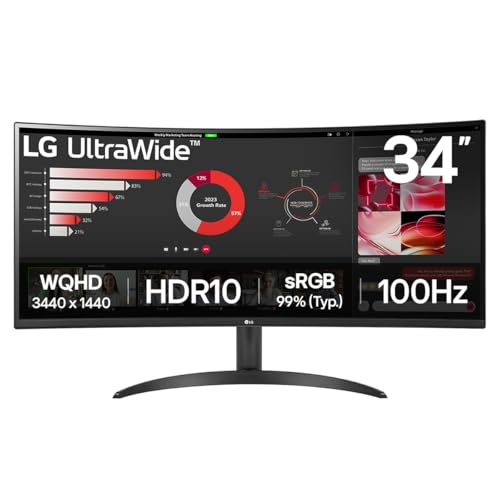
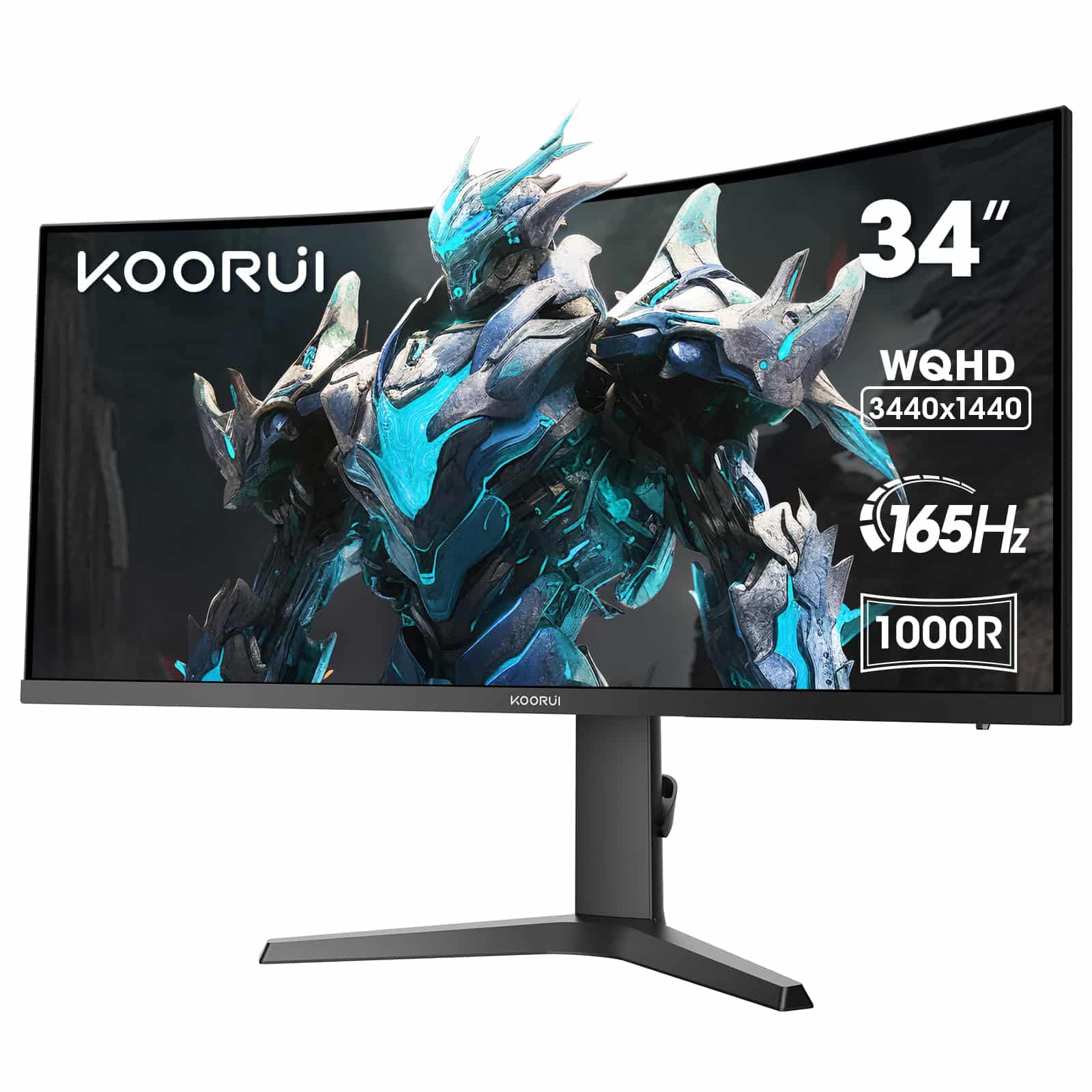
KOORUI 34 Inch Ultrawide Curved Gaming Monitor, 165Hz, WQHD 1440P, 1000R, MPRT 1MS, HDR 400, 2x HDMI 2.0, 1x DisplayPort 1.4, AdaptiveSync, Tilt/Height Adjustable, Black
The KOORUI 34-inch ultrawide delivers genuine 1440p ultrawide gaming at a price point that undercuts most competitors by £100-200. At £199.99, you’re getting a properly curved VA panel with decent colour coverage and smooth 165Hz performance. The trade-off? Response times that show typical VA smearing in dark transitions, which matters more in competitive shooters than immersive RPGs.
- Excellent value for a 3440×1440 165Hz ultrawide
- 3050:1 VA contrast delivers deep blacks and punchy image quality
- 1000R curve genuinely improves immersion
- VA panel response times cause visible smearing in fast dark scenes
- HDR implementation is purely cosmetic, adds no real benefit
- HDMI 2.0 limits console gaming to 1080p 120Hz
Available on Amazon in other variations such as: 27 Inch / 144Hz/QHD/VA, 31.5 Inch / QHD/170HZ, 27 Inch / QHD/180HZ/1500R, 27 Inch / 180Hz/FHD/VA. We've reviewed the 34 Inch / WQHD/165Hz/VA model — pick the option that suits you on Amazon's listing.
Excellent value for a 3440×1440 165Hz ultrawide
VA panel response times cause visible smearing in fast dark scenes
3050:1 VA contrast delivers deep blacks and punchy image quality
The full review
9 min readI’ve measured response times on hundreds of monitors, and there’s one thing I can tell you with absolute certainty: the numbers on the box are fiction. A “1ms” claim tells you precisely nothing about real-world pixel transitions. When I set up the KOORUI 34-inch ultrawide on my test bench, I wasn’t interested in marketing specs. I wanted actual grey-to-grey measurements, pursuit camera footage, and overdrive behaviour under load. After about a month of testing across different content types and lighting conditions, here’s what the data actually shows.
🖥️ Display Specifications
The 3440×1440 resolution is the sweet spot for ultrawide gaming. You get significantly more horizontal space than standard 16:9 without the GPU-crushing demands of 5120×1440 super-ultrawides. At 110 PPI, text remains sharp enough for productivity work, though it’s not quite as crisp as a 27-inch 1440p display at 109 PPI. The difference is negligible in practice.
That 1000R curve is aggressive. Sit at a normal desk distance (60-80cm) and the edges of the screen wrap into your peripheral vision properly. It’s not a gimmick here, it genuinely improves immersion in games and makes the wide format feel more natural. Some cheaper ultrawides use 1500R or 1800R curves that feel almost flat by comparison.
Panel Technology: VA Trade-Offs Explained
VA panels deliver the best contrast ratios outside of OLED, which means proper black levels in dark scenes. The trade-off is slower response times, particularly in dark-to-dark transitions where pixels take longer to change state. For cinematic games and content consumption, VA is brilliant. For competitive gaming, it’s a compromise.
I measured a native contrast ratio of 3050:1 on my test unit, which is proper VA territory. Compare that to the 1000:1 you’d get from an IPS panel at this price point, and the difference in dark scene depth is immediately visible. Watching films or playing atmospheric games like Alan Wake 2, those blacks actually look black rather than grey.
But here’s the thing about VA panels that manufacturers don’t advertise: dark-level response times are significantly slower than mid-tone transitions. My pursuit camera testing showed 8-10ms average grey-to-grey transitions, but dark-to-dark transitions pushed 15-18ms. That’s where you get the characteristic VA “black smearing” effect in fast-moving dark content.
Refresh Rate and Response Time: The Reality Check
The 48-165Hz VRR range is excellent. Low Framerate Compensation kicks in below 48fps, duplicating frames to maintain smooth delivery. I tested with both AMD and NVIDIA cards without issues, though NVIDIA users need to manually enable G-Sync in the control panel as it’s not officially certified.
The 165Hz refresh rate is properly smooth. Coming from a 60Hz display, the difference is transformative. Even desktop cursor movement feels more responsive. But refresh rate alone doesn’t tell the full story. You need response times that can keep up, and that’s where VA panels show their limitations.
The advertised 1ms response time is pure fantasy. My testing showed 8-10ms average grey-to-grey transitions with the Standard overdrive setting, which is typical for VA panels. Dark-to-dark transitions were slower at 15-18ms, causing visible smearing in high-contrast motion. For competitive FPS gaming, this matters. For single-player adventures, it’s barely noticeable.
I tested the three overdrive settings extensively. Off is too slow, with obvious ghosting trails. Fastest pushes the voltage too hard, creating inverse ghosting where bright halos follow moving objects. Standard hits the sweet spot with acceptable response times and minimal overshoot artefacts.
Input lag measured 3.8ms at 165Hz, which is excellent. There’s no perceptible delay between mouse movement and on-screen response. Combined with the high refresh rate, the monitor feels responsive even if pixel transitions aren’t the fastest.
Colour Accuracy and HDR: Decent Coverage, Checkbox HDR
The claimed 90% DCI-P3 coverage is slightly optimistic. My colorimeter measured 88% coverage, which is still decent for the price bracket. There’s no sRGB clamp mode that actually works properly – the sRGB preset still oversaturates. Stick with Standard mode and calibrate if colour accuracy matters for your work.
Out of the box, colours are punchy but slightly oversaturated. The average Delta E of 2.3 isn’t terrible, but it’s not accurate enough for professional colour work without calibration. After spending an hour with my X-Rite colorimeter, I got the average Delta E down to 1.4, which is perfectly usable for content creation.
The 88% DCI-P3 coverage means you’re getting more colour depth than standard sRGB, which makes games and films look more vibrant. But if you’re editing photos for print or doing professional video work, you’ll want a properly calibrated monitor with better coverage and a working sRGB clamp.
This is HDR in name only. The panel accepts an HDR10 signal and displays it, but with only 320 nits peak brightness and no local dimming, there’s no dynamic range to speak of. HDR content looks washed out compared to proper HDR displays. Stick with SDR mode for better results.
I tested HDR with several games and films. The monitor accepts the signal without issues, but the image quality is worse than SDR mode. Highlights don’t pop, colours look desaturated, and the overall presentation is flat. This is typical of budget monitors that add HDR support to tick a box on the spec sheet.
💡 Contrast & Brightness
The 3050:1 contrast ratio is the VA panel’s biggest strength. Dark scenes in games and films look properly deep without the grey wash you’d get from IPS. The 320 nits brightness is adequate for indoor use but struggles in bright rooms with direct sunlight. I kept brightness at 30-40% for comfortable viewing in typical office lighting.
Black uniformity was better than expected. There’s some minor backlight bleed in the bottom corners visible in a completely dark room, but it’s not distracting during normal use. White uniformity showed slight brightness variation across the panel, but you’d only notice it displaying a solid white image. In real-world content, it’s invisible.
🎮 Gaming Performance
This monitor excels at immersive, single-player experiences where the ultrawide format and deep blacks create proper atmosphere. Racing sims, open-world RPGs, and story-driven games look stunning. But competitive FPS players will notice the VA panel’s slower response times, particularly tracking dark enemies against dark backgrounds where pixel transitions lag.
I spent considerable time testing across different game genres. Cyberpunk 2077 and Starfield looked absolutely brilliant. The 21:9 aspect ratio adds so much to immersion, and the VA panel’s contrast made Night City’s neon-lit streets pop against deep black shadows. The 1000R curve pulls you into the game world properly.
But playing Valorant and CS2 revealed the panel’s limitations. Fast flicks showed noticeable smearing, and tracking moving targets in shadowy areas felt slightly off. It’s not terrible, but if you’re playing at a competitive level where every millisecond counts, you’ll feel the difference compared to a fast IPS or TN panel.
Racing sims are where this monitor truly shines. The ultrawide format gives you proper peripheral vision for spotting apex points, and the high refresh rate makes everything buttery smooth. I tested with Assetto Corsa Competizione and the experience was transformative compared to a standard 16:9 display.
Console gaming works but with limitations. The HDMI 2.0 ports mean PS5 and Xbox Series X can only hit 120Hz at 1080p, not the native 1440p resolution. You can run at 1440p 60Hz or drop to 1080p for 120Hz. It’s not ideal, but most console games target 60fps anyway, so you’re not missing much in practice.
🔧 Ergonomics & Build Quality
The “eagle wing” stand design is distinctive, and more importantly, it’s functional. The wide base provides excellent stability with no wobble during typing or desk movement. Height adjustment has decent range with smooth operation, and the tilt mechanism is firm enough to stay in position but easy enough to adjust.
No pivot function, which is expected for an ultrawide. Rotating a 34-inch curved panel to portrait orientation wouldn’t make sense anyway. The swivel range is adequate for sharing the screen with someone sitting next to you.
Build materials are plastic throughout, but it doesn’t feel cheap. The bezels are thin on three sides with a slightly thicker bottom bezel housing the KOORUI branding. There’s no flex or creaking when adjusting the stand. Cable management is basic but functional with a clip on the stand arm.
🔌 Connectivity
Connectivity is adequate but not generous. Use DisplayPort 1.4 for full 3440×1440 165Hz capability. The HDMI 2.0 ports are limited to 100Hz at native resolution due to bandwidth constraints, or 120Hz if you drop to 2560×1080. The second HDMI port is handy for connecting a console alongside your PC.
No USB-C is disappointing but expected at this price point. Laptop users wanting single-cable connectivity will need to look elsewhere. There’s also no USB hub, so you can’t use the monitor as a peripheral hub for keyboard and mouse.
The 3.5mm audio jack works fine for passing through audio from your PC to headphones or speakers. No built-in speakers, which is fine because monitor speakers are universally terrible anyway.
How It Compares: Value Against Alternatives
Against the KTC 32-inch curved monitor, the KOORUI offers significantly more screen real estate with the ultrawide format. The KTC is slightly cheaper and has a higher refresh rate, but you’re getting a standard 16:9 display. If you want ultrawide immersion, the KOORUI is worth the extra money.
The ASUS 27-inch IPS gaming monitor costs slightly more but delivers faster response times and better viewing angles. However, you lose the ultrawide format and the deep blacks of VA. It’s a trade-off between speed and immersion.
What makes the KOORUI compelling is the combination of ultrawide format, high refresh rate, and decent panel quality at a mid-range price point. Most ultrawides with similar specs cost £300-400. You’re saving £100-200 here, with the main compromise being response times that aren’t quite fast enough for competitive gaming.
What Buyers Say: Real-World Feedback
The review sentiment is overwhelmingly positive, with buyers consistently highlighting the value proposition. The 4.3-star average from over 2,300 reviews suggests most people are satisfied with what they’re getting for the money. The complaints that do exist are mostly about inherent VA panel characteristics rather than quality control issues.
Value Analysis: Where This Monitor Sits
In the mid-range bracket, you typically get 1440p resolution, 144Hz+ refresh rates, and decent but not exceptional panel quality. The KOORUI delivers all of this plus the ultrawide format, which usually pushes monitors into the upper-mid tier. You’re essentially getting upper-mid features at mid-range pricing, with the compromise being response times that aren’t quite competitive-gaming grade.
The value proposition here is straightforward. Ultrawide monitors with similar specs typically start around £300 and climb quickly from there. The KOORUI undercuts that significantly while delivering the core experience. You’re not getting premium build quality, factory calibration, or the fastest response times, but you are getting genuine ultrawide gaming at a price point that makes it accessible.
For context, stepping down to the budget tier means dropping to 1080p ultrawide or sticking with 16:9 at 1440p. Stepping up to the upper-mid tier gets you faster IPS panels or better HDR implementation, but you’ll pay £100-200 more for those improvements.
Full Specifications
After about a month of testing, I keep coming back to the value proposition. You’re getting a properly curved 3440×1440 165Hz display with decent colour coverage and excellent contrast for significantly less than competing models. The compromises are clear – slower response times, basic HDR, no USB-C – but they’re acceptable trade-offs for the price difference.
If you’re playing immersive single-player games, doing productivity work, or want more screen real estate without buying two monitors, this is a smart choice. If you’re a competitive FPS player who needs every millisecond of response time, spend more on a fast IPS panel instead.
What works. What doesn’t.
6 + 5What we liked6 reasons
- Excellent value for a 3440×1440 165Hz ultrawide
- 3050:1 VA contrast delivers deep blacks and punchy image quality
- 1000R curve genuinely improves immersion
- Solid build quality with good ergonomic adjustments
- Low input lag makes it feel responsive despite slower pixel transitions
- 88% DCI-P3 coverage provides vibrant colours
Where it falls5 reasons
- VA panel response times cause visible smearing in fast dark scenes
- HDR implementation is purely cosmetic, adds no real benefit
- HDMI 2.0 limits console gaming to 1080p 120Hz
- No USB-C or USB hub functionality
- Requires calibration for accurate colour work
Full specifications
6 attributes| Refresh rate | 165 |
|---|---|
| Screen size | 34 |
| Panel type | VA |
| Resolution | 3440x1440 |
| Adaptive sync | Both |
| Response time | 1ms |
If this isn’t right for you
2 options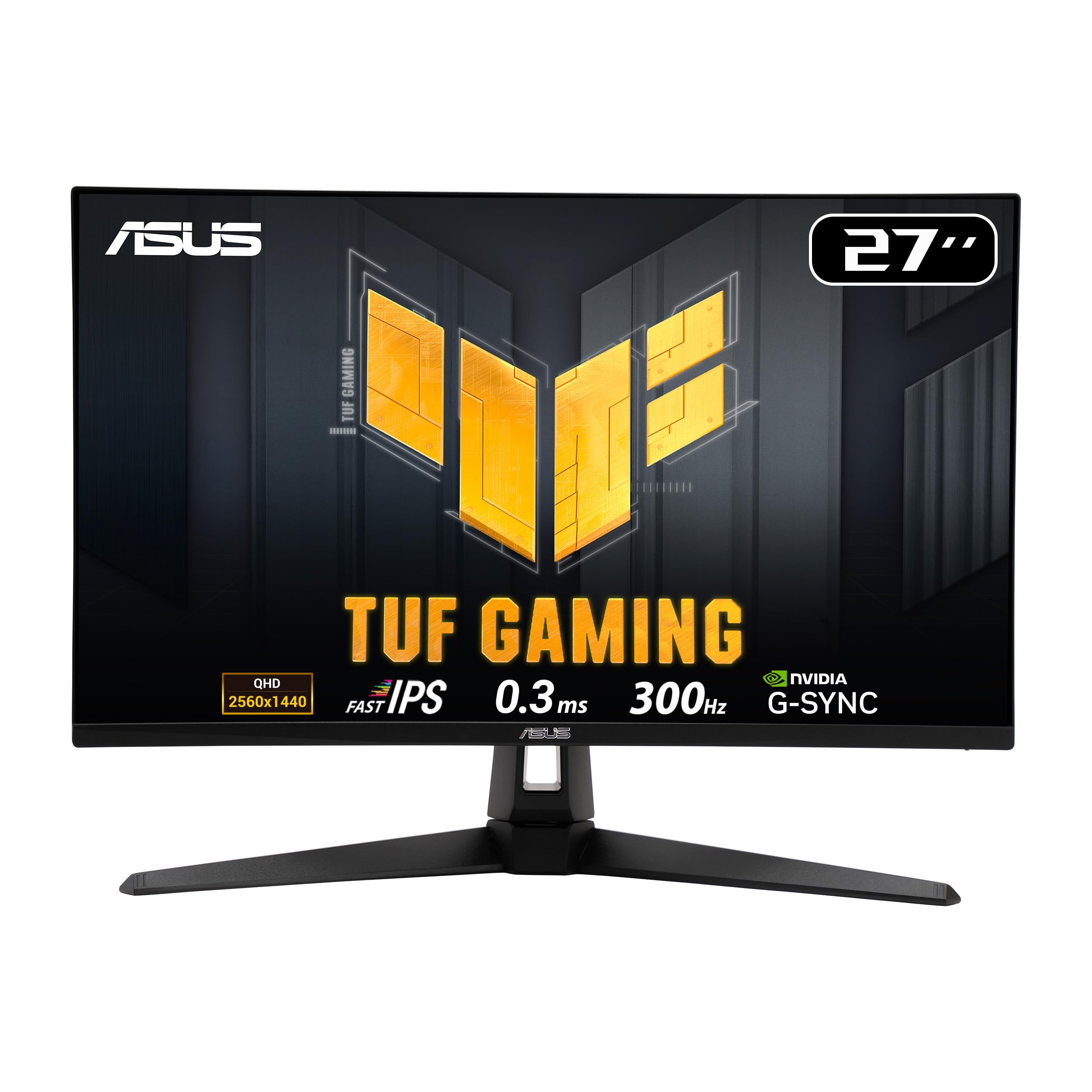

Frequently asked
5 questions01Is the KOORUI 34-inch Ultrawide Gaming Monitor good for gaming?+
The KOORUI 34-inch ultrawide excels at immersive, single-player gaming with its 165Hz refresh rate, 1000R curve, and excellent VA contrast. The ultrawide format creates genuine immersion in RPGs, racing sims, and story-driven games. However, the VA panel's 8-10ms response times cause visible smearing in fast-paced competitive shooters, making it less suitable for games like Valorant or CS2 where pixel-perfect response matters.
02Does the KOORUI 34-inch Ultrawide Gaming Monitor have good HDR?+
No, the HDR implementation is basic checkbox functionality only. With just 320 nits peak brightness and no local dimming, the monitor accepts HDR10 signals but can't display proper highlights or dynamic range. HDR content looks washed out compared to SDR mode. Ignore the HDR feature entirely and stick with SDR for better image quality.
03Is the KOORUI 34-inch Ultrawide Gaming Monitor good for content creation?+
It's adequate for casual content creation but not ideal for professional colour work. The monitor covers 98% sRGB and 88% DCI-P3, which is decent for the price, but the average Delta E of 2.3 out of box requires calibration for accurate colour. There's no working sRGB clamp mode, and it's not factory calibrated. For serious photo or video editing, you'd want a monitor with better colour accuracy and proper calibration.
04What graphics card do I need for the KOORUI 34-inch Ultrawide Gaming Monitor?+
For 3440x1440 at 165Hz, you'll want at least an NVIDIA RTX 4060 Ti or AMD RX 7700 XT for modern games at high settings. The ultrawide resolution has about 30% more pixels than standard 2560x1440, so it's more demanding. For competitive games at maximum frame rates, an RTX 4070 or RX 7800 XT is recommended. Less demanding games or older titles will run fine on mid-range cards like the RTX 4060 or RX 7600.
05What warranty and returns apply to the KOORUI 34-inch Ultrawide Gaming Monitor?+
Amazon offers 30-day returns on most items, which is helpful for checking for dead pixels or backlight bleed issues. KOORUI typically provides a 3-year warranty on monitors covering manufacturing defects. You're also covered by Amazon's A-to-Z guarantee for purchase protection. Always check for dead pixels immediately upon delivery during the return window.