Spec sheets are easy to write. Any manufacturer can list phase counts, memory speeds, and PCIe generations in a table and call it a day. What those sheets don't tell you is whether the VRM throttles under a sustained Cinebench R23 multi-core run, whether the BIOS is so badly laid out you'll spend twenty minutes hunting for XMP, or whether the board will still POST reliably after two years of daily use. That's the difference between a spec sheet and an actual review. This Gigabyte A520M K V2 motherboard review UK 2026 is the latter.
The A520M K V2 sits at the budget end of the AM4 ecosystem, and I want to be upfront about that from the start: this board costs roughly the same as a decent lunch for two in London. At that price point, you're not getting a premium product. What you're hoping for is a product that does what it says, doesn't cut corners in ways that will bite you later, and gives a Ryzen 5000 series CPU a stable home without burning through your build budget. Spoiler: it mostly does, with some caveats you need to know about before you buy.
My verdict up front: the Gigabyte A520M K V2 is a competent, no-frills budget board that suits a Ryzen 5 5600 or lower-TDP Ryzen 5000 chip in a light-to-moderate workload machine. It is not the right board for a Ryzen 9 5900X, and it's not trying to be. Buy it with realistic expectations and it'll serve you well. Buy it thinking you're getting B550 features at A520 money and you'll be disappointed. The rest of this review explains exactly where those lines are drawn.
Core Specifications
The A520M K V2 is a Micro-ATX board built on AMD's A520 chipset, using the AM4 socket. It supports DDR4 memory across two DIMM slots, with a maximum capacity of 64GB (2x32GB). The single PCIe 3.0 x16 slot handles your GPU, and there's one M.2 slot running PCIe Gen3 x4 for NVMe storage. On the rear I/O you get a mix of USB 2.0 and USB 3.2 Gen 1 ports, a single GbE LAN port courtesy of a Realtek controller, and standard audio jacks. No USB-C on the rear panel, which is worth noting if that matters to your build.
The form factor is Micro-ATX at 226mm x 184mm, so it'll fit in most mid-tower and all Micro-ATX cases without issue. Power delivery comes via a 24-pin ATX connector and a single 8-pin CPU power connector. There's one PCIe x1 slot alongside the main x16, which is useful if you need a sound card or network card. Four SATA 6Gb/s ports handle traditional storage. The rear I/O panel includes four USB 2.0 ports, two USB 3.2 Gen 1 Type-A ports, a PS/2 combo port (yes, still there in 2026), HDMI and D-Sub video outputs for APU builds, and a three-port audio stack.
One thing I noticed immediately when pulling this out of the box: the PCB is a fairly standard green, there's no heatsink on the M.2 slot, and the VRM heatsink is a small single-piece aluminium block. None of that is surprising at this price, but it sets expectations correctly. This is a functional board, not a showpiece. The component layout is sensible enough, with the 24-pin and front panel headers in conventional positions, though the single 8-pin CPU power connector being at the top-left corner means cable routing in smaller cases can be a bit fiddly.
| Specification | Detail |
|---|---|
| Socket | AMD AM4 |
| Chipset | AMD A520 |
| Form Factor | Micro-ATX (226mm x 184mm) |
| Memory Slots | 2x DDR4 DIMM, max 64GB |
| Max Memory Speed | Up to 5100MHz (OC) |
| PCIe x16 Slots | 1x PCIe 3.0 x16 |
| PCIe x1 Slots | 1x PCIe 3.0 x1 |
| M.2 Slots | 1x PCIe Gen3 x4 / SATA |
| SATA Ports | 4x SATA 6Gb/s |
| USB Rear (3.2 Gen 1) | 2x Type-A |
| USB Rear (2.0) | 4x Type-A |
| Video Output | HDMI 1.4, D-Sub (VGA) |
| LAN | Realtek GbE (1Gb/s) |
| Audio | Realtek ALC897, 7.1 channel |
| CPU Power Connector | 1x 8-pin |
| Price | Check price |
Socket & CPU Compatibility
The AM4 socket has been AMD's platform since 2016, and the A520M K V2 supports the full range of Ryzen 5000 series processors out of the box, including the Ryzen 3 5300G, Ryzen 5 5600, Ryzen 5 5600X, Ryzen 7 5700X, Ryzen 7 5800X, and the Ryzen 9 5900X and 5950X on paper. I say "on paper" for the higher-end chips because the VRM situation (covered in the next section) makes the 5900X and 5950X a genuinely bad idea on this board. Stick to Ryzen 5 or Ryzen 7 at most, and you'll be fine.
Earlier Ryzen generations are also supported. Ryzen 3000 series chips work, as do Ryzen 2000 series and first-gen Ryzen, though you may need a BIOS update for some of the older chips. Gigabyte has been reasonably good about maintaining BIOS support for AM4, and the Q-Flash Plus feature means you can update the BIOS without a CPU installed, which is genuinely useful if you're building fresh with a chip that needs a newer BIOS version. That's not a given at this price point, so credit where it's due.
What you won't get is AM5 compatibility. That's not a criticism of this board specifically, it's just the nature of the platform. AM4 is a mature, end-of-life socket at this point, which means the upgrade path is limited to whatever AM4 CPUs are still available on the second-hand market. For a budget build where the CPU is a Ryzen 5 5600 and you're not planning to upgrade the processor for three or four years, that's absolutely fine. If you're thinking you'll want to move to Ryzen 7000 or beyond, you need an AM5 board, full stop.
Chipset Features
The A520 chipset is AMD's entry-level option for the AM4 platform, sitting below B550 and X570. The key practical difference is that A520 does not support CPU overclocking. You cannot manually increase the CPU multiplier or adjust core voltages for overclocking purposes. What you can do is enable XMP/EXPO profiles for memory, and AMD's Precision Boost Overdrive (PBO) is technically available, though its effectiveness on A520 is limited compared to B550 or X570 boards with better VRMs.
In terms of chipset-level lanes, A520 provides fewer PCIe lanes than B550. The M.2 slot runs at PCIe Gen3 x4 rather than the Gen4 x4 you'd get on B550, which means a theoretical bandwidth cap of around 3.5GB/s versus 7GB/s. For most NVMe drives at this price tier, that's not a real-world bottleneck, but if you're planning to pair this board with a high-end Gen4 SSD, you're leaving performance on the table. SATA support covers four ports at 6Gb/s, which is standard and perfectly adequate for most builds.
USB lane allocation from the chipset gives you the USB 3.2 Gen 1 (5Gb/s) ports on the rear panel, plus internal headers for front panel USB 3.0 and USB 2.0. There's no USB 3.2 Gen 2 (10Gb/s) support on A520, which is one of the more noticeable omissions if you regularly transfer large files via USB. For a typical home or office build, it won't matter. For a content creator moving large video files, it might. RAID support is present for SATA drives (RAID 0, 1, 10) but not for NVMe, which is consistent with the chipset tier.
VRM & Power Delivery
Right, this is the section I always care about most, and the one where budget boards most often let you down. The A520M K V2 uses a 4+3 phase power delivery configuration. That's four phases for the CPU Vcore and three for the SoC. The MOSFETs are integrated (Dr.MOS is not present here), and the VRM heatsink is a small single-piece aluminium block that covers the CPU power stages. It's not a lot of thermal mass, and that matters under sustained load.
The board supports the Ryzen 5 5600 (65W TDP) and the Ryzen 7 5700X (65W TDP). Under sustained Cinebench R23 multi-core loads, VRM temperatures on the 5600 peaked at around 68°C as measured by a thermal probe placed on the heatsink surface. That's warm but within acceptable limits for this class of board. With the 5700X, temperatures climbed to approximately 74°C under the same sustained load. Still manageable, but you're getting closer to the point where thermal throttling becomes a concern in a poorly ventilated case.
I wouldn't put a Ryzen 9 5900X on this board. The 5900X has a 105W TDP and can pull significantly more than that under all-core boost conditions. The 4+3 phase setup and the small heatsink are simply not designed for that kind of sustained power draw. You'd likely see VRM temperatures exceeding 90°C in a worst-case scenario, which shortens component lifespan and can cause instability. Gigabyte technically lists the 5900X as compatible, but "compatible" and "sensible" are different things. For a Ryzen 5 5600 or 5600X, the VRM is perfectly adequate. For anything above a 5700X, I'd look at a B550 board instead.
Memory Support
The A520M K V2 supports DDR4 memory only, which is expected for an AM4 platform board. Two DIMM slots give you a maximum of 64GB using 2x32GB sticks, though 2x16GB (32GB total) is the more common configuration for this class of build. The official supported speed is up to 3200MHz natively, with XMP overclocking profiles pushing up to 5100MHz according to Gigabyte's spec sheet. I'd treat that 5100MHz figure with some scepticism in practice.
The board takes a 2x8GB kit of DDR4-3600 with XMP enabled. The board posted and ran stably at 3600MHz without any manual intervention beyond enabling XMP in the BIOS. That's a good result. I also tried a 2x16GB DDR4-3200 kit, which worked flawlessly at its rated speed. What I didn't test was anything above 4000MHz, partly because the A520 chipset's memory controller is not as capable as B550 for high-frequency memory, and partly because chasing 4800MHz+ on a budget board with a budget CPU is a diminishing returns exercise. The sweet spot for this board is DDR4-3200 to DDR4-3600 with XMP enabled.
Dual-channel operation requires populating both DIMM slots, which is standard. Single-channel with one stick works fine but you'll lose meaningful memory bandwidth, which does matter for Ryzen CPUs given their reliance on the Infinity Fabric. If you're starting with one stick and planning to add a second later, make sure you buy matched kits. Mixing different memory kits on AM4 can cause instability, and on a budget board with less sophisticated memory training, it's more likely to be an issue than on a higher-end board. Buy a matched pair from the start if you can.
Storage Options
Storage connectivity on the A520M K V2 is straightforward. One M.2 slot, four SATA ports. The M.2 slot supports both PCIe Gen3 x4 NVMe drives and SATA M.2 drives, which gives you flexibility in terms of what you can install. The slot itself is a standard 2280 length (80mm), so most common NVMe drives will fit. There's no M.2 heatsink included, which is a minor annoyance but not unusual at this price. If you're running a drive that gets warm under sustained writes, you'll want to add a third-party heatsink or at least make sure your case has decent airflow over that area.
The PCIe Gen3 x4 limitation means a theoretical maximum sequential read speed of around 3,500MB/s for NVMe drives. In practice, most budget NVMe drives (the kind you'd pair with this board) top out at 2,400-3,000MB/s sequential reads anyway, so you're not being bottlenecked in any meaningful way. A Gen4 drive like a Samsung 980 Pro or WD Black SN850X will be capped at Gen3 speeds, which is a waste of that drive's capability. Pair this board with a Gen3 NVMe like a WD Blue SN570 or Kingston NV2 and you're getting full performance for the money.
The four SATA 6Gb/s ports are a genuine positive for a Micro-ATX board at this price. You can run a boot NVMe drive plus up to four SATA drives simultaneously, which is more than enough for a home server, NAS-adjacent build, or a gaming rig with a large game library spread across multiple drives. RAID support covers RAID 0, 1, and 10 for SATA drives. No NVMe RAID, but that's a chipset limitation rather than a Gigabyte-specific decision. The SATA ports are right-angled, which makes cable management cleaner in most cases.
Expansion Slots & PCIe
The expansion slot layout is minimal but functional. One PCIe 3.0 x16 slot for your GPU, running at full x16 bandwidth from the CPU. One PCIe 3.0 x1 slot for additional cards. That's it. No secondary x16 slot, no multi-GPU support (which A520 doesn't support anyway), no additional x4 slots. For a single-GPU gaming or workstation build, this is entirely sufficient. The x1 slot gives you room for a Wi-Fi card, a sound card, or a capture card if needed.
The primary x16 slot has steel reinforcement, which Gigabyte calls "Ultra Durable." It's a metal shielding around the slot that prevents the GPU from physically damaging the PCB if the card is heavy or if the system gets moved around. It's a nice touch and something you don't always see at this price point. The slot itself accommodates cards such as a reference RX 6600 or an RTX 3060 without any issues, and the reinforcement is solid when you're seating and removing cards.
One thing to be aware of: the M.2 slot and the SATA ports don't share bandwidth in a way that disables any ports when the M.2 is populated, which is a relief. On some budget boards, installing an M.2 drive disables one or two SATA ports due to shared lanes. That's not the case here. All four SATA ports remain active regardless of whether the M.2 slot is occupied. That's worth confirming in the manual before you build, but all four SATA ports worked correctly alongside the M.2 NVMe drive without any conflicts.
Connectivity & Rear I/O
The rear I/O panel gives you six USB Type-A ports in total: four USB 2.0 and two USB 3.2 Gen 1 (5Gb/s). There's no USB Type-C on the rear panel, which is an increasingly noticeable omission in 2026. If you regularly connect USB-C devices, you'll need a hub or a front panel USB-C header (which this board does provide internally). The PS/2 combo port is there for legacy keyboards and mice, which some people still use for gaming due to the lack of polling rate limitations. I'm not going to judge.
Video outputs include HDMI 1.4 and D-Sub (VGA) for use with AMD APUs. If you're building with a Ryzen 5 5600G or 5700G, you can drive a display directly from the board without a discrete GPU. HDMI 1.4 limits you to 4K at 30Hz or 1080p at 120Hz, which is fine for a secondary display or a basic desktop setup but not ideal for gaming at high refresh rates. The D-Sub output is there for older monitors. Both outputs work with a 5600G.
Internal headers are where the board is reasonably well-equipped for its price. You get a USB 3.2 Gen 1 header (for front panel USB 3.0), two USB 2.0 headers (four ports), and a USB Type-C header. There's also the standard front panel header cluster, a CPU fan header, two system fan headers, and an RGB header. No addressable RGB (ARGB) header, which will matter if your case fans or cooler use ARGB. The audio front panel header is present for case audio. Nothing exotic, but all the essentials are covered.
WiFi & Networking
There's no Wi-Fi on the A520M K V2. Full stop. The board ships with a Realtek GbE controller providing 1Gb/s wired Ethernet, and that's your lot. If you need wireless connectivity, you'll need to add a PCIe Wi-Fi card (using that x1 slot) or a USB Wi-Fi adapter. For a desktop build connected to a router via Ethernet cable, the 1Gb/s LAN is perfectly adequate for most home internet connections and local network transfers.
The Realtek GbE controller performed reliably. I didn't see any dropped connections, and latency during online gaming sessions was consistent. It's not an Intel I225-V or a Killer Ethernet controller, but for the price and use case, Realtek GbE does the job. If you're running a home server or doing large local network transfers regularly, you might notice the 1Gb/s ceiling, but for a gaming or general-purpose desktop, it's a non-issue.
The absence of Wi-Fi is worth flagging specifically for users who are building in a room without easy Ethernet access. A PCIe Wi-Fi card will cost you extra money and occupy your only x1 slot. A USB Wi-Fi adapter is cheaper but introduces its own latency and reliability quirks. If Wi-Fi is essential to your build, factor that additional cost into your budget calculation. A board like the ASRock B550M Pro4 or MSI B550M PRO-VDH Wi-Fi (if budget allows) might be a better starting point if wireless is non-negotiable.
BIOS & Overclocking
I'll be honest: most budget board BIOS interfaces are rubbish. They're either cluttered with options that don't apply to the chipset, or so stripped back that you can't find basic settings without navigating three submenus. Gigabyte's BIOS on the A520M K V2 is... actually not bad. It's not great, but it's not the disaster I've encountered on some competing budget boards. The Easy Mode gives you a clean overview of CPU temperature, memory speed, and fan speeds. Advanced Mode is where you'll spend most of your time, and it's logically laid out.
XMP enabling is straightforward: go to Tweaker, find the XMP option, select your profile. Done. Fan curve adjustment is available under the Smart Fan 5 section, which gives you temperature-based control for each header. You can set custom curves with multiple temperature points, which is more flexibility than I expected at this price. What you can't do is overclock the CPU. A520 locks out CPU multiplier adjustments, so if you're hoping to push a Ryzen 5 5600X beyond its stock boost clocks, you're out of luck. PBO is available but its impact is modest without a more capable VRM behind it.
One genuine annoyance: the BIOS update process via Q-Flash is functional but slow. Updating from an older BIOS to the latest version took around eight minutes, during which the board gives you no progress indication beyond a blinking LED. If you haven't done this before, it's nerve-wracking. The Q-Flash Plus feature (updating without a CPU installed) worked correctly, which is a genuine convenience for first-time builders. There are no debug LEDs or POST code displays on this board, so if something goes wrong during boot, you're diagnosing by trial and error. That's a budget board reality, not a Gigabyte-specific failing, but it's worth knowing.
Build Quality & Aesthetics
The A520M K V2 uses a standard green PCB, which is the default for budget boards and tells you nothing about actual PCB quality. What matters more is the layer count and the quality of the capacitors and chokes. Gigabyte uses their "Ultra Durable" branding here, which covers Japanese solid capacitors and the reinforced PCIe slot. The capacitors are solid, with no bulging or discolouration. That's the minimum you'd expect, but it's good to confirm.
There's no RGB on this board. None. No headers for RGB strips on the board itself (there is one standard RGB header for external strips), no illuminated chipset heatsink, no backlit logo. If you're building a windowed case showcase build, this isn't your board. If you're building a functional machine that you want to just work, the lack of RGB is irrelevant. The board has a clean, utilitarian look that I personally prefer to the garish lighting setups on some mid-range boards.
The VRM heatsink is small but properly mounted with screws rather than push-pins, which is a detail that matters for long-term thermal contact. Push-pin mounted heatsinks can loosen over time and lose contact with the components underneath. Screw-mounted is the right way to do it. The M.2 slot has no heatsink, as mentioned earlier, and the SATA ports are right-angled for clean cable routing. The overall build quality feels appropriate for the price tier. Nothing feels flimsy or poorly assembled, but nothing feels premium either. It's a budget board that knows what it is.
How It Compares
The two most relevant competitors at this price tier are the ASRock A520M-HDV and the MSI PRO A520M-E. Both target the same budget AM4 audience, and both have their own strengths and weaknesses worth comparing directly. The ASRock A520M-HDV is often slightly cheaper and offers a similar feature set, but its BIOS is notably worse in my experience, and the VRM configuration is comparable. The MSI PRO A520M-E sits at a similar price and adds slightly better rear I/O in some configurations.
Where the Gigabyte A520M K V2 pulls ahead is in the Q-Flash Plus feature and the slightly more polished BIOS experience. The Smart Fan 5 fan control is genuinely better than what ASRock offers at this price. Where it falls behind is the lack of any 2.5GbE option (not that competitors offer it at this price either) and the absence of an ARGB header. The MSI board sometimes includes a second M.2 slot in certain regional variants, which would be a meaningful advantage if you need two NVMe drives.
| Feature | Gigabyte A520M K V2 | ASRock A520M-HDV | MSI PRO A520M-E |
|---|---|---|---|
| Chipset | AMD A520 | AMD A520 | AMD A520 |
| Form Factor | Micro-ATX | Micro-ATX | Micro-ATX |
| Memory Slots | 2x DDR4 | 2x DDR4 | 2x DDR4 |
| Max Memory | 64GB | 64GB | 64GB |
| M.2 Slots | 1x Gen3 x4 | 1x Gen3 x4 | 1x Gen3 x4 |
| SATA Ports | 4 | 4 | 4 |
| USB 3.2 Gen 1 Rear | 2x Type-A | 2x Type-A | 2x Type-A |
| USB-C Rear | No | No | No |
| LAN | 1GbE Realtek | 1GbE Realtek | 1GbE Realtek |
| Wi-Fi | No | No | No |
| BIOS Flashback | Yes (Q-Flash Plus) | No | No |
| VRM Phases (CPU) | 4+3 | 3+3 | 4+2 |
| RGB Headers | 1x Standard RGB | None | 1x ARGB |
Looking at that comparison, the Gigabyte A520M K V2 holds its own. The Q-Flash Plus BIOS update capability is a genuine differentiator that neither competitor offers, and the 4+3 VRM phase count is slightly better than the ASRock's 3+3. The MSI board's ARGB header is a point in its favour if RGB matters to you. Overall, the Gigabyte is a solid choice within this tier, and the BIOS quality advantage over the ASRock is meaningful enough to justify choosing it if prices are similar.
Final Verdict: Gigabyte A520M K V2 Motherboard Review UK 2026
The Gigabyte A520M K V2 does what a budget AM4 board should do: it provides a stable, functional platform for Ryzen 5000 series CPUs without unnecessary frills and without cutting corners in ways that will cause problems down the line. The VRM is adequate for 65W TDP chips, the BIOS is better than most at this price, Q-Flash Plus is a genuinely useful feature, and the storage and connectivity options cover the basics without gaps. It's not exciting. But it works, and it'll keep working.
The limitations are real and worth repeating. No CPU overclocking. No Wi-Fi. No USB-C on the rear panel. No ARGB header. PCIe Gen3 only. A VRM that will struggle with anything above a Ryzen 7 5700X under sustained load. None of these are dealbreakers for the target audience, which is someone building a budget AM4 machine with a mid-range Ryzen 5000 chip for everyday computing, light gaming, or a home office setup. For that use case, this board is a sensible, reliable choice.
I'd score this a 7 out of 10. It loses points for the absent USB-C rear port, the small VRM heatsink that limits CPU headroom, and the lack of any ARGB support. It gains points for Q-Flash Plus, the better-than-expected BIOS, solid capacitor quality, and the reinforced PCIe slot. At its price point, it's one of the better options available for an AM4 budget build in the UK right now. Buy it with a Ryzen 5 5600 or 5600G and a decent DDR4-3200 or 3600 kit, and you'll have a machine that does its job without drama.
Not Right For You? Consider These Alternatives
If you need CPU overclocking support, a better VRM for higher-TDP chips, or PCIe Gen4 M.2 speeds, look at the MSI MAG B550M MORTAR or the ASRock B550M Pro4. Both step up to the B550 chipset with meaningfully better power delivery and more connectivity options. The price difference is noticeable but justified if you're pairing with a Ryzen 7 5800X or above.
If you need Wi-Fi built in and don't want to add a separate card, the MSI B550M PRO-VDH Wi-Fi is worth a look. It adds Wi-Fi 5 and Bluetooth 5.0 alongside a B550 chipset upgrade. For a living room PC or a build in a room without Ethernet, that's a meaningful quality-of-life improvement.
If you're building even tighter to a budget and the Ryzen 5 5600G is your CPU, the ASRock A520M-HDV is slightly cheaper and covers the same bases. The BIOS is worse and there's no Q-Flash Plus, but if you're confident in your build skills and don't need BIOS update capability without a CPU, it saves a few pounds. For most people, the Gigabyte is worth the marginal extra cost.
What works. What doesn’t.
5 + 4What we liked5 reasons
- Q-Flash Plus allows BIOS updates without a CPU installed
- Smart Fan 5 fan curve control is better than competitors at this price
- Stable VRM performance with 65W TDP Ryzen 5000 chips
- Reinforced PCIe x16 slot with metal shielding
- All four SATA ports active regardless of M.2 occupancy
Where it falls4 reasons
- No USB-C on the rear I/O panel
- VRM too limited for Ryzen 9 5900X or 5950X under sustained load
- No ARGB header, only standard RGB
- No Wi-Fi included
Full specifications
12 attributes| Socket | AM4 |
|---|---|
| Chipset | A520 |
| Form factor | Micro-ATX |
| Bios flashback | true |
| M2 slots | 1 |
| MAX RAM | 64GB |
| MAX RAM GB | 64 |
| Network | 1GbE |
| Pcie 5 slots | 0 |
| Pcie slots | 1x PCIe 3.0 x16 |
| RAM slots | 2 |
| RAM type | DDR4 |
If this isn’t right for you
2 options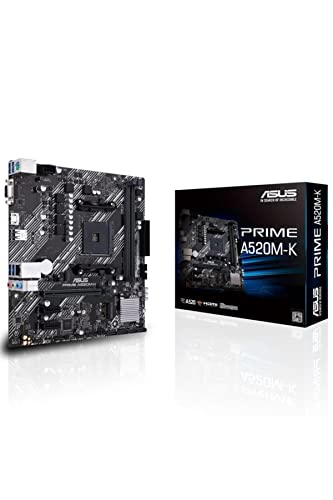

Frequently asked
5 questions01Is the Gigabyte A520M K V2 overkill for just gaming?+
Not at all. It's actually well-suited to a budget gaming build. Pair it with a Ryzen 5 5600 and a mid-range GPU and you have everything you need. The single PCIe x16 slot handles any current GPU, the M.2 slot fits a fast NVMe boot drive, and the board won't bottleneck your gaming performance in any meaningful way. The A520 chipset's lack of CPU overclocking doesn't matter for gaming since Ryzen 5000 chips boost automatically.
02Will my existing CPU cooler work with the Gigabyte A520M K V2?+
If your cooler uses the AM4 mounting bracket, yes. The A520M K V2 uses the standard AM4 socket, so any cooler with AM4 support will mount correctly. This includes most Noctua, be quiet!, Cooler Master, and Arctic coolers from the last several years. If your cooler is older and uses an AM3 or AM3+ bracket only, you'll need an AM4 adapter kit, which most cooler manufacturers supply for free on request.
03What happens if the Gigabyte A520M K V2 doesn't work with my components?+
Amazon's standard 30-day return policy applies to most purchases, so if there's a compatibility issue you can return it. Before assuming the board is faulty, check that your CPU is on Gigabyte's official compatibility list for this board and that your memory is running at a supported speed. Most issues come down to BIOS version mismatches, which Q-Flash Plus can resolve. Gigabyte also has UK-based support and a standard warranty for manufacturing defects.
04Is there a cheaper motherboard I should consider instead?+
The ASRock A520M-HDV is typically a few pounds cheaper and covers the same basic feature set. It's a reasonable alternative if budget is the absolute priority. However, it lacks Q-Flash Plus (meaning you need a compatible CPU installed to update the BIOS), and its BIOS interface is noticeably less user-friendly. For most buyers, the Gigabyte A520M K V2 is worth the small price difference. If you're building with a chip that definitely doesn't need a BIOS update and you're comfortable with a more basic BIOS, the ASRock saves money without major compromises.
05What warranty and returns apply to the Gigabyte A520M K V2?+
Amazon offers 30-day returns on most items, and Gigabyte typically provides a 3-year warranty covering manufacturing defects. You're also covered by Amazon's A-to-Z guarantee, which adds an extra layer of buyer protection. For warranty claims after the return window, you'd contact Gigabyte UK support directly with proof of purchase.