Samsung's sub-£200 monitor range has grown considerably more competitive over the past twelve months, with the brand pushing higher refresh rates, sharper resolutions, and smarter features into territory that once felt reserved for mid-range spending. Whether you are a budget-conscious PC gamer chasing silky-smooth frame rates, a remote worker who needs a large, versatile display, or someone wanting a secondary screen that doubles as a smart TV, there is now a Samsung panel at or below £200 that can genuinely serve you well. The arrival of the Odyssey G3's updated IPS variant and the 32-inch 4K Smart Monitor in particular have shaken up the value calculation. This guide cuts through the noise and focuses on four eligible Samsung monitors, comparing their real-world strengths, weaknesses, and the specific types of user each one suits best.
Quick Verdict
Best Overall: Samsung Odyssey G5 LS27CG552EUXXU. At under £135, it delivers QHD resolution and a 165 Hz VA panel in a 27-inch curved chassis, making it the single most capable screen in this group for the money.
Best Value for Smart Features: Samsung LS32FM703UUXXU 32" 4K Smart Monitor. A 32-inch 4K screen with built-in speakers and Smart TV functionality is genuinely difficult to argue with if you want a do-everything display.
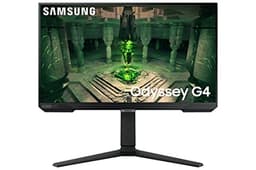
Best for Competitive Gaming: Samsung Odyssey G4B LS25BG400EU. Its IPS panel, fast pixel response, and strong port selection make it the pick for esports-focused players who prioritise speed and colour accuracy over screen size.
The Odyssey G5 is the headline act in this group, and it earns that position through a combination of specifications that simply should not exist at this price point. A QHD (2560x1440) resolution on a 27-inch screen gives you a pixel density of around 109 PPI, which is noticeably sharper than any 1080p panel at the same size. Pair that with a 165 Hz refresh rate and you have a monitor that can satisfy both the gamer who wants smoother motion and the creative professional who wants more desktop real estate without spending over £200.
The panel itself is a VA type with a 1000R curvature, which is Samsung's most aggressive curve and one that divides opinion. At 27 inches, the 1000R curve feels immersive during gaming and is comfortable for single-screen productivity use, but it can introduce slight distortion when working with straight lines in design applications. VA panels are known for their deep blacks and high contrast ratios compared to IPS alternatives, so dark scenes in games and films look genuinely impressive. The trade-off is that VA panels can exhibit some ghosting in fast motion, though Samsung's implementation here is generally well-regarded at this price.
Connectivity is sensible rather than lavish: one DisplayPort 1.4 and one HDMI 2.0 port cover the essentials, and a headphone output means you can connect a headset directly to the monitor rather than routing audio through your PC. The stand allows for tilt adjustment, which is standard at this price, though height adjustment is not available without a VESA mount.
Who is this for? Primarily PC gamers with a mid-range GPU, such as an RTX 3060 or RX 6700 XT, who want to push QHD gaming without spending on a premium display. It is also a strong pick for anyone upgrading from a 1080p monitor who wants a meaningful visual improvement. The aggressive price, currently sitting well below £140, makes it the most obvious recommendation in this group for pure performance per pound.
Verdict: The best all-round Samsung monitor under £200. QHD at 165 Hz for under £135 is exceptional value, and the VA panel's contrast strengths suit both gaming and media consumption.
Pros
- QHD 2560x1440 resolution delivers noticeably sharper image than 1080p at 27 inches
- 165 Hz refresh rate suits both competitive gaming and smooth everyday use
- VA panel produces deep blacks and high contrast, enhancing dark-scene gaming
- Lowest price in this group, making it outstanding value per specification
Cons
- VA panel can produce slight motion ghosting in very fast-paced games compared to IPS alternatives
- Stand offers tilt only, with no height or pivot adjustment without a separate VESA arm
- 1000R curvature may not suit users who work with precision graphics or straight-line design work
The LS32FM703UUXXU occupies a unique position in Samsung's sub-£200 range because it is not primarily a gaming monitor. Instead, it is a 32-inch 4K smart display designed to function as a monitor, a streaming device, and a secondary television all in one. At this price, it sits at the very top of this group's budget, but the breadth of what it offers is genuinely difficult to match from any single rival at the same price.
The 4K UHD resolution on a 32-inch VA panel gives you a pixel density that makes text, photos, and streaming content look crisp and detailed. HDR10 support means compatible content on streaming platforms will display with a wider dynamic range, though the brightness ceiling of a budget VA panel means HDR performance is more functional than spectacular. The built-in speakers remove the need for a separate audio solution for casual use, which is a meaningful convenience for anyone setting this up as a bedroom or living-room screen.
The Smart Monitor functionality is where this product truly differentiates itself. Samsung's Tizen-based operating system is built in, giving you access to Netflix, Disney+, YouTube, and other streaming apps without needing a PC, console, or streaming stick connected. This makes the LS32FM703UUXXU particularly appealing for users who want a large, sharp screen that works independently as an entertainment hub and connects to a PC when needed.
The white colourway is a distinctive choice that suits modern, minimalist desk setups and bedroom environments far better than the aggressive black-and-red aesthetic of gaming monitors. It is available in white, which is relatively unusual in the monitor market and gives it a clean, premium appearance that belies the price.
Who is this for? Remote workers, students, and casual users who want a large, versatile screen that doubles as a smart entertainment device. It is not the right choice for competitive gaming given its VA panel and unspecified refresh rate, but for everything else it punches well above its price tag.
Verdict: The most versatile monitor in this group. If you want a 32-inch 4K screen with smart streaming built in and built-in speakers for under £200, this is a genuinely impressive package.
Pros
- 32-inch 4K UHD resolution offers exceptional detail for productivity and media consumption
- Built-in Tizen smart platform allows Netflix, YouTube, and other streaming without a PC
- Integrated speakers reduce desk clutter and eliminate the need for a separate audio device
Cons
- VA panel and unspecified refresh rate make it unsuitable for competitive or fast-paced gaming
- HDR10 performance is limited by the panel's brightness ceiling, so HDR impact is modest
The Odyssey G3 LS27DG302EUXXU is Samsung's entry-level gaming monitor in this group, but entry-level does not mean without merit. Its headline specification is a 180 Hz refresh rate on a 27-inch IPS panel, which is a combination that directly targets the growing segment of budget-conscious PC gamers who want smooth, responsive gameplay without paying mid-range prices.
The IPS panel is a meaningful differentiator compared to VA alternatives. IPS technology delivers wider viewing angles, more accurate colour reproduction out of the box, and generally better performance in bright room conditions. For gamers who play in well-lit rooms or who use their monitor for colour-sensitive work alongside gaming, the IPS panel here is a genuine advantage over the VA-based Odyssey G5, even though the G5 wins on resolution.
At 1920x1080 on a 27-inch screen, pixel density is lower than ideal, sitting at around 82 PPI. This is the monitor's most significant limitation. Text and fine detail are noticeably softer than on a QHD screen of the same size, and users who sit close to the display or who do a lot of reading and document work may find the pixel density unsatisfying. However, for gaming at 180 Hz, the lower resolution is actually an advantage: it requires far less GPU power to drive, meaning even a mid-range graphics card can push frame rates well above 100 fps in modern titles.
The 1ms response time specification helps minimise motion blur during fast-paced gameplay, and the combination of 180 Hz and 1ms makes this one of the most responsive monitors in this group for esports titles such as Valorant, CS2, and Apex Legends. Connectivity is straightforward: one HDMI port and one DisplayPort cover the standard connections, keeping the rear panel clean and simple.
Who is this for? Esports players and budget gamers who prioritise frame rate and response time over resolution, and who have a GPU capable of pushing 100 fps or more at 1080p. It is also a sensible choice for console gamers connecting via HDMI who want a large, responsive screen.
Verdict: A solid 180 Hz IPS gaming monitor at a fair price. The 1080p resolution at 27 inches is the main compromise, but for pure gaming responsiveness it delivers exactly what it promises.
Pros
- 180 Hz IPS panel provides exceptionally smooth, low-latency gameplay at 1080p
- IPS technology delivers accurate colours and wide viewing angles compared to VA alternatives
- 1080p resolution is easy for mid-range GPUs to drive at high frame rates
Cons
- 1920x1080 at 27 inches produces a noticeably soft image for productivity and reading tasks
- Only one HDMI port limits multi-device connectivity compared to the G4B
The Odyssey G4B is the smallest screen in this group at 25 inches, but it compensates with one of the strongest port selections and a well-specified IPS panel that suits competitive gaming and productivity in equal measure. At this price, it sits between the budget G3 and the premium Smart Monitor, and it carves out a distinct niche for users who want a compact, well-connected gaming display.
The 25-inch form factor is a deliberate choice for competitive gamers. A smaller screen means less eye movement is required to scan the full display, which can be a genuine advantage in fast-paced esports titles where peripheral awareness matters. The pixel density at 1080p on a 25-inch panel is around 88 PPI, which is meaningfully sharper than the same resolution on a 27-inch screen, making text and fine details look noticeably crisper.
The IPS panel brings the same advantages seen in the G3: accurate colour reproduction, wide viewing angles, and good performance in bright environments. For users who split their time between gaming and creative work such as photo editing or video colour grading, the IPS panel's colour accuracy is a meaningful benefit over VA alternatives in this group.
Where the G4B genuinely stands out is its connectivity. Two HDMI 2.0 ports allow simultaneous connection of two devices, such as a PC and a games console, without needing to swap cables. The DisplayPort 1.2 output, USB port, and 3.5mm headphone output round out a port selection that is more generous than any other monitor in this group. For users with multiple devices on a single desk, this flexibility is a practical daily convenience.
The monitor's design follows Samsung's Odyssey aesthetic with a distinctive angular stand and rear lighting elements, giving it a more premium appearance than its price might suggest. The stand includes tilt adjustment, which is standard at this price tier.
Who is this for? Competitive gamers who want a compact, well-connected IPS display for esports, and users who need to connect multiple devices to a single monitor without a KVM switch.
Verdict: The best-connected monitor in this group. Two HDMI ports, DisplayPort, USB, and a headphone output make it the most versatile gaming display here for multi-device setups.
Pros
- Two HDMI 2.0 ports allow simultaneous connection of PC and console without cable swapping
- 25-inch size gives higher pixel density than 27-inch 1080p panels, producing a sharper image
- IPS panel delivers accurate colours and wide viewing angles for gaming and creative work
Cons
- 25-inch screen feels small for productivity tasks such as spreadsheets or multi-window working
- Priced higher than the Odyssey G3 despite sharing 1080p resolution and a similar IPS panel
Buying Guide
Resolution: how much detail do you actually need?
Resolution is one of the first specifications buyers focus on, and rightly so. At 27 inches, there is a meaningful visible difference between 1080p and 1440p. A Full HD (1920x1080) panel at 27 inches produces around 82 pixels per inch, which is acceptable for gaming but noticeably soft for reading text or fine detail work. A QHD (2560x1440) panel at the same size delivers around 109 PPI, which is a significant improvement for everyday productivity. If you spend more time working than gaming, or if you sit close to your screen, QHD is worth prioritising. If you are primarily a gamer with a mid-range GPU, 1080p at a higher refresh rate may serve you better because it is far easier to drive at high frame rates.
Panel type: IPS versus VA
IPS panels offer wider viewing angles, more accurate colour reproduction out of the box, and generally better performance in bright rooms. They are the preferred choice for creative work, productivity, and any situation where multiple people view the screen from different angles. VA panels, by contrast, offer higher native contrast ratios, producing deeper blacks and more vivid dark scenes. This makes them particularly effective for gaming in dark environments and for watching films. VA panels can exhibit some motion ghosting at very high speeds, though modern implementations have improved considerably. Neither panel type is universally superior: the right choice depends on your primary use case.
Refresh rate: beyond 60 Hz
A 60 Hz monitor refreshes the image 60 times per second, which is adequate for productivity and casual gaming. Moving to 144 Hz, 165 Hz, or 180 Hz produces noticeably smoother motion, which benefits both gaming and general desktop use. The practical benefit depends on your GPU: a graphics card that cannot push frame rates above 60 fps will not benefit from a 180 Hz panel. If you have a capable GPU and play fast-paced games, a high refresh rate monitor is one of the most impactful upgrades you can make.
Connectivity: ports matter more than you might think
The number and type of ports on a monitor determines how many devices you can connect and at what quality level. HDMI 2.0 supports 4K at 60 Hz or 1080p/1440p at high refresh rates. DisplayPort 1.4 supports higher bandwidth, making it preferable for QHD at 165 Hz or above. If you use a games console alongside a PC, having two HDMI ports on a single monitor eliminates the need to swap cables. A headphone output on the monitor itself is a convenience that allows direct headset connection without routing audio through your PC.
Smart features and built-in speakers
For users who want a monitor that functions independently of a PC, Samsung's Smart Monitor range adds genuine value. Built-in streaming apps, smart home integration, and integrated speakers transform a monitor into a multi-purpose display that can serve a bedroom or living room as effectively as a dedicated television. If your use case includes standalone streaming or you want to reduce cable clutter, these features are worth paying for at the top of the budget.
Size and ergonomics
Larger screens are not always better. A 32-inch monitor requires more desk depth and head movement to scan the full display, which can be tiring during long work sessions. For competitive gaming, 24 to 27 inches is the most common preference. For productivity and media consumption, 27 to 32 inches tends to suit users who sit further from their screen. Ergonomic adjustability, including height, tilt, and swivel, becomes more important the longer you spend in front of the screen, and it is worth noting that most budget monitors offer tilt adjustment only.
The Samsung Odyssey G5 LS27CG552EUXXU is the overall winner in this group. QHD resolution, a 165 Hz refresh rate, and a 27-inch curved VA panel at under £135 represents the strongest combination of specifications per pound available from Samsung's sub-£200 range. It suits the widest range of users: gamers benefit from the high refresh rate and deep contrast, while productivity users gain from the sharper QHD resolution and generous screen real estate. For users who want smart features and a large 4K screen, the LS32FM703UUXXU is the clear alternative and a genuinely impressive all-in-one display. Competitive esports players with a preference for IPS accuracy and multi-device connectivity should look at the Odyssey G4B, while the Odyssey G3 remains a reliable, no-fuss choice for 180 Hz gaming at a fair price.