Best Overall Value
Start with the price. At £258 the XFX RX 6600 is the cheapest card here that you'd genuinely recommend for 1440p, and that £38 saving over the MSI 5050 is the whole argument. It buys you 8GB of GDDR6 and an RDNA 2 core that punches well above what its old age suggests. In pure rasterisation, no ray tracing, no upscaling tricks, the RX 6600 trades blows with the newer cards and sometimes edges the RTX 5050 on frames per pound.
The reason it drops to second rather than first is the feature gap. AMD's FSR upscaling works, but it's a rung below Nvidia's DLSS on image quality, and ray tracing on RDNA 2 is best left switched off. For 1440p that trade is real: you get more raw frames for your money, but fewer of the modern tricks that stretch a budget card further. Where it claws points back is efficiency. Board power sits around 132W, so a modest 450W PSU runs it comfortably, and the SWIFT210 dual-fan cooler keeps temperatures and noise low. Owners report it running cool and quiet even in cramped micro-ATX cases.
Against the Sapphire RX 580 below it, the RX 6600 is a generational leap for roughly £109 more, with far better efficiency and modern FSR support the 580 can't match well. Against the ASUS RTX 4060, it's the choice for buyers who care about frames per pound over DLSS 3 frame generation and don't want a graded card. This is the value play. If your budget is tight and you're happy tuning settings and leaning on FSR, the RX 6600 gets you into 1440p for the least money without feeling like a compromise you'll regret.
Pros
- Lowest sensible price for 1440p in this group
- 132W draw runs on a 450W PSU with room to spare
- Strong native rasterisation, great frames per pound
- Compact dual-fan design fits small cases
Cons
- FSR upscaling trails Nvidia's DLSS on quality
- Ray tracing performance is weak, best disabled
- Older RDNA 2 silicon, shorter support runway than the 5050
Check availabilityRead full review
Best Feature Set
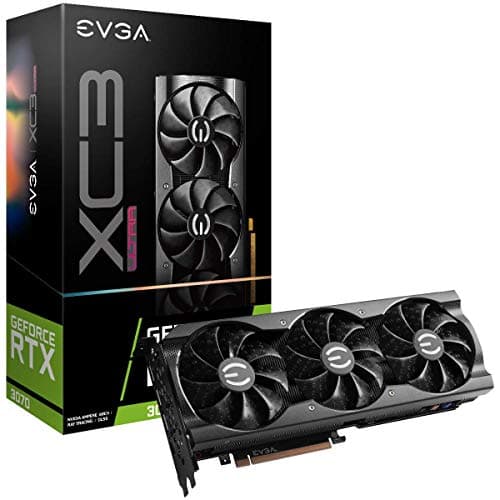
The RTX 4060 brings the one thing the RX 6600 can't: DLSS 3 with frame generation. At 1440p that's genuinely useful, letting the card conjure extra frames in supported titles and stretch its 8GB further than raw power alone would. It draws just 115W, the lowest of the four, so it's the pick for a small or quiet build where every watt of heat counts.
The catch is in the name. This is a graded unit at Check price, meaning it's been inspected and re-boxed rather than sold factory-fresh. That's why it sits at third rather than challenging the MSI 5050 for the top: you're paying full budget for a card that isn't strictly new, and grading can mean minor cosmetic marks. The silicon itself is proven Ada Lovelace, with a mature driver stack and strong owner reports across thousands of these cards elsewhere.
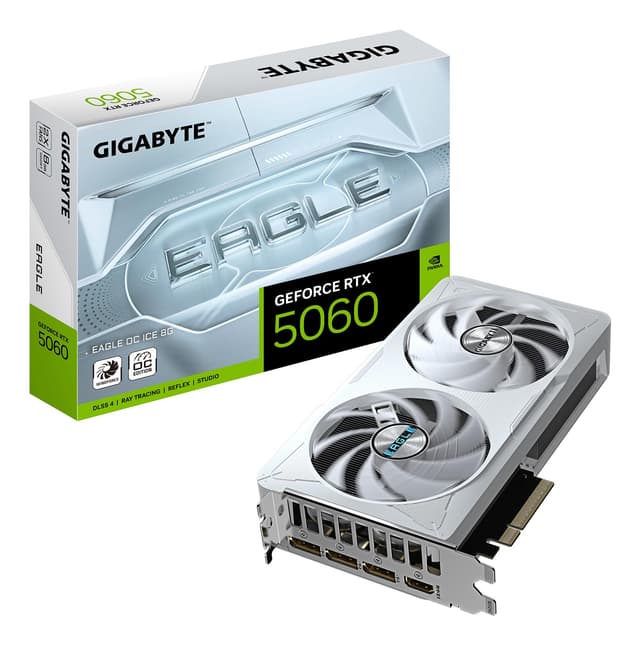
Against the RTX 5050, the 4060 is arguably the stronger rasteriser but the older architecture, and the graded status tips the decision. Against the XFX RX 6600, it's the DLSS 3 versus frames-per-pound question. If frame generation and the lowest power draw matter most to you, and you're relaxed about a graded box, this is the smart buy. Independent benchmarks from outlets like TechPowerUp confirm its efficiency credentials.
Pros
- DLSS 3 frame generation, unmatched here
- Lowest power draw at 115W
- Mature, stable Nvidia driver support
Cons
- Sold graded, not factory-new, at full budget price
- 128-bit bus limits 1440p texture bandwidth
- Older Ada generation than the RTX 5050
Check availabilityRead full review
Best Rock-Bottom Entry
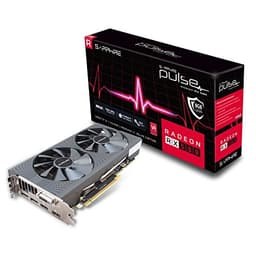
Don't buy this expecting native 1440p in modern games. That's the honest starting point. At £149 the Sapphire Pulse RX 580 is here because it's the cheapest way onto 8GB, and for older libraries, esports and 1080p it still does a job. At 1440p in 2024-to-2026 titles it runs out of steam, and with no meaningful FSR frame generation there's no rescue button.
What it does have going for it is that 256-bit memory bus, the widest here, feeding 8GB of GDDR5. That bandwidth is why the ageing card holds up better than you'd expect in some scenarios, even if the core is generations behind. Board power sits around 185W, the thirstiest of the four, so plan for a 500W PSU. The Pulse cooler is a known-quiet dual-fan design with dual DisplayPort and HDMI outputs.
Against the XFX RX 6600 above it, the RX 580 is a false economy for anyone serious about 1440p: the 6600 is a huge step up for roughly £109 more. But if £149 is the ceiling and you mostly play older or lighter games, it's a lifeline. We covered its strengths and limits in our full Sapphire Pulse Radeon RX 580 review.
Pros
- Cheapest 8GB card in the group by a wide margin
- 256-bit bus, widest memory bandwidth here
- Quiet dual-fan Pulse cooler
Cons
- Struggles at native 1440p in modern titles
- No effective frame generation or upscaling
- Highest power draw at around 185W
Check availabilityRead full review
Let's be honest about what this is. At £88.95 the ASUS GT 730 is far and away the cheapest card in this article, but it isn't a 1440p gaming card and it would be dishonest to pretend otherwise. It's here for one reason: the four HDMI ports. If you're building a machine that needs to drive multiple displays at 1440p on the desktop, spreadsheets, dashboards, a home trading setup, this passively cooled little board does that job for a fraction of everything else on the list.
The gaming reality is stark. The 2GB of GDDR5 and the ancient Kepler-era core mean modern titles at 1440p are simply off the table, and even older games will need everything dialled right down. There's no ray tracing, no DLSS, no FSR worth the name. What you get instead is silence and simplicity. The fanless heatsink makes zero noise, the single-slot design slips into tight cases, and the PCIe 2.0 board sips so little power that almost any PSU will run it without an extra connector. Owners buy these to revive old office PCs or to add display outputs, and for that they're reliable.
Against the RX 6600 above it, there's no contest on frames, the 6600 is a real gaming card and this is not. The GT 730 earns its slot on a different metric entirely: multi-monitor output at rock-bottom cost with no noise and no fuss. If you landed here wanting to game at 1440p, skip it and spend more. If you want four screens driven cheaply and quietly, it's hard to beat.
Pros
- Cheapest card here by a wide margin
- Four HDMI ports drive multiple 1440p desktops
- Passive cooling means completely silent operation
- Single-slot, low-power design fits almost any build
Cons
- Not a 1440p gaming card in any real sense
- Only 2GB GDDR5 and a dated Kepler core
- No ray tracing, DLSS or usable FSR support
Buy on Amazon£88.95Read full review
Best Feature Set
Buying Guide: What to Look For in the Best Graphics Cards for 1440p Gaming Under £300
Buying a budget GPU for 1440p is an exercise in picking your compromise. Here's how to pick the right one.
VRAM and bus width. Every card in this bracket ships with 8GB, which is now the floor for 1440p. What differs is the bus. A 128-bit bus (RTX 5050, RTX 4060) moves data more slowly than the 256-bit bus on the ageing RX 580. Faster GDDR6 memory offsets a narrow bus somewhat, but in texture-heavy games you may need to drop textures a notch to stay smooth. If a game lets you cap texture quality independently, do that before you drop everything else.
Upscaling matters more than raw power. At 1440p on a budget card, DLSS (Nvidia) or FSR (AMD) is the difference between playable and slideshow. Nvidia's DLSS, especially frame generation on the RTX 4060, currently produces cleaner results than AMD's FSR. If you want the best image quality from upscaling, lean Nvidia. If you want raw frames per pound, AMD's RX 6600 delivers.
Power draw and PSU. The RTX 4060 (115W) and RX 6600 (132W) are efficient enough for a 450W to 500W PSU. The RX 580 pulls around 185W, so budget for 500W minimum. Check your PSU has the right PCIe power connector before you order, and don't cheap out on the PSU to afford a better card.
New versus graded. The ASUS RTX 4060 here is a graded unit. Graded means inspected and re-boxed, often with minor cosmetic marks, at a lower price. It's a legitimate way to save money, but if you want factory-fresh, the MSI RTX 5050 is the new-stock pick.
The mistake to avoid. Don't pair a £149 RX 580 with a shiny new 1440p 144Hz monitor and expect miracles. Match the card to the games you actually play. Older and esports titles are fine on any of these. Latest AAA releases at native 1440p need the RTX 5050 or RX 6600 with upscaling on.