Gigabyte is one of the most established add-in board partners in the graphics card market, offering everything from entry-level budget options to high-performance gaming cards across both Nvidia and AMD platforms. This roundup is aimed at UK gamers who want a Gigabyte card without breaking the £500 barrier, whether they are building a first gaming PC, upgrading from a several-year-old card, or simply want the best frames-per-pound available right now. Since last year, the landscape has shifted considerably: Nvidia's RTX 50-series has arrived with GDDR7 memory and improved efficiency, AMD has launched the competitive RX 9060 XT with a generous 16 GB frame buffer, and older RTX 30-series cards have dropped to genuinely compelling prices. With four strong options sitting under £500, there is a Gigabyte card for almost every budget and use case in this pool, from the £197 RTX 3050 up to the £462 AORUS RTX 3070 Master.
Quick Verdict
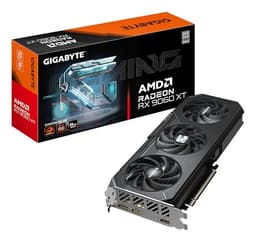
Best Overall: Gigabyte Radeon RX 9060 XT GAMING OC 16G. It delivers modern architecture, a class-leading 16 GB frame buffer and strong 1080p/1440p performance at a price that undercuts many rivals.
Best Value: Gigabyte GeForce RTX 5060 AERO OC 8G. At this price it brings next-generation GDDR7 memory and Ada-successor efficiency to a mainstream price point, making it the smartest buy for those who want future-ready hardware without overspending.
The RX 9060 XT GAMING OC 16G is the card that arguably makes the most compelling case for itself in this entire roundup. Built on AMD's latest RDNA 4 architecture using the Navi 44 GPU, it arrives with a genuinely surprising 16 GB of GDDR6 memory on a 128-bit bus. That memory capacity is the headline story: at a time when 8 GB cards are increasingly struggling with modern game textures at 1440p and beyond, having 16 GB at this price point is a significant advantage.
This card is best suited to gamers who play at 1080p or 1440p and want headroom for the next several years. Content creators who use GPU-accelerated applications will also appreciate the large VRAM pool, which allows larger textures and more complex scene data to be held in memory without spilling to system RAM. The GAMING OC cooler uses a triple-fan configuration with Gigabyte's WINDFORCE technology, keeping thermals well in check even under extended gaming sessions.
Performance-wise, RDNA 4 brings meaningful improvements in rasterisation efficiency over RDNA 3, and AMD's FidelityFX Super Resolution 4 (FSR 4) is now a genuine competitor to Nvidia's DLSS 3, offering machine-learning upscaling that was previously an Nvidia exclusive advantage. Ray tracing performance has also improved considerably versus the previous generation, though it still trails Nvidia's equivalent tier.
The 128-bit memory bus is a point of discussion: in isolation it sounds narrow, but AMD has compensated with a large infinity cache on RDNA 4, which dramatically reduces the effective bandwidth penalty. Real-world benchmarks show the card performing well above what the bus width alone would suggest.
At £499.99, it sits above the RTX 5060 AERO OC but offers double the VRAM, which for many buyers is worth every penny. If you are building a system intended to last four or five years and play demanding open-world titles, the 16 GB buffer is an insurance policy that the 8 GB alternatives simply cannot match.
Verdict: The best all-round Gigabyte card under £500 for gamers who prioritise longevity and VRAM headroom over raw current-generation performance metrics.
Pros
- 16 GB GDDR6 VRAM is class-leading at this price and future-proofs 1440p gaming
- RDNA 4 architecture delivers strong rasterisation and improved ray tracing over RDNA 3
- Triple-fan GAMING OC cooler keeps temperatures low under sustained load
- FSR 4 machine-learning upscaling closes the gap with Nvidia DLSS significantly
Cons
- 128-bit memory bus is narrower than the RTX 3070's 256-bit, which can show in bandwidth-heavy workloads
- AMD software ecosystem (Adrenalin drivers) is less mature than Nvidia's GeForce Experience for some users
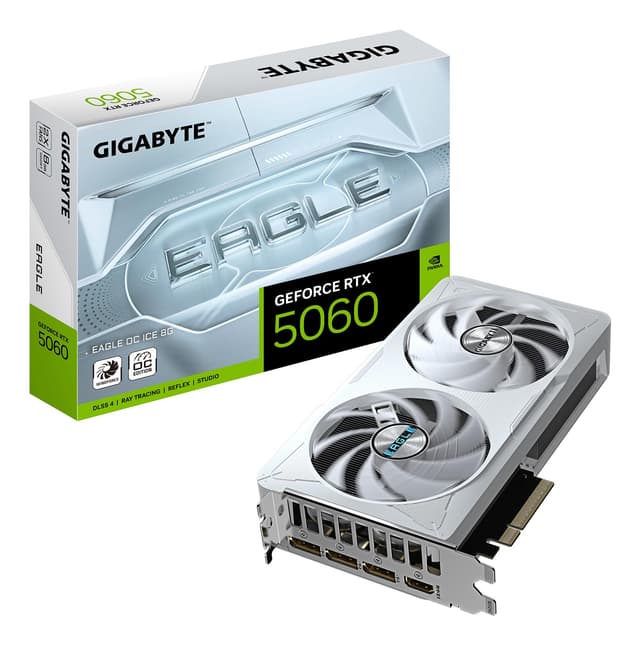
The RTX 5060 AERO OC 8G is one of the first Blackwell-architecture mainstream cards to reach UK retail shelves, and it brings several genuinely new features that set it apart from anything in the Ampere generation. Built on the GB206 GPU using TSMC's 4N process node, it uses 8 GB of GDDR7 memory, which is a first for a mainstream Nvidia card and delivers substantially higher bandwidth per pin than GDDR6.
This card is aimed squarely at 1080p gamers who want the latest technology, DLSS 4 Frame Generation support, and a card that will handle new releases comfortably for the next two to three years. The AERO OC is Gigabyte's mid-tier aesthetic line, featuring a cleaner, more understated look than the AORUS range, with a dual-fan cooler that is compact enough to fit in smaller cases. The card draws around 150 W, making it one of the most power-efficient options in this roundup and suitable for builds with a modest 550 W power supply.
DLSS 4 with Multi Frame Generation is the headline feature: Nvidia's latest upscaling technology can generate multiple frames per rendered frame, dramatically boosting perceived frame rates in supported titles. In practice, this means that in games like Cyberpunk 2077 or Alan Wake 2, the RTX 5060 can deliver frame rates that feel significantly higher than its raw rasterisation performance would suggest. This is a meaningful advantage over the AMD RX 9060 XT, though AMD's FSR 4 has closed the gap considerably.
The 128-bit memory bus is the same width as the RX 9060 XT, and the 8 GB frame buffer is the key limitation here. At 1440p with very high texture settings in demanding titles, 8 GB can be saturated, leading to stuttering. For 1080p gaming, however, 8 GB remains adequate for the vast majority of current titles.
At £533.85, the RTX 5060 AERO OC is the second-cheapest card in this roundup and the best value pick for Nvidia loyalists who want DLSS 4 and the latest architecture without spending close to £500.
Verdict: The best value Gigabyte card in this roundup for Nvidia fans, bringing GDDR7 memory, DLSS 4 and Blackwell efficiency to a mainstream price point.
Pros
- GDDR7 memory delivers higher bandwidth than GDDR6 on a comparable bus width
- DLSS 4 Multi Frame Generation support is exclusive to Blackwell and provides a significant perceived performance boost
- ~150 W TDP makes it one of the most power-efficient cards in this roundup
Cons
- 8 GB VRAM is a limitation at 1440p in texture-heavy titles compared to the RX 9060 XT's 16 GB
- AERO OC dual-fan cooler is less capable than the triple-fan designs on the GAMING OC and AORUS Master
The RTX 3050 WINDFORCE OC V2 6G is the entry-level option in this roundup, and it occupies a very specific niche: the absolute budget end of discrete GPU gaming, office builds that occasionally need to handle light gaming, or HTPC (home theatre PC) setups where power consumption and physical size are priorities. At £238.99, it is by far the most affordable card here, and it reflects that in its specification sheet.
Built on Nvidia's Ampere architecture using the GA107 chip, this V2 revision of the RTX 3050 uses 6 GB of GDDR6 on a 96-bit memory bus. The reduction from the original RTX 3050's 8 GB to 6 GB was a controversial decision by Nvidia, and it does limit the card's longevity in demanding titles. However, for 1080p gaming at medium to high settings in esports titles, older AAA games, and less demanding indie titles, the RTX 3050 V2 performs adequately.
The WINDFORCE OC cooler uses a dual-fan design that is more than sufficient for the card's 70 W TDP, one of the lowest in any discrete gaming card on the market. This means it can be powered entirely from the PCIe slot on some motherboards, though Gigabyte includes a 6-pin power connector for stability. The low power draw makes it ideal for small form factor builds or systems with older, lower-wattage power supplies.
DLSS 2 support is present, which helps the card punch above its weight in supported titles. Ray tracing is technically available but is not a realistic use case at this performance tier: enabling RT in most games will drop frame rates to unplayable levels without heavy DLSS assistance.
The honest assessment is that 6 GB of VRAM on a 96-bit bus is a significant constraint in 2025. Games are increasingly shipping with texture packs that exceed 6 GB, and even at 1080p, some modern titles will stutter when VRAM is exhausted. This card is best suited to buyers on a very strict budget who understand its limitations, or those building a secondary PC for casual use.
Verdict: A capable entry-level card for strict budgets and low-power builds, but the 6 GB VRAM and 96-bit bus mean it will struggle with demanding 2025 titles even at 1080p.
Pros
- 70 W TDP is exceptionally low, making it suitable for small form factor and low-wattage PSU builds
- WINDFORCE dual-fan cooler runs quietly given the low thermal output
Cons
- 6 GB GDDR6 on a 96-bit bus is the most constrained specification in this roundup and limits longevity
- Ampere architecture lacks DLSS 3 Frame Generation and the performance uplift of newer architectures
- Ray tracing is technically supported but practically unusable at this performance level
Buying Guide
Architecture and Generation
Graphics card architecture matters more than raw clock speeds. Nvidia's Blackwell (RTX 50-series) and AMD's RDNA 4 are the current generations, bringing improved efficiency, better ray tracing hardware, and newer upscaling technologies. Ampere (RTX 30-series) cards are now two generations old but remain capable, particularly at 1440p, and have dropped to attractive prices. When buying under £500, you are choosing between a newer, more efficient architecture with fewer raw compute units, or an older, more powerful architecture at a reduced price. For most buyers, the newer generation is the better long-term investment.
VRAM: How Much Do You Actually Need?
This is the most debated specification in 2025. At 1080p with standard settings, 8 GB remains adequate for most current titles. At 1440p with high or ultra texture settings, 8 GB is increasingly tight, with some games exceeding this limit and causing stuttering. The RX 9060 XT's 16 GB is genuinely future-proofing at this price tier. If you play demanding open-world games or plan to keep your card for four or more years, prioritise VRAM capacity.
Memory Bus Width
The memory bus width determines how quickly data can move between the GPU and its VRAM. A 256-bit bus (RTX 3070) provides more bandwidth than a 128-bit bus (RTX 5060, RX 9060 XT), but manufacturers compensate with larger caches and faster memory types. GDDR7 on the RTX 5060 delivers higher per-pin bandwidth than GDDR6, partially offsetting the narrower bus. Do not dismiss 128-bit cards outright, but be aware of the trade-offs.
Power Supply Compatibility
Always check your power supply unit (PSU) wattage before buying. The RTX 3050 V2 at 70 W is the most forgiving, while the RTX 3070 Master at 220 W requires a quality 650 W or higher PSU. Gigabyte recommends specific PSU wattages for each card in the product listing, and it is wise to have at least 100 W of headroom above the recommended figure.
Is Gigabyte Made by Nvidia?
No. Gigabyte is an independent Taiwanese hardware manufacturer that produces graphics cards using GPU chips designed by Nvidia and AMD. Nvidia designs the GPU silicon and sets the reference specifications; Gigabyte (and other add-in board partners such as MSI, ASUS and Sapphire) designs its own PCB, cooler, and factory overclock around that chip. Gigabyte is not owned by or affiliated with Nvidia.
Gigabyte vs MSI: Which is Better?
Both are highly regarded add-in board partners with strong quality control and good warranty support in the UK. Gigabyte's AORUS line competes directly with MSI's Gaming X Trio, and both offer excellent cooling and build quality. Choice between them often comes down to aesthetics, specific cooler performance in independent reviews, and price at the time of purchase. Neither brand is objectively superior across the board.
The overall winner in this roundup is the Gigabyte Radeon RX 9060 XT GAMING OC 16G. Its combination of AMD's latest RDNA 4 architecture, a class-leading 16 GB GDDR6 frame buffer, and a competitive price makes it the most sensible long-term purchase for the majority of UK gamers building or upgrading a system in 2025. The 16 GB VRAM advantage over every other card in this pool is not a marketing gimmick: it is a genuine future-proofing measure that will keep the card relevant as game texture budgets continue to grow. FSR 4's machine-learning upscaling has also significantly closed the software feature gap with Nvidia's DLSS ecosystem.
For buyers who are firmly in the Nvidia camp and want the latest architecture at the lowest possible entry point, the Gigabyte RTX 5060 AERO OC 8G is the best value pick, bringing GDDR7 memory and DLSS 4 Multi Frame Generation to a mainstream price. The RTX 3070 AORUS Master remains a capable card but is difficult to justify at its current price given the newer options available. The RTX 3050 V2 serves a specific budget niche but is not recommended for anyone intending to play demanding modern titles.