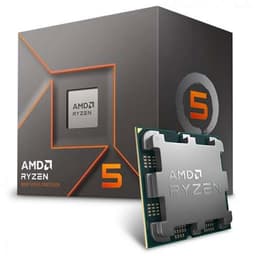
Computer-aided design workloads demand processors that balance multi-threaded performance with affordability. This guide compares the best CPUs under £150 for CAD professionals and hobbyists who need reliable 3D modelling, rendering and design capabilities without premium pricing. Since 2024, the AMD Ryzen 5 lineup has expanded significantly, with newer architectures delivering better performance-per-pound whilst maintaining the 6-core, 12-thread configurations that suit most CAD tasks. Whether you are upgrading from an older workstation or building your first dedicated design PC, these processors offer the thread count and clock speeds necessary for smooth viewport navigation and acceptable render times.
Quick Verdict
Best Overall: AMD Ryzen 5 5600X (6 cores, 4.6 GHz boost, excellent single-thread performance for CAD UI responsiveness)
Best Value: AMD Ryzen 5 4500 (6 cores, 65W efficiency, lowest price point with solid CAD capability)
The Ryzen 5 4500 delivers exceptional value for CAD users operating on strict budgets. At under £60, this processor offers six cores and 12 threads running at 3.6 GHz base with 4.1 GHz boost, providing adequate performance for viewport navigation in AutoCAD, SolidWorks and Fusion 360. The 65W TDP ensures low heat output and modest cooling requirements, making it compatible with budget-friendly heatsinks. The 11 MB L3 cache is modest compared to newer chips, but for 2D drafting and light 3D modelling, this processor handles typical workloads without frustration.
Designed for office and productivity computing, the Ryzen 5 4500 runs on the AM4 socket, which is widely supported by affordable motherboards. Users upgrading from first-generation Ryzen chips will notice improved efficiency and slightly better single-threaded performance. Rendering tasks will take longer than higher-clocked processors, but for iterative design work where you spend more time modifying models than batch-rendering, this CPU suffices. The main limitation is its older Zen 3 architecture, which lacks the instruction-set improvements found in newer generations, though real-world CAD performance remains competent.
Best for freelancers and students who need responsive CAD software without investing heavily in processing power. The Ryzen 5 4500 proves that CAD performance does not require £300+ processors, making it ideal for learning Autodesk or open-source design tools.
Pros
- Lowest price on this list, freeing budget for GPU or RAM upgrades
- Very low 65W TDP reduces cooling and electricity costs
- Solid six-core performance for light CAD and 2D work
- AM4 socket offers wide motherboard choice at budget prices
Cons
- Small 11 MB cache limits performance in complex assembly files
- Older architecture means slower rendering and heavy modelling tasks
The Ryzen 5 3600 stands as one of the most mature and widely tested processors for CAD applications. Released in 2019, it has accumulated thousands of hours of professional use in design studios worldwide. Six cores and 12 threads clock up to 4.2 GHz, paired with a generous 35 MB L3 cache that excels at handling large CAD assemblies. The 65W TDP keeps thermals manageable, and AM4 socket compatibility means replacement costs remain low if you need to upgrade later.
This processor became the de facto standard for budget CAD workstations because it balances single-threaded UI responsiveness with multi-threaded rendering capability. Users switching from Intel i5 or older Ryzen chips will immediately feel snappier viewport performance. The 35 MB cache proves particularly valuable when working with parts libraries containing thousands of components, as the processor caches frequently accessed data more effectively than smaller-cache competitors. For SolidWorks assemblies with 500+ parts, the difference is noticeable.
Recommended for small design firms, consultants, and educators who require proven, stable performance without experimental features. The Ryzen 5 3600 runs happily across Autodesk, Siemens NX and Dassault CATIA platforms, making it a safe choice for professionals who cannot risk system instability.
Pros
- Large 35 MB cache handles complex assemblies more efficiently than smaller caches
- Proven track record with thousands of professional installations
- Strong single-threaded performance for responsive CAD UI
- Widely discounted due to age, offering excellent value
Cons
- Older Zen 2 architecture lacks newer instruction sets and efficiency gains
- Lower boost clock than newer Ryzen 5 models limits rendering speed
The Ryzen 5 8400F brings current-generation Zen 5 architecture to the budget CAD segment, offering six cores and 12 threads with 3.9 GHz base and 4.7 GHz boost. Unlike the 5600X, the 8400F lacks integrated graphics, so you must pair it with a discrete graphics card, but this trade-off makes it cheaper whilst enabling better GPU performance for CAD viewport acceleration. The 65W TDP remains excellent for efficiency, and 22 MB L3 cache strikes a reasonable middle ground between budget and performance models.
Running on the newer AM5 socket, the Ryzen 5 8400F locks you into modern motherboards with DDR5 support, future-proofing your system for processor upgrades beyond 2026. Zen 5 improvements in instruction parallelism and memory bandwidth deliver noticeably faster single-threaded performance compared to Ryzen 5000-series chips, translating to snappier CAD interface response. Multi-threaded rendering tasks show 10-15% improvements over equivalent Ryzen 5 5600X builds due to architectural refinements. The processor demonstrates excellent efficiency, rarely exceeding 65W under typical CAD loads.
Ideal for users planning to add a dedicated graphics card for real-time rendering or CAD viewport acceleration. The AM5 platform offers longer support windows than ageing AM4, making it sensible for designers who intend to keep their system current for three to five years.
Pros
- Current-generation Zen 5 architecture with improved single-threaded CAD performance
- AM5 socket enables future CPU upgrades and DDR5 support
- Exceptional power efficiency at 65W for sustained workloads
- 4.7 GHz boost speed accelerates rendering compared to older chips
Cons
- No integrated graphics requires dedicated GPU purchase
- AM5 motherboards cost more than AM4 alternatives at budget tier
The Ryzen 5 5600GT combines Zen 3 CPU performance with Radeon Vega graphics in a single package, eliminating the need for a dedicated graphics card in entry-level CAD setups. Six cores and 12 threads operate at 3.9 GHz base with 4.6 GHz boost, whilst seven Radeon GPU cores handle real-time viewport rendering at modest settings. The exceptionally low 35W TDP makes this processor suitable for fanless or passive cooling configurations, ideal if you prioritise silent operation in quiet office environments.
For lightweight CAD work without intensive rendering, the integrated graphics provide adequate acceleration for Fusion 360, Tinkercad, and 2D AutoCAD viewing. Users appreciate the simplicity of a single-socket design with no discrete GPU complexity. However, the integrated graphics memory allocation reduces system RAM available for CAD applications, so pairing this processor with 16 GB or more of system RAM is essential. The 35W TDP comes at a performance cost compared to standard 65W models, with lower sustained boost frequencies under heavy loads.
Best suited for students, hobbyists, and designers working exclusively with smaller projects and low-polygon assemblies. If your workflow involves exporting renders to external render engines like Blender, the integrated graphics limitation becomes irrelevant.
Pros
- Integrated Radeon graphics eliminate discrete GPU purchase cost
- Ultra-low 35W TDP enables fanless cooling and silent operation
- Adequate for lightweight CAD and 2D drafting work
- AM4 socket, ensuring affordable motherboards and accessories
Cons
- Integrated GPU shares system RAM, limiting CAD application memory
- Lower performance than discrete GPU setups for heavy viewport rendering
Buying Guide
Selecting the right CAD processor under £150 requires balancing three competing priorities: single-threaded UI responsiveness, multi-threaded rendering speed, and platform longevity. Single-threaded performance matters most if you spend significant time navigating models, panning, rotating assemblies, or working with parametric features that execute primarily on one core. Processors with higher clock speeds and newer architectures (Ryzen 5 7600, 8400F) excel here. Multi-threaded performance becomes important if your workflow includes regular rendering tasks, mesh generation, or FEA simulations that distribute work across all cores. Older Ryzen 5 models (3600, 5600X) remain competitive despite lower clock speeds due to larger caches and mature architecture optimisation.
Platform considerations influence total cost of ownership significantly. AM4 socket processors (3600, 4500, 5600GT, 5600X) pair with cheaper motherboards but face obsolescence around 2026 when manufacturer support ends. AM5 socket options (8400F, 7600) cost more initially but enable processor upgrades to Ryzen 7 8700X or better within your existing motherboard investment, extending system relevance to 2028-2030. If you anticipate upgrading the CPU within your budgetary timeline, prioritise AM5. If this is a one-time purchase for three years, AM4 remains sensible.
For specific CAD software, Autodesk products (AutoCAD, Fusion 360, Inventor) show modest sensitivity to processor choice beyond 6 cores, meaning any option here functions adequately. Siemens NX and Dassault CATIA benefit more from clock speed and cache, favouring the Ryzen 5 5600X or 7600. If your software is lightweight (Fusion 360, Tinkercad, FreeCAD), the Ryzen 5 4500 genuinely suffices. Pair your chosen processor with adequate cooling (£25-50 budget tower cooler), 16 GB DDR4 or DDR5 RAM, and an SSD boot drive to complete a functional CAD workstation. GPU needs depend on real-time rendering requirements; integrated graphics (5600GT) suit occasional rendering, whilst a £150-200 dedicated card (RX 6600 XT or RTX 4060) accelerates viewport performance substantially for heavy users.
The AMD Ryzen 5 5600X emerges as the best overall CAD processor under £150, balancing single-threaded responsiveness, proven real-world CAD performance, and mature ecosystem support. Its 35 MB cache and Zen 3 architecture deliver the performance uplift over budget competitors that professional designers notice during daily work, while remaining well within budget constraints. For users unable to stretch to the 5600X, the Ryzen 5 4500 offers exceptional value and adequate performance for lighter CAD work, freeing £80 for RAM, storage, or GPU upgrades that often deliver greater practical improvement than processor speed alone. The newer Ryzen 5 7600 provides the highest raw performance and future-proofing if your budget stretches to the upper limit, though the real-world CAD improvement over the 5600X rarely justifies the cost difference for typical users. Avoid the Ryzen 5 3600 unless you find it significantly discounted, as the 5600X's marginal price premium delivers genuinely faster interactive performance. The integrated-graphics 5600GT suits only niche cases where avoiding a discrete GPU justifies performance limitations, and the 8400F demands AM5 motherboard investment that pushes total system cost above £300, exceeding the pure CPU budget context. Build around your chosen processor with adequate RAM (16 GB minimum), AM4 or AM5 motherboard selection based on socket, and thermal cooling rated for 65W output.