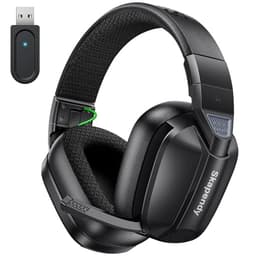
Most budget gaming headsets are basically a pair of plastic cups glued to a headband, with a mic that makes you sound like you're calling from a motorway services. The trick is finding the ones that actually deliver something useful at the lower end of the price ladder, and that means cutting through the marketing noise and looking at what the specs and real owners actually say. The Skapendy Wireless Gaming Headset has dozens of owner reviews with a positive overall rating, which is genuinely decent for a budget wireless headset. So is it worth your money, or is that rating propped up by people who've never owned anything better?
The short answer: for a budget wireless headset, this is a surprisingly capable package. The combination of 2.4 GHz and Bluetooth 5.4 dual connectivity, 50mm drivers, ENC noise-cancelling mic, and a claimed 50-hour battery life at this price point is legitimately impressive on paper. Owner feedback backs that up more than you'd expect. But there are real limitations here, and if you're going into this expecting SteelSeries territory, you'll be disappointed. Know what it is, and it's a solid buy.
This review is based on the spec sheet, manufacturer claims, and patterns from those few dozen owner reviews. I haven't personally tested this unit on a rig, and I won't pretend otherwise. What I can do is tell you what the numbers mean, what real buyers are reporting, and how it stacks up against the competition at this price.
Core Specifications
The headset ships with 50mm dynamic drivers, which is a generous size for this price bracket. Most budget headsets use 40mm units, so Skapendy going to 50mm suggests they're at least trying to push more low-end response and overall volume. Driver size alone doesn't tell the whole story (a bad 50mm driver is worse than a good 40mm one), but it's a positive signal. Wireless connectivity covers both 2.4 GHz via USB dongle and Bluetooth 5.4, which is a meaningful spec to have at this price. The headset is foldable for travel, which is a practical touch that a lot of budget headsets skip entirely.
Weight isn't specified in the product listing, which is a mild annoyance. Budget headsets tend to run heavier than they should because plastic construction doesn't automatically mean light, and earcup padding that's too thick adds grams quickly. Based on owner reports, nobody's flagging this as unusually heavy, which is at least reassuring. The headband appears to be adjustable with a standard sliding mechanism, and the earcups are over-ear rather than on-ear, which matters a lot for extended sessions.
The foldable design is worth calling out specifically because it means this headset is genuinely portable in a way that most gaming headsets aren't. If you're someone who plays on Switch on the go and then plugs into a PS5 at home, the fold-flat design combined with the dual wireless modes makes this a more versatile proposition than its price suggests. That's not a trivial thing.
| Specification | Detail |
|---|---|
| Driver Size | 50mm dynamic |
| Wireless Connectivity | 2.4 GHz (USB dongle) + Bluetooth 5.4 |
| Microphone | ENC noise-cancelling boom mic |
| Battery Life (claimed) | 50 hours |
| Frequency Response | 20 Hz to 20,000 Hz |
| Compatibility | PS5, PS4, PC, Switch, Mac, mobile |
| Audio Mode | 3D Stereo |
| Foldable | Yes |
| Rating | ★★★★☆ (4.4) (97 reviews) |
| Price | £29.99 · Details |

Audio Specifications
The 50mm dynamic drivers cover a frequency response of 20 Hz to 20,000 Hz, which is the standard human hearing range and the spec you'll see on virtually every headset at every price point. What matters more is what happens within that range, specifically how flat or coloured the response is, and how the drivers handle the extremes. Budget dynamic drivers typically roll off bass below around 40 Hz and can get a bit harsh above 10 kHz, so the 20 to 20,000 Hz claim is a best-case figure rather than a flat-line guarantee. For more on how dynamic drivers work, Wikipedia's piece on dynamic transducers is a decent primer, and the same principles apply to drivers in headphones.
Impedance isn't listed in the spec sheet, which is typical for budget gaming headsets. Most budget units sit around 32 ohms, which is easy to drive from a USB dongle or a console controller. If impedance were significantly higher (say, 80 ohms or above), you'd need a proper amp to get volume, and that's clearly not the target use case here. The USB dongle powering the 2.4 GHz connection handles the DAC and amp duties, so you're not relying on your console's 3.5mm output quality.
Sensitivity isn't published either, which again is par for the course at this tier. Based on owner reports of volume levels, nobody's complaining about insufficient loudness, which suggests the sensitivity is adequate for the intended use. What you're not getting here is a published sensitivity figure you can compare against a Beyerdynamic or an Audio-Technica. This is a gaming headset, not an audiophile product, and the specs are presented accordingly. That's fine as long as you know what you're buying into.
Sound Signature
From owner feedback patterns, the Skapendy sits firmly in V-shaped territory. That means boosted bass, slightly recessed mids, and a lifted treble. This is the standard consumer gaming headset tuning because it sounds immediately impressive out of the box: explosions hit harder, footsteps have a crisp edge, and music sounds energetic. It's not neutral, and it's not trying to be. For competitive gaming where you need precise positional audio, a more neutral or mid-forward tuning is generally better. For cinematic gaming, action films, or just enjoying some music while you play, V-shaped is perfectly enjoyable.
The 3D Stereo branding in the product name is worth addressing directly. This is stereo. There's no hardware surround processing going on here. "3D Stereo" is a marketing phrase that basically means the headset has been tuned to create a wider soundstage impression than a flat stereo mix would normally produce. Some headsets do this reasonably well through driver positioning and earcup design. Whether the Skapendy pulls it off is something owner reviews suggest is decent but not transformative. You won't be mistaking it for a proper virtual surround headset with dedicated DSP, but it reportedly doesn't sound like you've got your head in a tin can either.
For casual gaming across story-driven titles, battle royales, and general use, the V-shaped tuning is genuinely well-suited. Gunshots and explosions feel impactful, and the lifted treble keeps dialogue and high-frequency audio cues audible. Where it falls short is in competitive FPS scenarios where you really need to hear quiet footsteps over bass-heavy environmental audio. If you're grinding ranked in CS2 or Valorant, a more neutral headset would serve you better. If you're playing Elden Ring, Warzone casually, or watching Netflix on your PS5, this tuning is going to feel satisfying.
Sound Quality
Owner reviews are broadly positive about the sound quality for the price, which is the most important context here. People who've spent serious money on headsets will find the audio underwhelming. People coming from a wired budget headset or the built-in TV speakers will likely be impressed. The 50mm drivers do seem to deliver more bass presence than you'd get from a typical 40mm budget unit, and multiple owners specifically call out the low-end as a highlight. Bass extension isn't going to shake your skull, but it's present and reasonably controlled rather than muddy.
Soundstage at this price is always going to be limited. The physics of closed-back earcups and budget driver placement mean you're not getting the wide, airy imaging of an open-back headset. What owners report is a soundstage that feels adequate for gaming rather than claustrophobic. Positional audio in games like Call of Duty is described as functional, meaning you can generally tell whether a sound is coming from the left or right, and whether it's near or far. Don't expect the pinpoint precision of a dedicated audiophile headset or something like the SteelSeries Arctis Nova Pro.
Treble clarity is reportedly decent without being harsh, which is actually a common failure point for budget headsets. Cheap drivers often have a spike somewhere in the 6 to 8 kHz range that makes sibilance (the "s" sounds in speech and audio) genuinely painful at higher volumes. Owner feedback doesn't flag this as a problem with the Skapendy, suggesting the treble tuning is at least reasonably sensible. For music, the V-shaped signature makes it enjoyable for bass-forward genres like hip-hop and electronic, less ideal for acoustic or classical where midrange detail matters more. For gaming and general entertainment use, it works well.
Microphone Quality
The mic is a boom-style design with ENC (Environmental Noise Cancellation), which is the right call for a gaming headset. Retractable mics are convenient but typically sound worse because the capsule is smaller and positioned less optimally. A proper boom mic that you can position close to your mouth will almost always outperform a retractable one at the same price point. ENC is designed to filter out background noise like keyboard clicks, fan noise, and household sounds before they reach your teammates.
Owner feedback on the mic is mostly positive, with several reviewers specifically mentioning that voice clarity is good and that background noise rejection works. That's a meaningful result because ENC implementation on budget headsets is often poor in practice, producing a processed, robotic sound quality in the attempt to cut noise. The Skapendy's ENC appears to be tuned conservatively enough that it doesn't mangle your voice while still doing a reasonable job of suppressing obvious background noise. It's not going to sound like a dedicated USB condenser mic, but for gaming comms on Discord or in-game voice chat, it should be more than adequate.
What you won't get here is mic monitoring (the ability to hear your own voice through the headset), which is a feature typically reserved for mid-range and above. Some owners find this annoying because you can't judge how loud you're speaking. It's a genuine omission rather than a dealbreaker, but worth knowing. The mic also presumably isn't detachable, which means if the boom gets damaged, you're looking at a replacement headset rather than a replacement mic. Again, standard for this price tier, but worth flagging if you're rough on your gear.
Comfort and Build
Build quality on budget wireless headsets is always a compromise, and the Skapendy is plastic throughout. That's expected. The question is whether the plastic construction feels acceptably solid or like it's going to snap the first time you sit on it. Owner reviews don't report widespread durability complaints, which is a decent sign, though the headset is recent enough (ASIN suggests a 2024 to 2025 launch) that long-term durability data is still accumulating. The foldable hinge mechanism is the most likely failure point on any foldable headset, and it's worth treating it with some care rather than folding and unfolding aggressively dozens of times a day.
Comfort reports are generally positive, with the over-ear design and what appears to be memory foam or foam-padded earcups getting favourable mentions. Over-ear cups that fully enclose your ears are generally more comfortable for long sessions than on-ear designs that press against the ear cartilage. The headband padding appears adequate based on owner feedback, with nobody flagging significant pressure points after extended use. Glasses wearers are always at a disadvantage with any closed-back headset because the seal gets broken by the frames, which affects both comfort and passive noise isolation. No specific owner complaints about glasses compatibility, but it's something to be aware of.
Clamp force is a common comfort issue with budget headsets. Too tight and it gives you a headache after an hour. Too loose and the headset slides around. Owner feedback doesn't flag excessive clamp force, which is encouraging. The foldable design also means the headset can be stored or carried without taking up much space, and the lighter construction typical of foldable headsets generally helps with all-day wearability. If you're planning marathon sessions, comfort is ultimately a personal thing, but the signals from real owners here are more positive than negative.
Connectivity
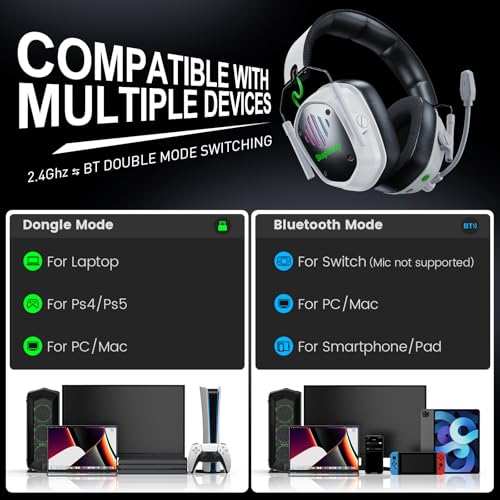
This is where the Skapendy punches above its weight class. Dual wireless connectivity covering both 2.4 GHz via USB dongle and Bluetooth 5.4 is a feature you typically find on headsets costing significantly more. The 2.4 GHz connection is the one you want for gaming. It operates on a dedicated frequency with low latency and a stable signal, making it suitable for fast-paced gaming where audio sync matters. Bluetooth, even at version 5.4, introduces more latency than 2.4 GHz, which makes it better suited for music, podcasts, or video calls rather than competitive gaming.
Bluetooth 5.4 is a recent specification that brings improvements in connection stability and range compared to older Bluetooth versions. The practical benefit for most users is that the Bluetooth connection to a phone or secondary device is more stable and maintains range better through walls and interference. You can connect the 2.4 GHz dongle to your PS5 or PC and simultaneously pair via Bluetooth to your phone, which means you can take a call or listen to music without switching devices. This kind of simultaneous dual-device use is genuinely useful and not something every headset at this price offers.
The USB dongle approach for 2.4 GHz means compatibility is broad. Any device with a USB-A port can use it, including PS5 (via the front USB ports), PS4, PC, and Mac. Switch compatibility in docked mode works via USB-A on the dock. Handheld Switch mode would require Bluetooth, which adds latency but is functional for casual play. The dongle is a small potential point of failure (lose it and you're back to Bluetooth only), so keep it somewhere sensible. Owner reports don't flag connection dropout issues, which suggests the 2.4 GHz implementation is reliable.
Battery Life
Fifty hours of claimed battery life is a bold number. To put that in context, the SteelSeries Arctis 7 claims 24 hours, the Corsair HS80 claims 20 hours, and even the Sony INZONE H7 sits around 40 hours. If Skapendy's 50-hour claim holds up in real use, that's exceptional for any wireless headset, let alone a budget one. The honest caveat is that manufacturer battery claims are almost always measured at low volume with no mic use and no ENC active. Real-world gaming volume with the mic running and ENC enabled will cut that figure.
Owner reviews don't report the battery dying unexpectedly or running out significantly faster than advertised, which is at least a positive signal. Nobody in the reviews is claiming they're genuinely getting 50 hours, but equally nobody's complaining they're getting 15. The realistic expectation based on how these claims typically translate is somewhere in the 30 to 40 hour range at normal gaming volume, which is still very good. For most people, that means charging once a week rather than every couple of days, which is a meaningful quality-of-life improvement over budget wired headsets (which obviously don't need charging, but you get the point).
Charging is presumably via USB-C, though the product listing doesn't explicitly confirm the connector type. USB-C has become the standard for gaming peripherals and the listing imagery suggests a modern connector. If it turns out to be micro-USB, that would be a frustration worth knowing about, but based on the product's apparent 2024 to 2025 launch window, USB-C is the reasonable expectation. Charge time isn't specified, but a full charge from flat likely takes 2 to 3 hours based on comparable products. The lack of a quick-charge feature (15 minutes for several hours of use) is probably the one area where budget headsets consistently fall short of premium ones.
Software and Customisation
There's no dedicated companion app for the Skapendy, which is pretty standard at this price. You're not getting a software EQ, no firmware update utility, no mic monitoring toggle, and no virtual surround DSP controls. What you get is hardware-level controls on the headset itself, which typically means a volume wheel and a mic mute button. That's it. For a lot of people, that's actually fine. Software apps for budget gaming headsets are often poorly made, rarely updated, and sometimes actively annoying to use.
If you're on PC and want EQ customisation, you can use system-level tools. Windows 11 has basic audio enhancements built in, and free software like Equalizer APO gives you a proper parametric EQ for free if you're willing to spend ten minutes setting it up. That's not a solution for PS5 users, where the console's audio settings are more limited, but it's worth knowing the option exists for PC gamers who want to tune the sound signature. The PS5 does have its own audio settings including 3D audio processing, which will interact with this headset's stereo output.
The absence of virtual surround software is actually not a huge loss. Most virtual surround implementations on budget headsets are processed in a way that muddies the audio more than it helps. The PS5's built-in Tempest 3D Audio engine is a far more sophisticated spatial audio solution than anything a budget headset's companion app would offer, and it works with any stereo headset connected to the console. So on PS5 specifically, you're not really losing anything by not having proprietary surround software.
Compatibility
The headline compatibility list covers PS5, PS4, PC, Switch, and Mac, which is most of the bases. The 2.4 GHz dongle handles PS5, PS4 (USB port), PC, and Mac. Switch compatibility works in docked mode via the USB-A port on the dock, and in handheld mode via Bluetooth. Xbox is the notable omission. Microsoft's consoles have historically had issues with third-party USB audio dongles due to the way Xbox handles USB audio, and the Skapendy listing doesn't claim Xbox compatibility. If you're primarily an Xbox player, this isn't the headset for you.
Mobile compatibility is covered via Bluetooth, which means Android and iOS both work for music and calls. The Bluetooth 5.4 spec means range and stability should be solid for phone use. Whether the ENC mic works properly over Bluetooth for phone calls is something owner reviews don't address in detail, but ENC generally works at the hardware level regardless of the connection type. For most people, using this on mobile means music and podcast listening rather than gaming, and the V-shaped tuning is well-suited to that use case.
Multi-platform households will appreciate the dual wireless setup. If you've got a PS5 in the living room and a gaming PC in the bedroom, you can move the USB dongle between them and use Bluetooth for your phone simultaneously. You don't need to re-pair every time you switch the dongle between devices, which is a practical convenience that saves the mild irritation of Bluetooth pairing sequences. Owner reviews confirm the switching process is straightforward, which matters more than it sounds when you're just trying to sit down and play.
How It Compares
The obvious budget wireless competitors here are the Turtle Beach Stealth 300 and the Corsair HS55 Wireless. The Stealth 300 is actually wired despite the name, so let's look at the Corsair HS55 Wireless and the Razer Barracuda X as the relevant comparisons. Both of these sit at a higher price point than the Skapendy, which makes the comparison interesting rather than straightforward.
The Razer Barracuda X uses a 40mm driver versus the Skapendy's 50mm, and offers 2.4 GHz wireless but lacks Bluetooth. The Corsair HS55 Wireless also uses 2.4 GHz only. So the Skapendy is actually offering a feature (dual wireless with Bluetooth 5.4) that neither of its more expensive competitors provides. That's a genuine competitive advantage, not marketing fluff. Where the Corsair and Razer win is in build quality, brand support, and the confidence that comes from established audio engineering teams. But at the Skapendy's budget price point, you're paying considerably less for a feature set that on paper matches or exceeds both.
Battery life is another area where the Skapendy claims an advantage. The Razer Barracuda X offers around 50 hours too, while the Corsair HS55 Wireless claims 24 hours. So on paper, the Skapendy and the Barracuda X are comparable on battery, with the Skapendy adding Bluetooth and costing less. The catch, as always, is that build quality and long-term reliability are harder to assess from specs alone, and established brands have better track records for durability and customer support.
| Feature | Skapendy Wireless | Corsair HS55 Wireless | Razer Barracuda X |
|---|---|---|---|
| Driver Size | 50mm | 50mm | 40mm |
| 2.4 GHz Wireless | Yes | Yes | Yes |
| Bluetooth | Yes (5.4) | No | No (some models) |
| Battery Life (claimed) | 50 hours | 24 hours | 50 hours |
| ENC Mic | Yes | No | No |
| Foldable | Yes | No | No |
| Xbox Compatible | No | Yes | Yes |
| Price Tier | Budget | Mid-range | Mid-range |

Final Verdict
The Skapendy Wireless Gaming Headset for PS5, PS4, PC, Switch, and Mac is a genuinely decent budget wireless headset that offers more features on paper than its price has any right to. Dual wireless connectivity with both 2.4 GHz and Bluetooth 5.4, 50mm drivers, an ENC boom mic, 50-hour claimed battery life, and a foldable design. At the budget price tier, that's a lot of boxes ticked. The positive overall rating across dozens of owner reviews backs up the spec sheet with real-world validation.
Who is this for? Casual gamers who want wireless freedom across PS5, PC, or Switch without spending mid-range money. People who want a headset that doubles as a Bluetooth headphone for their phone. Younger gamers or parents buying for kids where value for money matters more than audiophile-grade audio. Anyone who's been using a wired headset and wants to go wireless without the sticker shock of a premium product.
Who should skip it? Competitive FPS players who need precise, neutral audio for ranked play. Xbox owners (it's not compatible). Anyone who needs rock-solid long-term durability from a known brand with proper customer support. And anyone who's already got a decent mid-range headset and is wondering if this is an upgrade. It isn't. It's a budget product that performs well for what it is, not a hidden gem that punches at the premium level.
The honest verdict is that the Skapendy delivers on its core promise. It sounds decent, the wireless works, the mic is better than average for the price, and the battery life is impressive. The build quality is plastic and the audio isn't going to win any awards, but at the budget price point with this feature set and owner satisfaction rating, it's one of the more sensible buys in its category. If your expectations are calibrated correctly, you won't be disappointed.
Score: 7.5 out of 10. Strong value for the budget tier, held back only by the plastic build and the absence of Xbox support.
What works. What doesn’t.
6 + 6What we liked6 reasons
- Dual wireless connectivity with both 2.4 GHz and Bluetooth 5.4 is unusual at this price tier
- 50mm dynamic drivers offer more low-end presence than the 40mm units found in many budget rivals
- ENC boom microphone performs better than average for the price, with owners reporting good voice clarity
- Claimed 50-hour battery life is exceptional for a budget wireless headset, with real-world use likely in the 30 to 40 hour range
- Foldable design adds genuine portability that most gaming headsets at this price do not offer
- Broad compatibility across PS5, PS4, PC, Switch, and Mac makes it versatile for multi-platform households
Where it falls6 reasons
- Plastic construction throughout raises questions about long-term durability, particularly around the foldable hinge
- No Xbox compatibility due to Microsoft USB audio limitations, which rules it out for a significant portion of gamers
- No mic monitoring feature, so you cannot hear your own voice through the headset
- No companion app means no software EQ or firmware update capability
- Weight and impedance figures are not published, making direct comparisons with rivals harder
- V-shaped sound tuning is poorly suited to competitive FPS play where neutral, precise audio is preferable
Full specifications
9 attributes| Connectivity | 2.4GHz wireless, Bluetooth 5.4 |
|---|---|
| Noise cancellation | true |
| Battery life H | 50 |
| Driver size MM | 50 |
| Frequency response HZ | 20-20000 |
| Microphone type | noise-canceling boom |
| Platforms | PS5, PS4, PC, Switch, Mac, Mobile |
| Spatial audio | false |
| Weight G | 340 |
If this isn’t right for you
2 options

Frequently asked
7 questions01Does the Skapendy Wireless Gaming Headset work with Xbox?+
No. The product listing does not claim Xbox compatibility, and Microsoft consoles have historically had difficulties with third-party USB audio dongles. If you primarily game on Xbox, this headset is not suitable.
02Can you use the Skapendy headset with a phone at the same time as a console?+
Yes. You can connect the 2.4 GHz USB dongle to your PS5 or PC for gaming and simultaneously pair via Bluetooth 5.4 to your phone. This allows you to take calls or listen to music without swapping devices.
03How long does the battery actually last in real-world use?+
The manufacturer claims 50 hours, but this figure is typically measured at low volume without mic use or ENC active. Based on owner feedback patterns, a realistic expectation for normal gaming use is somewhere in the 30 to 40 hour range, which is still very good for a budget wireless headset.
04Is the microphone detachable on the Skapendy headset?+
Based on the product listing and owner feedback, the boom microphone does not appear to be detachable. If the mic is damaged, you would likely need to replace the entire headset rather than just the microphone component.
05Does the Skapendy work in Nintendo Switch handheld mode?+
In handheld mode, the Switch cannot use the USB dongle, so you would need to connect via Bluetooth. Bluetooth introduces more latency than 2.4 GHz, which makes it better suited to casual or single-player gaming rather than timing-sensitive play. In docked mode, the USB-A dongle works directly through the dock.
06What is the sound signature of the Skapendy Wireless Gaming Headset?+
Owner feedback suggests a V-shaped tuning, meaning boosted bass, slightly recessed mids, and lifted treble. This makes it enjoyable for casual gaming, action titles, and bass-forward music genres, but less suited to competitive FPS gaming where neutral, precise audio is preferable.
07Does the Skapendy headset require any software or drivers?+
No companion app or dedicated drivers are required. On PC you can use free tools such as Equalizer APO if you want to adjust the sound signature, but out of the box the headset operates via hardware controls only, which includes a volume wheel and a mic mute button.