Competitive FPS gaming places very specific demands on a graphics card. Unlike cinematic single-player titles, games such as Counter-Strike 2, Valorant, Apex Legends and Rainbow Six Siege reward raw frame rates above all else. Hitting 144 fps, 240 fps or beyond on high-refresh monitors requires a card that can push through geometry-heavy scenes at lower resolutions without becoming VRAM-starved or thermally throttled mid-match. Since last year, the landscape has shifted considerably: NVIDIA's RTX 50-series cards have arrived with GDDR7 memory and improved rasterisation, while AMD's RDNA 4 architecture, headlined by the RX 9070 XT, delivers exceptional 1080p and 1440p frame rates at a price point that undercuts the green team's comparable offerings. The graded market has also matured, making last-generation powerhouses genuinely compelling for budget-conscious players. Whether you are building a dedicated 1080p rig for maximum refresh rates, stepping up to 1440p for a sharper image without sacrificing frames, or future-proofing with a card that handles 4K when the ranked session ends, this guide covers five carefully chosen options across the price spectrum.
Quick Verdict
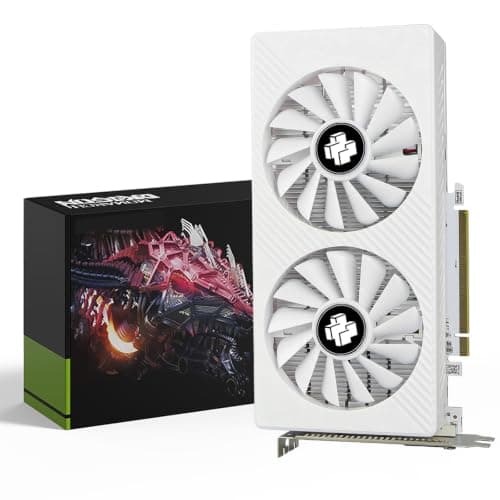
Best Overall: XFX Mercury Radeon RX 9070 XT OC Magnetic Air Edition. RDNA 4 architecture, 16 GB GDDR6 and outstanding competitive FPS frame rates at 1080p and 1440p make it the strongest all-round pick for serious players.
Best Value: ASUS DUAL RTX 4060 8 GB OC (Graded). At its graded price point it delivers smooth 1080p competitive performance and pairs well with 144 Hz monitors without breaking the bank.
The XFX Mercury Radeon RX 9070 XT OC is the card to beat for competitive FPS gaming in 2025. Built on AMD's RDNA 4 architecture using the Navi 48 die, it represents a generational leap over RDNA 3 in both raw rasterisation throughput and power efficiency. For the player whose monitor runs at 1440p 165 Hz or above, this card consistently delivers frame rates that saturate even the most demanding high-refresh panels in titles like Counter-Strike 2, Apex Legends, Valorant and Overwatch 2.
The headline figure is the 16 GB of GDDR6 memory on a 256-bit bus. While competitive FPS titles rarely consume more than 8 GB at 1440p today, that headroom matters as texture quality creeps upward with game updates, and it also means the card handles 4K gaming sessions comfortably when you step away from ranked play. The XFX OC edition pushes the boost clock to approximately 2970 MHz, which is notably higher than reference, translating into a measurable uplift in minimum frame rates, the figure that truly determines whether your aim feels consistent.
The Magnetic Air Edition cooler is a dual-fan design with a magnetic fan attachment system that makes cleaning trivial, a practical benefit for any PC that runs long gaming sessions. Thermal performance is excellent: under sustained load in CS2 at 1440p, temperatures sit comfortably below 80°C, and the fans remain inaudible at desktop idle. The card draws around 304 W under load, so a 750 W PSU is the sensible minimum.
AMD's FSR 4 upscaling is available for titles that support it, and while competitive players rarely need upscaling at 1080p or 1440p, it provides a safety net for more demanding open-world titles. DisplayPort 2.1 output means the card is ready for next-generation monitors without any adapter fuss. At its price point it undercuts NVIDIA's Blackwell alternatives that offer comparable rasterisation performance, making it the strongest value proposition in the high-performance tier for pure FPS use.
Verdict: The best graphics card for competitive FPS gaming available right now, combining RDNA 4 rasterisation, generous VRAM, an excellent cooler and a price that sits below comparable NVIDIA Blackwell cards.
Pros
- RDNA 4 architecture delivers class-leading 1440p FPS frame rates for the price
- 16 GB GDDR6 on a 256-bit bus provides long-term headroom well beyond current competitive titles
- Magnetic fan design simplifies maintenance during heavy gaming use
- DisplayPort 2.1 output supports next-generation high-refresh monitors natively
Cons
- Requires a 750 W or higher PSU, which adds cost to budget builds
- AMD's software ecosystem and driver maturity still lags NVIDIA for some overlay and capture tools
Buying Guide
Resolution and refresh rate targets
The single most important question before choosing a graphics card for competitive FPS gaming is: what resolution and refresh rate does your monitor run at? A 1080p 144 Hz monitor has very different GPU requirements from a 1440p 240 Hz panel. At 1080p 144 Hz, a card like the RTX 4060 is genuinely sufficient for most competitive titles. At 1440p 165 Hz, you need something closer to the RTX 4070 SUPER or RX 9070 XT to avoid frame-rate drops below the monitor's refresh rate in busy scenes. At 1440p 240 Hz or above, only the top-tier cards in this guide will reliably saturate the panel in demanding titles. Buying a card that outpaces your monitor's refresh rate is wasted money; buying one that cannot reach it means you are leaving performance on the table.
VRAM: how much do you actually need?
For competitive FPS titles at 1080p in 2025, 8 GB of VRAM is the practical minimum. Most competitive titles are optimised to run within this budget at medium-to-high settings. At 1440p, 12 GB is the comfortable minimum, with 16 GB providing meaningful headroom for future title updates and texture quality improvements. The memory bus width matters as much as capacity: a 128-bit bus with 8 GB is noticeably slower than a 192-bit or 256-bit bus with the same capacity, which can introduce micro-stutters in texture-streaming scenarios. If you are choosing between two cards with the same VRAM but different bus widths, favour the wider bus for competitive play.
Power supply requirements
Modern high-performance graphics cards draw significantly more power than their predecessors. An RTX 5070 Ti at 285 W requires a quality 750 W PSU with a 16-pin or dual 8-pin connector. Budget cards like the RTX 4060 at 115 W are compatible with 550 W units. Always check the card's TDP against your PSU's rated output and leave at least 100-150 W of headroom for the rest of the system. Using an underpowered PSU with a high-end GPU is a common cause of instability and crashes during gaming sessions.
Graded cards: are they worth buying?
Graded graphics cards offer genuine value for competitive FPS players who prioritise performance per pound over having a brand-new product. A graded card from a reputable retailer has been tested to confirm it functions correctly, and most come with a warranty of at least 90 days, sometimes longer. The primary risks are cosmetic wear and a shorter warranty compared to new cards. For a card that lives inside a closed case, cosmetic wear is irrelevant. Always verify the warranty terms and the retailer's returns policy before purchasing a graded card.
AMD vs NVIDIA for competitive FPS
Both AMD and NVIDIA produce excellent competitive FPS cards in 2025. NVIDIA's advantages include DLSS 4 with Multi Frame Generation, NVIDIA Reflex 2 for latency reduction, and a more mature software ecosystem for streaming and capture. AMD's advantages include generally better rasterisation performance per pound at the high-performance tier, FSR 4 upscaling (which works in any game regardless of developer support), and DisplayPort 2.1 on RDNA 4 cards. For pure frame-rate performance at a given price, RDNA 4 is highly competitive. For players who rely on NVIDIA-specific features, the green team remains the natural choice.
For competitive FPS gaming in 2025, the XFX Mercury Radeon RX 9070 XT OC Magnetic Air Edition is the overall winner. RDNA 4 architecture delivers the frame rates that matter, the 16 GB GDDR6 on a 256-bit bus provides genuine long-term headroom, and the price undercuts comparable NVIDIA Blackwell alternatives. It is the card that best satisfies the core requirement of competitive FPS gaming: maximum, consistent frame rates at 1440p, without compromise. Players who are deeply invested in the NVIDIA ecosystem and specifically want DLSS 4 with Multi Frame Generation and NVIDIA Reflex 2 should look at the Gigabyte RTX 5070 Ti GAMING OC as the best NVIDIA alternative. For 1080p players on a budget, the graded ASUS DUAL RTX 4060 8 GB OC remains a compelling, practical choice that delivers everything a 144 Hz competitive player needs without unnecessary expenditure.