Sciatica turns a long gaming session into genuine misery. The shooting pain that travels from the lower back down through the buttock and leg is aggravated by poorly designed seats that flatten the lumbar curve, put pressure on the sciatic nerve, and offer no way to adjust your sitting position throughout the day. The good news is that the gaming chair market has matured considerably over the past twelve months, with more budget options now including proper lumbar cushions, adjustable headrests, and reclining mechanisms that were previously reserved for premium office seating. This roundup is aimed squarely at PC and console gamers who spend two or more hours a day seated and need a chair that actively manages lower back pressure rather than simply looking the part. Whether you are recovering from a flare-up or trying to prevent one, the picks below have been selected for their lumbar support quality, seat depth, recline range, and overall adjustability. Price points range from under £50 to £150, so there is something here for every budget.
Quick Verdict
Best Overall: SONGMICS Racing Gaming Chair (B086MC977H) delivers the most complete package of adjustability, build quality, and genuine lumbar support at a mid-range price that most gamers can justify.
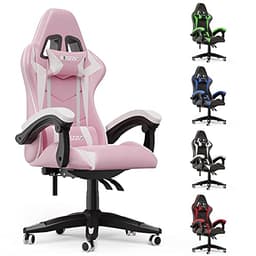
Best Value: bigzzia Ergonomic Gaming Chair (B0D635MK4K) punches well above its sub-£50 price tag with a dedicated lumbar cushion and adjustable headrest that directly address sciatica triggers.
Spec Comparison
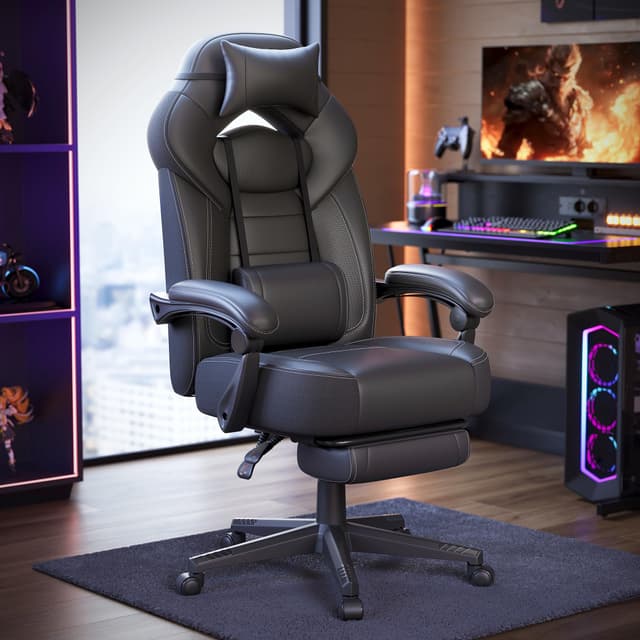
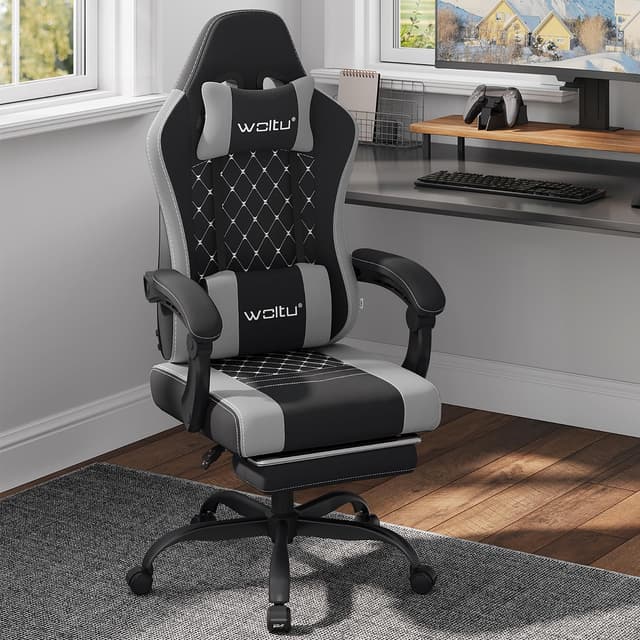
The SONGMICS Racing Gaming Chair is the pick for gamers who want a well-rounded sciatica-friendly seat without paying premium office-chair prices. It sits in a sweet spot where build quality, adjustability, and lumbar management all come together in a package that does not demand a second mortgage.
The chair is aimed at adults of average to tall build who game for extended sessions. The racing-style shell provides a fairly deep seat bucket, which helps distribute weight across the thighs rather than concentrating pressure at the base of the spine. That matters enormously for sciatica sufferers, because pressure at the ischial tuberosities (the sitting bones) can directly irritate the sciatic nerve. The extendable footrest is a meaningful addition here: elevating the legs slightly reduces the downward pull on the lumbar spine and allows you to alternate between an upright working posture and a more reclined rest position throughout a session.
The lumbar cushion is adjustable in height via a strap system, which means you can position it precisely at the L4-L5 region where most sciatica originates. The headrest pillow is similarly adjustable, supporting the cervical spine and preventing the forward-head posture that creates a chain reaction of tension all the way down to the lower back. Recline goes from 90 degrees to 135 degrees, which is a practical range for gaming rather than the exaggerated 180-degree flat positions that look impressive in marketing but are rarely useful.
The faux leather upholstery is easy to wipe clean and the chair arrives mostly pre-assembled, with the base and gas lift attached. Assembly of the backrest and armrests takes around 20 minutes for one person. The 150 kg weight capacity covers the majority of adult users. At this price point, the armrests are fixed-height, which is a limitation if you want to fine-tune elbow position, but the overall ergonomic package is strong enough to make this the top recommendation for sciatica relief in the mid-range bracket.
Verdict: The best all-round sciatica gaming chair in this roundup. Adjustable lumbar, a footrest for leg elevation, and a sensible recline range make it genuinely therapeutic rather than merely comfortable.
Pros
- Height-adjustable lumbar cushion targets the L4-L5 region precisely
- Extendable footrest allows leg elevation to relieve sciatic nerve pressure
- 135° recline range is practical for alternating postures during long sessions
Cons
- Armrests are fixed-height, limiting elbow and shoulder adjustment
- Faux leather can become warm and slightly sticky during longer summer sessions
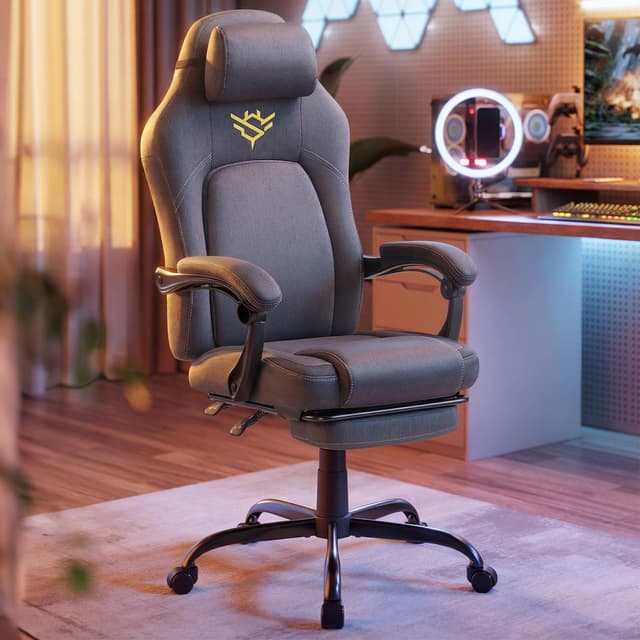
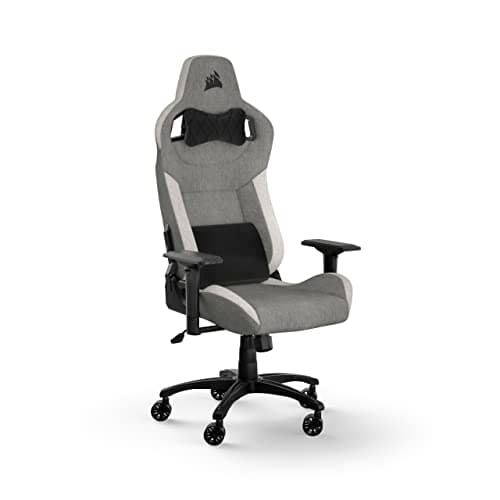
The GTPLAYER Fabric Gaming Chair is the standout choice for sciatica sufferers who run hot or simply find faux leather uncomfortable after an hour. The breathable fabric upholstery is the headline differentiator here, and it makes a meaningful practical difference when you are trying to maintain a consistent sitting position for pain management rather than shifting constantly to cool down.
This chair suits gamers of average build who prioritise comfort over the aggressive racing aesthetic. The fabric cover is softer against the skin, reduces the clammy feeling that plagues PU leather chairs, and is more forgiving on the pressure points around the thighs and lower back. For sciatica specifically, reducing the urge to fidget is genuinely useful: every time you shift to relieve discomfort, you risk adopting a compensatory posture that creates new pain patterns.
The lumbar support on the GTPLAYER is a two-part system: there is a built-in lumbar curve in the backrest shell itself, supplemented by a removable cushion that you can position where it is most effective for your anatomy. This layered approach is more sophisticated than a simple strap-on pillow and gives you more options to dial in the support. The recline range extends to an impressive 155 degrees, and the retractable footrest deploys easily to allow a near-flat rest position. For sciatica sufferers who find that lying back with legs elevated is the only way to get through a long session, this combination is particularly valuable.
The seat padding is generously thick and the foam density feels appropriate for long-term use rather than the cheap foam that compresses within a few months. Assembly is straightforward, with clear pictorial instructions. The chair is available in several colour options, which is a minor but pleasant bonus. At around £120, it is not the cheapest option here, but the fabric construction and dual lumbar system justify the premium over the budget picks.
The one caveat is that fabric upholstery is harder to clean than faux leather, which matters if you eat or drink at your desk. A fabric protector spray applied on delivery is a sensible precaution.
Verdict: The best choice for gamers who find faux leather chairs aggravate their discomfort through heat and pressure. The dual lumbar system and 155-degree recline make it a genuinely therapeutic seat.
Pros
- Breathable fabric upholstery reduces heat build-up and pressure-point discomfort
- Dual lumbar system (built-in curve plus removable cushion) offers precise support adjustment
- 155° recline with retractable footrest enables leg elevation for nerve decompression
Cons
- Fabric surface is harder to clean than faux leather if food or drink is spilled
- Slightly bulkier footprint than some rivals, which may be tight in smaller gaming setups
The SONGMICS Office Chair takes a more understated approach than the racing-style picks in this list. It is styled like a conventional executive office chair rather than a bucket-seat racer, and that has real ergonomic implications for sciatica sufferers. The flatter, wider seat pan distributes weight more evenly across the buttocks and thighs, which reduces localised pressure on the sciatic nerve compared to the narrower, more contoured seats found on racing-style chairs.
This chair is best suited to gamers who also use their setup for work, study, or other desk-based tasks. The professional appearance means it does not look out of place in a home office, and the ergonomic features are calibrated for all-day sitting rather than purely for gaming postures. The adjustable headrest is a genuine highlight: it pivots and adjusts in height, allowing you to support the neck regardless of whether you are sitting bolt upright or slightly reclined. Proper neck support prevents the head from drifting forward, which reduces the muscular tension that propagates down through the thoracic and lumbar spine to aggravate sciatica.
The lumbar cushion is adjustable in position and provides firm, targeted support at the lower back. The tilt function allows the backrest to rock slightly, which encourages micro-movements that keep the spinal discs hydrated and reduce static loading. This rocking motion is something that physios often recommend for sciatica management, and it is a feature that purely rigid gaming chairs cannot offer.
The chair does not include a footrest, which is a notable omission at this price point. If leg elevation is important to your pain management routine, you would need to add a separate footrest accessory. The armrests are fixed in position, which is another limitation. However, the quality of the seat padding, the adjustable headrest, and the tilt function make this a strong choice for gamers whose sciatica is primarily triggered by poor lumbar and neck alignment rather than leg positioning.
Verdict: An excellent option for gamers who also work from home and need a chair that manages sciatica across a full working and gaming day. The tilt function and adjustable headrest are the standout features.
Pros
- Wider, flatter seat pan distributes pressure more evenly than narrow racing buckets
- Tilt function encourages micro-movements that physios recommend for sciatica management
- Adjustable headrest prevents forward-head posture that creates downstream lumbar tension
Cons
- No footrest included, which limits leg elevation options for nerve decompression
- Fixed armrests cannot be adjusted for elbow height or width
4. bigzzia Heavy Duty Gaming Chair (B0CC8GJKJG)
The bigzzia Heavy Duty Gaming Chair is the pick for larger or heavier gamers who find that standard gaming chairs compress too quickly, lose their support, or simply feel unstable. With a verified weight of 13.4 kg, the chair is relatively light for its heavy-duty classification, which makes assembly and repositioning more manageable than you might expect from a reinforced frame.
The 180 kg weight capacity is the headline specification and it is a meaningful one for sciatica sufferers. When a chair is used near or beyond its rated capacity, the foam compresses unevenly, the seat pan tilts, and the lumbar cushion loses its positional accuracy. All of these factors can dramatically worsen sciatic nerve irritation. By choosing a chair rated well above your body weight, you ensure that the ergonomic features continue to function as designed over months and years of use.
The lumbar cushion is included and provides support at the lower back, and the recline range extends to 155 degrees, giving you the option to lean back and take pressure off the lumbar discs during rest periods. The seat itself is well-padded with a foam density appropriate for heavier users, and the base is a reinforced five-star design that provides stability without flex.
The chair does not include a footrest, which is a limitation for users who benefit from leg elevation. The armrests are adjustable in height, which is a genuine advantage over some rivals at this price point and allows you to position your elbows correctly to reduce shoulder and upper back tension. The faux leather upholstery is standard for this category and performs adequately, though it will warm up during long sessions.
For gamers who have struggled to find a chair that maintains its support over time, the heavy-duty construction here is a practical solution that directly addresses one of the most common causes of worsening sciatica symptoms during extended gaming.
Verdict: The best choice for larger or heavier gamers who need a chair that maintains its ergonomic integrity under sustained use. The 180 kg capacity and reinforced frame make it a long-term investment in pain management.
Pros
- 180 kg weight capacity ensures foam and lumbar support remain effective over time for larger users
- Height-adjustable armrests allow correct elbow positioning to reduce upper back tension
- Lightweight for its heavy-duty classification at 13.4 kg, making repositioning easier
Cons
- No footrest included, limiting options for users who need leg elevation
- Faux leather upholstery retains heat during long sessions
Buying Guide
Understanding Sciatica and Gaming Chairs
Sciatica is caused by irritation or compression of the sciatic nerve, most commonly at the point where it exits the spine between the L4-L5 or L5-S1 vertebrae. Prolonged sitting is one of the most common aggravating factors because it increases intradiscal pressure, flattens the lumbar curve, and can create direct pressure on the nerve through the piriformis muscle in the buttock. A gaming chair cannot cure sciatica, but the right chair can significantly reduce the postural factors that trigger and worsen symptoms.
Lumbar Support: The Most Important Feature
The single most important feature to look for is adjustable lumbar support. Fixed lumbar supports are positioned for an average body height and will be in the wrong place for anyone shorter or taller than the design target. An adjustable lumbar cushion that can be moved up or down the backrest allows you to position it precisely at your own L4-L5 region. Some chairs offer a built-in lumbar curve in the backrest shell in addition to a removable cushion, which gives you more options to fine-tune the support. Avoid chairs where the lumbar support is purely decorative padding with no real firmness.
Recline Range and Postural Variation
Sitting in any single position for extended periods increases sciatic nerve irritation. A chair with a meaningful recline range, ideally 90 to 155 degrees, allows you to alternate between an upright working posture and a more reclined rest position. This variation keeps the spinal discs hydrated and prevents the static loading that compresses nerve roots. A tilt-lock function that allows you to rock slightly is an additional benefit, as it encourages the micro-movements that physios recommend for disc health.
Footrest and Leg Elevation
Elevating the legs slightly reduces the downward pull of gravity on the lumbar spine and takes pressure off the sciatic nerve at the piriformis. A retractable footrest built into the chair is the most convenient way to achieve this. If a chair does not include a footrest, a separate footrest accessory placed under the desk can achieve a similar effect, though it requires more planning and desk space.
Seat Pan Depth and Width
A seat pan that is too deep forces you to either sit with your back away from the lumbar support or with your knees unable to bend correctly. Both positions increase lumbar stress. Look for a seat depth that allows you to sit with your back fully against the backrest while leaving two to three fingers of space between the front edge of the seat and the back of your knee. Wider seat pans distribute weight more evenly and reduce pressure on the ischial tuberosities, which can directly compress the sciatic nerve.
Weight Capacity and Foam Longevity
A chair used at or near its maximum weight capacity will compress its foam more quickly, causing the lumbar support and seat padding to lose effectiveness within months. Choosing a chair rated at least 20 to 30 kg above your body weight ensures that the ergonomic features remain functional over the long term. This is particularly important for sciatica sufferers who are relying on the chair for pain management rather than just comfort.
Armrests
While armrests are not directly related to sciatic nerve management, poorly positioned armrests cause shoulder and upper back tension that propagates down through the thoracic spine and can worsen lumbar symptoms. Adjustable-height armrests that allow you to keep your elbows at roughly 90 degrees are preferable to fixed armrests.
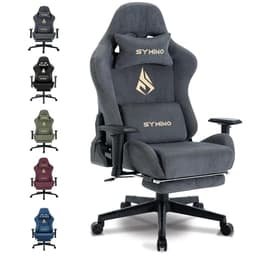
The SONGMICS Racing Gaming Chair (B086MC977H) is the overall winner for sciatica sufferers. It combines a height-adjustable lumbar cushion, an extendable footrest for leg elevation, and a practical 135-degree recline range in a well-built package that is priced accessibly enough for most gamers to justify. The lumbar cushion's adjustability is the key differentiator: being able to position it precisely at the L4-L5 region rather than accepting a fixed position makes a genuine, measurable difference to sciatic nerve pressure during long sessions. The footrest adds the leg elevation that physios recommend, and the faux leather construction is easy to maintain. For those on a tighter budget, the bigzzia B0D635MK4K delivers the core sciatica-management features at a fraction of the price and is an excellent starting point. For gamers who want every available ergonomic tool and are willing to pay for it, the Symino B0G572X5PG is the most fully featured option in the list and will serve you well for years.