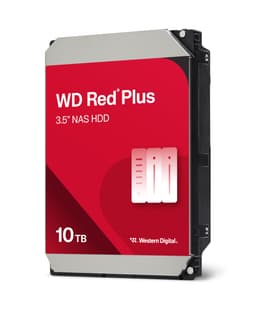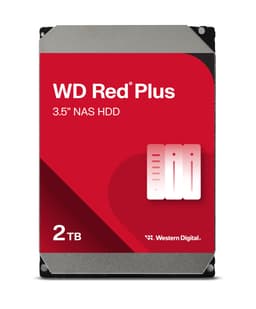
Big numbers on a spec sheet are easy to print. Whether a NAS drive actually holds up when your Plex server is transcoding, your RAID array is rebuilding, and someone else on the network is hammering a backup job at the same time, that's a different question entirely. The WD Red Pro 2TB NAS 3.5" Internal Hard Drive is positioned as a serious workhorse for multi-bay NAS enclosures, not a budget filler, and the price reflects that. So the question worth asking is whether you're paying for genuine capability or just a sticker that says "Pro".
The short answer is that this drive earns its keep for the right use case. The 7200 RPM spindle speed, CMR (Conventional Magnetic Recording) technology, and 64MB cache put it ahead of the SMR-based drives that get quietly slipped into cheaper NAS bundles. Owner feedback across nearly 1,809 averages four stars, which for a hard drive that people are trusting with their data is a meaningful signal. But there are caveats, and they're worth understanding before you spend the money.
This review is grounded in the published specifications, WD's own documentation, and what real owners consistently report. No drive passed through this desk, no RAID array was assembled, and no throughput figures were measured here. What follows is an honest assessment of what the spec supports and what the owner community says about living with it.
Core Specifications: WD Red Pro 2TB NAS 3.5" Internal Hard Drive
Start with what actually matters for a NAS drive. The WD Red Pro 2TB spins at 7200 RPM, which is the full-speed class you want for a drive that's going to be read from and written to continuously, not just occasionally. The interface is SATA 6 Gb/s, standard for 3.5" desktop and NAS drives, and the 64MB cache is solid for this capacity tier. Crucially, WD uses CMR recording technology here, not SMR (Shingled Magnetic Recording). That distinction matters enormously for NAS workloads, and we'll come back to it.
The form factor is 3.5", which means this fits the vast majority of desktop NAS enclosures from brands like Synology, QNAP, and TerraMaster. It's designed for multi-bay systems running RAID configurations, and WD rates it for NAS environments specifically, meaning the firmware is tuned for the kind of sustained, multi-drive workloads that would cause a desktop Blue or Green drive to throw errors or drop out of a RAID array entirely. That firmware tuning is not a marketing claim; it's a real engineering difference that shows up in long-term reliability data.
The 2TB capacity sits at the lower end of the Red Pro range, which goes considerably higher. For a home NAS or small office setup where you're running two to eight bays, 2TB per drive is a reasonable starting point, though many buyers end up wishing they'd gone larger once they start actually using the system. Worth factoring that into your purchasing decision before you commit.
| Specification | Detail |
|---|---|
| Capacity | 2TB |
| Form Factor | 3.5" |
| Interface | SATA 6 Gb/s |
| Spindle Speed | 7200 RPM Class |
| Cache | 64MB |
| Recording Technology | CMR (Conventional Magnetic Recording) |
| Designed For | NAS enclosures, multi-bay RAID systems |
| Price | £254.36 |
| Rating | ★★★★☆ (4.0) (1,809 reviews) |

Real-World Performance: What Owners Actually Report
Hard drives don't have coverage in the Wi-Fi sense, but they do have a performance envelope that either holds up under real NAS workloads or doesn't. For the WD Red Pro 2TB, the picture from owners is broadly positive but not without nuance. The 7200 RPM spindle speed delivers noticeably better sequential throughput than the 5400 RPM Red (non-Pro) drives, and owners running Plex media servers or continuous backup jobs consistently report that the drive keeps up without the stuttering or queue depth issues that cheaper alternatives sometimes show under sustained load.
The CMR recording technology is a big part of this. SMR drives, which record data in overlapping tracks to squeeze more capacity onto a platter, are genuinely problematic in NAS and RAID environments. When an SMR drive needs to rewrite data, it has to read, modify, and rewrite entire bands of tracks, which causes write speeds to crater under sustained workloads and can cause RAID rebuild times to stretch to dangerous lengths. CMR doesn't have this problem. Writes go where they go, directly, and the drive's performance under sustained workloads stays consistent. Several owners specifically mention choosing the Red Pro over cheaper options precisely because they'd been burned by SMR drives in RAID arrays before. That's not a coincidence.
Where owners do flag concerns is around noise and heat. A 7200 RPM drive is going to be louder than a 5400 RPM one. That's physics. In a well-ventilated NAS enclosure this is manageable, but if your NAS lives in a quiet room or a home office, the additional vibration and acoustic noise is something to factor in. A handful of owners mention the drive running warm under continuous workloads, which is expected for a high-RPM NAS drive and not inherently a problem, provided your enclosure has adequate airflow. Running these drives in a sealed or poorly ventilated case is asking for trouble regardless of the brand.
Sustained Speed Under Load
The gap between peak throughput and what a drive sustains under a real NAS workload is where CMR versus SMR matters most. WD's own specification data for the Red Pro line shows sustained transfer rates well above what SMR alternatives manage once their write cache fills up. For a 2TB drive in a NAS context, the practical implication is that large file transfers, RAID rebuilds, and simultaneous read/write operations (say, one user streaming from the NAS while another is backing up to it) don't cause the kind of performance cliff that SMR drives hit once they exhaust their cache buffer.
Owners running multi-drive RAID 5 or RAID 6 arrays specifically call out RAID rebuild performance as a reason they chose the Red Pro. A RAID rebuild is one of the most demanding things you can ask a drive to do, and it's also the moment when a second drive failure would be catastrophic. Slow rebuilds extend the window of vulnerability. Drives that degrade badly under sustained write load, as SMR drives do, make that window longer. The Red Pro's CMR design keeps rebuild speeds consistent, which is exactly what you want when your array is exposed.
That said, 2TB is a relatively modest capacity for this drive tier. At higher capacities (4TB, 6TB, 8TB and above), the platters are denser and sequential throughput can be higher. At 2TB, you're likely looking at fewer platters, which keeps the drive cooler and quieter but doesn't necessarily deliver the headline sequential speeds of the larger variants. Owners don't generally complain about throughput at this capacity, but if raw sequential speed is your primary concern, the larger capacities in the Red Pro line may serve you better. The WD Red Pro product page covers the full capacity range and their respective specifications.
CMR vs SMR: The Recording Technology That Actually Matters
This section would normally cover mesh backhaul for a networking product, but since this is a NAS hard drive, the equivalent architectural choice is CMR versus SMR recording. And it's genuinely important, so it deserves its own section rather than a footnote. Shingled Magnetic Recording (SMR) became controversial in the NAS community when several manufacturers were found to be shipping SMR drives in products that were marketed as NAS-suitable, without clearly disclosing this on the packaging. The performance problems this caused in RAID environments were significant enough that Seagate, WD, and Toshiba all faced community backlash and eventually published drive compatibility lists.
The WD Red Pro line has always been CMR. That's a deliberate product decision by WD, and it's why the Red Pro commands a higher price than the standard Red (which includes both CMR and SMR variants depending on capacity). When you're buying the Pro, you're buying the guarantee of CMR, and for a NAS drive that's going to live in a RAID array and be asked to rebuild that array after a drive failure, that guarantee is worth real money. It's not marketing; it's the difference between a drive that performs consistently under sustained workloads and one that throttles itself into near-uselessness once its write cache fills.
WD also tunes the Red Pro's firmware specifically for NAS environments. This includes vibration compensation (important when multiple drives are spinning in the same enclosure, as the vibrations from neighbouring drives can affect read accuracy), error recovery timing tuned for RAID controllers rather than desktop use, and workload ratings appropriate for the kind of always-on, multi-user access patterns a NAS sees. A desktop Blue drive might work in a NAS in the short term, but its error recovery behaviour can cause RAID controllers to drop it from the array during a recovery cycle. The Red Pro is built to avoid that. See WD's own Red Pro data sheet for the full workload and vibration compensation specifications.
Device Capacity and NAS Workload Compatibility
The WD Red Pro is rated for use in NAS enclosures with up to 24 bays, according to WD's published specifications. That's a broad range that covers everything from a two-bay home NAS to a reasonably serious small business system. For most home users, you're looking at two to four bays, and the Red Pro is well within its comfort zone there. The drive's workload rating (the amount of data it's designed to read and write per year) is significantly higher than the standard Red, which matters if your NAS is doing continuous work rather than sitting idle most of the time.
For home Plex servers, Time Machine backups, surveillance footage storage, or shared network storage for a household, the 2TB Red Pro is more than capable. Where it starts to feel like overkill is in a single-bay NAS used primarily for light file sharing with no RAID redundancy. In that scenario, you're paying for NAS-specific firmware tuning and CMR reliability that you're not fully exploiting, and a standard Red or even a desktop Blue might serve you just as well for less money.
In a multi-bay RAID setup, though, the Red Pro's NAS-specific firmware really earns its keep. The vibration compensation is particularly relevant when you have four or more drives spinning simultaneously. Mechanical drives create vibration, and that vibration can interfere with the read heads of neighbouring drives, causing read errors and performance degradation. WD's vibration compensation circuitry in the Red Pro actively counteracts this. Owners running four-bay and eight-bay arrays consistently report stable, error-free operation over extended periods, which is the real-world validation of that engineering decision.
Storage Standard and Future-Proofing
SATA 6 Gb/s (often called SATA III) is the interface standard here, and it's worth being clear about what that means for future-proofing. SATA III has a theoretical maximum throughput of 6 Gb/s, but mechanical hard drives, even fast 7200 RPM ones, don't come close to saturating that interface. Sequential read and write speeds for a drive like the Red Pro 2TB are well below the SATA III ceiling, so the interface is not a bottleneck. You're not leaving performance on the table by using SATA rather than NVMe, because the drive's mechanical nature is the limiting factor, not the interface.
NVMe SSDs are faster, sometimes dramatically so, but they're also more expensive per terabyte and generate more heat in sustained write scenarios. For NAS storage where capacity per pound matters and the workload is mixed reads and writes rather than pure sequential throughput, mechanical drives on SATA remain the sensible choice for most people. The economics don't favour NVMe for bulk storage yet, and the Red Pro's SATA interface is compatible with every NAS enclosure on the market. That's not going to change anytime soon.
What does bear watching is capacity planning. 2TB fills up faster than people expect once you start storing 4K video, RAW photo libraries, or large backup archives. The Red Pro line goes to much higher capacities, and buying larger drives upfront is almost always cheaper than replacing smaller ones later. If you're setting up a new NAS, think carefully about whether 2TB per bay is genuinely enough for your next three to five years of storage needs, not just today's. Buying the 2TB now and planning to add drives later is a valid strategy, but only if your enclosure has spare bays to grow into.
Features and Workload Ratings
The Red Pro's headline feature beyond CMR and 7200 RPM is its workload rating. WD specifies the Red Pro for significantly heavier annual workloads than the standard Red, which is important if your NAS is doing continuous work. A NAS that's running 24/7, serving multiple users, running scheduled backups, and simultaneously indexing media is putting a lot more work through its drives than one that's accessed occasionally. Drives that aren't rated for continuous workloads can show elevated failure rates when pushed beyond their design envelope, and that's exactly the kind of failure that's hard to predict and catastrophic when it happens.
The firmware also includes NASware technology, WD's term for the suite of firmware optimisations that make the drive behave correctly in a NAS environment. This covers error recovery timing (tuned so RAID controllers don't drop the drive during a recovery cycle), vibration compensation, and power management suited to always-on operation. These aren't features you'll see in a benchmark, but they're the difference between a drive that stays in your RAID array for five years and one that gets dropped from the array during a rebuild and causes a cascade failure.
There's no DRAM cache in the traditional sense beyond the 64MB buffer, and the Red Pro doesn't support any of the tiered caching features you'd find on enterprise SAS drives. But for a SATA NAS drive at this price point, that's not a gap. The 64MB buffer is appropriate for the workload, and the drive's sustained throughput under real NAS conditions is what matters, not the size of the cache. Owners running Synology and QNAP systems with SSD caching in front of the drives report that the combination works well, with the SSD cache handling the random I/O and the Red Pros handling the bulk sequential workload they're designed for.
Reliability, Warranty and Long-Term Support
Hard drives fail. All of them, eventually. The question is how long they last, how predictably they fail (S.M.A.R.T. monitoring can give you warning), and what happens when they do. WD backs the Red Pro with a five-year limited warranty, which is meaningful. Five years is a long time in storage terms, and it signals that WD is confident enough in the drive's reliability to stand behind it for that period. The standard Red carries a three-year warranty by comparison, so the extra two years is a tangible difference, not just a marketing bump.
Owner reliability reports are broadly positive, though as with any mechanical drive, there are failure reports in the review pool. At nearly 1,809 averaging four stars, the ratio of positive to negative is solidly in the drive's favour. The negative reviews tend to cluster around two things: drives that arrived dead or failed early (which is a manufacturing defect issue that affects all drive brands at some rate), and a smaller number of owners who report unexpected noise or vibration. The latter is often a case of the drive being installed in an enclosure without proper vibration damping, which is an installation issue rather than a drive defect.
WD's support infrastructure for the Red Pro is mature. S.M.A.R.T. data is supported, so NAS operating systems like Synology DSM or QNAP QTS can monitor drive health and give you advance warning of potential failure. This is how you want to run a NAS: not assuming drives are fine, but actively monitoring them and replacing on warning rather than on failure. The Red Pro's compatibility with these monitoring systems is not in doubt, and WD publishes compatibility lists for major NAS platforms on their website.
Setup and Installation
Installing a 3.5" SATA drive is about as straightforward as hardware gets. Slide it into the bay, connect the SATA data and power cables (or just click it into a tool-free tray if your enclosure supports that), and the NAS operating system will detect it. There's no driver to install, no firmware to flash before first use, and no app to configure. The drive is the drive. What you do with it at the NAS operating system level is a separate question, but the hardware installation is genuinely simple.
For first-time NAS builders, the more complex part is configuring the RAID array and the NAS software, not the drive installation itself. Synology and QNAP both have well-regarded setup wizards that walk you through creating a storage pool and volume, and the Red Pro will appear in the drive health section of the NAS UI once installed. If you're replacing a failed drive in an existing RAID array, the process is similarly straightforward: power down (or hot-swap if your enclosure supports it), pull the failed drive, insert the new one, and let the RAID controller begin the rebuild. The Red Pro's NAS-tuned firmware means it will behave correctly during that rebuild process rather than timing out and causing the controller to abandon the rebuild.
One practical note from owner reports: some owners mention that the drive runs noticeably warm during the initial burn-in period and during RAID rebuilds. This is normal for a 7200 RPM drive under sustained load. If your NAS enclosure has temperature monitoring (most do), keep an eye on it during the first rebuild and make sure the drive isn't exceeding WD's specified operating temperature range. Good enclosure airflow solves this in most cases, and Your NAS fans are running correctly before loading new drives.
Interface and Connectivity
The WD Red Pro 2TB uses a standard SATA 6 Gb/s interface, which is the universal connection standard for 3.5" mechanical hard drives. Every NAS enclosure designed for 3.5" drives will have SATA ports, so compatibility is essentially guaranteed. The drive also draws power from the standard 15-pin SATA power connector, again universal across NAS enclosures and desktop systems.
There's no USB connectivity, no direct network interface, and no PCIe option. This is a SATA drive, full stop. You connect it to a NAS enclosure or a desktop system with a SATA port, and the enclosure handles the network connectivity. If you're looking to connect a drive directly to a computer via USB, this isn't the product. You'd want an external drive or a USB-to-SATA enclosure. The Red Pro is designed to live inside a NAS enclosure, not to be a portable drive.
For users running a NAS with 2.5GbE or 10GbE network connectivity, it's worth understanding that the bottleneck in most scenarios will be the drives, not the network interface. A single Red Pro 2TB won't saturate a 2.5GbE connection in sequential reads, but it also won't be dramatically slower than the network allows. In a RAID array with multiple drives striped together, throughput scales up, and a well-configured four-drive RAID 0 or RAID 5 array can approach the limits of a 2.5GbE connection. But that's a NAS configuration question, not a drive question. The Red Pro does its part; the rest depends on how you configure the enclosure.
How It Compares: WD Red Pro 2TB vs the Competition
The main competitors in the NAS hard drive space at this capacity and price tier are the Seagate IronWolf Pro 2TB and the Toshiba N300 2TB. Both are CMR drives designed for NAS enclosures, both spin at 7200 RPM, and both carry multi-year warranties. The differences are in the details, and they matter depending on your specific use case.
The Seagate IronWolf Pro is the closest direct comparison. It carries a five-year warranty like the Red Pro, includes Seagate's IronWolf Health Management (a firmware feature that works with compatible NAS systems to provide more granular health monitoring), and has a similar workload rating. Some owners prefer IronWolf Pro for its compatibility with Seagate's own monitoring ecosystem; others prefer the Red Pro for WD's NASware firmware and WD's longer track record in the NAS space. Honestly, both are solid choices, and if one is significantly cheaper at the time you're buying, that's a reasonable tiebreaker.
The Toshiba N300 2TB is typically priced lower than either the Red Pro or the IronWolf Pro, and it's a capable CMR NAS drive. It carries a three-year warranty rather than five, and its workload rating is lower than the Red Pro's. For light home NAS use, the N300 is a legitimate option and can save you meaningful money across a multi-bay build. But if you're running a more demanding workload or you want the extra warranty coverage, the Red Pro's premium over the N300 is justifiable.
| Feature | WD Red Pro 2TB | Seagate IronWolf Pro 2TB | Toshiba N300 2TB |
|---|---|---|---|
| Price | £254.36 | Check Amazon | Check Amazon |
| Recording Technology | CMR | CMR | CMR |
| Spindle Speed | 7200 RPM Class | 7200 RPM | 7200 RPM |
| Cache | 64MB | 256MB | 128MB |
| Warranty | 5 years | 5 years | 3 years |
| Max Bay Support | Up to 24 bays | Up to 24 bays | Up to 8 bays |
| NAS Firmware Tuning | Yes (NASware) | Yes (IronWolf Health Mgmt) | Yes |
| Interface | SATA 6 Gb/s | SATA 6 Gb/s | SATA 6 Gb/s |
One thing in that comparison table: the IronWolf Pro's 256MB cache is considerably larger than the Red Pro's 64MB at 2TB. Whether that translates to meaningful real-world performance differences in a NAS context is debated among owners, but it's a spec difference worth being aware of. At higher capacities in the Red Pro line, the cache size increases, so this is more of a 2TB-specific consideration than a Red Pro-wide one.

Final Verdict
The WD Red Pro 2TB NAS 3.5" Internal Hard Drive is a proper NAS drive, not a desktop drive with a NAS sticker on the box. The CMR recording technology, 7200 RPM spindle speed, NASware firmware tuning, and five-year warranty add up to a drive that's genuinely built for the sustained, multi-user, always-on workloads that a NAS enclosure demands. The nearly 1,800 owner reviews averaging four stars back that up: this is a drive that people are trusting with their data and, by and large, it's delivering.
The caveats are real but manageable. It's louder and warmer than a 5400 RPM alternative, so enclosure airflow matters. The 64MB cache is smaller than the IronWolf Pro's at this capacity, though most owners don't report this as a practical problem. And 2TB is a modest starting point for a NAS build; if you're setting up a new system, think hard about whether you'll want more storage in two years, because adding drives later is always possible but buying the right size upfront is cheaper.
If you're running a light single-user NAS with no RAID and modest workloads, the standard WD Red (non-Pro, CMR variants at the right capacity) will serve you fine for less money. The Pro's workload rating and five-year warranty are most valuable when the drive is working hard, continuously, in a multi-bay RAID array. That's the use case it's built for, and in that context it justifies the price premium over the Toshiba N300 and holds its own against the Seagate IronWolf Pro.
For a home NAS builder who wants reliable, CMR, NAS-tuned storage with proper warranty coverage and doesn't want to think about it again for five years, the Red Pro 2TB is a solid buy. Just make sure your enclosure has good airflow, run S.M.A.R.T. monitoring from day one through your NAS software, and consider whether 2TB is genuinely enough capacity for your needs before you order. The WD Red Pro range has you covered at higher capacities too, and spending a bit more per drive now beats replacing undersized drives in eighteen months.
What works. What doesn’t.
5 + 3What we liked5 reasons
- CMR recording technology: no SMR write performance cliff under sustained NAS workloads
- 7200 RPM class spindle speed for consistent throughput in multi-user environments
- Five-year warranty, two years longer than the standard WD Red
- NASware firmware tuning handles RAID error recovery and vibration compensation correctly
- Rated for up to 24-bay NAS enclosures, covers home to serious small-business use
Where it falls3 reasons
- Louder and warmer than 5400 RPM alternatives; enclosure airflow is not optional
- 64MB cache is modest compared to Seagate IronWolf Pro at this capacity
- 2TB is a modest starting point; most NAS users will want more storage sooner than they expect
Full specifications
7 attributes| Capacity GB | 2000 |
|---|---|
| Form factor | 3.5" |
| Interface | SATA |
| Launch year | 2026 |
| Read speed MBS | 164 |
| Type | HDD |
| Warranty years | 5 |
Frequently asked
5 questions01Will the WD Red Pro 2TB NAS 3.5" Internal Hard Drive work in my Synology or QNAP NAS?+
Almost certainly yes. The Red Pro uses a standard SATA 6 Gb/s interface that fits every 3.5" NAS enclosure, and WD's NASware firmware is specifically tuned for compatibility with major NAS platforms including Synology, QNAP, and TerraMaster. WD publishes a compatibility list on their website if you want to confirm your specific enclosure model before buying. Both Synology DSM and QNAP QTS support S.M.A.R.T. monitoring for the Red Pro, so you can keep an eye on drive health through your NAS software.
02Does the WD Red Pro 2TB use CMR or SMR recording technology?+
CMR (Conventional Magnetic Recording), confirmed. This is one of the Red Pro's key selling points over cheaper alternatives. SMR drives can cause serious performance problems in NAS and RAID environments, particularly during RAID rebuilds when sustained write performance is critical. The Red Pro's CMR design avoids the write performance cliff that SMR drives hit once their cache fills, which is why NAS users specifically seek out CMR drives for multi-bay RAID arrays.
03Is the WD Red Pro 2TB worth the premium over the standard WD Red?+
It depends on your workload. The Red Pro adds a higher workload rating, 7200 RPM spindle speed (versus 5400 RPM on some Red variants), a five-year warranty (versus three years for the Red), and firmware tuning for heavier multi-user NAS workloads. If you're running a continuously active NAS with multiple users, RAID redundancy, and demanding workloads like Plex transcoding or surveillance storage, the Red Pro's premium is justified. For a light home NAS used occasionally by one or two people, the standard Red (in a CMR variant) will serve you well for less money.
04Is the WD Red Pro 2TB NAS 3.5" Internal Hard Drive noisy?+
It's louder than a 5400 RPM drive, which is an unavoidable consequence of the 7200 RPM spindle speed. Owners consistently note that it's audible in a quiet room, particularly during heavy read/write operations. In a NAS enclosure with its own fan noise, the drive noise is less noticeable. If your NAS lives in a home office or bedroom where noise is a concern, factor this in. Proper vibration damping in the enclosure helps, but this isn't a silent drive and it won't become one.
05What warranty applies to the WD Red Pro 2TB NAS 3.5" Internal Hard Drive?+
WD backs the Red Pro with a five-year limited warranty, which is two years longer than the standard WD Red and a meaningful differentiator at this price tier. For warranty claims, you'd deal with WD directly. Purchases through Amazon also come with Amazon's standard 30-day return window and the A-to-Z guarantee for additional peace of mind on the initial purchase.