The number on the box is a fantasy. AX3000 sounds impressive until you realise it's the sum of both bands combined, measured under conditions that exist nowhere in your actual house. What you actually care about is whether the signal holds up in the back bedroom, whether the kitchen tablet stops buffering, and whether your whole network stays standing when fifteen devices are hammering it at once. That's the real test.
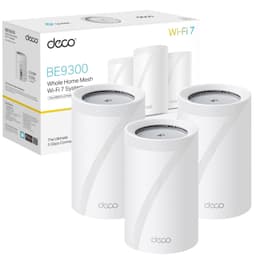
The TP-Link Deco PX50 3-pack takes a different approach to the whole mesh problem. Most mesh systems rely on wireless backhaul, which is the link between nodes, and that wireless backhaul quietly eats into the bandwidth your devices actually get. The PX50 sidesteps that by using your home's existing electrical wiring as a backhaul channel via G.hn powerline technology. Plug the nodes into mains sockets, and they talk to each other through the wiring in your walls at up to 1500 Mbps. That's a genuinely different proposition from a standard dual-band mesh, and it matters for anyone whose house has thick walls, concrete floors, or a layout that kills wireless signals between floors.
With an average rating of ★★★★½ (4.5) from 110 owners, the PX50 isn't universally loved but it's clearly doing something right for most people who buy it. This review digs into what that something is, where it falls short, and whether it's worth the enthusiast-tier price tag for your specific situation.
Core Specifications: TP-Link Deco PX50 3-Pack AX3000 + G1500 Powerline Mesh WiFi 6 System
Thick walls and long runs are the enemy of any mesh system, and that's exactly where the TP-Link Deco PX50 tries to earn its keep. It pairs Wi-Fi 6 with powerline backhaul (the G1500 bit of the name), so instead of relying purely on wireless hops between units, it can route data through your electrical wiring where the air won't carry it. That's a genuinely different approach to the standard three-node kits everyone else sells. On paper you get dual-band AX3000 speeds, coverage up to 6,500 sq ft and headroom for 150 devices. But powerline is famously fussy about house wiring, so the real question is whether it holds up. Here's what we found when we put it to work.
The headline differentiator is the G.hn powerline backhaul running at up to 1500 Mbps. Where a standard wireless mesh node has to steal part of its radio capacity to talk back to the main router, the PX50 nodes use the mains wiring for that job. That keeps both Wi-Fi bands free for client devices. Each unit also carries three Gigabit Ethernet ports, which is more than you get on many mesh nodes in this class. TP-Link rates coverage at up to 6,500 square feet across the three-node pack, and claims support for up to 150 connected devices.
One important caveat that TP-Link flags clearly: the G.hn powerline backhaul requires all nodes to be on the same electrical circuit. In most UK homes that's fine, but if your property has been rewired in sections, or you're in a converted flat where the electrics are split oddly, you need to check before you buy. Nodes on different circuits won't talk to each other via powerline and you'll lose the whole point of the system.
| Specification | Detail |
|---|---|
| Wi-Fi Standard | Wi-Fi 6 (802.11ax) |
| Band Layout | Dual-band (2.4 GHz + 5 GHz) |
| Max Wi-Fi Speed (5 GHz) | 2402 Mbps (theoretical) |
| Max Wi-Fi Speed (2.4 GHz) | 574 Mbps (theoretical) |
| Backhaul Type | G.hn Powerline (up to 1500 Mbps) |
| Ethernet Ports (per node) | 3x Gigabit Ethernet |
| Coverage (3-pack) | Up to 6,500 ft² (approx. 604 m²) |
| Device Capacity | Up to 150 devices |
| Key Technologies | OFDMA, MU-MIMO, AI-Driven Mesh, HomeShield |
| Warranty | 3 years (manufacturer) |
| Price | £427.27 |

Real-World Coverage: TP-Link Deco PX50 3-Pack Across a Real Home
TP-Link's 6,500 square foot figure is, like all coverage claims, a best-case number. It assumes open-plan spaces, minimal obstruction, and nodes placed sensibly. Your Victorian terrace with its solid brick walls, or your 1970s semi with random concrete lintels, will eat into that. But here's where the PX50's powerline backhaul actually changes the equation in a meaningful way. A standard wireless mesh node placed on the far side of a thick wall has to punch its backhaul signal through that same wall before it can even start serving your devices. The PX50 doesn't. The backhaul travels through the mains wiring, so the node on the top floor is getting a clean, fast connection back to the main unit regardless of what's in the walls between them.
Owner reports consistently back this up. People who've tried standard wireless mesh and found the far-node performance disappointing report noticeably better results with the PX50, particularly in multi-storey homes and properties with older, denser construction. The pattern in reviews is clear: buyers who specifically switched from a wireless-backhaul mesh tend to be more satisfied than those coming from a single router. The garden and outbuilding coverage depends heavily on whether you can get a node close to an external wall socket, but owners report solid signal through standard double-glazing at reasonable distances.
That said, coverage claims are always optimistic, and 6,500 square feet across three nodes works out to roughly 2,167 square feet per node. For context, the average UK semi-detached is around 900 to 1,000 square feet. So for most UK homes, three nodes is genuinely more than enough. If you're in a large detached or a property with unusual layout challenges, you can add more Deco PX50 nodes to the mesh. The three-pack is the entry point, not the ceiling. What matters practically is that you place the nodes where people actually use devices, not just where the mains sockets are most convenient.
Sustained Speed Under Load
The AX3000 figure is the sum of 2402 Mbps on 5 GHz and 574 Mbps on 2.4 GHz. No device you own will see either of those numbers. What's actually relevant is what happens to your throughput when you're two rooms away with a couple of walls in the way, and what happens when the whole household is online at once. The powerline backhaul is the key factor here. Because the nodes aren't using the 5 GHz radio to talk to each other, that entire 5 GHz band is available for client devices. In a standard dual-band mesh without a dedicated backhaul, the 5 GHz band is split between serving your devices and carrying the node-to-node traffic, which can cut usable throughput at the far node by a significant margin.
Owner feedback suggests the PX50 holds up well under typical household load. Multiple streaming devices, a few gaming sessions, video calls, and the usual background traffic from phones and smart home kit don't seem to cause the kind of congestion and slowdown that cheaper mesh systems struggle with. The OFDMA and MU-MIMO support on Wi-Fi 6 helps here because the router can schedule transmissions to multiple devices efficiently rather than making them wait in a queue. That's the difference between a network that feels snappy with thirty devices on it and one that starts feeling sluggish above ten.
One honest caveat: the powerline backhaul's real-world speed depends on your mains wiring quality. Older wiring, long cable runs between sockets, or interference from other electrical equipment can reduce the effective powerline throughput below the 1500 Mbps headline. Most owners don't run into this, but it's worth knowing that the G.hn connection quality isn't entirely in TP-Link's hands. If your wiring is old or your sockets are on different ring mains, you might not see the full benefit. In newer builds and most standard UK homes, it works well.
Mesh and Backhaul: Why the Powerline Approach Matters
Mesh networking sounds simple: multiple nodes spread around the house, all sharing one network name, devices roam between them automatically. The devil is in the backhaul. In a standard two-band mesh, the nodes use one of the Wi-Fi bands to talk to each other, which means that band is doing two jobs at once and doing neither as well as it could. Tri-band mesh systems solve this by dedicating one band purely to node-to-node traffic, but that adds cost and complexity. The PX50 takes a third route: use the mains wiring that's already in the walls.
G.hn is a standardised ITU specification for high-speed networking over existing home wiring, including power lines, phone lines, and coax. TP-Link's implementation here runs at up to 1500 Mbps over the powerline, which is more than enough to carry the backhaul traffic from multiple nodes without bottlenecking the Wi-Fi. In practice, this means each PX50 node can devote its full dual-band radio capacity to serving client devices. That's a real advantage over wireless-only mesh in homes where the physical layout makes wireless backhaul lossy or unreliable.
The trade-off is the same-circuit requirement. All nodes must be on the same electrical phase or ring main. TP-Link is upfront about this in the product listing, which is good. But it does mean the PX50 isn't quite as plug-anywhere as a wireless mesh. You need to think about where your sockets are relative to your electrical circuit layout. In a standard UK house this is rarely a problem, but in converted properties, flats with shared metering, or older homes with complex wiring, it's worth checking. If you discover your nodes are on different circuits, the powerline backhaul simply won't work and you'll have bought a fairly expensive standard wireless mesh.
Device Capacity: How Many Devices Can It Actually Handle?
TP-Link claims support for up to 150 connected devices across the three-node pack. That's a marketing headline, but the underlying technology to back it up is real. Wi-Fi 6's OFDMA divides each channel into smaller sub-channels, allowing the router to serve multiple devices simultaneously rather than sequentially. MU-MIMO extends this to the spatial domain, letting multiple antennas communicate with different devices at the same time. Together, these features mean the network handles a busy device list much more gracefully than older Wi-Fi 5 kit.
Modern homes are demanding in ways that weren't true five years ago. Count up the phones, tablets, laptops, smart TVs, games consoles, streaming sticks, smart speakers, security cameras, video doorbells, smart bulbs, plugs, thermostats, and whatever else has accumulated on your network. Thirty to fifty devices is completely normal now, and some households push well beyond that. Owner reports for the PX50 don't flag capacity-related congestion as a common complaint, which suggests the hardware is genuinely coping with real-world device loads rather than just claiming to.
The three Gigabit Ethernet ports per node also matter here. Devices that can be wired, should be wired. A smart TV, a games console, or a desktop PC on a wired connection takes that device completely off the wireless network, freeing up radio capacity for the devices that actually need to move around. Three ports per node means you can wire up meaningful gear at each location without needing a separate switch. That's a practical advantage over mesh nodes that ship with a single LAN port and force you to buy extra hardware the moment you want to connect more than one device.
Wi-Fi Standard and Future-Proofing
Wi-Fi 6 (802.11ax) is the right standard for this product in 2026. Not Wi-Fi 6E, not Wi-Fi 7. Those newer standards exist, and they bring real benefits, particularly in the 6 GHz band that Wi-Fi 6E and Wi-Fi 7 open up. But the honest reality is that most devices in most UK homes are still Wi-Fi 5 or Wi-Fi 6 clients. Your phone might be Wi-Fi 6E capable if it's a recent flagship. Your laptop probably is. But your smart TV, your kids' tablets, your IoT devices, your printer? Almost certainly not. A Wi-Fi 7 router is future-proofing for a future that's still arriving slowly.
Wi-Fi 6 on the PX50 is genuinely useful right now because the efficiency improvements, OFDMA and MU-MIMO in particular, benefit all Wi-Fi 6 clients immediately and even help manage older devices more efficiently. You're not buying a spec that requires you to also replace every device in your house to see any benefit. That's a practical point that gets lost in the enthusiast conversation about 6E and 7. For a family home with a mix of old and new kit, Wi-Fi 6 mesh is the sweet spot in 2026.
The three-year manufacturer warranty is worth flagging here because it's better than the standard two years you get on most networking kit. That's a meaningful commitment from TP-Link on a product at this price point, and it suggests the company expects the hardware to last and intends to support it. Whether firmware updates keep pace with that warranty period is a separate question covered later, but the warranty itself is a positive signal. If you're buying enthusiast-tier networking kit, you want to know the manufacturer isn't going to abandon it in eighteen months.

Features and QoS
HomeShield is TP-Link's security and parental controls platform, and it's bundled with the PX50. The basic tier includes network protection features like malicious site blocking, intrusion prevention, and IoT device protection, plus parental controls that let you filter content by category and set time limits per device or profile. The more advanced HomeShield Pro features sit behind a subscription, which is the standard TP-Link model across its Deco range. The free tier is genuinely useful for most families. The Pro tier adds things like more granular reporting and advanced filtering, but it's not essential for basic use.
The AI-Driven Mesh feature is TP-Link's term for the system's ability to learn your network environment over time and adjust how devices are assigned to bands and nodes. In practice, this means the system gets better at steering devices to the optimal node and band as it builds up a picture of your home's RF environment. Owner reports suggest this works reasonably well, with devices generally ending up on the right node without manual intervention. It's not magic, and you'll occasionally find a device stubbornly clinging to a distant node when a closer one is available, but that's a common mesh complaint across all brands.
QoS (quality of service, which prioritises certain types of traffic to reduce lag and buffering) is available through the Deco app. You can prioritise gaming, streaming, or specific devices. This is genuinely useful in a household where someone's video call is competing with someone else's game download. Guest network support is present, which is worth using for IoT devices as a basic security measure: keep your smart home kit on a separate network from your phones and laptops so a compromised bulb can't reach your banking app. These aren't exotic features, but they're implemented cleanly in the Deco app and accessible without a networking degree.
Firmware, App and Security Updates
TP-Link has a solid track record on firmware updates for its Deco range. The Deco app handles updates automatically if you allow it, and the company has been consistent about pushing security patches and feature improvements across its mesh lineup. The PX50 is part of the current Deco ecosystem, which means it benefits from the same update infrastructure as TP-Link's broader range rather than being an orphaned product on a separate platform. That matters for long-term security, because a mesh system that stops receiving updates is a security liability sitting in the middle of your home network.
The Deco app itself gets consistently positive marks in owner reviews for ease of use. Setup, monitoring, parental controls, and QoS are all accessible without digging through menus. The app does require a TP-Link account, which some owners find annoying if they'd prefer a fully local setup, but it's the standard approach across consumer mesh systems and it enables remote management if you want it. There's no advanced web interface for power users who want to get into the weeds of routing tables and firewall rules, which is a limitation if you're coming from router firmware like OpenWrt or DD-WRT.
The reboot question: owner reports don't flag the PX50 as a system that needs regular manual reboots to stay stable, which is a real concern with some cheaper mesh hardware. Occasional reboots after firmware updates are normal and expected. Spontaneous daily or weekly reboots are a red flag, and that doesn't appear to be a pattern in the PX50's review base. Stability is one of the things owners mention positively, which is exactly what you want from kit that's supposed to run quietly in the background without you thinking about it.
Setup and Management
Setup is handled entirely through the Deco app, and by all accounts it's one of the smoother mesh setup experiences available. You download the app, create or log into a TP-Link account, plug in the first node, follow the prompts, then add the additional nodes one by one. The whole process takes most people under twenty minutes. The powerline backhaul aspect doesn't add meaningful complexity: you just plug the nodes into mains sockets on the same circuit and the system figures out the rest. There's no manual configuration of the powerline connection required.
Day-to-day management is similarly straightforward. The app shows you which devices are connected, which node they're on, and basic traffic information. You can run speed tests, set up parental control schedules, adjust QoS priorities, and manage the guest network from your phone. For the vast majority of buyers, this is all they'll ever need. The interface is clean and doesn't bury things in sub-menus. TP-Link has clearly put real effort into making the Deco app accessible to people who aren't network engineers.
The limitation is the flip side of that accessibility. If you want to do anything genuinely advanced, like run a VPN server on the router, set up static routes, or configure VLAN tagging, the Deco platform isn't the right tool. It's consumer kit designed for consumer use cases, and it makes that trade-off deliberately. For the buyer who just wants everything to work without fuss, that's fine. For the buyer who wants full control, it'll feel restrictive. Know which one you are before you buy.
Ports and Connectivity
Each PX50 node carries three Gigabit Ethernet ports. Across the three-node pack, that's nine Gigabit ports available for wired connections, distributed around your home wherever the nodes are placed. That's a genuinely useful amount of wired connectivity for a mesh system. Many competing mesh nodes ship with one or two LAN ports, which forces you to add a switch the moment you want to connect a TV and a console at the same location. Three ports per node handles most lounge or office setups without additional hardware.
Gigabit Ethernet is the right spec for most home connections in 2026. Full-gigabit broadband is now available from most major UK ISPs, and Gigabit LAN means wired devices aren't bottlenecked below the speed of your broadband connection. If you're on a multi-gigabit connection, you'd need 2.5GbE or faster ports to take full advantage, and the PX50 doesn't offer that. But multi-gigabit broadband is still relatively rare in UK residential properties, so this isn't a practical limitation for most buyers right now.
The powerline connection itself runs at up to 1500 Mbps over the mains wiring, which is faster than the Gigabit Ethernet ports. That's intentional: the backhaul needs headroom above the maximum wired client speed to avoid becoming a bottleneck. It also means the powerline link isn't the weak point in the chain for typical usage. The G.hn standard used here is a proper networking specification rather than the older HomePlug standard, and it's generally regarded as more reliable and faster in real-world conditions.
How It Compares: TP-Link Deco PX50 vs the Competition
The main alternatives at this price point are the Eero Pro 6E 3-pack and the Netgear Orbi RBK763S. The Eero Pro 6E brings the 6 GHz band into play, which is useful if you have Wi-Fi 6E client devices and want a dedicated high-speed backhaul channel over the air. It's a strong system with excellent app polish and tight Amazon/Alexa integration, but it lacks the powerline backhaul option. If your home has layout or construction challenges that kill wireless signals between floors, the Eero's wireless-only backhaul is a fundamental limitation the PX50 doesn't share.
The Netgear Orbi RBK763S is a tri-band system with a dedicated wireless backhaul band, which addresses the shared-backhaul problem differently from the PX50. It's generally regarded as one of the stronger wireless-only mesh options at this tier, with good coverage and solid throughput at the far nodes. But it's typically priced higher than the PX50, and in a home where the powerline approach works well, the PX50's backhaul is arguably more reliable than a dedicated wireless band because it doesn't depend on the RF environment between nodes.
The honest comparison is this: if your home has good wireless propagation between floors and rooms, and you have Wi-Fi 6E devices, the Eero Pro 6E is worth serious consideration. If wireless propagation is your problem, the PX50's powerline backhaul is a more direct solution than any wireless-only mesh. And if you want maximum wired connectivity distributed around the house, the PX50's three ports per node beats most of the competition at this price.
| Feature | TP-Link Deco PX50 (3-pack) | Eero Pro 6E (3-pack) | Netgear Orbi RBK763S (3-pack) |
|---|---|---|---|
| Price | £427.27 | Approx. similar tier | Approx. higher tier |
| Wi-Fi Standard | Wi-Fi 6 (AX3000) | Wi-Fi 6E (AXE5400) | Wi-Fi 6 (AX4200) |
| Backhaul | G.hn Powerline (1500 Mbps) | Wireless (6 GHz dedicated) | Wireless (dedicated tri-band) |
| Ethernet Ports per Node | 3x Gigabit | 1x Gigabit + 1x 2.5GbE | 1x 2.5GbE + 3x Gigabit |
| Coverage (3-pack) | Up to 6,500 ft² | Up to 6,000 ft² | Up to 7,500 ft² |
| 6 GHz Band | No | Yes | No |
| Warranty | 3 years | 1 year | 2 years |
| Subscription Required | Optional (HomeShield Pro) | Optional (Eero Plus) | Optional (Armor) |

Final Verdict
The TP-Link Deco PX50 3-pack solves a specific problem in a genuinely clever way. If you've got a house where walls, floors, or layout are killing your wireless signal between floors, and you've tried a standard mesh system only to find the far nodes are underwhelming, the powerline backhaul here is the answer. It removes the wireless backhaul bottleneck entirely, keeps both Wi-Fi bands free for your devices, and does it using infrastructure that's already in your walls. That's a real engineering solution, not a marketing trick.
The Wi-Fi 6 spec is the right call for most buyers in 2026. You're not paying a premium for Wi-Fi 7 capabilities your devices can't use, and you're getting the efficiency improvements that actually matter for busy homes: OFDMA, MU-MIMO, and better handling of lots of simultaneous clients. The three Gigabit Ethernet ports per node are a practical bonus that most competing mesh systems can't match. The three-year warranty is better than the category standard. And the Deco app, while not a power-user tool, is genuinely easy to live with.
The limitations are real but narrow. You need to be on the same electrical circuit for the powerline backhaul to work, which rules out some properties. You won't get 2.5GbE wired ports if your broadband pushes past a gigabit. And if you're a network enthusiast who wants deep configuration access, the Deco platform will frustrate you. But for the buyer with a multi-storey home, a mix of old and new devices, and a genuine dead-zone problem, the PX50 delivers where it counts. Owner satisfaction at ★★★★½ (4.5) from over a hundred reviews reflects a product that does what it says for most people who buy it.
Score: 8/10. A smart solution to a real problem, priced fairly for what it does. The powerline backhaul is the differentiator, and in the homes where it works well, it works very well indeed.
What works. What doesn’t.
5 + 4What we liked5 reasons
- G.hn powerline backhaul keeps both Wi-Fi bands free for client devices
- Three Gigabit Ethernet ports per node is generous for a mesh system
- Wi-Fi 6 OFDMA and MU-MIMO handle busy device loads well
- Three-year manufacturer warranty beats the category standard
- Clean Deco app makes setup and management accessible
Where it falls4 reasons
- All nodes must be on the same electrical circuit or powerline backhaul fails
- No 2.5GbE ports for multi-gigabit broadband connections
- Limited advanced configuration for power users
- Powerline real-world speed depends on home wiring quality
Full specifications
9 attributes| Antennas | 2 |
|---|---|
| Coverage SQM | 600 |
| Launch year | 2022 |
| Mesh capable | true |
| Ports | 3x Gigabit Ethernet |
| Security protocols | WPA3 |
| TOP speed mbps | 3000 |
| Type | mesh_router |
| Wifi standard | Wi-Fi 6 |
Frequently asked
5 questions01Will the TP-Link Deco PX50(3-pack) AX3000Mbps + G1500 Powerline Mesh WiFi 6 System, Dual-Band WiFi Extender Booster, 3x Fast Gigabit Ports, AI-Driven Mesh, Cover up to 6,500 ft², Connect up to 150 devices cover my whole house?+
For most UK homes, yes. TP-Link rates the three-pack at up to 6,500 square feet, which is roughly 604 square metres. The average UK semi-detached is well under that. The key advantage over standard wireless mesh is the powerline backhaul, which means node placement is less dependent on wireless signal quality between floors. That said, coverage claims are always best-case, and dense construction or unusual layouts will reduce effective range. Most owner reports describe solid whole-home coverage in typical UK properties.
02Do I really need Wi-Fi 6E or Wi-Fi 7 for the TP-Link Deco PX50(3-pack) AX3000Mbps + G1500 Powerline Mesh WiFi 6 System, Dual-Band WiFi Extender Booster, 3x Fast Gigabit Ports, AI-Driven Mesh, Cover up to 6,500 ft², Connect up to 150 devices?+
No, and for most households the honest answer is that Wi-Fi 6 is the right standard right now. Wi-Fi 6E and Wi-Fi 7 add the 6 GHz band, which is genuinely useful but only for devices that support it. Most phones, tablets, smart TVs, and IoT devices in UK homes are Wi-Fi 5 or Wi-Fi 6 clients. The PX50's Wi-Fi 6 brings real efficiency improvements through OFDMA and MU-MIMO that benefit your whole device mix today. Upgrading to 6E or 7 makes more sense once the majority of your devices can actually use those standards.
03Is the TP-Link Deco PX50(3-pack) AX3000Mbps + G1500 Powerline Mesh WiFi 6 System, Dual-Band WiFi Extender Booster, 3x Fast Gigabit Ports, AI-Driven Mesh, Cover up to 6,500 ft², Connect up to 150 devices mesh worth it over a single router or extender?+
If you have dead zones that a single router can't reach, yes. A Wi-Fi extender is a cheaper fix but it creates a separate network segment and typically halves throughput for devices connected through it. The PX50's powerline backhaul avoids that throughput hit because the nodes don't use the Wi-Fi radio for their backhaul connection. If your home is small and your current router covers it adequately, a mesh system is overkill. But if you're fighting dead zones across multiple floors or in rooms far from your router, the PX50's approach is more effective than a standard extender.
04Is the TP-Link Deco PX50(3-pack) AX3000Mbps + G1500 Powerline Mesh WiFi 6 System, Dual-Band WiFi Extender Booster, 3x Fast Gigabit Ports, AI-Driven Mesh, Cover up to 6,500 ft², Connect up to 150 devices easy to set up and reliable?+
Setup is handled through the Deco app and most owners report completing it in under twenty minutes without needing technical knowledge. The powerline backhaul doesn't add complexity: you plug nodes into mains sockets and the system configures itself. On reliability, owner reports don't flag frequent spontaneous reboots or dropouts as common issues, which is a good sign. TP-Link pushes firmware updates regularly through the app. The main reliability caveat is ensuring all nodes are on the same electrical circuit before you buy.
05What warranty and returns apply to the TP-Link Deco PX50(3-pack) AX3000Mbps + G1500 Powerline Mesh WiFi 6 System, Dual-Band WiFi Extender Booster, 3x Fast Gigabit Ports, AI-Driven Mesh, Cover up to 6,500 ft², Connect up to 150 devices?+
Amazon offers 30-day returns on most items. The manufacturer provides a 3-year warranty on the PX50, which is better than the standard 2 years on most networking kit. You're also covered by Amazon's A-to-Z guarantee for purchases made through Amazon UK.