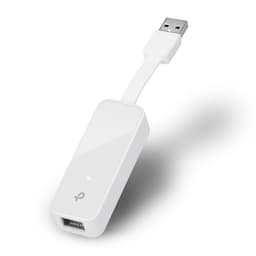
Every few months, someone at TP-Link's marketing department presumably sits down and thinks: how do we explain to a normal person why they should care about AC1300? The answer, honestly, is that most people don't need to understand the number. They just need their desktop PC to stop falling off the network, or they've moved house and realised the ethernet socket is on the wrong wall. The TP-Link AC1300 USB WiFi Adapter, sold as the Archer T3U, is the answer to a very specific, very practical question: how do I add decent dual-band Wi-Fi to a machine that doesn't have it, without spending a fortune or fiddling with a PCIe card?
With over 17,500 owner reviews averaging 4.4 stars, this is one of the most widely bought USB Wi-Fi adapters in the UK. That's not marketing fluff, that's a meaningful signal. But a big review count can hide a lot of nuance, so let's look at what the spec actually delivers, where owners run into trouble, and whether the Archer T3U is genuinely the right pick for your situation or whether you'd be better served by something else.
Short answer: for a budget desktop adapter that needs to pull in a 5GHz signal and stay reasonably stable, it's a solid buy. But there are some real caveats around driver behaviour and the tiny antenna design that you should know before you click add to basket.
Core Specifications
The Archer T3U is a Wi-Fi 5 (802.11ac) dual-band USB adapter. That means it can connect to both the 2.4GHz and 5GHz bands on your router, which is the single most important thing a budget adapter can offer. The AC1300 rating is the theoretical combined maximum across both bands: 400Mbps on 2.4GHz and 867Mbps on 5GHz. Nobody will ever see those numbers in real use. What matters is that the 5GHz band is there, and it supports 80MHz channel width, which means it can actually make use of a half-decent modern router.
The adapter connects via USB 3.0, which is important because USB 2.0 caps out at around 480Mbps theoretical throughput. Given that the 5GHz band alone is rated at 867Mbps theoretical, you'd be bottlenecking yourself on a USB 2.0 port. Most PCs built in the last decade have USB 3.0, but it's worth double-checking before you buy. The physical design is a compact dongle with a small fixed antenna, not a folding external one. That matters for placement, and we'll come back to it.
MU-MIMO (Multi-User, Multiple Input, Multiple Output) is listed as supported, which means the adapter can theoretically handle multiple simultaneous data streams rather than taking turns. On a single client device like a desktop PC, the practical benefit of MU-MIMO is limited compared to a router serving dozens of clients, but it's a sign the hardware isn't completely bottom-of-the-barrel. There's no OFDMA here, which is a Wi-Fi 6 feature and not expected at this price or standard. Windows 11, 10, 8.1, 8, 7, and XP are all listed as supported, as is Mac OS X 10.9 through 10.14. Linux support is not officially listed, which matters if that's your platform.
| Specification | Detail |
|---|---|
| Wi-Fi Standard | Wi-Fi 5 (802.11ac/a/b/g/n) |
| Frequency Bands | Dual-band: 2.4GHz and 5GHz |
| Max Theoretical Speed | AC1300 (400Mbps on 2.4GHz + 867Mbps on 5GHz) |
| Channel Width | Up to 80MHz on 5GHz |
| MU-MIMO | Yes |
| OFDMA | No (Wi-Fi 6 feature, not applicable) |
| USB Standard | USB 3.0 |
| Antenna | Fixed internal antenna (compact dongle form) |
| OS Support | Windows 11/10/8.1/8/7/XP, Mac OS X 10.9 to 10.14 |
| Dimensions | Compact dongle (no folding external antenna) |
| Price | £26.83 |
| Owner Rating | ★★★★☆ (4.4) (17,525 reviews) |

Real-World Coverage and Signal Reach
This is a USB adapter, not a router, so coverage here means something different: it's about how well the adapter can pick up your router's signal from wherever your PC sits, not how far the adapter broadcasts. And this is where the compact dongle design becomes relevant. A small fixed antenna, tucked into the back of a PC tower, potentially surrounded by metal chassis, is not going to pull in signal as well as a larger adapter with an external folding antenna, or a proper PCIe card with external antennas that sit above the desk.
Owner reports consistently flag this. When the Archer T3U is used in a USB port on the front of a desk, or extended away from the tower on a short USB cable, signal quality improves noticeably. Plugged directly into the back of a desktop tower, especially one that's tucked under a desk or inside a cabinet, owners report weaker signal pickup, particularly on 5GHz. This isn't a fault exactly, it's physics. The 5GHz band has shorter range and less wall penetration than 2.4GHz anyway, and a small antenna in an awkward position makes that worse. If your router is in the same room or the next room with a clear line of sight, you'll be fine. If you're trying to reach across two floors through solid brick, the T3U's compact form will struggle more than a larger adapter would.
The 2.4GHz band is more forgiving. Owners in the same general area as their router but not in the same room report stable 2.4GHz connections with no major complaints. For basic browsing, streaming, and light use, 2.4GHz at this range is perfectly adequate. The 5GHz band, when conditions are right, is where you get the speed benefit, but it requires better placement. TP-Link's own product page suggests using a USB extension cable to position the adapter away from the tower, and that's genuinely good advice based on what owners report.
Sustained Speed Under Load
The AC1300 label on the box is the combined theoretical maximum across both bands simultaneously, which is not how a single device works. Your PC connects to one band at a time. So realistically, you're looking at a maximum of 867Mbps theoretical on 5GHz, and 400Mbps theoretical on 2.4GHz. In practice, real-world throughput is always lower than theoretical maximums, because of signal attenuation, interference, protocol overhead, and the distance between the adapter and the router. Expect actual throughput to be a fraction of those headline numbers in typical home conditions.
What owners consistently report is that for the tasks most people are actually doing, the T3U is more than fast enough. Streaming 4K content, video calls, general browsing, downloading games, these all work without issue when the adapter has a decent signal. Where owners do report problems is in edge cases: very high sustained throughput over extended periods, or use cases where the adapter is being pushed hard while also dealing with a marginal signal. A small number of owners report the adapter warming up during heavy sustained use, which is normal for compact USB adapters but if you're planning to run it flat-out for hours.
The USB 3.0 connection is the right call here. USB 2.0's theoretical ceiling of 480Mbps would actually become a bottleneck if you were consistently hitting the upper end of the 5GHz band's throughput. In practice, most home broadband connections in the UK are still well under 500Mbps, so USB 2.0 wouldn't be a bottleneck for most people's actual internet speeds. But for local network transfers, the USB 3.0 headroom matters. It's a sign TP-Link didn't cut that particular corner, which is reassuring at this price point.
Extension, Backhaul, and Network Architecture
The T3U is a client adapter, not a router, not an extender, and not a mesh node. So there's no backhaul to discuss in the traditional sense. What's relevant here is how this adapter fits into your existing network architecture, and whether it's the right tool for what you're trying to do. If you're adding Wi-Fi to a desktop PC that currently has no wireless capability, this is exactly the right category of product. If you're trying to extend your network's coverage to a new room, a USB adapter on a PC doesn't help with that at all. You'd want a range extender or an additional mesh node for that job.
Where the network architecture question does matter is in how you use the T3U once it's installed. If your router supports band steering (automatically pushing clients to the best band), the T3U will participate in that. If your router has a dedicated 5GHz network with a separate SSID, you can manually connect the T3U to that for better throughput. Some owners report that letting the adapter auto-select the band can result in it sticking to 2.4GHz even when 5GHz is available and would be better. Manually selecting the 5GHz network in Windows is a simple fix, but You may need to do it.
There's also the question of what happens when you're using this on a network with a lot of connected devices. The T3U is a single client device; it doesn't affect how your router manages other clients. But if your router is already struggling with device capacity, adding another client isn't going to help. The adapter itself handles one connection at a time, as you'd expect. MU-MIMO on the adapter side means it can benefit from a MU-MIMO capable router that's serving multiple streams simultaneously, but the practical gain for a single desktop PC is modest compared to the benefit MU-MIMO brings on the router side.
Device Capacity and Busy Network Behaviour
As a client adapter, the T3U doesn't manage device capacity itself, that's your router's job. But it's worth understanding how the T3U behaves on a busy home network, because a lot of people buying this are adding it to a household where the router is already juggling phones, laptops, smart TVs, consoles, and a growing collection of smart home devices. Thirty to fifty connected clients is genuinely normal in a modern UK home, and cheap routers can start to struggle with that load.
The T3U's MU-MIMO support means it can take advantage of a router that's simultaneously serving multiple clients without waiting in a queue. On a Wi-Fi 5 (802.11ac) network with a MU-MIMO capable router, this matters in practice. On an older single-user MIMO router, the T3U will still work fine, it just won't benefit from the multi-stream capability. What owners don't report is the adapter itself causing network congestion or behaving badly on a busy network. It connects, it does its job, and it doesn't interfere with other devices. That's about as much as you can ask of a client adapter.
One thing for people with very busy networks: if your broadband is being hammered by multiple 4K streams and someone's gaming at the same time, the bottleneck is almost certainly your router or your broadband connection, not the T3U. The adapter will deliver whatever throughput your router and ISP can provide, up to its own theoretical ceiling. If you're seeing slow speeds on your desktop after installing the T3U, check your router's load before blaming the adapter. A surprising number of negative owner reviews for USB adapters turn out to be router or ISP issues on closer inspection.
Wi-Fi Standard and Future-Proofing
The Archer T3U is a Wi-Fi 5 (802.11ac) device. Not Wi-Fi 6, not Wi-Fi 6E, definitely not Wi-Fi 7. For a USB adapter at this price, that's completely fine. Here's why: the vast majority of home routers in the UK are still Wi-Fi 5, and even on a Wi-Fi 6 router, a Wi-Fi 5 client adapter will connect and work without issue. The router handles the newer standard; the adapter just needs to be compatible, and Wi-Fi 5 is compatible with any modern router.
Should you pay more for a Wi-Fi 6 USB adapter? Honestly, for most people, no. Wi-Fi 6's headline benefits, OFDMA and better MU-MIMO, are most meaningful on busy networks with many simultaneous clients. A single desktop PC connecting to a home router doesn't stress the network in a way that makes Wi-Fi 6 on the client side noticeably better in day-to-day use. The real-world speed difference between a good Wi-Fi 5 connection and a Wi-Fi 6 connection on a typical UK broadband line is negligible. Your broadband speed is almost certainly the bottleneck, not the Wi-Fi standard.
Future-proofing is a fair concern though. If you're planning to upgrade to a Wi-Fi 6 or Wi-Fi 6E router in the next year or two, a Wi-Fi 6 USB adapter would let you take advantage of that upgrade. But Wi-Fi 6 USB adapters cost more, and the practical benefit on a single desktop PC is limited. If you're buying the T3U to solve a specific problem right now, and your current router is Wi-Fi 5, the T3U is the sensible choice. If you're building a new machine and planning a full network upgrade, it might be worth stepping up. But that's a pretty specific situation, and most people reading this aren't in it.
Features and QoS
This is a USB client adapter, so the feature set is intentionally minimal. There's no QoS (Quality of Service) on the adapter itself, no parental controls, no guest network, no VPN client. All of those features live on your router, not on the adapter. What the T3U does offer is dual-band selection, MU-MIMO support, and compatibility with WPA3 security on networks that support it, though the listing primarily emphasises WPA2. The adapter supports the standard Wi-Fi security protocols you'd expect: WPA, WPA2, and WEP (though WEP is ancient and you shouldn't be using it).
The TP-Link utility software that comes with the adapter (or can be downloaded from TP-Link's support page) gives you a basic interface for scanning networks, connecting, and checking signal strength. Most Windows users will just use the built-in Windows network manager, which works perfectly well with the T3U once the drivers are installed. The TP-Link utility is optional. Mac users similarly have the option to use the native macOS network tools once the driver is installed.
One feature that's genuinely useful, if not glamorous, is the soft AP mode mentioned in some versions of the T3U listing. This lets you use the adapter as a wireless hotspot, sharing a wired internet connection over Wi-Fi. It's not a common use case for a desktop adapter, but if you're in a situation where you have a wired connection and need to share it wirelessly, it's a handy option. Whether this is available depends on the driver version and Windows version you're running. Owners who've used it report it works, though it's not a primary selling point.
Firmware, App, and Security Updates
Driver stability is the main story here, and it's the area where owner reviews show the most variation. The majority of owners report a smooth install: download the driver from TP-Link's website or use the included CD (yes, some versions still include a CD, which is either charming or maddening depending on whether your PC has an optical drive), plug in the adapter, and it works. But a meaningful minority of owners, particularly on Windows 10 and Windows 11, report driver issues. These range from the adapter not being recognised initially, to the connection dropping intermittently, to the adapter needing to be unplugged and replugged after the PC wakes from sleep.
The sleep/wake issue is the most commonly reported problem. Windows power management sometimes doesn't properly reinitialise USB devices after sleep, and USB Wi-Fi adapters are particularly susceptible to this. The fix is usually to disable USB selective suspend for the adapter in Windows Device Manager, or to set the power management on the USB root hub to not allow Windows to turn off the device to save power. It's a two-minute fix once you know about it, but it's annoying if you don't. TP-Link's support documentation covers this, and a quick search of their support forums will find the answer.
TP-Link does release driver updates for the T3U, and the most recent drivers available on their support page are more stable than the ones that shipped with early units. If you're having any issues, the first thing to do is download the latest driver directly from TP-Link's website rather than relying on whatever Windows Update finds or whatever's on the CD. For Mac users, the officially supported range stops at macOS 10.14 (Mojave). If you're on Catalina, Big Sur, Monterey, Ventura, or Sonoma, you're outside the official support window, and while some owners report using third-party drivers successfully, TP-Link doesn't officially support those configurations.
Setup and Management
For most Windows users, setup is genuinely straightforward. Plug in the adapter, Windows will attempt to install a driver automatically. If that works, you're done. If it doesn't (and sometimes it doesn't, particularly on Windows 11), head to TP-Link's support page, download the latest driver package, run the installer, and you're sorted. The process takes five minutes if everything goes smoothly, maybe fifteen if you need to troubleshoot. That's about as good as it gets for a USB adapter.
The TP-Link utility is a simple scan-and-connect interface. It's not particularly pretty, but it's functional. You can see available networks, their signal strength, and the band they're on (2.4GHz or 5GHz), which is useful if you want to make sure you're connecting to the right one. Most owners skip the utility entirely and just use Windows' built-in network manager, which is fine. The utility is more useful if you want to use the soft AP mode or if you want a clearer view of signal quality.
For non-technical buyers, the key thing to know is that this is not a plug-and-play device in the same way a USB storage drive is. You will need to install a driver. That's normal for network adapters, and it's not difficult, but it does require downloading a file from the internet and running an installer. If the person setting this up is comfortable with basic Windows tasks, they'll be fine. If they're not, it's worth being nearby to help. Once it's set up, day-to-day management is zero-effort: Windows handles the connection automatically, and you don't need to touch the TP-Link utility again unless something goes wrong.
Ports and Connectivity
The T3U connects via a single USB 3.0 Type-A port. That's the standard rectangular USB port that's been on PCs for years. USB 3.0 ports are usually marked with a blue plastic insert inside the port, though not always. The adapter is a compact dongle, meaning it plugs directly into the USB port and doesn't stick out much. That's good for cable management and for not getting knocked, but it does mean the antenna is very close to the PC chassis, which can affect signal quality as discussed earlier.
There's no ethernet port on the adapter, obviously. It's a wireless adapter. There are no additional USB ports on the adapter itself either, so it does occupy one of your PC's USB ports. On a modern desktop with six or more USB ports, that's rarely a problem. On a laptop with only two or three USB ports, it might be more of an issue, though this adapter is primarily aimed at desktop PCs that lack built-in Wi-Fi. If you're adding Wi-Fi to a laptop, you'd usually be better served by a laptop with built-in Wi-Fi or a USB-C adapter, depending on your ports.
TP-Link recommends using a USB extension cable to position the adapter away from the PC chassis for better signal reception. A short USB 3.0 extension cable (30cm to 60cm) costs very little and can make a meaningful difference to signal quality, particularly if your PC is under a desk or in an enclosed space. Some owners buy the T3U specifically because of its compact size, then use an extension cable to position it optimally. It's a sensible approach and worth factoring into your setup. The adapter doesn't ship with an extension cable, so you'd need to source one separately.
How It Compares
The budget USB Wi-Fi adapter market is crowded, and the T3U has a couple of obvious competitors worth comparing. The TP-Link Archer T2U Plus is the T3U's sibling, offering AC600 speeds (150Mbps on 2.4GHz, 433Mbps on 5GHz) but with a larger folding external antenna. The antenna design is the key difference: the T2U Plus's external antenna generally picks up signal better at range, particularly through walls, even though its theoretical maximum speed is lower. If signal reach is your primary concern and raw throughput is secondary, the T2U Plus is worth a look.
The Netgear A6210 is a step up in both price and performance, offering AC1200 dual-band speeds with a larger form factor and a more substantial antenna. Netgear's driver support has historically been more stable on Windows than some TP-Link adapters, and the A6210 is well-regarded by owners who've had driver grief with other adapters. It costs more, but if you've already had a bad experience with USB adapter drivers and want something that just works, the extra spend might be worth it.
| Feature | TP-Link Archer T3U (AC1300) | TP-Link Archer T2U Plus (AC600) | Netgear A6210 (AC1200) |
|---|---|---|---|
| Wi-Fi Standard | Wi-Fi 5 (802.11ac) | Wi-Fi 5 (802.11ac) | Wi-Fi 5 (802.11ac) |
| Max Theoretical Speed | AC1300 (400 + 867Mbps) | AC600 (150 + 433Mbps) | AC1200 (300 + 867Mbps) |
| Antenna Design | Fixed internal (compact dongle) | External folding antenna | External folding antenna |
| USB Standard | USB 3.0 | USB 2.0 | USB 3.0 |
| MU-MIMO | Yes | No | Yes |
| OS Support | Windows 11/10/8.1/8/7/XP, Mac 10.9-10.14 | Windows 10/8.1/8/7/XP, Mac 10.9-10.14 | Windows 10/8.1/8/7, Mac 10.9+ |
| Driver Stability (owner reports) | Generally good, occasional sleep/wake issues | Generally good | Very good |
| Price | £26.83 | Slightly lower | Higher |
The comparison makes the T3U's position clear. It sits in the middle of this bracket: faster theoretical maximum than the T2U Plus, better USB standard than the T2U Plus, but with a compact antenna design that can be a disadvantage in challenging signal environments. The Netgear A6210 beats it on antenna design and driver reputation, but costs more. For most people in a typical UK home with the router in the same room or the next room, the T3U is the sensible middle ground.

Final Verdict
The TP-Link AC1300 USB WiFi Adapter (Archer T3U) does what it says on the tin, which is more than you can say for a lot of budget networking kit. It adds dual-band Wi-Fi 5 to a desktop PC that doesn't have it, it connects via USB 3.0 so it doesn't bottleneck itself, it supports MU-MIMO, and it's compatible with every version of Windows you're likely to encounter. Over 17,500 owners have bought it, and the 4.4-star average tells you that the vast majority of them are happy with it.
The caveats are real though. The compact dongle form means the antenna is small and potentially obstructed by your PC chassis. If you plug it into the back of a tower that lives under a desk, you may find signal quality disappointing, particularly on 5GHz. The fix is simple (use a short USB extension cable to position the adapter somewhere with a clear line of sight to your router), but it's upfront. Driver issues on Windows 11, particularly the sleep/wake problem, affect a minority of users, and the Mac support stops at Mojave officially.
Who should buy this? Anyone adding Wi-Fi to a desktop PC that currently has none, where the router is in the same room or a nearby room, and where the budget is tight. It's particularly good value if your broadband is under 200Mbps, because you'll never come close to the adapter's ceiling. It's also a decent temporary fix while you wait for an electrician to run ethernet, or while you figure out whether a PCIe card is worth the hassle of opening the case.
Who should skip it? If your PC is far from the router, separated by multiple walls or floors, the compact antenna will struggle. In that case, look at the TP-Link Archer T2U Plus for its external antenna, or consider a PCIe Wi-Fi card with proper external antennas, which will outperform any USB adapter in a difficult signal environment. If you're on a recent Mac (Catalina or later), look elsewhere entirely. And if you've already had bad experiences with USB adapter drivers and just want something that installs without drama, the Netgear A6210 has a stronger reputation for driver reliability, even if it costs a bit more.
The honest don't-overspend line: if your broadband is under 100Mbps and your router is in the same room, the cheaper TP-Link Archer T2U (AC600) will do the job just as well for less money. The T3U's extra headroom only matters if you're on a fast connection or doing local network transfers.
Editorial score: 7.5 out of 10. Good value, does the job, but the antenna design and driver quirks stop it being a perfect recommendation.
What works. What doesn’t.
5 + 4What we liked5 reasons
- Dual-band (2.4GHz and 5GHz) at a budget price
- USB 3.0 connection avoids bandwidth bottlenecking
- MU-MIMO support for better performance on capable routers
- Wide Windows compatibility including Windows 11
- Compact form factor suits most desktop setups
Where it falls4 reasons
- Fixed internal antenna struggles when PC is tucked away or far from router
- Driver sleep/wake issues affect a minority of Windows 10/11 users
- Mac support officially stops at macOS 10.14 Mojave
- No Linux support listed
Full specifications
6 attributes| Antennas | 0 |
|---|---|
| Launch year | 2019 |
| Mesh capable | false |
| TOP speed mbps | 1300 |
| Type | router |
| Wifi standard | Wi-Fi 5 |
Frequently asked
5 questions01Will the TP-Link AC1300 USB WiFi Adapter (Archer T3U) reach my router from the other end of the house?+
That depends heavily on your home's layout and construction. The T3U's compact dongle design means its antenna is small, and if it's plugged into the back of a tower PC tucked under a desk, signal pickup will be limited. Owner reports suggest it works well when the router is in the same room or the next room with a relatively clear path. Through multiple solid walls or across two floors, the compact antenna will struggle, particularly on the 5GHz band. Using a short USB 3.0 extension cable to position the adapter somewhere with a clearer line of sight to the router makes a meaningful difference, and TP-Link themselves recommend this approach.
02Does the TP-Link AC1300 USB WiFi Adapter (Archer T3U) support Wi-Fi 6E or Wi-Fi 7?+
No. The Archer T3U is a Wi-Fi 5 (802.11ac) device. It does not support Wi-Fi 6, Wi-Fi 6E, or Wi-Fi 7. For the vast majority of home users, this is not a problem. Wi-Fi 5 is compatible with all modern routers, and the practical speed difference between Wi-Fi 5 and Wi-Fi 6 on a single desktop PC connected to a typical UK broadband line is negligible. Your broadband connection is almost certainly the bottleneck, not the Wi-Fi standard. If you're planning a full network upgrade to Wi-Fi 6 or Wi-Fi 6E and want to take advantage of those standards on your desktop, you'd need a Wi-Fi 6 USB adapter, but for most people the T3U is more than adequate.
03Is the TP-Link AC1300 USB WiFi Adapter (Archer T3U) a mesh device or a range extender?+
Neither. The Archer T3U is a client adapter that adds Wi-Fi connectivity to a single desktop PC. It does not extend your network's coverage, create a mesh node, or act as a range extender. If you need to extend Wi-Fi coverage to a new area of your home, you'd want a separate range extender or mesh node. The T3U simply gives your PC wireless access to your existing network, the same way built-in Wi-Fi does on a laptop.
04Is the TP-Link AC1300 USB WiFi Adapter (Archer T3U) easy to set up and reliable day-to-day?+
Setup is straightforward for most Windows users: install the driver (download the latest version from TP-Link's website rather than relying on the CD or Windows Update), plug in the adapter, and connect to your network. The majority of owners report no issues. The most commonly reported problem is the adapter losing connection after the PC wakes from sleep, which is a Windows power management issue rather than a fault with the adapter. The fix is to disable USB selective suspend for the device in Windows Device Manager. Once set up correctly, day-to-day reliability is generally good. Mac users should note that official support ends at macOS 10.14 Mojave.
05What warranty and returns apply to the TP-Link AC1300 USB WiFi Adapter (Archer T3U)?+
Warranty details are not confirmed in the verified product listing data. TP-Link generally offers a 24-month warranty on their networking products sold in the UK, but you should verify this at point of purchase. Regardless of manufacturer warranty, purchases made through Amazon are covered by Amazon's standard 30-day returns policy and the A-to-Z Guarantee, which provides a meaningful safety net if the product arrives faulty or not as described.