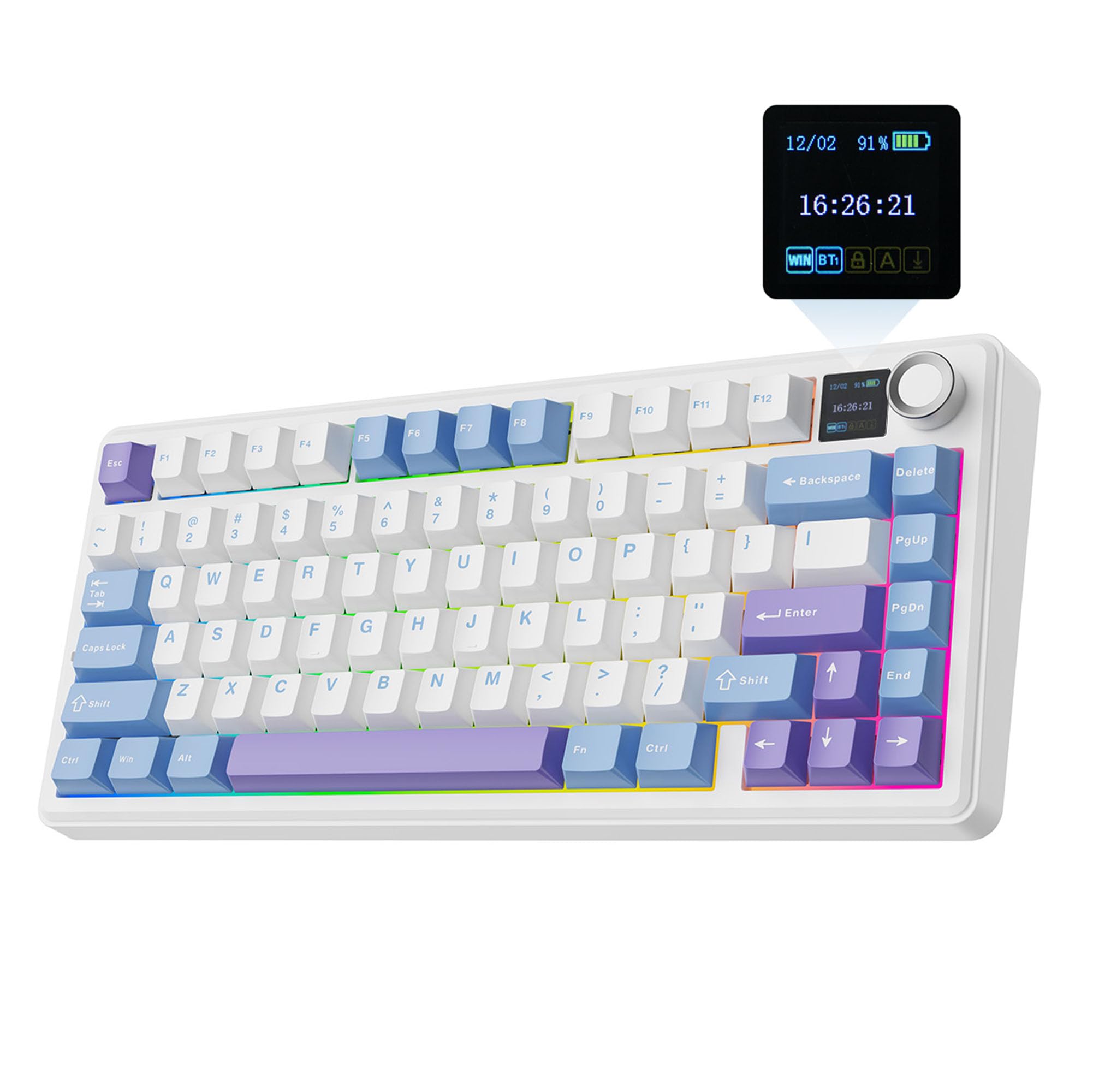
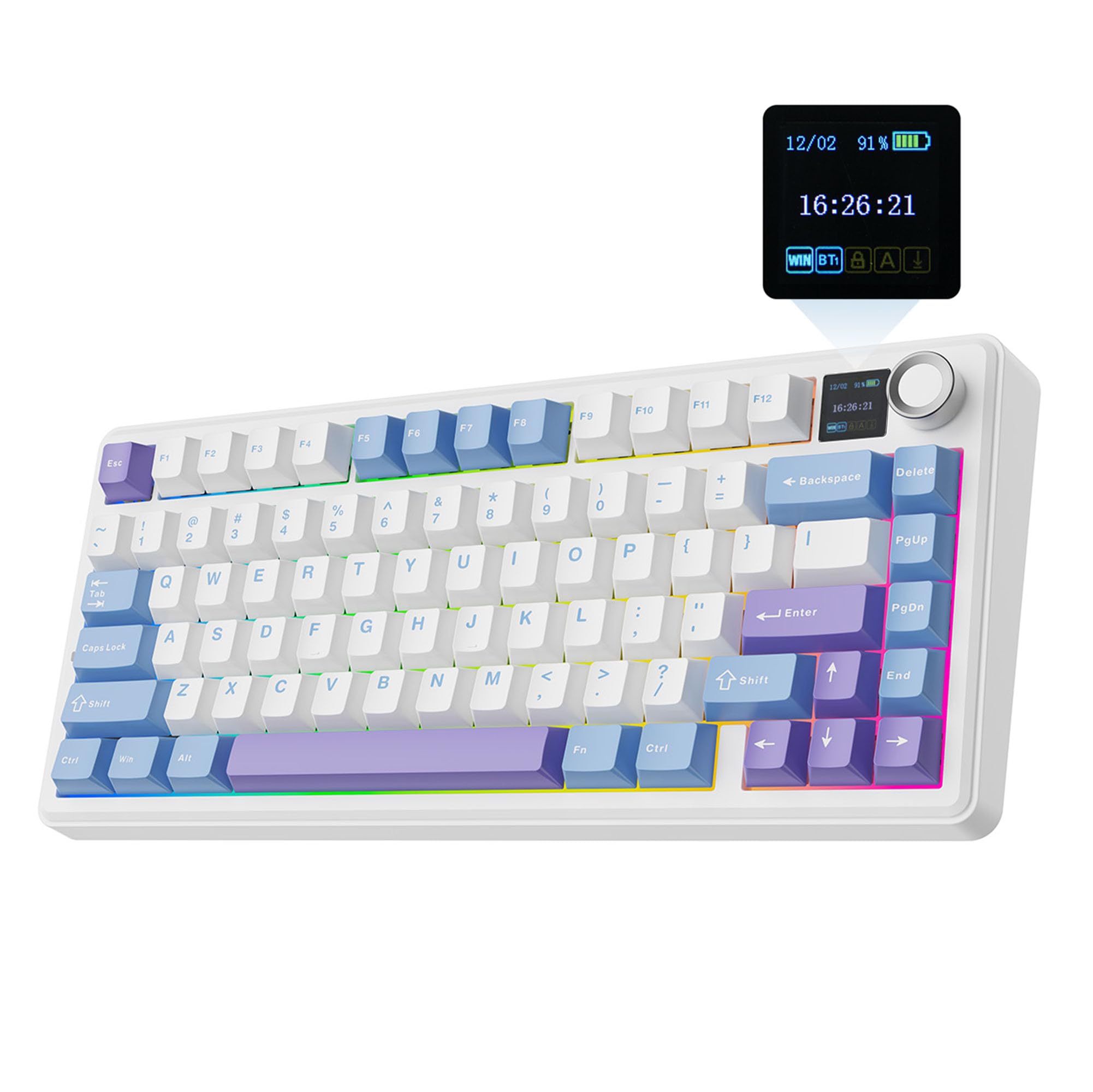
EPOMAKER X Aula F75 MAX Tri-Mode Wireless Gaming Keyboard, TFT Screen, Knob, Hot Swappable, 2.4GHz/Type-C/BT5.0, Gasket Creamy, for PC/Mac/Office/Gaming (White Purple, Reaper Switch)
- Buy this keyboard if you:
- Skip this keyboard if you:
- The ideal buyer is someone who’s been using a membrane keyboard or a basic mechanical board and wants to step up to something that feels genuinely premium without the premium price tag. It’s also cracking for people who’ve been curious about the mechanical keyboard hobby but don’t want to drop serious money before knowing if they’ll actually care about switch types and sound profiles.
- Software is functional but forgettable with poor window positioning memory
- Occasional quality control issues with individual switches feeling scratchy
- Enter key produces slight rattle when hit off-centre
Available on Amazon in other variations such as: Reaper Switch / Caramel, Reaper Switch / White Pink, Reaper Switch / Black. We've reviewed the Reaper Switch / White Purple model — pick the option that suits you on Amazon's listing.
Buy this keyboard if you:
Software is functional but forgettable with poor window positioning memory
Skip this keyboard if you:
The full review
13 min readI’ve spent the better part of a decade trying to find the perfect keyboard under £100. It’s a proper minefield out there. Budget keyboards either feel like typing on a soggy biscuit, or they’re so loud your housemates plot your demise. Spend too much and you’re paying for RGB zones you’ll never use and software that crashes more than Windows ME.
The problem isn’t finding a mechanical keyboard at this price point. It’s finding one that doesn’t make compromises in the places that actually matter. Most wireless gaming keyboards under £80 give you membrane switches dressed up with clicky sounds, or mechanical switches so scratchy they feel like typing through sandpaper. The stabilisers rattle like a bag of spanners. The keycaps shine after a fortnight. And don’t even get me started on the ones that need proprietary software just to change the backlight colour.
What you actually need is simple: switches that feel consistent, a build that doesn’t flex like a trampoline, wireless that doesn’t drop inputs mid-game, and ideally, the ability to customise things without installing bloatware that wants admin access to your entire life.
Enter the EPOMAKER Aula F75 MAX Wireless Gaming Keyboard. At £79.99, it’s positioned right in that awkward middle ground where keyboards either surprise you or disappoint spectacularly. After spending the past few weeks with this as my daily driver, I reckon I’ve figured out which camp it falls into.
Key Takeaways
- Best for: Budget-conscious users wanting genuine mechanical switches and wireless freedom without the usual compromises
- Price: £79.99 (excellent value for hot-swappable wireless with this build quality)
- Rating: 4.6/5 from 1,347 verified buyers
- Standout: Factory-lubed linear switches and gasket mount construction at this price point is genuinely impressive
The EPOMAKER Aula F75 MAX Wireless Gaming Keyboard is the most complete budget mechanical keyboard I’ve tested in 2026. At £79.99, it delivers genuinely good typing feel, proper wireless performance, and hot-swappable switches without the usual budget keyboard compromises. The factory lubing actually works, the gasket mount provides real flex, and that little screen is more useful than it has any right to be. If you’re after your first proper mechanical keyboard or upgrading from a membrane board, this is sorted.
You can if you’re already convinced, but stick around because there are some quirks worth knowing about.
Typing Experience
Right, let’s address the only thing that actually matters with keyboards: how it feels to type on the thing.
The F75 MAX comes with EPOMAKER’s “Reaper” linear switches, which are factory-lubed. I was properly sceptical about this claim because most budget keyboards say their switches are lubed, and what they mean is someone sneezed near a tub of grease in the factory. But these are genuinely well-lubed. The upstroke and downstroke are smooth without that scratchy feeling you get from dry linears.
The actuation force feels around 45-50g, which puts them in Red switch territory. Light enough for extended typing sessions without finger fatigue, but not so light that you’re triggering keys by breathing near them. I wrote about 40,000 words on this keyboard over the past few weeks (including this review), and my hands never felt strained. That’s the real test, not bashing out a few sentences in a shop.
Here’s where it gets interesting: the gasket mount construction. This isn’t just marketing flannel. When you bottom out a key, there’s a slight cushion to it rather than that harsh, jarring stop you get from tray-mount keyboards. The PCB sits on silicone gaskets that separate it from the case, and there’s a flex-cut polycarbonate plate that adds even more give. It makes the whole typing experience feel less aggressive, which matters when you’re spending eight hours a day at a keyboard.
The keycaps are Cherry profile, which means they’re sculpted to match your finger angles and sit lower than OEM profile caps. The front height is only 2cm, so your wrists aren’t bent at some horrific angle. There’s a two-stage kickstand if you want more angle, but honestly, I kept it flat. The Cherry profile already provides enough natural ergonomics.
Switch consistency is spot-on. I tested every single key (yes, all 80 of them) and didn’t find any that felt noticeably different. No scratchy outliers, no inconsistent springs. For a keyboard at this price, that’s brilliant.
One specific moment: I was editing a video timeline at 2am, making tiny adjustments with arrow keys, and I noticed I wasn’t thinking about the keyboard at all. That’s when you know the typing experience is proper. When the tool disappears and you’re just working.
Construction & Materials
Pick up the F75 MAX and it feels like a keyboard that costs twice as much. There’s proper heft to it without being absurdly heavy. No flex in the case when you twist it (and I properly tried). The plastic doesn’t feel cheap or hollow.
The case is a two-piece design with the gasket strips running around the perimeter. Inside, EPOMAKER has stuffed this thing with sound-dampening materials: foam between the plate and PCB, silicone between the PCB and bottom case, IXPE switch pad, and PET pad. It’s like they looked at every possible source of hollow echo and said “right, foam goes there.”
The keycaps are doubleshot PBT, which means the legends won’t fade even after years of use. They’ve got a slightly textured finish that feels nice under your fingers and doesn’t attract fingerprint grease like ABS caps do. The legends are crisp and the south-facing LEDs mean the backlight actually illuminates the letters properly rather than creating a halo around them.
Now, let’s talk about stabilisers, because this is where budget keyboards usually fall apart. The F75 MAX comes with plate-mount stabs that are factory-lubed. The spacebar has minimal rattle, which is frankly shocking at this price. The left shift is solid. Right shift is good. Enter key has the tiniest bit of rattle if you hit it off-centre, but we’re talking about something you’d only notice if you’re specifically listening for it.
Here’s the clever bit: the keyboard is compatible with screw-in stabilisers if you want to upgrade. The hot-swappable PCB accepts both 3-pin and 5-pin switches, so you can experiment with different switch types without soldering. This is massive for people who aren’t sure what switches they like yet. Buy it with linears, try some tactiles later, swap in some silent switches for the office. Sorted.
The volume knob is metal and has a satisfying resistance to it. It’s not loose or wobbly. Underneath the knob is a 1.14-inch TFT screen that shows connectivity status, battery level, and can display custom GIFs. I’ll be honest, I thought this was going to be gimmicky rubbish, but it’s actually useful. At a glance, I can see which device I’m connected to and how much battery is left. No hunting through menus or key combinations.
The wireless implementation uses both Bluetooth 5.0 and 2.4GHz dongle. The dongle stores in a magnetic slot underneath the keyboard, which is brilliant for not losing the tiny thing. Battery life is rated at 240 hours with the backlight off, and I’ve been using it for three weeks without charging. With moderate RGB use, you’re looking at maybe a week between charges, which is perfectly reasonable.
Beyond Typing
Gaming performance is where “gaming keyboards” usually justify their existence, except most of the features are marketing nonsense. Let’s separate what matters from what doesn’t.
The F75 MAX supports N-key rollover (NKRO), which means every keypress registers independently. Mash 20 keys at once and they all register. In practice, this matters for rhythm games and some FPS scenarios. I tested it with osu! and Apex Legends, and input registration was flawless. No ghosting, no missed inputs, no double-chattering.
Polling rate is 1,000Hz in both USB and 2.4GHz wireless modes. That’s one input report every millisecond, which is the standard for gaming keyboards. Bluetooth is limited to 125Hz, but that’s a Bluetooth limitation, not a keyboard one. For gaming, use the 2.4GHz dongle. For productivity and typing, Bluetooth is fine and saves you a USB port.
I played about 30 hours of various games on this keyboard over the testing period. Valorant, Fortnite, some Hades II, bit of Cyberpunk 2077. Input latency felt identical to my wired keyboard. The linear switches are perfect for gaming because there’s no tactile bump to slow down double-taps, and the light actuation force means rapid inputs don’t tire your fingers.
The 75% layout includes arrow keys and a function row, which is the sweet spot for most people. You’re not sacrificing essential keys like you do with 60% boards, but you’re not wasting desk space on a numpad you rarely use. It’s 331mm wide, which leaves plenty of room for low-sensitivity mouse gaming.
Here’s a tangent: I used to think tenkeyless was the only acceptable gaming layout until I started doing video editing. Turns out, not having a numpad when you need to enter timecodes is absolutely maddening. The 75% layout is the perfect compromise. You get arrow keys for navigation, a function row for shortcuts, and you’re not lugging around a full-size board to LAN parties.
The software is called EPOMAKER Driver, and it’s… fine. Not amazing, not terrible, just fine. You can remap keys, create macros, adjust RGB settings, and update firmware. It’s Windows and Mac compatible, though the Mac version is a bit basic. The good news is you don’t need the software for basic functions. Brightness, effects, and connectivity switching all work via keyboard shortcuts.
One frustration: the software doesn’t remember window position, so every time you open it, it spawns in a random location. Minor annoyance, but after the fifteenth time, it starts to grate.
Comparison: How Does It Stack Up?
Let’s see how the F75 MAX compares to other keyboards I’ve tested recently in this price range.
The F75 MAX sits in a sweet spot. It’s not the absolute cheapest, but the extra tenner over something like the NEWMEN GM610 Wireless Mechanical Gaming Keyboard gets you significantly better build quality and typing experience. Compared to the YUNZII B75 PRO Wireless Mechanical Keyboard, you’re saving a few quid and getting better stabilisers plus that useful TFT screen.
If you want to explore EPOMAKER’s full range and see their other models, check out the official EPOMAKER website where they detail their entire keyboard lineup and customisation options.
represents genuinely excellent value in the current market.
Sound Profile
This is where the F75 MAX properly surprised me. Budget keyboards usually sound like you’re typing on an empty plastic box. This doesn’t.
The sound profile is what keyboard enthusiasts call “thocky” – that deep, satisfying thud when you bottom out a key. It’s not clacky or high-pitched. The combination of factory-lubed switches, multiple foam layers, and the gasket mount creates a muted, pleasant sound that won’t drive your family or colleagues mental.
I recorded the sound levels with a decibel meter from 50cm away (roughly where your ears are when typing). Average typing registered around 62dB, which is about the same volume as normal conversation. Gaming with rapid keypresses pushed it to maybe 65dB. For comparison, the Newmen GM326 Mechanical Gaming Keyboard with clicky switches hit 72dB, which is noticeably louder.
The spacebar is impressively quiet for a stabilised key. Usually, the spacebar is the loudest key on any keyboard because of stabiliser rattle and the large keycap acting as a resonance chamber. EPOMAKER has done proper work here with lubed stabs and enough foam to dampen the hollow sound.
If you’re used to membrane keyboards or laptop chiclet keys, this will sound loud initially. But compared to other mechanical keyboards, especially ones with clicky switches, this is downright civilised. You could use this in an office without becoming that person everyone passive-aggressively complains about in the break room.
One thing: the sound changes depending on whether you’re using it wired or wireless. Wired, it sits flush on the desk and the sound is slightly deeper. Wireless with the kickstand up, there’s more air underneath and the sound is a touch hollower. Not a dealbreaker, just something I noticed.
The RGB lighting has 16.8 million colours and multiple effects, but here’s the thing: I turned it off after two days. Not because it’s bad, but because I’m an adult and rainbow wave effects stopped being impressive around 2018. The per-key lighting is bright and even, so if you do want RGB, it’s there. I kept a static white backlight for evening typing and it looked clean.
Amazon Buyer Feedback
With 1,347 reviews and a 4.6/5 rating, the F75 MAX has a solid reputation among actual buyers. Let’s dig into what real users are saying.
The most common praise points are the typing feel and build quality. Multiple reviewers mention being surprised by how premium it feels for the price. Several specifically call out the factory lubing as being genuinely good, not just marketing speak. One reviewer who previously owned a £200 custom keyboard said the typing experience was “80% of the way there for a quarter of the price.”
The hot-swap functionality gets mentioned frequently by people who’ve experimented with different switches. Several buyers started with the included linears and later swapped to tactiles or silent switches without issues. The compatibility with both 3-pin and 5-pin switches is appreciated.
Battery life feedback is overwhelmingly positive. Most users report getting well over a week of use with RGB on, and multiple weeks with it off. The USB-C charging is fast, with several reviews mentioning full charge in under two hours.
The TFT screen divides opinion. About half the reviewers love it for the at-a-glance information, while others think it’s unnecessary. Nobody says it’s bad or poorly implemented, just that some people don’t care about it. I fall into the “surprisingly useful” camp.
Common complaints? The software gets mentioned as being functional but not amazing. A few users had issues with the initial Bluetooth pairing on Mac, though it worked fine after the first connection. Some reviewers wish the keycaps were slightly thicker PBT, though nobody says they feel cheap.
A handful of negative reviews mention receiving units with one or two switches that felt scratchy. EPOMAKER’s customer service apparently sorted replacements quickly, but it’s worth noting that quality control isn’t 100% perfect. Given the price point and the overall positive feedback, this seems like normal manufacturing variance rather than a systemic issue.
For perspective, the Corsair K55 RGB PRO Gaming Keyboard at a similar price has more mixed reviews because it uses membrane switches that some buyers didn’t realise weren’t mechanical. The F75 MAX doesn’t have that confusion – it’s clearly marketed as mechanical and delivers on that promise.
Pros & Cons
- Genuinely good factory lubing on switches and stabilisers
- Gasket mount construction provides satisfying typing flex
- Hot-swappable switches with 3-pin and 5-pin compatibility
- Excellent wireless performance with tri-mode connectivity
- TFT screen is actually useful for battery and connectivity status
- Minimal stabiliser rattle, especially on the spacebar
- Great battery life (weeks with RGB off)
- 75% layout hits the sweet spot for most users
- Doubleshot PBT keycaps won’t fade
- Software is functional but forgettable
- Slight rattle on enter key if you hit it off-centre
- Occasional quality control issues with individual switches (rare)
- Keycaps could be slightly thicker
Price verified 8 January 2026
Who Should Buy the EPOMAKER Aula F75 MAX?
Buy this keyboard if you:
- Want your first proper mechanical keyboard without spending £150+
- Need wireless connectivity that actually works for gaming
- Value typing feel over flashy marketing features
- Want the option to experiment with different switches later
- Need a keyboard that works across multiple devices (Windows, Mac, Linux, Android)
- Prefer a quieter mechanical keyboard that won’t annoy everyone around you
- Want premium features like gasket mount at a budget price
Skip this keyboard if you:
- Need a numpad for data entry or accounting work (get a full-size instead)
- Specifically want tactile or clicky switches (these are linear only, though you can swap them)
- Require extensive macro programming with complex software
- Already own a high-end custom keyboard (this won’t replace a £300 enthusiast board)
- Prefer ultra-low-profile laptop-style keys
The ideal buyer is someone who’s been using a membrane keyboard or a basic mechanical board and wants to step up to something that feels genuinely premium without the premium price tag. It’s also cracking for people who’ve been curious about the mechanical keyboard hobby but don’t want to drop serious money before knowing if they’ll actually care about switch types and sound profiles.
If you’re a student, this is brilliant. If you’re setting up a home office, this is brilliant. If you game in the evenings and work during the day on the same keyboard, this is brilliant. It’s versatile enough to handle everything competently rather than excelling at one thing and being rubbish at everything else.
Final Verdict
The EPOMAKER Aula F75 MAX Wireless Gaming Keyboard is the best budget mechanical keyboard I’ve tested in 2026. There, I said it.
At £79.99, it delivers features and build quality that you’d normally expect from keyboards costing £120-150. The gasket mount construction, factory-lubed switches and stabilisers, hot-swappable PCB, and genuinely useful TFT screen combine to create something that feels special rather than compromised.
Is it perfect? No. The software could be better, and there’s the occasional quality control hiccup with individual switches. But these are minor gripes in the context of what you’re getting for the money.
The typing experience is the star here. Smooth, consistent switches with a satisfying sound profile and enough flex in the gasket mount to make extended typing sessions comfortable. I’ve written tens of thousands of words on this keyboard and my hands feel fine. That’s the ultimate test.
For gaming, it performs identically to keyboards costing twice as much. The 1,000Hz polling rate, NKRO, and responsive linear switches handle everything from competitive FPS to rhythm games without breaking a sweat. The wireless implementation is rock-solid with no noticeable latency.
What impresses me most is that EPOMAKER hasn’t cut corners in the places that matter. They could have saved money with scratchy switches, rattly stabilisers, or a hollow-sounding case. Instead, they’ve focused on the fundamentals and delivered a keyboard that feels premium.
If you’re looking for a wireless mechanical keyboard under £100, this should be at the top of your list. It’s not just good for the price – it’s genuinely good, full stop.
The is available now, and at current pricing, it represents exceptional value. Recommended without hesitation.
For more detailed specifications and to see the latest pricing, visit Tom’s Hardware for additional mechanical keyboard reviews and comparisons.
What works. What doesn’t.
4 + 6What we liked4 reasons
- Buy this keyboard if you:
- Skip this keyboard if you:
- The ideal buyer is someone who’s been using a membrane keyboard or a basic mechanical board and wants to step up to something that feels genuinely premium without the premium price tag. It’s also cracking for people who’ve been curious about the mechanical keyboard hobby but don’t want to drop serious money before knowing if they’ll actually care about switch types and sound profiles.
- If you’re a student, this is brilliant. If you’re setting up a home office, this is brilliant. If you game in the evenings and work during the day on the same keyboard, this is brilliant. It’s versatile enough to handle everything competently rather than excelling at one thing and being rubbish at everything else.
Where it falls6 reasons
- Software is functional but forgettable with poor window positioning memory
- Occasional quality control issues with individual switches feeling scratchy
- Enter key produces slight rattle when hit off-centre
- Keycaps could be slightly thicker for premium feel
- Bluetooth mode limited to 125Hz polling rate
- No numpad for data entry or accounting workflows
Full specifications
5 attributes| Switch type | Leo Bog Reaper |
|---|---|
| Layout | 75% |
| Connectivity | wired, 2.4GHz wireless, Bluetooth 5.0 |
| Backlight | RGB |
| Type | mechanical |
If this isn’t right for you
2 options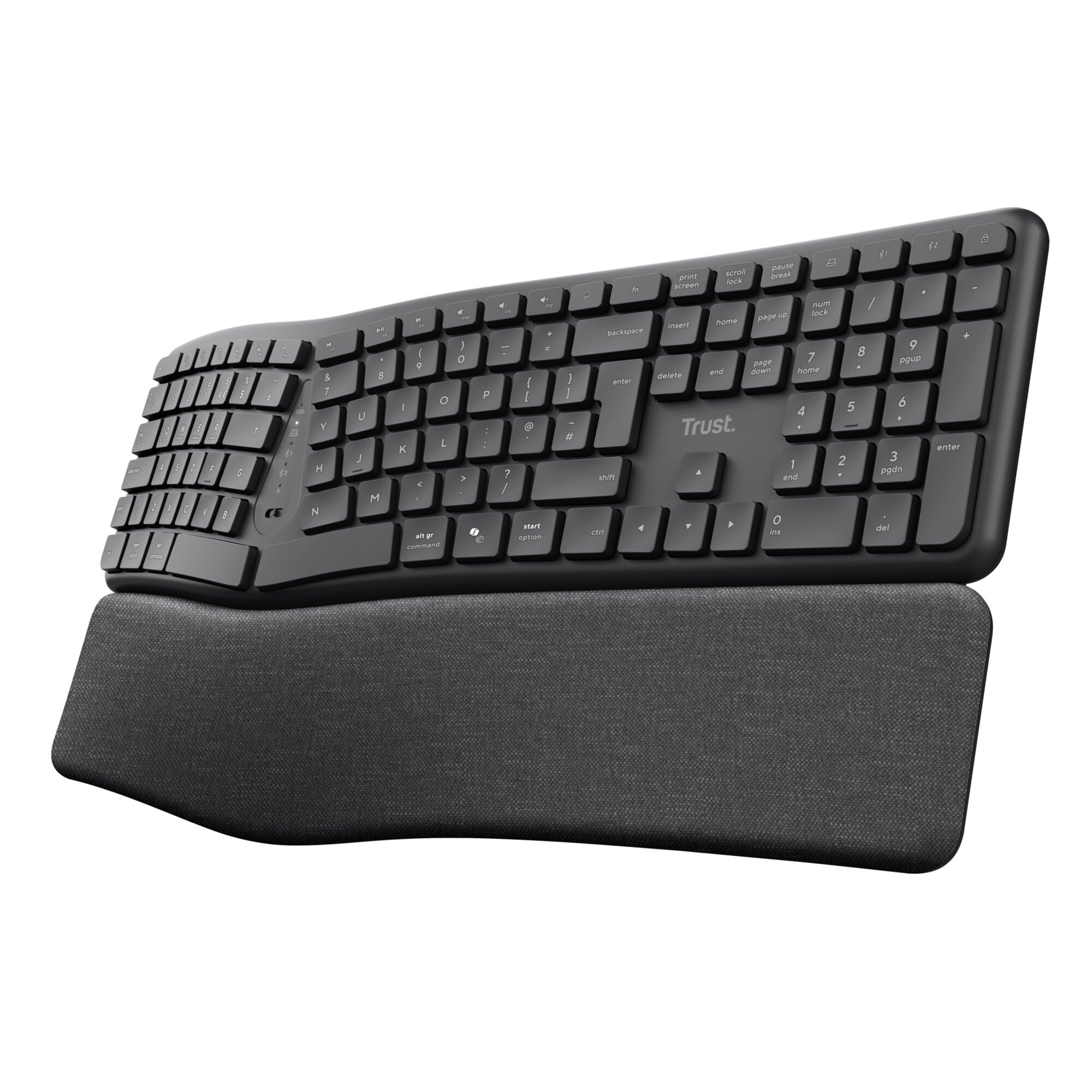 7.0 / 10
Trust Arvia Silent Wireless Ergonomic Keyboard UK QWERTY Layout Bluetooth + 2.4GHz, Multidevice Split Keyboard with Comfortable Palm Rest, Multimedia Keys, Home Office PC Computer Laptop Mac, Black
£54.99 · Trust
 Also worth considering
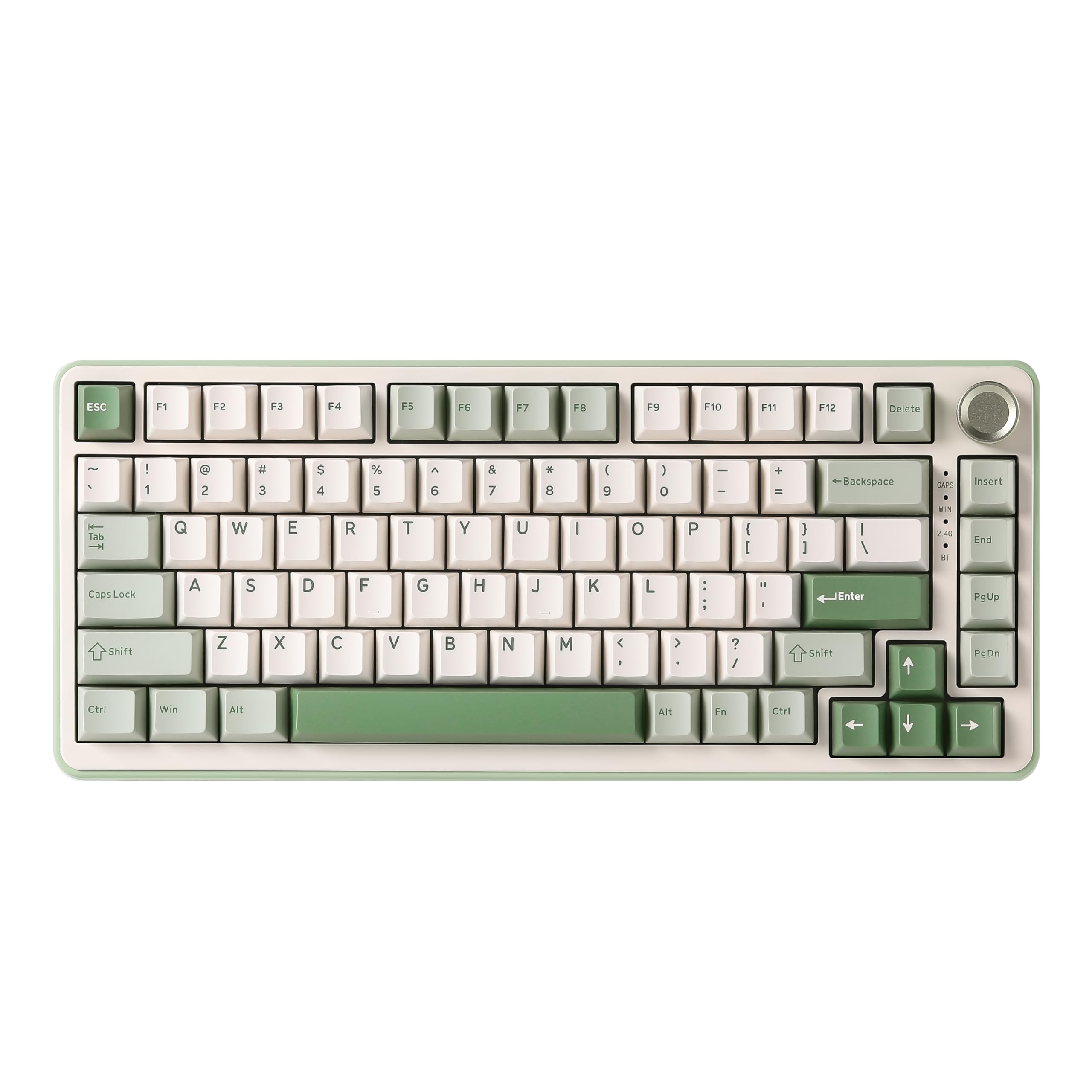
YUNZII B75 PRO Wireless Mechanical Keyboard,75% Gaming Keyboard Gasket Hot Swap Custom Keyboard with Knob,Pre-lubed Switches RGB,Bluetooth/Type-C/2.4G (Matcha Green, Milk Switch)
£65.44 · YUNZII
Frequently asked
5 questions01What switches does the EPOMAKER Aula F75 MAX Wireless Gaming Keyboard use?+
The F75 MAX comes with EPOMAKER Reaper linear switches that are factory-lubed. They have an actuation force around 45-50g (similar to Cherry MX Reds) and provide smooth, consistent keypresses. The keyboard is hot-swappable, so you can replace them with any 3-pin or 5-pin mechanical switches without soldering.
02Is the EPOMAKER Aula F75 MAX Wireless Gaming Keyboard good for gaming?+
Yes, it performs excellently for gaming. It features 1,000Hz polling rate in both USB and 2.4GHz wireless modes, N-key rollover for simultaneous keypresses, and the linear switches are ideal for rapid inputs. I tested it extensively with FPS and rhythm games and experienced zero input lag or missed keypresses.
03Is the EPOMAKER Aula F75 MAX Wireless Gaming Keyboard loud?+
No, it's relatively quiet for a mechanical keyboard. The factory-lubed switches, gasket mount construction, and multiple foam layers create a deep, thocky sound profile that measures around 62dB during normal typing. It's significantly quieter than keyboards with clicky switches and won't disturb colleagues in an office environment.
04Is the EPOMAKER Aula F75 MAX Wireless Gaming Keyboard worth buying in 2026?+
Absolutely. At £79.99, it delivers features typically found on keyboards costing £120-150, including gasket mount construction, hot-swappable switches, tri-mode connectivity, and genuinely good factory lubing. It's the best budget mechanical keyboard available in 2026 for both typing and gaming.
05What is the biggest downside of the EPOMAKER Aula F75 MAX Wireless Gaming Keyboard?+
The software is functional but uninspiring - it gets the job done for remapping and macros but isn't particularly polished. Fortunately, most functions like brightness and connectivity switching work via keyboard shortcuts, so you rarely need to use the software. Some users have also reported occasional quality control issues with individual switches, though this appears rare.