Finding a gaming headset that fits a smaller head is genuinely difficult. Most headsets are engineered around an average or large adult head size, which means people with narrower or shorter skulls often end up with ear cups that sit on their cheeks rather than over their ears, or a headband that extends to its minimum and still wobbles. The problem has become more discussed over the past year as manufacturers have started acknowledging fit diversity, with a handful of models now shipping with shorter headband travel, lighter clamping force, or flexible suspension bands that redistribute pressure more evenly. This roundup focuses on headsets that either have a documented reputation for working well on smaller heads, offer a suspension-style headband, weigh under 300 g to reduce fatigue during long sessions, or have a notably slim headband arc. Whether you are a PC gamer, a console player, or someone who switches between platforms, there is a well-fitting option here at every price point from budget to premium.
Quick Verdict
Best Overall: Logitech G733 LIGHTSPEED. Its suspension headband and 278 g weight make it one of the most consistently comfortable headsets on smaller heads, and the wireless performance is excellent.
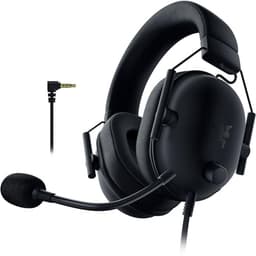
Best Value: Razer BlackShark V2 X Xbox. At well under £40, it is a wired option that is light, compact, and sounds far better than its price suggests, making it ideal for younger gamers or anyone on a tight budget.
Spec Comparison
The Logitech G733 is arguably the single best gaming headset for smaller heads currently available in the UK, and it earns that position primarily because of its suspension headband design. Rather than a rigid plastic or metal arc that clamps down on the top of your skull, the G733 uses a soft, elasticated band that stretches across the headband frame. This means the headset self-adjusts to your head shape and distributes weight without any pressure points at the crown. For people with narrower or shallower heads, this is transformative: there is no feeling of the cups being pushed outward by a frame that is too wide, and there is no need to fiddle with a slider that never quite reaches the right position.
The verified weight of 278 g is genuinely light for a wireless headset with a full-size form factor, and after two or three hours of play you are unlikely to notice it is there. The 2.4 GHz LIGHTSPEED wireless connection is one of the most reliable in the gaming headset market, with a quoted range of up to 20 metres and virtually no perceptible latency. Battery life is rated at up to 29 hours, which covers most gaming weeks on a single charge. The 40 mm drivers deliver a well-balanced sound signature with a slight low-end emphasis that suits both gaming and music. The Blue VO!CE microphone technology, accessed through Logitech G HUB software, gives you a range of filters and EQ presets that can make your voice sound noticeably cleaner than the hardware alone would suggest.
The G733 is a PC-first headset. It connects via a USB-A dongle, which means it works perfectly on PC and is compatible with PS4 and PS5 via the USB port, but it does not natively support Xbox without an adapter. The ear cushions use a fabric mesh material rather than leatherette, which some people prefer for breathability but others find less immersive in terms of passive noise isolation. The colour options, which include lilac, white, and black, have made it popular with a younger audience and with streamers who want something that looks good on camera.
At its price point it faces competition from the SteelSeries Arctis Nova range, but for small-head comfort specifically, the suspension band gives it a meaningful edge. If you game primarily on PC or PlayStation and you have struggled with headsets that feel too large, the G733 should be your first port of call.
Pros
- Suspension headband self-adjusts to narrower and shallower head shapes without pressure points
- Verified 278 g weight keeps fatigue low during marathon sessions
- LIGHTSPEED wireless is among the most reliable connections in consumer gaming headsets
Cons
- USB dongle connection means no native Xbox support without an adapter
- Fabric ear cushions provide less passive noise isolation than leatherette alternatives
If the G733 is the comfort champion for smaller heads, the Logitech G435 is the weight champion. At just 165 g, it is one of the lightest gaming headsets on the market at any price point, and that figure alone makes it a compelling choice for anyone who finds standard headsets fatiguing. The G435 achieves this through a minimalist construction: there is no detachable microphone boom, no leatherette padding, and no heavy battery pack. Instead it uses built-in dual beamforming microphones, a soft fabric headband, and a compact chassis that folds flat for storage.
The headband arc on the G435 is notably smaller than on most over-ear headsets, which is a deliberate design choice by Logitech. The headset was partly designed with younger gamers and people with smaller heads in mind, and it shows. The minimum headband extension is shorter than on the G733 or G PRO X 2, meaning it can sit correctly on a head that would leave other headsets at their absolute minimum adjustment. The ear cups are on the smaller side of over-ear, which works well for people with smaller ears but may feel slightly on-ear for those with larger ears.
The G435 supports both 2.4 GHz LIGHTSPEED wireless via a USB-A dongle and Bluetooth 5.0, making it genuinely multi-platform in a way that few headsets in this price range manage. You can be connected to your PC via LIGHTSPEED and your phone via Bluetooth simultaneously, which is useful for monitoring Discord or taking calls without disconnecting from your game. Battery life is rated at 18 hours on LIGHTSPEED, which is shorter than the G733 but still enough for most daily use.
The 40 mm drivers produce a sound that is clear and detailed but lacks the bass weight of larger drivers. For competitive gaming, where positional audio and voice clarity matter more than cinematic rumble, this is actually an advantage. For single-player games with orchestral soundtracks, you may find it a little thin. The built-in microphone is decent for casual communication but does not match the quality of a dedicated boom mic. Overall, the G435 is the best pick for younger gamers, people with very small heads, or anyone who prioritises lightness above all else.
Pros
- 165 g weight is exceptional and eliminates neck and head fatigue entirely
- Shorter headband arc fits genuinely small heads without bottoming out the adjustment
- Dual wireless modes (LIGHTSPEED and Bluetooth) allow simultaneous multi-device connection
Cons
- Built-in microphones are noticeably inferior to a dedicated boom mic for voice clarity
- Smaller ear cups may sit on-ear rather than over-ear for people with larger ears
The Razer BlackShark V2 X is the budget pick in this roundup, and it earns its place not just because of its price but because it genuinely fits smaller heads well. The headband arc is narrower than on many competing headsets, and the ear cups are sized proportionally, meaning they sit correctly over smaller ears rather than engulfing them. The overall weight of approximately 240 g is light for a wired headset with 50 mm drivers, and the build uses a combination of plastic and metal reinforcement that keeps it feeling solid without adding unnecessary mass.
The 50 mm TriForce Titanium drivers are a highlight at this price point. Razer has tuned them to separate bass, mid, and treble frequencies across different sections of the driver membrane, which produces a more detailed and layered sound than a conventional single-membrane driver of the same size. The result is a headset that sounds noticeably more refined than its price would suggest, with clear positional audio in games and enough bass weight to make explosions and music feel satisfying.
The cardioid microphone uses a hypercardioid polar pattern that picks up your voice from directly in front while rejecting sound from the sides and rear. This is useful if you game in a shared space or a noisy environment. The mic is not detachable, but it folds up flush against the ear cup when not in use, which is a practical solution. The connection is a single 3.5 mm jack, making it compatible with PC, Xbox, PlayStation, Nintendo Switch, and mobile devices without any adapters. This cross-platform versatility is a genuine advantage for households with multiple consoles.
The primary limitation of the BlackShark V2 X is that it is wired and lacks any software-driven audio enhancement on console. On PC, Razer Synapse provides EQ and virtual surround options, but on Xbox or PlayStation you get the hardware tuning only. For a budget headset used primarily for casual gaming or by younger players, this is unlikely to be a dealbreaker. If you need a well-fitting, good-sounding headset for under £40, this is the one to buy.
Pros
- Narrower headband arc and proportionally sized ear cups fit smaller heads without excessive clamping
- 50 mm TriForce Titanium drivers produce detailed, layered audio well above the price point
- Single 3.5 mm connection works across PC, Xbox, PlayStation, Switch, and mobile without adapters
Cons
- Wired only, with no wireless option at any price tier in this product line
- No software EQ or virtual surround on console, limiting audio customisation for non-PC users
4. Logitech G PRO X 2 LIGHTSPEED Wireless Gaming Headset
The Logitech G PRO X 2 LIGHTSPEED is the premium pick in this roundup, and it is aimed at serious gamers who want the best possible audio and microphone performance without compromising on wireless reliability. At its price point it is a significant investment, and it is worth being clear about where it fits for smaller heads: it is not the most naturally accommodating headset in this list in terms of headband design, but it offers enough adjustment range and sufficient padding quality that most smaller-headed users will find a comfortable fit with some experimentation.
The 50 mm graphene drivers are the standout hardware feature. Graphene is a stiffer and lighter material than conventional mylar, which allows the driver to move more precisely and respond faster to transient sounds. The result is an audio profile that is exceptionally detailed and accurate, with a flat frequency response that professional players and audio enthusiasts will appreciate. The soundstage is wide enough for competitive gaming while remaining precise enough for music production use. The Blue VO!CE microphone, which is a detachable boom design, delivers broadcast-quality voice capture with real-time noise filtering and EQ adjustment via G HUB software.
The LIGHTSPEED 2.4 GHz wireless connection offers a claimed range of up to 30 metres and battery life of up to 50 hours, both of which are class-leading figures. The headset charges via USB-C, which is a welcome modern standard. The ear cushions are available in both leatherette and velour variants, and Logitech sells replacement cushions separately, meaning you can switch between materials depending on your preference or the season.
The weight of approximately 345 g is the heaviest in this roundup, which is worth noting for smaller-headed users who are also concerned about fatigue. The clamping force is firm, which helps with passive noise isolation and keeps the headset stable during movement, but may feel tight on narrower heads initially. Most users report that the clamping force softens after a few weeks of use. If budget is not a constraint and you want the best-performing headset that can be made to fit a smaller head, the G PRO X 2 LIGHTSPEED is the choice. For those who prioritise immediate comfort over raw performance, the G733 or G435 are better starting points.
Pros
- 50 mm graphene drivers deliver class-leading audio accuracy and transient detail
- 50-hour battery life and 30-metre LIGHTSPEED range are best-in-class for wireless gaming headsets
- Detachable boom microphone with Blue VO!CE processing produces broadcast-quality voice capture
Cons
- 345 g weight is the heaviest in this roundup and may cause fatigue on smaller heads over long sessions
- Firm initial clamping force can feel tight on narrower heads until the headset breaks in
- Premium price is difficult to justify for casual or budget-conscious gamers
Buying Guide
Why headset fit matters more than you might think
Most people shopping for a gaming headset focus on audio quality, microphone performance, and wireless range. These are all important, but for people with smaller heads, fit is the factor that will determine whether a headset is actually usable for long sessions. A headset that is too large will sit with the ear cups resting on the cheeks rather than enclosing the ears, which destroys passive noise isolation, changes the perceived sound signature (because the drivers are not positioned correctly relative to the ear canal), and creates pressure points that become painful within an hour. Getting the fit right first means everything else the headset offers can actually be experienced as intended.
Headband types and what they mean for smaller heads
There are three main headband types to be aware of. Rigid sliding headbands are the most common: a plastic or metal arc with a slider on each side that you extend or compress to fit. The problem for smaller heads is that many headsets have a minimum extension that is still too long, leaving the headset sitting too low on the head. Suspension headbands, as used by Logitech on the G733 and G435 and by SteelSeries on the Arctis range, use a fabric or elasticated band that hangs between two anchor points. These self-adjust to any head size and eliminate the minimum extension problem entirely. Fixed headbands are less common in gaming headsets but appear on some budget models: these have no adjustment at all and are only suitable if the manufacturer has sized them for a range that includes your head.
Clamping force and how to assess it
Clamping force is the inward pressure the headset exerts on the sides of your head. Too little and the headset falls off; too much and it causes headaches and jaw fatigue. For smaller heads, the challenge is that a headset designed for a larger head will often exert more clamping force when compressed to a smaller size, because the spring tension in the headband is calibrated for a wider position. If you find a headset you like but it clamps too tightly, a common fix is to place it over a stack of books slightly wider than your head overnight, which gently stretches the headband spring. This is not a permanent solution but can make a meaningful difference to comfort.
Ear cup size and depth
Ear cup size is often overlooked. A headset marketed as over-ear will sit over the ear on an average head but may sit on the ear on a smaller head, effectively becoming an on-ear headset with worse comfort and noise isolation. Check the internal dimensions of the ear cup if the manufacturer publishes them: you want the internal opening to be larger than your ear in both height and width. Depth matters too: deeper cups keep the driver further from the ear canal, which can improve soundstage but also means the headset protrudes further from your head. For smaller heads, a moderate cup depth is usually preferable.
Weight and long-session comfort
Headset weight is more significant for smaller heads because the frame is compressed to a smaller span, concentrating the weight over a smaller area. A 350 g headset that feels fine on a large head may feel noticeably heavy on a smaller one. As a general guide, aim for under 300 g for long gaming sessions, and under 200 g if you are particularly sensitive to headset weight or if you plan to use the headset for four or more hours at a time. Wireless headsets are generally heavier than wired ones due to the battery, but the freedom of movement they offer often compensates for the added weight.
The Logitech G733 LIGHTSPEED is the overall winner for gaming headsets on smaller heads. Its suspension headband is the most effective solution to the fit problem that this category presents: it eliminates the minimum extension issue entirely, distributes weight without pressure points, and self-adjusts to head shapes that rigid sliders cannot accommodate. The verified 278 g weight keeps it comfortable over long sessions, the LIGHTSPEED wireless connection is class-leading, and the Blue VO!CE microphone delivers strong voice quality. It is not the cheapest option here, but it solves the core problem better than anything else in the catalogue. For those on a tighter budget, the Razer BlackShark V2 X is a genuinely impressive wired alternative that fits smaller heads well and sounds far better than its price suggests.