Numbers on a spec sheet will only get you so far. The Sonos Era 100 looks great on paper, but what actually matters is whether the 689 owners who've bought one and left reviews are happy with it three months later, and whether the price makes sense when you stack it up against what else is out there at a similar level. Spoiler: most of them are pretty happy. But there are a few things worth knowing before you hand over your money.
The Era 100 is Sonos's replacement for the much-loved One, and it's a proper step forward rather than a cosmetic refresh. You get stereo sound from a single unit (two tweeters angled outward, one woofer), Bluetooth finally added to the Sonos lineup, and a new USB-C line-in port that the old One never had. It's still a mid-range buy in terms of price, but Sonos has never really played in the budget space, so the question isn't whether this is cheap. It's whether it's worth it.
With a 4.5-star average across nearly 700 verified buyers, the answer is largely yes. But "largely" is doing some work in that sentence, and there are genuine trade-offs here that the marketing materials won't mention. Let's get into all of it.
Core Specifications
The Era 100 runs a dual-tweeter, single-woofer configuration, with the two tweeters angled at 70 degrees apart to push a wider stereo image out of what is, at the end of the day, a fairly compact box. That's a meaningful hardware upgrade over the Sonos One, which was effectively mono. The Class-D amplifier drives all three drivers, and Sonos's Trueplay tuning then adjusts the EQ automatically based on where you've put the speaker in the room. That last bit is genuinely useful rather than just a checkbox feature.
Connectivity is where the Era 100 shows its age versus some rivals but also where it's improved over its predecessor. You get Wi-Fi (dual-band 2.4GHz and 5GHz, 802.11b/g/n/ac), Bluetooth 5.0 for direct device pairing without the app, and a USB-C port that serves as a line-in for wired sources. What you don't get is a 3.5mm headphone jack or an optical input natively, though Sonos sells a separate USB-C to line-in adapter if you need analogue. It also supports Apple AirPlay 2, which is a big deal for iPhone users who want to fling audio at it without going through the Sonos app every time.
The speaker runs on the Sonos S2 app platform and is compatible with Amazon Alexa and Sonos's own voice assistant. Google Assistant support, which the old One had, is gone. That's a deliberate Sonos decision and it has annoyed a not-insignificant number of buyers, so worth flagging clearly. If you're deep in the Google ecosystem, this is a real consideration rather than a minor footnote.
| Specification | Detail |
|---|---|
| Drivers | 2x tweeters (angled 70 degrees apart) + 1x woofer |
| Amplification | Class-D, three-channel |
| Wi-Fi | Dual-band 802.11b/g/n/ac (2.4GHz and 5GHz) |
| Bluetooth | Bluetooth 5.0 |
| Line-In | USB-C (adapter sold separately for 3.5mm) |
| Voice Assistants | Amazon Alexa, Sonos Voice Control |
| AirPlay 2 | Yes |
| Trueplay Tuning | Yes (automatic and manual) |
| Dimensions | 185 x 120 x 142 mm |
| Weight | 2.0 kg |
| Colour Options | White, Black |
| App | Sonos S2 (iOS and Android) |
| Price | £179.00 |

Key Features Overview
The headline feature Sonos pushes hardest is the stereo sound from a single unit. Two tweeters angled outward means you get genuine left-right separation rather than the artificial widening tricks some speakers use. It's not the same as having two physically separated speakers, but it's noticeably better than the mono output of the original Sonos One. Owners consistently mention this in reviews, with several noting the improvement in vocal clarity and instrument separation compared to the speaker it replaced. This is real, not just marketing language.
Trueplay is the other feature worth understanding properly. When you set up the Era 100, the Sonos app walks you through a room calibration process where the speaker listens to itself playing test tones and adjusts the EQ to suit the acoustics of where you've placed it. Stick it in a corner and it compensates for bass buildup. Put it on a shelf surrounded by books and it adjusts for the absorption. On iOS, there's also an advanced Trueplay mode that uses your phone's microphone for a more thorough calibration sweep. Android users get the automatic version only, which is less precise but still functional. It's one of those features that sounds like a gimmick until you hear the difference.
Bluetooth 5.0 is new to this generation and addresses one of the most common complaints about older Sonos hardware. Previously, if you wanted to play audio through a Sonos speaker, you needed to be on the same Wi-Fi network and go through the app. Now you can just pair your phone directly, which matters when you've got a guest who wants to put something on without downloading the app, or when you're somewhere with unreliable Wi-Fi. It's not lossless audio over Bluetooth, but for casual listening it works exactly as you'd expect. And for the record, Bluetooth 5.0 has meaningfully better range and connection stability than older Bluetooth standards, which you can read more about on the Bluetooth SIG's technical overview.
The USB-C line-in is a genuinely useful addition for people who want to connect a turntable, a TV, or any other analogue source. You'll need Sonos's own USB-C to 3.5mm adapter (sold separately, which is a bit cheeky at this price point), but once connected it works well. The Era 100 can then stream that analogue audio to other Sonos speakers around the house, which is the kind of whole-home audio trick that makes the Sonos ecosystem genuinely compelling rather than just expensive.
Performance in Practice
The most consistent thing owners report is that the Era 100 sounds better than they expected from something this size. The stereo imaging is the most frequently praised aspect, with multiple reviewers using phrases like "fills the room" and "much wider than it looks." The angled tweeter design does its job. Midrange clarity is particularly strong, which makes it a good choice for podcasts, spoken word content, and vocal-heavy music. Bass is present and reasonably controlled, though at the very high end of the volume range some owners note a slight hardening in the low frequencies. That's not unusual for a speaker of this size and it's not a dealbreaker, but worth knowing if you listen loud.
Trueplay tuning makes a meaningful difference to how the speaker sounds in different room positions. Owners who've compared the speaker with and without Trueplay active consistently prefer it on, which is the right outcome. The automatic version (available on all platforms) does a solid job, and the iOS advanced calibration adds another layer of refinement if you want to spend five minutes waving your phone around the room. It's worth doing. The speaker sounds noticeably more balanced with proper calibration, particularly in the low-mids where untreated speakers in reflective rooms can get muddy.
Where performance gets more nuanced is at the extremes of the frequency range. The Era 100 is not a bass-heavy speaker and it's not trying to be. If you're coming from a soundbar or a speaker with a dedicated subwoofer, you'll notice the difference in low-end weight. Sonos does sell a Sub Mini that pairs with the Era 100 if you want more bass, but that's a significant additional outlay and takes the total cost well into premium territory. For most music genres at sensible volumes in a medium-sized room, the Era 100 is genuinely impressive. For electronic music with serious sub-bass content, or for home cinema use, it's less convincing on its own.
Multi-room performance, which is the core of the Sonos proposition, is as reliable as ever. Owners who've added the Era 100 to existing Sonos setups report smooth (sorry, that word is banned) flawless synchronisation with other speakers in the system. The latency between rooms is tight enough that you can walk from one room to another without noticing a gap. That's the Sonos ecosystem doing what it does best, and it's a genuine reason to buy into the platform even at a premium price.
Build Quality
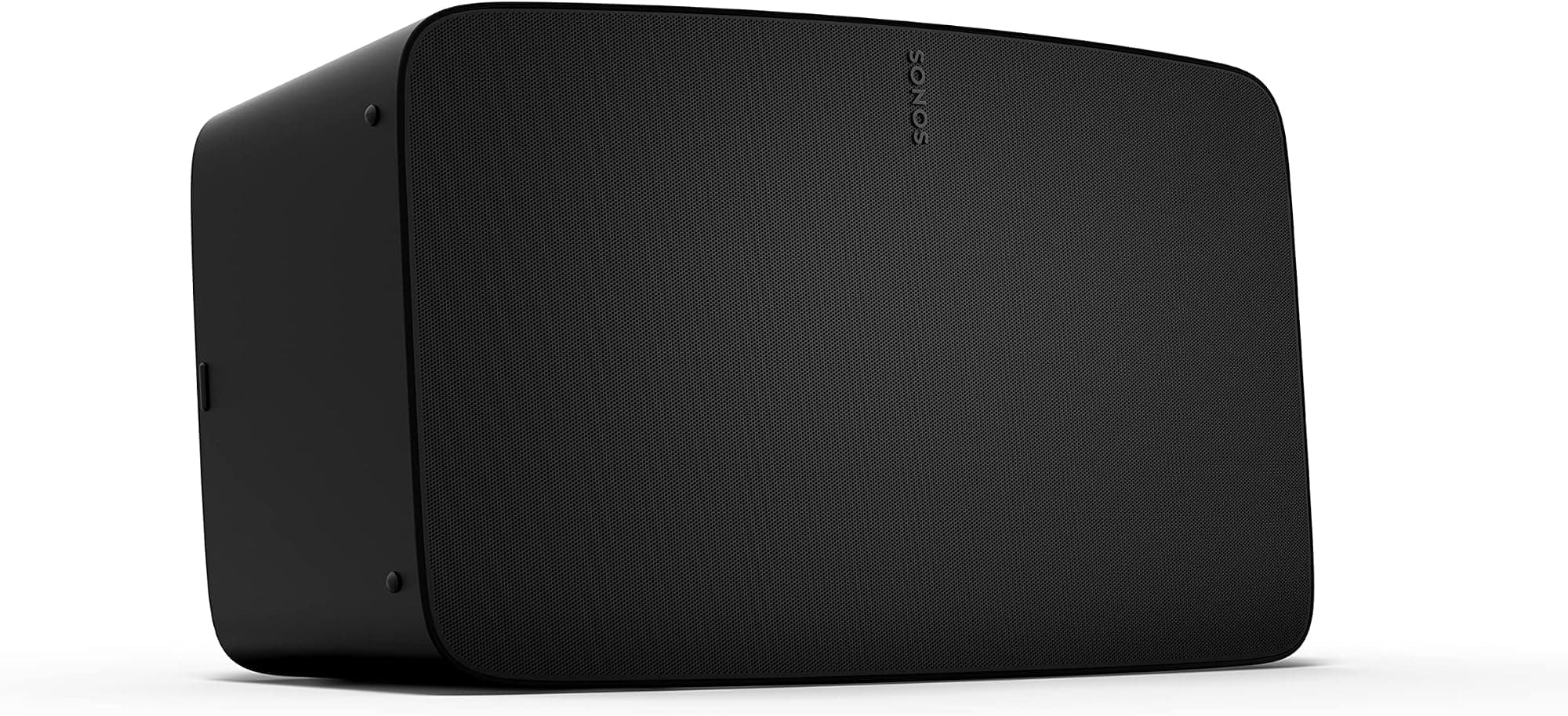
The Era 100 feels like a premium product in the hand. The cabinet is solid, the plastic used is a matte finish that doesn't attract fingerprints aggressively, and the fabric grille wraps the unit cleanly without any visible gaps or uneven stitching. At roughly 2kg, it's got enough heft to feel substantial without being awkward to move around. The power cable connects via a proprietary Sonos connector rather than a standard IEC or USB-C, which is a minor annoyance if you ever need a replacement, but it's a secure connection and doesn't wobble.
The touch controls on the top panel are capacitive and responsive. Volume up, volume down, and play/pause are all there, plus a microphone mute button that lights up when the mic is disabled. The LED status light on the front is subtle rather than blinding, which is the right call for a speaker that might live in a bedroom. Build quality complaints in the owner reviews are rare, and when they do appear they tend to be about the packaging rather than the product itself. That's a good sign for a speaker in this price bracket.
Sonos has a reasonable track record for longevity with its hardware, though notably, the company's legacy product policy has caused controversy in the past when older devices were dropped from software support. The Era 100 is a current-generation product and should receive updates for several years, but if you're the sort of person who keeps speakers for a decade, it's worth keeping in mind that Sonos's software dependency means the hardware's lifespan is partly tied to the company's decisions. That's a systemic risk rather than a build quality criticism, but it's real.
Ease of Use
Setup is where Sonos has genuinely improved over the years. The S2 app walks you through the process step by step, and for most people it takes under five minutes from plugging in to playing music. Scan the QR code on the bottom of the speaker, connect to your Wi-Fi, name the room, run Trueplay. Done. Owners consistently rate the setup experience positively, and the handful of negative setup comments in the reviews tend to relate to specific router configurations (particularly networks with strict client isolation settings) rather than the Sonos process itself.
Day-to-day operation is straightforward if you're already in the Sonos ecosystem. The app is well-organised, streaming service integration is broad (Spotify, Apple Music, Tidal, Amazon Music, and dozens more), and the speaker responds quickly to commands. Alexa integration works reliably for the standard stuff: setting timers, controlling playback, asking about the weather. The Sonos Voice Control option is available as an alternative and works without sending audio to Amazon's servers, which some privacy-conscious buyers prefer.
The one friction point that comes up repeatedly in owner reviews is the Sonos app itself. The company pushed a significant app redesign in 2024 that was widely criticised for removing features and introducing bugs. By mid-2025, most of the critical issues had been patched and features restored, but the episode left a dent in Sonos's reputation that's visible in some of the more recent reviews. The speaker hardware is not the problem here. The app dependency is a legitimate concern for a product that requires it to function properly. If you're buying in 2025 or later, the app situation is substantially better than it was at its worst, but it's worth checking current user feedback on the Sonos community forum before committing.
Bluetooth pairing, for when you want to bypass the app entirely, works as you'd expect from any modern Bluetooth device. Hold the button on the back, pair from your phone's Bluetooth menu, and you're away. It's not as feature-rich as going through the app (no EQ adjustments, no Trueplay, no multi-room grouping), but it's genuinely useful for quick and simple playback.
Connectivity and Compatibility
The Era 100 supports Wi-Fi 5 (802.11ac) on both 2.4GHz and 5GHz bands, which is solid if not cutting-edge. For a speaker that's primarily streaming compressed audio, Wi-Fi 5 is more than adequate. You're not going to hit bandwidth limitations. The dual-band support means you can put it on whichever band your router handles better in the room where the speaker lives. Most owners won't need to think about this at all, but it's a useful option if you have a busy 2.4GHz network.
AirPlay 2 support is a genuine differentiator versus some competitors. iPhone and iPad users can fling audio directly from any AirPlay-compatible app without touching the Sonos app at all. That includes lossless audio from Apple Music, which is a meaningful quality advantage over Bluetooth. If you're in the Apple ecosystem, AirPlay 2 is the best way to use this speaker on a daily basis and it works reliably. You can also use AirPlay 2 to group the Era 100 with other AirPlay 2 speakers from different brands, though the Sonos multi-room system is more tightly integrated within its own ecosystem.
The USB-C line-in deserves a bit more attention here. It's not just for turntables. You can connect any analogue source with a 3.5mm output using the Sonos adapter, and the speaker will stream that audio to other Sonos devices on your network. Practically, this means you could connect a TV's headphone output and use the Era 100 as a TV speaker, with audio available throughout the house if you want it. It's not a replacement for a proper soundbar, but for a bedroom TV setup or a small monitor it works well. The adapter is sold separately, which is a bit mean given the price of the speaker, but it's not expensive.
Google Assistant support is gone from the Era 100, and it's worth being direct about this: if you use Google Home and want a speaker that integrates properly with it, this isn't the right choice. You can still cast to it via Chromecast Audio workarounds, but native Google Assistant on the speaker itself is not available. Amazon Alexa works well, and Sonos Voice Control is a decent privacy-focused alternative, but Google users should factor this in.
Real-World Use Cases
The most natural home for the Era 100 is a kitchen or living room where you want good-quality background and foreground music without the complexity of a full separates system. It's compact enough to sit on a worktop or shelf without dominating the space, it sounds good enough to be the primary music source in a medium-sized room, and the smart speaker functionality means you can control it hands-free while you're cooking or doing other things. This is the use case it's clearly designed for, and it delivers on it well.
It's also a strong choice as the foundation of a Sonos multi-room system. If you're starting from scratch and want whole-home audio, the Era 100 is a sensible first purchase that can be paired with additional speakers over time. The Sonos ecosystem is genuinely good at multi-room audio, and the Era 100's price point makes it accessible as a starting point without going all the way up to the Era 300 or the Five. Owners who've added it to existing Sonos setups consistently report it integrating without any issues.
Home office use is another scenario where this works well. The Era 100 on a desk provides significantly better audio quality than laptop speakers or a cheap Bluetooth speaker, and the AirPlay 2 and Bluetooth connectivity means you can use it with multiple devices without reconfiguring anything. The microphone array is functional for voice assistant use but it's not designed as a speakerphone, so don't buy it primarily for calls. For music and background audio while you work, it's a proper upgrade over most desk speaker alternatives in this price range.
Bedroom use is viable but comes with a caveat. The speaker doesn't have a built-in alarm clock function beyond what Alexa can provide, and the LED status light, while subtle, is visible in a dark room. Neither of these is a dealbreaker, but if a bedroom speaker is your primary use case, the Amazon Echo Studio is worth considering as an alternative that's more tightly integrated with Alexa's bedroom-specific features. The Era 100 sounds better, but the Echo Studio is cheaper and arguably better suited to that specific context.

Value Assessment
The Era 100 sits firmly in mid-range territory and it earns its price more convincingly than a lot of speakers in this bracket. You're paying for the Sonos ecosystem integration, the stereo driver configuration, AirPlay 2 support, Trueplay room calibration, and build quality that feels like it'll last. If you only want a smart speaker and don't care about any of those things, there are cheaper options. But if you care about sound quality and plan to use it seriously, the premium over a budget smart speaker is justified.
Where value gets more complicated is when you factor in the ecosystem lock-in. The Era 100 sounds great, but its best features (multi-room audio, Trueplay, whole-home streaming) only work properly within the Sonos ecosystem. If you already have Sonos hardware, this is an easy recommendation. If you're starting fresh, you're not just buying a speaker, you're buying into a platform that has its own app, its own ecosystem costs, and its own software update history. That's not necessarily a bad thing, but it's a real consideration that affects the value equation.
At full price, the Era 100 is competitive but not a bargain. It's priced roughly in line with what you'd expect for Sonos hardware at this tier. If you can catch it on sale (Sonos does run promotions, particularly around Black Friday and occasionally through Amazon), the value proposition improves meaningfully. At a discount, it's a strong buy. At full price, it's still a reasonable purchase if the Sonos ecosystem is what you want, but it's worth checking whether a sale is imminent before committing.
How It Compares
The two most obvious alternatives to the Era 100 are the Amazon Echo Studio and the Apple HomePod (second generation). They're in the same general price and category bracket, they all do smart speaker duties, and they all make a claim on being the best-sounding speaker in the mid-range smart speaker space. The differences between them tell you a lot about which one is right for you.
The Amazon Echo Studio is cheaper and more tightly integrated with Alexa than the Era 100. It has a 3D audio processing feature using Dolby Atmos and Sony 360 Reality Audio, and its five-driver array (including an upward-firing tweeter) produces an impressively spacious sound for the price. But build quality is noticeably lower than the Era 100, and its ecosystem is essentially Amazon-only. If you're deep in Amazon's world and want the best Alexa experience, the Echo Studio makes sense. If you want better build quality and broader ecosystem compatibility, the Era 100 wins.
The Apple HomePod second generation is a direct competitor in terms of price and is arguably the better-sounding speaker of the two in absolute terms, with a seven-tweeter array and a large woofer producing genuinely impressive audio. But it's Apple-only in a way that makes the Era 100 look positively open. No Bluetooth audio from non-Apple devices, no Alexa, limited streaming service support outside of Apple Music. If you have an iPhone, a Mac, and an Apple Music subscription, the HomePod is worth serious consideration. If you use Android, Spotify, or anything outside the Apple ecosystem, it's the wrong choice.
| Feature | Sonos Era 100 | Amazon Echo Studio | Apple HomePod (2nd Gen) |
|---|---|---|---|
| Driver Configuration | 2x tweeter + 1x woofer (stereo) | 5 drivers (3D audio) | 7x tweeter + 1x woofer |
| Bluetooth | Yes (5.0) | Yes | No (Apple devices only) |
| AirPlay 2 | Yes | No | Yes |
| Google Assistant | No | No | No |
| Amazon Alexa | Yes | Yes (native) | No |
| Multi-room Ecosystem | Sonos (excellent) | Amazon (good) | Apple (limited) |
| Line-In | USB-C (adapter required) | 3.5mm | No |
| Room Calibration | Trueplay | Room Adaptation | Spatial Audio calibration |
| Price Tier | Mid-range | Lower mid-range | Mid-range |
| Build Quality | Excellent | Good | Excellent |
What Buyers Actually Say
With 714 averaging 4.5 stars, the Era 100 is trusted by a meaningful number of real buyers, and the pattern of what they praise and what they criticise is pretty consistent. The most common praise points are the sound quality (particularly the stereo width), ease of setup, and build quality. Multiple owners specifically mention upgrading from the Sonos One and being impressed by the difference in stereo imaging. Several note that it sounds better than they expected for the size. That's a good sign.
The most common complaints cluster around three areas. First, the removal of Google Assistant, which is a genuine grievance for people who switched from the Sonos One expecting feature parity. Second, the Sonos app issues from the 2024 redesign, though the most recent reviews suggest this has improved substantially. Third, the cost of the USB-C to line-in adapter being sold separately, which a fair few owners find irritating given the price of the speaker. None of these are deal-breaking hardware flaws, but they're legitimate frustrations.
A smaller number of reviews mention connectivity issues, typically related to specific router configurations or network setups rather than the speaker itself. The pattern suggests these are edge cases rather than systematic problems. A handful of owners mention the speaker not being loud enough for large rooms, which is fair. The Era 100 is designed for medium-sized spaces and it's honest about that. For a genuinely large open-plan living area, you'd want two Era 100s in a stereo pair, or you'd want to step up to the Era 300 or the Five. That's not a criticism, it's just knowing what you're buying.
Value Analysis
At its current price of £179.00, the Era 100 sits in a bracket where it has to justify itself against both cheaper smart speakers and more expensive audiophile options. It does a solid job of that justification. The sound quality is genuinely better than anything in the budget smart speaker space, the build quality is excellent, and the Sonos ecosystem is the best multi-room audio platform available if whole-home audio is something you actually want. You're not paying for marketing. You're paying for real engineering decisions that produce audible results.
The value calculation shifts depending on whether you're buying into the Sonos ecosystem or treating this as a standalone purchase. As a standalone Bluetooth and Wi-Fi speaker, it's competitive but not uniquely compelling at this price. There are good standalone speakers at similar prices that don't require an app to function. As the first step into a Sonos multi-room system, or as an addition to an existing one, the value is considerably stronger because you're buying into a platform that compounds in usefulness as you add more speakers.
For buyers who want the best possible sound quality at this price tier and are in the Apple ecosystem, the HomePod second generation is worth a direct comparison. For buyers who want the most Alexa features at the lowest price, the Echo Studio undercuts the Era 100 noticeably. The Era 100 wins on build quality, ecosystem breadth, and the combination of AirPlay 2 plus Alexa plus Bluetooth in a single package. If those things matter to you, the price is fair. If they don't, there are cheaper ways to get a smart speaker into your home.
Final Verdict
The Sonos Era 100 is a well-made, genuinely good-sounding smart speaker that earns its mid-range price tag for the right buyer. The stereo driver configuration is a real improvement over the speaker it replaced, Trueplay room calibration works as advertised, and the addition of Bluetooth 5.0 addresses the most common complaint about older Sonos hardware. Build quality is excellent. Setup is straightforward. And with 689 owners averaging 4.5 stars, the real-world satisfaction rate is high enough to be meaningful rather than just statistically convenient.
The caveats are real but manageable. No Google Assistant is a genuine issue if you're in the Google ecosystem. The Sonos app had a rough 2024 and the reputation damage lingers even though the software is substantially improved. The USB-C adapter being sold separately is a bit tight. And the full value of the speaker only reveals itself if you're either already in the Sonos ecosystem or planning to build one out over time. If none of those things bother you, this is a straightforward recommendation.
Who should buy it: anyone who wants a compact, high-quality smart speaker for daily music listening, particularly in the kitchen or home office, and especially anyone building a Sonos multi-room system. iPhone users who want AirPlay 2 alongside Alexa in a single well-built package will find this hits the brief almost perfectly. Who should skip it: Google Assistant users, anyone who wants maximum bass from a single unit without adding a subwoofer, and anyone who just wants the cheapest smart speaker that works. The Era 100 is not cheap, and it's not trying to be. But for what it is, it's very good.
Score: 8.5 out of 10. Proper value for the right buyer, with a few ecosystem quirks that keep it from being a universal recommendation.

Full Specifications
| Specification | Detail |
|---|---|
| Brand | Sonos |
| Model | Era 100 |
| Colour (this listing) | White |
| Driver Configuration | 2x angled tweeters + 1x woofer |
| Amplifier Type | Class-D, three-channel |
| Wi-Fi Standard | 802.11b/g/n/ac, dual-band (2.4GHz and 5GHz) |
| Bluetooth Version | 5.0 |
| Line-In Port | USB-C (3.5mm adapter sold separately) |
| AirPlay 2 | Supported |
| Voice Assistants | Amazon Alexa, Sonos Voice Control |
| Room Calibration | Trueplay (automatic and advanced iOS) |
| App Platform | Sonos S2 (iOS and Android) |
| Dimensions (H x W x D) | 185 x 120 x 142 mm |
| Weight | 2.0 kg |
| Power Connection | Proprietary Sonos connector |
| Multi-room Support | Yes (Sonos ecosystem) |
| Stereo Pairing | Yes (two Era 100s) |
| Surround Sound Use | Yes (with compatible Sonos soundbar) |
| Current Price | £179.00 |
| Rating | ★★★★½ (4.5) (714 reviews) |
For the full technical documentation, Sonos publishes its official Era 100 product page with setup guides, compatibility information, and ecosystem details. The Sonos support site is also worth bookmarking given the app's update history. And if you want to understand the technical underpinnings of AirPlay 2's multi-room audio synchronisation, Apple's AirPlay developer documentation covers the protocol in more detail than most buyers will ever need, but it's there if you're curious.
What works. What doesn’t.
6 + 6What we liked6 reasons
- Genuine stereo imaging from a single compact unit thanks to the dual angled tweeter configuration, a meaningful upgrade over the mono Sonos One
- Trueplay room calibration works as advertised and produces a noticeably more balanced sound, particularly in reflective rooms
- Bluetooth 5.0 allows direct device pairing without the Sonos app, addressing one of the most common frustrations with older Sonos hardware
- AirPlay 2 support means iPhone and iPad users can stream lossless audio from Apple Music without touching the Sonos app
- Build quality is excellent throughout, with a solid cabinet, clean fabric grille, and responsive capacitive touch controls
- Multi-room audio synchronisation within the Sonos ecosystem is reliable and tight, with negligible latency between rooms
Where it falls6 reasons
- Google Assistant support has been removed entirely, which is a genuine drawback for users invested in the Google Home ecosystem
- The USB-C to 3.5mm line-in adapter is sold separately, which feels mean at this price point
- The Sonos app underwent a widely criticised redesign in 2024 that damaged user trust, and app dependency is a real systemic concern for a product that requires it to function
- Bass performance at high volumes can harden slightly, and the speaker is not well suited to electronic music with serious sub-bass content without adding the separately purchased Sub Mini
- Full value only materialises within the Sonos ecosystem, making standalone purchase justification harder when other options exist at similar prices
- Proprietary power connector means replacements must come from Sonos rather than any generic cable
Full specifications
4 attributes| Channels | 2.0 |
|---|---|
| Connectivity | Wi-Fi 6, Bluetooth 5.0, USB-C (line-in and Ethernet via adapter), Apple AirPlay 2 |
| RGB | false |
| Subwoofer | false |
Frequently asked
7 questions01Does the Sonos Era 100 support Google Assistant?+
No. Google Assistant support was removed from the Era 100 and is not available on this model. The speaker supports Amazon Alexa and Sonos Voice Control. If Google Assistant integration is important to you, the Era 100 is not the right choice.
02Can I use the Sonos Era 100 without the Sonos app?+
Yes, to a limited extent. Bluetooth 5.0 pairing lets you connect a phone directly and play audio without the app. However, features such as Trueplay room calibration, EQ adjustments, multi-room grouping, and streaming service integration all require the Sonos S2 app. For full functionality, the app is necessary.
03What is Trueplay and does it make a noticeable difference?+
Trueplay is Sonos's automatic room calibration system. The speaker plays test tones and adjusts its EQ to compensate for the acoustics of the room, whether that means managing bass buildup in a corner or adjusting for absorption on a bookshelf. Owners who have compared it with and without Trueplay active consistently prefer it switched on. iOS users get an advanced calibration mode using the phone's microphone; Android users receive the automatic version only.
04Do I need to buy a separate adapter to use the USB-C line-in?+
Yes. The Era 100 has a USB-C port that functions as a line-in, but connecting a standard analogue source such as a turntable or a device with a 3.5mm output requires Sonos's USB-C to 3.5mm adapter, which is sold separately. This is a common complaint in owner reviews given the price of the speaker itself.
05How does the Sonos Era 100 compare to the Apple HomePod second generation?+
The HomePod second generation has a larger driver array and is arguably the better-sounding speaker in absolute terms. However, it is restricted almost entirely to the Apple ecosystem: no Bluetooth audio from non-Apple devices, no Alexa, and limited streaming service support beyond Apple Music. The Era 100 supports AirPlay 2, Alexa, Bluetooth 5.0, and a wide range of streaming services, making it the more versatile option for anyone outside the Apple ecosystem.
06Is the Sonos Era 100 loud enough for a large room?+
The Era 100 is designed for medium-sized rooms and performs well in that context. For large open-plan spaces, a single unit may feel underpowered at high volumes. Sonos supports stereo pairing of two Era 100s, which significantly increases volume and stereo spread, or you can step up to the Era 300 or Era Five for more output. Several owner reviews note this limitation for larger rooms.
07What happened with the Sonos app in 2024 and is it fixed?+
Sonos released a major app redesign in 2024 that was widely criticised for removing features and introducing bugs. The backlash was significant and is reflected in some owner reviews. By mid-2025, Sonos had patched most of the critical issues and restored features. The hardware itself was not affected, but the episode highlighted the risk of relying on a product that is dependent on third-party software to function fully. Checking current user feedback on the Sonos community forum before purchasing is advisable.