
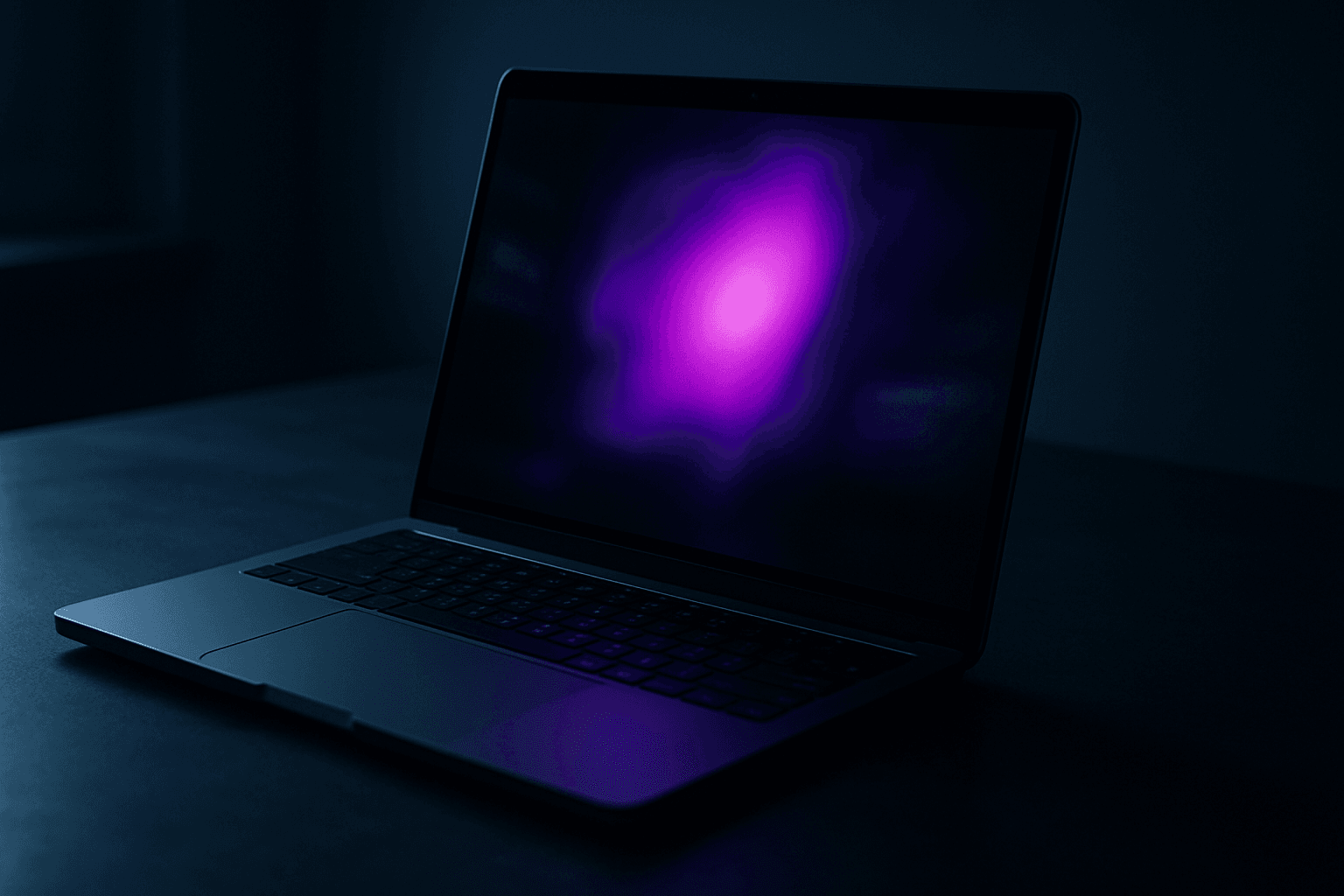
A purple spot on your MacBook display is one of those problems where the fix depends entirely on what's actually causing it. Throw random resets at it without diagnosing first and you'll waste an hour and still end up with the same purple blob staring back at you. This guide works through the causes in order, from the quickest software checks to hardware-level diagnosis, so you know exactly what you're dealing with before spending any money.
TL;DR
A MacBook purple spot screen is caused by display cable damage, panel damage, GPU faults, or software corruption. Test an external monitor and boot Safe Mode first to separate hardware from software. Reset NVRAM and SMC if software is suspected. If the spot changes with lid angle, it's almost certainly a cable or panel fault needing hardware repair.
Key Takeaways
- A MacBook purple spot screen is caused by display cable damage, panel damage, GPU faults, or software/driver corruption.
- If the spot shifts when you adjust the lid angle, the hinge-area display cable is the most likely culprit.
- If the purple spot appears on an external monitor too, the GPU or logic board is at fault, not the display panel.
- Safe Mode and NVRAM/SMC resets can fix software-related causes without any hardware work.
- Persistent hardware-related spots require display assembly replacement or logic board repair by a qualified technician.
At a Glance
- Difficulty: Intermediate
- Time Required: 15 to 30 mins
- Success Rate: High for diagnosis, variable for fix depending on cause
What Causes a MacBook Purple Spot Screen?
The purple spot can come from several different places in the display chain, and they behave differently enough that you can usually tell them apart before opening anything up. Here's what we see most often in the workshop.
Display cable damage in the hinge area. This is the most common culprit on MacBooks that have been opened and closed thousands of times. The display cable runs through the hinge, and over time it flexes, frays, or develops a partial break. The result is a purple or pink discoloration that often changes when you adjust the lid angle. Sometimes it's fine at 90 degrees but goes purple at 120. That lid-angle dependency is a dead giveaway.
Internal panel damage. Pressure on the lid (from a bag, a book, or closing the lid on something small) can damage the LCD layer directly. This usually shows up as a fixed spot that doesn't move with lid angle. It might be a tight purple blob or a larger spreading discoloration. Physical impact does the same thing. If you've dropped the Mac or sat something heavy on top of it, this is where to look first.
GPU or logic board fault. Less common, but it happens. If the graphics processor itself is producing bad output, the purple artifact will show up on every connected display, not just the built-in screen. This is the scenario you really don't want, because it means a board-level repair rather than a display swap.
Software and driver corruption. Occasionally a macOS graphics driver gets into a bad state after an update or a hard shutdown. This is the easiest cause to rule out because it usually disappears in Safe Mode or after an NVRAM reset. Don't skip these checks even if the spot looks hardware-related. I've seen spots that looked like cracked panels vanish after a clean reboot. Took three reboots before one of them stuck, but it did clear.
Liquid or heat damage. Liquid getting into the hinge area or display connector causes corrosion that shows up as discoloration. Overheating can accelerate existing weaknesses in the panel or cable. If you've had any liquid near the machine, that context matters.
For comparison, a Mac black screen battery fault is a different beast entirely where the display gets no signal at all rather than a corrupted image, so the diagnostic path is different. The purple spot almost always means the display is receiving a signal, just a damaged or corrupted one.
MacBook Purple Spot Screen: Quick Fix
Start here. These checks take 5 to 10 minutes and they tell you whether you're dealing with a software problem or a hardware one. That distinction matters a lot before you start resetting things.
Isolation and Safe Mode Check Easy
- Restart the Mac completely.
A clean restart clears any transient graphics state. Don't just close the lid, do a proper restart from the Apple menu. - Open a plain white or black background.
Go to System Settings > Wallpaper and pick a solid colour, or open a blank document. A plain background makes the purple spot much easier to see and photograph for reference. - Adjust the lid angle slowly.
Move the lid from about 70 degrees to fully open while watching the spot. If it shifts, fades, or intensifies at certain angles, you almost certainly have a display cable fault in the hinge area. If it stays completely fixed regardless of angle, it's more likely panel damage or a GPU issue. - Connect an external monitor.
Use a known-good cable and adapter (USB-C to HDMI or DisplayPort). Check the external display carefully for any purple artifacts. If the external is clean, the fault is in the internal display assembly. If the same spot or similar artifacts appear on the external, the GPU or logic board is involved. - Boot into Safe Mode.
Restart the Mac. On Intel Macs, hold Shift immediately after the startup chime until you see the login screen with 'Safe Boot' in the menu bar. On Apple silicon, shut down, then hold the power button until you see startup options, select your disk, hold Shift, and click 'Continue in Safe Mode'. Check whether the purple spot is still there. - Assess the result.
If the spot disappears in Safe Mode, software or driver corruption is involved. If it's still there in Safe Mode, it's hardware. Either way, you now know which direction to go.
More MacBook Purple Spot Screen Solutions
If the quick checks pointed to software involvement, or if you want to rule out every software cause before touching hardware, these intermediate steps cover the Apple-recommended resets. They're not complicated, but the key combination timings matter, so read each step before you start.
Reset NVRAM Easy
- Shut down the Mac completely.
Not sleep, not restart. Full shutdown from the Apple menu. - Press the power button, then immediately hold Command + Option + P + R.
Keep all four keys held down. On Intel Macs, hold until you hear the startup chime play a second time, then release. On newer Macs without a chime, hold until the Apple logo appears and disappears twice. This resets the NVRAM, which stores display-related settings that can occasionally get corrupted. - Let the Mac boot normally and check the display.
Open your plain background again and look for the purple spot. Also check System Settings > Displays to make sure your resolution and colour profile are set correctly after the reset.
Reset the SMC Easy
- On Intel Macs:
Shut down. Hold Shift + Control + Option (all on the left side of the keyboard) plus the Power button simultaneously for 10 seconds. Release all keys, then press Power to start normally. The SMC controls low-level hardware functions including display backlight and power states. - On Apple silicon Macs (M1, M2, M3, M4):
There's no separate SMC reset procedure. Simply shut the Mac down completely, wait 30 seconds, and restart. The Apple silicon architecture handles this automatically on a clean boot. - Check the display after restart.
Look for the purple spot on a plain background. If this was the cause, the display should now be clean.
Update macOS Easy
- Go to System Settings > General > Software Update.
Let it check for updates. If there's a macOS update available, install it. Graphics and display driver fixes are often bundled into point releases without much fanfare in the changelog. - Restart after the update completes.
Don't skip the restart. Some display fixes only take effect after a full reboot. - Test the display again.
Open a plain background and check for the MacBook purple spot screen. If it's gone, a driver bug was the cause. If it's still there, the problem is hardware and software fixes won't help further.
Advanced MacBook Purple Spot Screen Fixes
You've done the software checks, the spot is still there, and the external monitor is clean. That means the fault is inside the display assembly. Here's how to confirm exactly what needs replacing and what to do about it.
Hardware Inspection and Display Cable Check Advanced
- Confirm the lid-angle dependency one more time.
Before opening anything, do a final check. Slowly move the lid from nearly closed to fully open. Apply very gentle pressure to different areas of the screen bezel (not the panel itself). If the spot changes at all with movement, the display cable running through the hinge is the most likely cause. This is actually good news because cable replacement or reseating is cheaper than a full panel swap. - If you're qualified to open the machine:
Power down completely and disconnect the battery before touching anything inside. The display cable connector sits at the top of the logic board near the hinge. Inspect it for visible corrosion (greenish residue), bent pins, or any sign the connector isn't fully seated. iFixit's MacBook repair guides have model-specific teardown instructions if you need them. Reseat the connector firmly and reassemble, then test. - If the panel itself is damaged:
Look for any visible cracks, dark pressure marks, or areas where the LCD layer is visibly broken. These won't improve with cable work. A full display assembly replacement is the practical fix. Apple's own repair documentation at Apple Support covers what's involved, though for most people this is a job for a repair shop. - If the external monitor also shows artifacts:
Stop here. Don't spend money on a display assembly. The GPU or logic board is producing bad output and the display is just showing it faithfully. This needs board-level diagnosis at Apple or an authorised repair centre. Bring photographs of the artifacts on both screens when you go. - Document everything before you go anywhere.
Take photos of the spot at different lid angles, note when it first appeared, and write down anything that happened around that time (drops, liquid, a macOS update). A good technician will ask all of this and having it ready speeds things up.
For context, display-related faults aren't unique to MacBooks. We see similar diagnostic paths with other devices, like the Dell Chromebook 11 3120 blank screen issue where a loose display cable is also a common root cause, or the iPad black screen of death where distinguishing a panel fault from a software fault follows a very similar logic. The principle is the same: isolate the display chain step by step before committing to hardware work.
Preventing a MacBook Purple Spot Screen
Most of the MacBook purple spot screen cases we see were preventable. The display panel and the hinge-area cable are both more fragile than people expect, and the damage usually builds up gradually rather than happening in one obvious event.
The single most damaging habit is closing the lid on debris. A grain of rice, a small pebble, even a thick cable left on the keyboard. When the lid closes, all that pressure goes straight into the panel. It doesn't always crack immediately, but it creates a pressure mark that gradually turns into a permanent discoloration. Get into the habit of clearing the keyboard before closing the lid.
Carrying the MacBook in a bag without a sleeve is the second biggest cause. Books, chargers, and other bag contents press against the lid constantly. A padded sleeve costs very little and removes that risk entirely.
Open and close the lid gently. The hinge cable flexes every single time you do it. Over thousands of cycles, aggressive opening and closing accelerates wear. It's not about being precious with it, just not yanking the lid open from one corner.
Keep macOS updated. Display and GPU driver fixes do appear in point releases, and staying current means you're less likely to hit a known graphics bug that manifests as screen artifacts. It's also worth keeping vents clear and using the Mac on a hard flat surface rather than a pillow or lap, since restricted airflow leads to heat buildup that can accelerate existing weaknesses in the display assembly over time.
If liquid ever gets near the machine, power it down immediately. Don't wait to see if it's fine. Connector corrosion from liquid exposure is slow-moving but persistent, and it gets worse the longer the machine stays powered on after exposure.
MacBook Purple Spot Screen: Summary
A MacBook purple spot screen is almost always one of four things: a damaged display cable in the hinge area, physical panel damage, a GPU or logic board fault, or a software/driver issue. The fastest way to tell them apart is to check whether the spot changes with lid angle (cable fault), whether it disappears in Safe Mode (software), and whether it appears on an external monitor too (GPU). Software causes are fixable with NVRAM/SMC resets and macOS updates. Hardware causes need either a display assembly replacement or, in the GPU scenario, professional board-level repair. Don't skip the diagnostic steps and go straight to the expensive fix. Nine times out of ten, a bit of methodical testing saves you money.
If you're seeing other display oddities alongside the purple spot, it might also be worth checking whether you have any random black screen behaviour on other machines in your setup, as GPU-related faults sometimes affect multiple devices connected to the same peripherals. And if you're recording your screen to document the fault for a repair shop, our guide to free screen recorder Windows tools covers some decent options if you need to capture it on a secondary machine.