ChatGPT PC build compatibility is a real problem, and it's costing people money. The AI spits out a parts list, it looks plausible, and then you either buy incompatible components or end up with a machine that won't install Windows 11. I've seen this exact situation land in our remote support queue more times than I can count in 2026. Here's how to actually fix it.
What Causes ChatGPT PC Build Compatibility Problems?
The root issue is simple: ChatGPT doesn't know what year it is when you're talking to it, not really. Its training data has a cutoff, so it may confidently recommend a CPU that launched two years ago, pair it with a chipset that's been superseded, and suggest RAM speeds the motherboard can't actually run. None of that is obvious from the list it produces because the list looks fine on paper.
Here's the thing: even when the generation is roughly right, ChatGPT has no idea how long your GPU is, what socket revision your chosen motherboard uses, or whether the PSU it picked has the right connectors for a modern GPU. It also doesn't know your case. A 360mm GPU in a mid-tower that only clears 330mm is a problem you won't discover until you're elbow-deep in the build.
Windows 11 compliance is another area where AI-generated lists fall flat. Microsoft requires TPM 2.0 and UEFI Secure Boot. Older boards may not have hardware TPM, and some have firmware TPM disabled by default in BIOS. ChatGPT won't flag this. It also won't tell you that certain older Intel or AMD CPUs are not on the Microsoft Windows 11 supported processor list, which means a clean install will fail or refuse to activate properly.
Budget mismatch is a quieter problem but just as damaging. The AI might allocate a disproportionate chunk of your budget to a high-end CPU when your workload is 1080p gaming, where the GPU does most of the heavy lifting. Or it might suggest 64 GB of RAM for a machine that will only ever run a browser and Office. Conversely, it might under-specify storage, leaving you with a 256 GB drive that fills up the moment you install a couple of modern games. None of this is malicious. It's just that ChatGPT is pattern-matching on forum posts and review articles, not actually modelling your specific situation.
The good news is that all of these problems are fixable before you spend a penny, provided you know what to check. And that's exactly what the steps below cover.
ChatGPT PC Build Compatibility Quick Fix
This takes 5 to 10 minutes and catches the obvious killers. Do this before anything else.
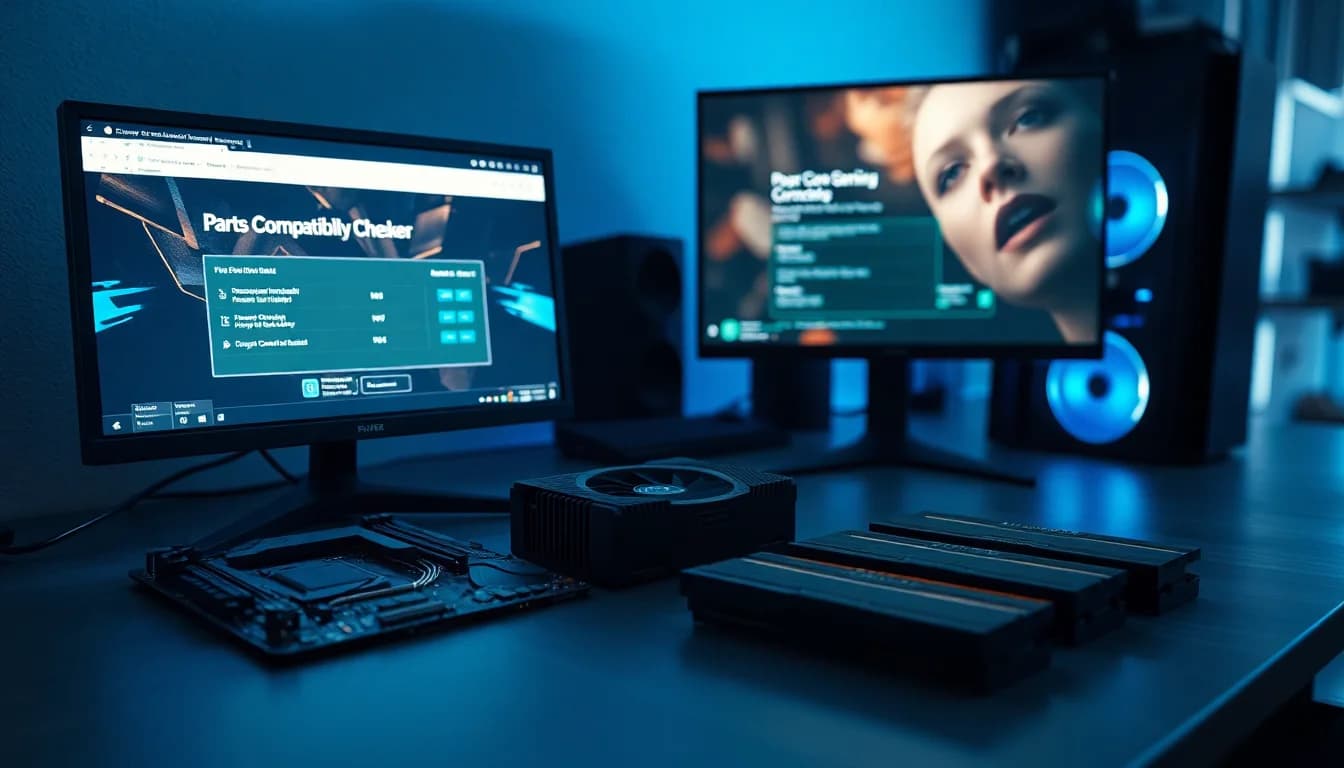
Run the Build Through a Compatibility Checker Easy
- Open PCPartPicker
Head to pcpartpicker.com and start a new build list. Add every component from the ChatGPT list: CPU, motherboard, RAM, GPU, PSU, case, storage, and cooler. - Read the compatibility warnings
PCPartPicker will flag CPU socket mismatches, wrong RAM types (DDR4 vs DDR5), case clearance conflicts, and PSU wattage shortfalls automatically. Don't skip the warnings. Each one is a real problem. - Fix flagged incompatibilities
Swap out any flagged component for a compatible alternative. The site suggests replacements in the same category. Prioritise socket compatibility and RAM type first, then clearances. - Check Windows 11 CPU support
Confirm the CPU is Intel 8th-gen or newer, or AMD Zen 2 or newer. If ChatGPT suggested something older, swap it out now. This is non-negotiable for a clean Windows 11 install. - Verify PSU wattage
Check the GPU vendor's minimum PSU recommendation (found on the product page or in the GPU's spec sheet). Add 100 to 150 W on top of that figure. If the suggested PSU falls short, replace it with a higher-wattage 80+ rated unit. - Regenerate with constraints if needed
If the list needs major surgery, go back to ChatGPT. This time, specify your exact budget, primary use case (gaming, video editing, general use), target resolution, your country for pricing, and add: 'current-generation parts only, Windows 11 compatible.' Then run the new list through the checker again.
More ChatGPT PC Build Compatibility Solutions
The quick fix catches obvious problems. This intermediate tier is where you dig into the details that actually determine whether the build will be stable long-term and whether Windows 11 will install without a fight.
Verify Each Component Against Manufacturer Specs Intermediate
- CPU and motherboard socket
Don't just trust the checker. Go to the motherboard manufacturer's product page and find the CPU support list (sometimes called the CPU compatibility list or QVL for processors). Search for your exact CPU model. Some boards need a BIOS update to support newer CPU steppings, and if you're buying a new board with an older BIOS pre-installed, it may not POST at all with a current-gen CPU. This is a real gotcha, especially with AM5 and LGA1851 boards bought from old stock. - RAM type and QVL
Check the motherboard's Qualified Vendor List for RAM. DDR4 and DDR5 are not interchangeable. The notch positions are physically different. Beyond that, the QVL tells you which specific RAM kits have been validated at which speeds. If ChatGPT picked a RAM kit that runs at 6000 MHz but the board only officially supports 5600 MHz, you may need to manually set XMP/EXPO profiles or accept slower speeds. - Case clearances
Find the case spec sheet and note three numbers: maximum GPU length, maximum CPU cooler height, and supported motherboard form factors (ATX, mATX, ITX). Then check the GPU length from the GPU product page and the cooler height from the cooler product page. A 40 mm discrepancy between GPU length and case clearance isn't a minor issue. It means the side panel won't close. - Windows 11 TPM and UEFI
On the motherboard product page, confirm it supports UEFI firmware (all modern boards do, but double-check for budget options) and has TPM 2.0 support. This may be listed as 'firmware TPM' or 'fTPM' for AMD boards, or 'PTT' for Intel boards. Both work fine for Windows 11. But you need to enable it in BIOS before installing Windows. If the board has neither, it's the wrong board. - Storage configuration
Make sure the build includes at least one NVMe SSD of 500 GB or larger on a PCIe 3.0 or 4.0 M.2 slot for the Windows installation and core applications. ChatGPT sometimes omits secondary storage entirely. If you're gaming or storing large media files, add a secondary SSD or HDD at this stage, and a partition manager like MiniTool makes it easy to allocate and resize partitions across your drives. Running out of space six months after building is annoying and avoidable. - CPU and GPU balance for your workload
For 1080p gaming, the GPU does most of the work. Allocate more budget there. For productivity tasks like video editing, virtual machines, or software compilation, prioritise CPU core count, thread count, and RAM capacity. A ChatGPT list that puts a mid-range GPU with a flagship CPU for a gaming build is wasting money. Rebalance if needed.
If you're also planning to set up a home network for the new machine, our home network setup guide covers the router and switch configuration side of things once the build is sorted.
Advanced ChatGPT PC Build Compatibility Fixes
This section is for two situations: you've already built the system and it's unstable, or you want to harden the plan with proper power and thermal modelling before spending anything. Either way, this is where you get into the technical detail.
Stabilise an Already-Built System Advanced
- Update BIOS and drivers first
Before stress-testing anything, install the motherboard vendor's update utility. For ASUS boards that's Armoury Crate, for MSI it's MSI Center, for Gigabyte it's Gigabyte Control Center. Run a BIOS update and update all critical drivers including chipset, LAN, and audio. Then use Device Manager and Windows Update to catch anything the vendor utility missed. A stale BIOS is one of the most common causes of RAM instability and CPU recognition failures on new builds. - Stress-test for stability
Run CPU, GPU, and RAM under load simultaneously. Watch temperatures and look for crashes, sudden reboots, or throttling. If the system crashes during RAM stress testing, the XMP/EXPO profile may be too aggressive for your specific RAM and motherboard combination. Drop back to the next conservative XMP profile, or run at JEDEC defaults temporarily to isolate the issue. - Re-seat GPU, RAM, and check power cables
If you're getting no display or random crashes, physically re-seat the GPU and RAM. Pull them out, clean the contacts gently, and push them back in until you hear the clip engage. Check every power cable: the 24-pin motherboard connector, the 8-pin CPU connector (some boards need two), and the GPU power connectors. A partially seated 12VHPWR connector on a high-end GPU is a fire risk, not just a stability issue. - Thermal tuning via vendor utilities
Set fan curves in the BIOS or via the vendor utility so the system doesn't run hot under sustained load. If the PSU is borderline for the build, a modest GPU undervolt (using AMD Software or NVIDIA's built-in performance tuning) can reduce power draw by 20 to 40 W without meaningful performance loss. That headroom matters if the PSU is already at its limit. - Replace genuinely wrong components
Wrong socket motherboard: swap the board, keep the CPU and RAM if they're compatible with a replacement. Underpowered PSU: replace it with a higher-wattage reputable 80+ rated unit. Don't cheap out here. A failing PSU can take other components with it. Oversized GPU: select a shorter card, a low-profile cooler, or a larger case. There's no workaround for a GPU that physically doesn't fit.
If the instability turns out to be driver-related rather than hardware, our Windows driver troubleshooting guide covers the Device Manager and rollback steps in detail.
And if Windows 11 won't install at all because of TPM or Secure Boot errors, see our Windows 11 TPM 2.0 fix guide for the BIOS steps to enable fTPM on AMD boards and PTT on Intel boards.
Preventing ChatGPT PC Build Compatibility Issues
Most of these problems are avoidable if you change how you use ChatGPT for build advice in the first place. The AI is genuinely useful as a starting point, but it needs guardrails.
The single most important habit: always run the list through a compatibility checker before buying anything. Not after. Before. It takes five minutes and it's caught socket mismatches, wrong RAM types, and undersized PSUs on almost every AI-generated list I've reviewed this year.
When you ask ChatGPT for a build, be specific. Tell it your exact budget in your local currency, what you're primarily using the machine for, your target gaming resolution if applicable, your country (pricing varies significantly), and add an explicit requirement for current-generation parts and Windows 11 compatibility. Vague prompts produce vague builds. A prompt like 'build me a gaming PC UK, primarily 1080p gaming, Windows 11 required, current-gen parts only, AMD or Intel both fine' will produce a much more usable starting point than 'build me a gaming PC.'
On PSU selection specifically: pick a reputable brand with an 80+ Gold rating or better, and size it with 30 to 50 percent headroom above your estimated maximum draw. That headroom covers power spikes, future upgrades, and the natural degradation of PSU capacity over time. A 650 W PSU running at 90 percent capacity constantly will fail sooner than a 750 W unit running at 70 percent.
Finally, get a second opinion. Post the finalised list on a PC building community forum before ordering. People there will spot things both ChatGPT and automated checkers miss, particularly regional availability issues and known problem combinations with specific board revisions.
ChatGPT PC Build Compatibility Summary
ChatGPT PC build compatibility problems are common, fixable, and almost entirely avoidable with the right checks. The AI is a useful starting point for a parts list, but it doesn't know your case dimensions, your BIOS version, or whether your chosen CPU is on Microsoft's Windows 11 supported list. Those gaps are where builds go wrong.
Run every AI-generated list through an online compatibility checker. Verify Windows 11 TPM 2.0 and UEFI support on the motherboard manually. Check PSU wattage against the GPU vendor's actual recommendation, not just a rough estimate. And if the system is already built and misbehaving, start with a BIOS update and a proper stress test before assuming the hardware is faulty.
Do those things and ChatGPT PC build compatibility stops being a problem. The AI does the broad strokes, you do the verification, and you end up with a build that actually works.