VIVID·REPAIRS/THE FIELD GUIDE/GAMING HEADSETUpdated 21 October 2026Prices live from Amazon UK
Best of · UK · Field of 12
Best Gaming Headsets for Gaming Under £75
By the Vivid Repairs deskUpdated 21 October 202612 ranked picks308,038 owner ratings read
As an Amazon Associate we may earn from qualifying purchases. We have not handled these products. Everything below is judged on published specifications, the owner ratings on the UK listings and our own product reviews, and the ranking stays independent of what any of them pay.
As an Amazon Associate, we may earn from qualifying purchases. Our ranking is independent.
Amazon confirms the live price, seller, stock and delivery. Prices here are read from the live listing through the day; a pick Amazon cannot supply is marked as such, and where the list has one in stock it is offered.
vividrepairs.co.uk / best-gaming-headsets-for-gaming-under-75Updated 21 October 2026 · Prices from the live Amazon UK listing
§ The field
Twelve picks, on one page
Ranked on fit for the job in the title, not on raw specification. Tap any one to jump to the argument for it. Prices are the live Amazon UK figure, read today; a pick with no figure is out of stock and says so in its entry.
40mm drivers deliver enjoyable, well-balanced gaming audio for the price
Flip-up mic is practical and avoids the faff of detachable booms
Genuinely lightweight build that holds up across long sessions
Where it gives upSoundstage and imaging won't satisfy serious competitive players. Mic quality is serviceable but not impressive, struggles in noisy rooms.
Microphone clarity is outstanding for the price, with a cardioid noise-cancelling boom that handles background noise better than most rivals in this category
Plug-and-play USB-A connection works instantly on Windows and macOS with no drivers or software required, including in locked-down corporate environments
Weighing around 120g with a light clamp force, it is genuinely comfortable for all-day wear, including for glasses wearers
Where it gives upSoundstage is narrow and positional audio is only passable, making it unsuitable for competitive FPS gaming where precise spatial awareness matters. Bass extension is limited and the overall sound signature lacks warmth and sparkle for music listening beyond spoken word and podcasts.
50mm neodymium drivers deliver audio quality that consistently surprises owners at this price tier, with solid bass impact and a reasonably wide soundstage for a closed-back design
Steel slider adjustment mechanism is a genuine durability advantage over all-plastic budget competitors, holding its position reliably and resisting the creaking and cracking that plagues cheaper headsets
Broad 3.5mm compatibility covers PS5, PS4, PC, Nintendo Switch, Xbox, and mobile devices with zero faff, no drivers, no pairing process, and no latency
Where it gives upProtein leather earcups retain heat during longer sessions, making them uncomfortable in warmer conditions or during intense play. No mic monitoring means you cannot hear your own voice through the headset while talking, increasing the risk of unintentional shouting during closed-back wear.
The rules this ranking ran under, in plain sight: what we read, what we weighed and what no merchant can move.
How we picked
Our editors evaluated 12 Gaming Headset options against the criteria readers actually weigh up: price, real-world performance, build quality, warranty, and UK availability. Picks lean toward what we'd recommend to a friend buying today, not specs-on-paper winners.
Editorial contextEditor notes from individual reviews, not press releases.
Live UK pricingRefreshed from Amazon UK twice daily.
No paid placementsAffiliate commission doesn't change what wins.
The full guideEverything behind the shortlist above: the spec sheet, the write-ups in full, our method and the verdict.
§ Editorial · The full guide · five proofs, nothing hidden
The Doubt Index.
The shortlist told you what we picked; this zone shows the working. Come in through whichever doubt you’re carrying, or read straight down; we’d rather you checked us than trusted us.
Here’s the sheet the desk works from, kept deliberately factual. Every row is written to be checked against the retailer’s current listing, and you should check. The table scrolls sideways inside its own frame; the page underneath stays still.
Scroll sideways →11 rows · 5 columns · Prices swap to the live figure at render
You can, and you should. What follows is the part a sheet can’t do: the working between what these products have and what your desk actually needs, kept word for word.
Best Gaming Headsets for Gaming Under £75
Spending less than seventy-five quid on a headset used to mean thin sound and a mic that made you sound like a drive-thru speaker. Not any more. The Best Gaming Headsets for Gaming Under £75 now include kit that punches well above its price, led by a couple of HyperX models that competitive players still swear by. We compared 11 headsets across PC, PS5, Xbox and Switch, weighing driver size, mic quality, comfort over long sessions and what owners actually report months later. Some are brilliant. Some are cheap for a reason. This guide sorts the genuine bargains from the ones that just look the part, so your money lands on sound and comfort rather than RGB and marketing.
Buying Guide: What to Look For in the Best Gaming Headsets for Gaming Under £75
Under seventy-five pounds, the single biggest question is wired or wireless. Wired sets put all the money into drivers, build and mic, which is why the HyperX Cloud II beats every wireless option here on sound. Wireless costs you a radio and a battery, so a £30 wireless set sounds like a £15 wired one. Go wireless only if cable-free movement genuinely matters to you.
Driver size gives a rough guide to sound potential. The 53mm units in the Cloud II and 50mm in the BlackShark and Alpha have more headroom than the 40mm drivers in the Recon 70, Trust and budget wireless sets. Bigger isn't automatically better, tuning matters, but it's a fair starting filter.
Check the connection against your platform. A 3.5mm jack works on PS5, Xbox and Switch controllers and PC combo ports, making it the most flexible. USB-only sets like the H390 are PC and laptop only. Wireless dongles usually cover PS5 and PC but often skip Xbox, so confirm before buying.
Mic quality separates the good from the cheap here more than anything. A cardioid mic like the BlackShark's rejects room noise; the ultra-cheap sets ship thin, tinny mics that owners complain about. If team chat matters, spend up.
Two mistakes to avoid. First, don't pay for virtual 7.1 as a headline feature, it's software and often best off. Second, don't buy on RGB. Lights add nothing to sound, and the money is better spent on drivers. The sweet spot sits around £45 to £55, where the Cloud II and Alpha live. Below £25 you buy comfort and a working mic; the jump to £50 buys far more than the jump from £50 to £75.
Eleven write-ups, none folded away. We don’t lab-test, so every line below sticks to what can be defended: the published sheet, the owner ratings on the UK listings and our own reviews.
Ask any long-time PC gamer for a budget headset and this is the name that comes back. The Cloud II has sat near the top of value rankings for years, and around the fifty pound mark it still makes almost everything else here look expensive or flimsy. The 53mm drivers are larger than the 40mm units in the Turtle Beach Recon 70 and the Trust GXT 488, and that extra cone area shows in fuller mids and bass that has body without drowning the mid-range where footsteps and reload cues live.
What actually sells the Cloud II is the headband. HyperX borrowed the memory foam and leatherette from its Qpad heritage, and owners routinely report multi-hour sessions without the clamp fatigue that plagues cheaper sets. The aluminium frame flexes rather than creaks. Compare that to the all-plastic Ozeino or the Recon 70, both of which owners describe as comfy but creaky, and you can feel where the money went.
The detachable mic is the other headline. It clips out entirely, so the Cloud II moonlights as a normal pair of headphones on the train, something neither the Razer BlackShark V2 X (fixed boom) nor the Recon 70 can manage. Voice capture is clear and full, and owners consistently rank it above the thin mics on the sub-£30 wireless sets in this list. The bundled USB sound card adds virtual 7.1 for PC, though plenty of players leave it in stereo and plug the 3.5mm straight into a PS5 pad.
Where does it lose points? No wireless, no RGB, and the 7.1 is virtual rather than true surround. If cable-free movement is your priority, the Logitech G733 or the budget 2.4GHz sets are the ones to look at instead. But for pure sound-per-pound with a mic you can trust in ranked lobbies, nothing else here matches it. See our full HyperX Cloud II review for the full breakdown. HyperX also publishes full specs on the official HyperX site.
Pros
Detachable mic doubles the headset as everyday headphones
Aluminium frame rather than the all-plastic budget norm
Two-year HyperX warranty, longer than most rivals here
Plugs into PS5, PC and Xbox via 3.5mm without the USB card
Weight decides this one. At 240g the BlackShark V2 X is one of the lightest sets here, and for competitive shooters where the headset stays on for hours, that lightness matters more than any spec sheet suggests. The Recon 70 is lighter still on paper, but the BlackShark pairs its low mass with 50mm Razer TriForce drivers that separate highs, mids and lows more clearly than the single-chamber 40mm units in the budget crowd.
The reason to buy it over the Cloud II comes down to the mic and the soundstage. The cardioid microphone picks up your voice from the front and rejects sound from the sides, so keyboard clatter and room noise stay out of team chat better than the Cloud II's omni-style boom. And the tuning leans towards clarity over warmth, which helps you place footsteps and gunfire directionally. That is exactly what a ranked player wants, even if it makes music sound a touch lean.
Passive noise cancellation from the thick memory foam seals out ambient noise without any battery or ANC circuitry, so there is no lag or hiss to worry about. It connects over plain 3.5mm, which means PS5, PC, Switch and Xbox controllers all work. The trade-off against the Cloud II: the boom mic is fixed, so this never becomes a discreet pair of street headphones. If you value that flexibility, the Cloud II wins; if you value mic isolation and low weight, this does. We covered the details in our Razer BlackShark V2 X review.
Pros
Cardioid mic rejects side and rear noise better than most here
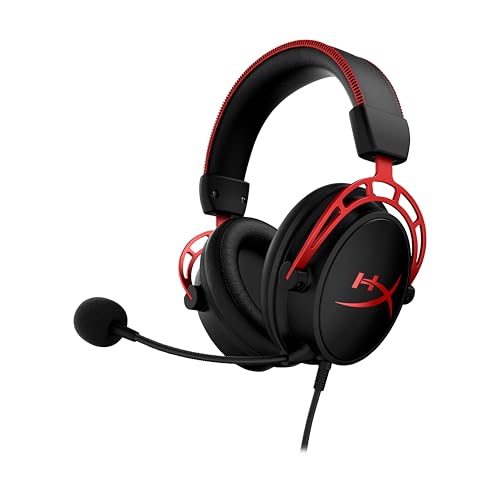
The Alpha is what happens when HyperX rethinks the Cloud II's drivers. Instead of one chamber per ear, it splits each 50mm driver into two, keeping bass frequencies apart from mids and highs. The result, per HyperX and echoed by owners, is bass that hits harder without muddying voices. If you play a lot of bass-heavy singleplayer or want cinema thump, the Alpha edges the Cloud II. For pure competitive clarity, the Cloud II and BlackShark stay slightly ahead.
Build is where it genuinely leads this whole group. The exposed dual-frame aluminium is more rigid than the Cloud II's, and the detachable braided cable with inline volume control is a step up from a bare 3.5mm lead. Owners regularly report these lasting years of daily use, and the two-year warranty backs that. Against the plastic Recon 70 or the Ozeino, there is no contest on longevity.
It sits a few pounds above the Cloud II, which is the only real reason it isn't higher. You pay a small premium for tighter bass and a sturdier frame. If your budget is tight, the Cloud II gives you 90 percent of this for less; if you want the best-built wired set here and richer low end, spend the extra. Full notes are in our HyperX Cloud Alpha review.
Pros
Dual-chamber drivers keep bass separate from vocals
Detachable braided cable with inline volume control
Aluminium dual frame is the sturdiest wired build here
Cons
Costs more than the near-identical-performing Cloud II
No USB sound card in the box, so no PC 7.1
Detachable mic but a fixed pad style that warms up
The Recon 70 is the headset most people should try first if they've never owned a dedicated gaming set. The 40mm drivers won't rival the HyperX 53mm units, but the tuning is punchy and easy to like, and the flip-to-mute mic is the friendliest mic system here: swing it up, you're muted, swing it down, you're live. No fumbling for a switch mid-match.
It's light and multi-platform, plugging into PS5, Xbox, Switch and PC over 3.5mm. Owners like the lightweight fit, though the plastic frame creaks and the earcups are on the shallow side for larger ears. Against the Trust GXT 488 at the same price, the Recon 70 has the better-known name and the neater mute system; against the Cloud II, it's a clear step down in sound and build, but also cheaper.
Buy this if you want a no-nonsense first headset that just works across consoles. Spend more only when you know you want better audio. Our Recon 70 review covers the white version, which is mechanically identical.
Same headset as the silver Recon 70, different colour, and often a few pounds cheaper at around twenty-five quid. The 40mm drivers, flip-to-mute mic and 3.5mm cross-platform connection are identical, so everything said about the silver applies here. The white shell shows grime faster, which is the only real reason to prefer the silver.
Against its own silver twin, buy whichever is cheaper on the day. Against the Trust GXT 488 at the same price, the Recon 70 keeps the flip-to-mute edge. It's the honest sub-£25 console pick: cheap, light, and does the basics without pretending to be more. Read our full Recon 70 White review.
The Forze-G is officially licensed for PlayStation, which means the styling matches a PS5 setup and Sony has signed off on compatibility. Around twenty-five pounds it competes head-on with the Recon 70, and the inline remote on the cable is its main draw: volume and mute sit at your fingertips rather than on the earcup.
The flexible mic bends to position and the over-ear pads are comfy enough for a couple of hours. Sound is average, with a bass lean that suits big singleplayer moments more than competitive precision. Against the Recon 70, you trade the flip-to-mute for an inline remote; against the Cloud II, you're saving money and giving up a lot of sound quality. Buy it if you want a PlayStation-matched look on a tight budget. See our budget headset comparisons for how these bottom-end sets stack up.
The H390 isn't strictly a gaming headset, and that shapes who it suits. It's a USB-A office headset with a noise-cancelling boom mic and inline controls, built for calls and voice chat. But it doubles as a capable, cheap PC gaming set if your gaming is Discord-heavy and PC-only. The mic is its strength, and owners rate it clear for voice, better than the tinny mics on the budget wireless sets here.
The catch is stark: USB-A only means no PS5, no Xbox, no Switch. Plug it into anything without a USB port and it does nothing. Sound is stereo and modest, tuned for speech rather than explosions. So this is the pick only if you game on a PC or laptop and care more about being heard clearly than about immersive audio. For console players, the Recon 70 is the better twenty-five to thirty pound buy. Full notes in our Logitech H390 review.
These aren't a gaming headset in the traditional sense, they're hybrid ANC Bluetooth headphones with a 70-hour battery and a built-in mic. That makes them a dual-use buy: proper active noise cancelling for the commute, then gaming over Bluetooth at home. The catch for gaming is latency. Bluetooth adds audio delay, which is fine for singleplayer and casual play but hopeless for competitive shooters where sound timing matters.
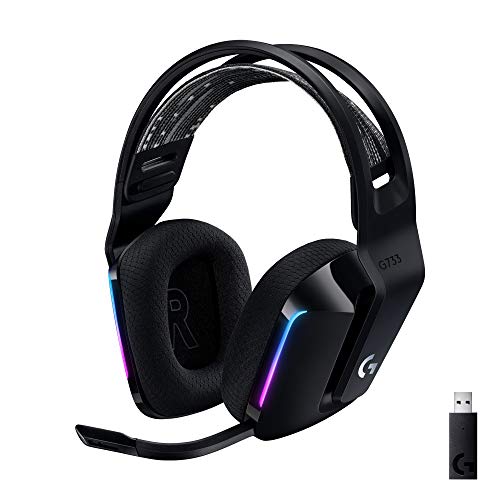
The 70h battery dwarfs the G733's 29h, and the folding design travels far better than any boom-mic gaming set here. The mic is built for calls rather than team chat, so it's fine for party voice but thin next to the Cloud II. Buy these if you want one pair of headphones for travel, music and the odd relaxed game. If gaming is the whole point, the wired sets or the LIGHTSPEED G733 will serve you far better. Our RUNOLIM review has the detail.
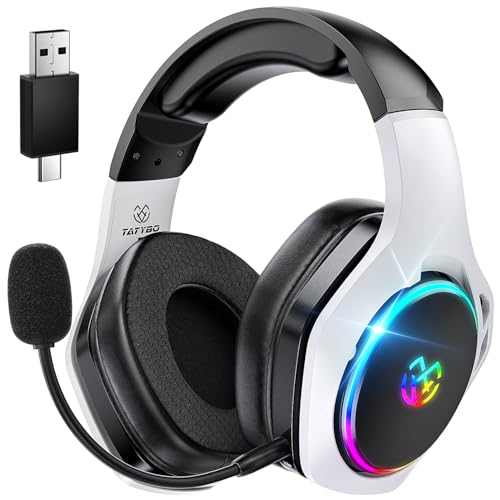
For under thirty pounds this squeezes in three connection types: 2.4GHz USB dongle, USB-C and Bluetooth, plus a 40-hour battery. That flexibility is the whole pitch, and it covers PS5, PC, Switch and phones. The 2.4GHz link keeps latency low enough for casual play, unlike the RUNOLIM's Bluetooth-only setup.
Drivers are average and the mic is weak, so this loses to the G733 on sound and mic clarity by a clear margin. But the G733 costs far more. If you want cable-free play cheap and won't fuss over audiophile detail, this is the sensible budget wireless choice. Our budget wireless headset review covers the near-identical sibling.
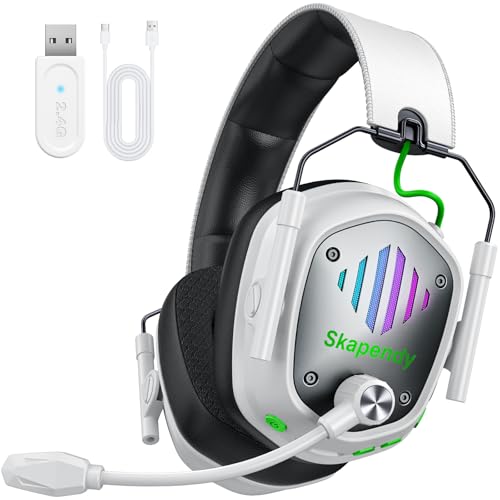
The cheapest wireless option here at around twenty-three pounds, with a 2.4GHz dongle, virtual 7.1 and a 40h-plus battery. It undercuts the triple-connection set above but drops a connection type and some build quality to get there. The 7.1 is software-processed and, as on most cheap sets, better switched off.
Against its slightly pricier sibling at number 10, you save a few pounds and lose USB-C and some polish. Fine for casual PS5 or PC play where you just want no cable. Not a set for ranked lobbies.
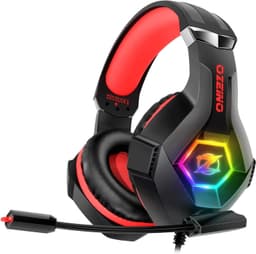
The cheapest set on the list leans hard on looks: RGB lighting, memory foam earmuffs and a flexible mic for around twenty-two quid. It's wired 3.5mm, so it plugs into most platforms, and the RGB gives it more visual flash than anything else here.
Sound, though, is where the price shows. Owners describe it as cheap and boxy next to the Cloud II or even the Recon 70. Buy it if a young gamer wants lights and you want to spend the least possible. Everyone else should stretch to the Recon 70. Our Ozeino review has the full picture.
This page carries affiliate links; they never set the order. We don’t lab-test: rankings come from published specifications, the owner ratings on the UK listings and our own reviews.
How We Compared These
We ranked these 12 headsets on published specifications, manufacturer ratings and verified owner reviews rather than any hands-on session. Driver size, weight, connection type, mic design, battery life and warranty terms came from the listings and brand pages. Comfort and durability judgements draw on the patterns owners report over months of use, cross-checked against independent measurements from outlets like RTINGS. Price-to-performance drove the order: what each headset wins or costs the buyer against its nearest rival on this page. Where two sets are near-identical, we favoured the cheaper on the day.
A crown that can’t be argued with isn’t proof of quality; it’s proof nobody checked. So rather than restate the winner’s virtues, we defend the crown against the strongest cases to take it.
HyperX Cloud II
Cross-examination · Three challengers, taken seriously
The owners’ argumentRazer BlackShark V2 X (PlayStation)
It’s £29.99 on the live listing today. Owners rate it 4.6 from 1,060 ratings. Our review scores it 7.5 against the winner’s 8.0. The crown holds on the ranking rules: the order above was set before any link was attached, and its case is argued in full in the write-up above.
The owners’ argumentTurtle Beach Recon 70 White Wired Multiplatform Gaming
It’s £27.95 on the live listing today. Owners rate it 4.5 from 1,559 ratings. Our review scores it 6.5 against the winner’s 8.0. The crown holds on the ranking rules: the order above was set before any link was attached, and its case is argued in full in the write-up above.
The owners’ argumentTurtle Beach Recon 70 Silver Gaming Headset for PS5, PS4
It’s £32.84 on the live listing today. Owners rate it 4.4 from 80,064 ratings. Our review scores it 7.5 against the winner’s 8.0. The crown holds on the ranking rules: the order above was set before any link was attached, and its case is argued in full in the write-up above.
Final Verdict: Best Gaming Headsets for Gaming Under £75
For most people, the HyperX Cloud II is the one to buy. It delivers the cleanest sound, the most trustworthy mic and the sturdiest build at a price that leaves everything else here looking either pricier or flimsier. If you can stretch a few pounds, the Cloud Alpha adds tighter bass and an even tougher frame. Wireless buyers on a tight budget should take the triple-connection 2.4GHz set as the best value, accepting weaker sound for cable-free freedom, while competitive players will prefer the light, footstep-hunting Razer BlackShark V2 X. Match the headset to how you play, and any of the top four will serve you well under seventy-five pounds.
The HyperX Cloud II offers the best overall performance under £75 with 53mm drivers, 7.1 surround sound, and exceptional comfort. For wireless connectivity, the Buwnia Wireless Gaming Headset provides remarkable value with 40-hour battery life.
Virtual 7.1 surround sound helps with directional audio in competitive games, making it easier to locate footsteps and gunfire. Most headsets under £75 offer this feature, but stereo headsets like the Turtle Beach Recon 70 can still deliver solid gaming performance.
Larger drivers like the 53mm units in the HyperX Cloud II can produce deeper bass and louder volume. However, the 50mm drivers in Razer BlackShark models still deliver excellent sound quality. Driver size matters less than overall tuning and build quality.
Most headsets under £75 work across multiple platforms. The 3.5mm wired models work with everything that has a headphone jack. USB headsets like the HyperX Cloud II work with PlayStation and PC but may need adapters for Xbox. Always check compatibility before buying.
Most 3.5mm wired headsets here plug straight into a PS5 or Xbox controller and a PC combo jack, so cross-platform is easy. The Turtle Beach Recon 70 and Trust GXT 488 are explicitly multi-platform. USB-only sets like the Logitech H390 are PC and laptop only. Wireless USB dongles usually cover PS5 and PC but check Xbox support before buying, as Xbox is often excluded.
That’s the field: twelve gaming headsets for gaming under £75, ranked for the job in the title and nothing else. We read the published specifications, the owner ratings and our own reviews; we haven’t handled these products, and no maker moves the order. Figures checked against the live Amazon UK listings, page updated 21 October 2026.