You know how it goes. You're browsing Amazon at half eleven, you see a gaming headset for less than the price of a takeaway, and you think: surely not. Surely it can't actually be decent. Gaming headsets have been promising the world for years, spatial audio this, crystal-clear mic that, and most of them nail maybe one thing if you're lucky. The rest is usually marketing fluff dressed up in RGB lighting.
So when the Ozeino gaming headset landed on my desk, I wasn't exactly buzzing with excitement. Budget headsets have burned me before. But I've been testing gaming audio gear for eight years now, and I've learned that occasionally something genuinely surprises you at the lower end of the market. The question is whether this is a hidden gem or just another piece of kit destined for the back of a drawer, across proper gaming sessions, voice chats and a fair bit of music listening.
This is my full Ozeino Gaming Headset Budget Review UK (2026), and I'm going to be straight with you about what it does well and where it falls short. No fluff, no copy-pasting the spec sheet back at you. Just two weeks of actual use.
Core Specifications
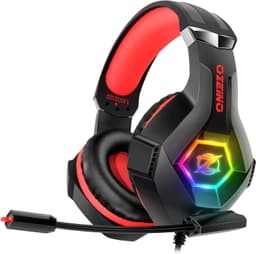
Right, let's get the basics down. The Ozeino is a wired headset, connecting via a 3.5mm jack with a USB adapter included for PC use. It's got 50mm drivers, which is actually on the larger side for a budget headset and something I'll get into more in the audio section. The headset is listed as compatible with PC, PS4, PS5, Xbox One, Xbox Series X/S, Nintendo Switch, and mobile devices, so it's trying to cover all the bases there.
Build-wise, it's a fairly standard over-ear design with an adjustable headband and a detachable boom microphone. The cable is braided, which I always appreciate at this price point because the cheap rubber cables on budget headsets tend to fray within a few months. Weight is light, noticeably so, which matters a lot when you're wearing something for three or four hours straight. The earcups are covered in what Ozeino calls "protein leather", which is basically just faux leather, but it's soft enough.
There's no wireless here, no Bluetooth, no USB-C charging port because there's nothing to charge. It's purely wired, and honestly at this price that's the right call. Wireless adds cost and complexity, and budget wireless headsets are almost universally terrible. Better to do wired properly than wireless badly. The inline volume control and mic mute button on the cable are a nice touch, and they actually work reliably, which isn't always a given at this end of the market.
| Specification | Detail |
|---|---|
| Driver Size | 50mm |
| Frequency Response | 20Hz - 20,000Hz |
| Impedance | 32 Ohm |
| Sensitivity | 108 dB |
| Microphone Type | Detachable boom mic |
| Microphone Frequency Response | 100Hz - 10,000Hz |
| Connection | 3.5mm (USB adapter included) |
| Cable Length | Approx. 2m braided cable |
| Weight | Approx. 260g |
| Platform Compatibility | PC, PS4, PS5, Xbox One, Xbox Series X/S, Switch, Mobile |
| Surround Sound | Virtual 7.1 (software, PC only) |
| Price | £23.99 |

Audio Specifications
The Ozeino uses dynamic drivers, specifically those 50mm units I mentioned. Dynamic drivers are the standard for gaming headsets at every price point, and there's nothing wrong with that. Dynamic transducers are well understood technology, they're durable, and when tuned properly they can produce genuinely enjoyable sound. The 50mm size gives the driver more surface area to move air, which in theory means better bass extension and more volume headroom. Whether the theory translates to practice is another matter, and I'll get into that shortly.
Impedance sits at 32 Ohm, which is exactly where you want it for a headset that's going to be plugged directly into a controller, a phone, or a PC's onboard audio. Low impedance means it'll get loud enough without needing a dedicated headphone amplifier. Sensitivity is rated at 108 dB, which is fairly high and means this thing can get genuinely loud. Probably too loud if you crank it, so just... don't do that. The frequency response is quoted as 20Hz to 20,000Hz, which is the standard claim you see on basically every headset ever made. It tells you very little about the actual sound signature, which is why the next few sections exist.
The microphone specs are a bit more modest. The boom mic has a frequency response of 100Hz to 10,000Hz, which is narrower than the headphones themselves. That's normal for gaming mics, and honestly 10kHz is enough to capture voice clearly. The mic is omnidirectional rather than cardioid, which is a bit of a shame because cardioid pickup patterns do a better job of rejecting background noise. More on that in the microphone section. The 32 Ohm impedance also means you won't need any special adapters or audio interfaces to get it working, which is exactly what you want from a budget headset aimed at casual and mid-level gamers.
Sound Signature
The Ozeino is tuned with a V-shaped sound signature, which means boosted bass and treble with a slightly recessed midrange. This is extremely common in gaming headsets because it sounds exciting and impressive on first listen, especially to people who haven't spent much time with more neutral headphones. Bass hits feel punchy, explosions sound dramatic, and high-frequency effects like gunshots and footsteps get a bit of extra sparkle. It's a crowd-pleasing tuning, and I get why manufacturers go for it.
For competitive gaming, the V-shape is a bit of a double-edged sword. The boosted treble does help with directional cues, footsteps in particular, which is useful in something like Warzone or Apex Legends. But the recessed mids mean voices can sound a bit thin and distant, which matters when you're trying to hear callouts from teammates. It's not a dealbreaker, but if you're playing at a level where communication is critical, you might find it slightly frustrating. For casual play and story-driven games, though, the V-shape works well. It makes action sequences feel impactful and cinematic in a way that a flat, neutral headset wouldn't.
For music, the V-shape suits certain genres better than others. Electronic music, hip-hop, and anything bass-heavy sounds decent. Rock and metal benefit from the treble boost. But acoustic music, jazz, and anything where the midrange carries the emotional weight of the performance sounds a bit hollow. I wouldn't recommend this as a music headset primarily, but for background listening while gaming it's absolutely fine. The key thing to understand is that this tuning is a deliberate choice for gaming entertainment, not an accident, and within that context it does its job.
Sound Quality
Okay, so how does it actually sound in practice? Better than I expected, honestly. In Apex Legends and single-player time in Elden Ring, the Ozeino holds up surprisingly well. The bass is present and punchy without being completely overwhelming, which is more than can be said for some budget headsets that just turn everything into a muddy low-end mess. Gunshots have satisfying weight to them, and environmental audio in Elden Ring, the distant roar of enemies, the crunch of footsteps on stone, comes through clearly enough to be useful.
Soundstage is where budget headsets usually struggle, and the Ozeino is no exception. It's not wide. Audio feels fairly intimate and close, which means positional audio is functional but not precise. I could tell roughly where enemies were in Apex, left or right, in front or behind, but pinpointing exact positions was harder than it would be with a mid-range or premium headset. The virtual 7.1 surround sound feature (available via the USB adapter on PC) adds some width, but like most software surround implementations it introduces a slightly artificial quality to the sound that I actually preferred to turn off. Stereo mode sounded more natural and more useful for gaming.
Treble clarity is decent for the price. High-frequency detail is present without being harsh or sibilant, which is a common problem with budget headsets that boost the treble too aggressively. I didn't get any listening fatigue during longer sessions, which is genuinely impressive. The second week I threw some music at it properly, a mix of Massive Attack, Arctic Monkeys, and some classical stuff, and the results were predictable given the V-shape tuning. Electronic and rock sounded enjoyable, classical felt a bit thin. But again, this is a gaming headset, not a pair of audiophile cans, and judged against that standard it performs well above its price bracket.
Microphone Quality
The microphone is a detachable boom mic, which I always prefer over retractable designs because you can remove it entirely when you don't need it. The boom is flexible and holds its position well, so you can angle it close to your mouth without it drooping back down after five minutes. Getting mic placement right matters more than people realise, and the flexibility here is genuinely useful. I positioned it about two centimetres from the corner of my mouth, which is roughly where you want it for most gaming mics.
Voice clarity is acceptable. My teammates could hear me clearly in Apex and in Discord calls, and nobody complained about my audio quality. That's the baseline, really. The mic captures voice with enough fidelity that you sound like a human being and not a robot phoning in from 1987. However, the omnidirectional pickup pattern means it picks up quite a bit of background noise. A mechanical keyboard is audible to teammates, and in a noisier environment, such as someone watching telly in the same room, background audio bleeds through noticeably. If you're in a quiet room, it's fine. If your setup is noisy, your teammates will hear it.
There's no noise cancellation to speak of, which isn't surprising at this price. The mic mute button on the inline control works reliably, which is more important than it sounds because a mic mute that doesn't actually mute is one of the most infuriating things in gaming. It cuts the mic signal cleanly and consistently. The mic monitoring feature (hearing your own voice in the headset) isn't present here, which is a minor annoyance if you're used to it, but not a dealbreaker. Overall, the microphone is functional and honest. It's not going to make you sound like a podcast host, but it'll get the job done in casual and semi-competitive play.
Comfort and Build
Comfort is where this headset genuinely surprised me. At roughly 260g it's light, noticeably lighter than a lot of headsets in this category, and that makes a real difference over a long session. I wore it for a four-hour stint on a Saturday afternoon without any significant discomfort, which is more than I can say for some headsets costing three times as much. The headband has decent padding and distributes weight reasonably well across the top of the head. It's not the plushest headband I've ever worn, but it's far from uncomfortable.
The earcups are over-ear, which means they sit around your ears rather than on them. The faux leather padding is soft enough and the cups are large enough to accommodate most ear sizes without pressing directly on the ear. I do wear glasses, and the clamping force is gentle enough that I didn't get the pressure headache that some tighter headsets cause after an hour or so. That's a genuine win for glasses wearers. The clamp force is actually on the lighter side overall, which is great for comfort but does mean the headset can feel a bit loose if you move your head quickly. It's not going to fall off, but it's not the most secure fit either.
Build quality is plastic, as you'd expect at this price, but it doesn't feel flimsy. The headband adjustment clicks into place satisfyingly and doesn't slip during use. The earcup hinges have a reasonable amount of movement and don't feel like they're going to snap off. The braided cable is a proper upgrade over the rubber cables you often see on budget headsets, and it doesn't tangle as aggressively. Some budget headsets have cables that start fraying within a month, so the braided design here is a meaningful quality-of-life improvement. Is it built to last five years? Probably not. But for a budget headset, the build is honest and functional.
Connectivity
The Ozeino connects via a 3.5mm TRRS jack, which is the standard single-plug connection that carries both audio and microphone signals. A USB adapter is included in the box for PC users who want to use the USB port instead, and this adapter is also what enables the virtual 7.1 surround sound feature on PC. The cable is approximately two metres long, which is plenty for most desktop setups and comfortable for couch gaming on a console. I didn't find myself stretching or being restricted by the cable length at any point.
The 3.5mm connection means plug-and-play on essentially everything. PS5, Xbox Series X, Nintendo Switch, phones, tablets, laptops, all of it works immediately without any drivers or setup. On PC via the USB adapter, Windows recognised it instantly and it showed up as a separate audio device. No driver installation required, which is exactly what you want. The 3.5mm TRRS standard is about as universal as it gets in audio connectivity, and for a multi-platform headset it's the right choice.
There's no wireless option, no Bluetooth, and no USB-C. For some people that'll be a dealbreaker, but I'd argue it's actually the correct decision at this price point. Wireless audio at budget prices almost always involves noticeable latency, compression artefacts, or both. The wired connection here is clean and lag-free, which matters more for gaming than the convenience of going wireless. The inline control on the cable handles volume and mic mute, and both functions work reliably. The only minor gripe is that the volume wheel is quite small and can be fiddly to find by feel during an intense gaming session, but that's a minor complaint.
Battery Life
There's no battery in this headset. It's wired. So this section is going to be brief, but it's worth addressing because it's actually a positive rather than a negative. You never have to charge it. You never pick it up before a gaming session and realise it's dead. You never get fifteen minutes into a match and hear the low battery warning. These are real problems with wireless headsets that people underestimate until they've lived with them.
The trade-off is obviously the cable. You're tethered to your device, and if you're a fidgety gamer who likes to lean back or move around, the cable can occasionally get in the way. I found it manageable on both PC and console, but I'll acknowledge that if you've been using a wireless headset for years, going back to wired can feel like a step backwards in terms of freedom of movement. It's a genuine trade-off, not a clear win either way.
What I will say is that for the target audience of this headset, budget-conscious gamers who want reliable audio without the faff of charging and wireless pairing, the wired design is absolutely the right call. You plug it in, it works, and you don't think about it again. That simplicity has real value, especially if you're buying this as a first proper gaming headset or as a secondary headset for a different room or platform. No battery anxiety, no charging cables to keep track of, no firmware updates for the wireless dongle. Just audio.
Software and Customisation
There's no dedicated software for the Ozeino headset. No companion app, no EQ suite, no RGB lighting controls (there's no RGB on this headset anyway, which I respect). On PC, you get access to whatever your operating system or sound card software provides. Windows Sonic and Dolby Atmos for Headphones are both available through Windows settings if you want to experiment with virtual surround, and the USB adapter enables the headset's own virtual 7.1 mode through the Windows audio stack.
If you're on PC and you want EQ control, you'll need to use a third-party application. Equalizer APO is the standard free option that most PC gamers use for system-wide EQ, and it works fine with the Ozeino. Tweaking the EQ to pull the mids up slightly and tame some of the bass works well, as the headset responds to EQ adjustments. The drivers have enough range that you can push the sound signature towards something more neutral if that's your preference. But out of the box, there's nothing to configure.
On console, you get whatever the console's audio settings offer. PS5 has its own 3D audio processing via Tempest, and the Ozeino works with it through the controller's 3.5mm jack. It adds a bit of spatial width to the sound, though the effect is subtle. Xbox has its own spatial audio options too. The lack of dedicated software isn't a problem for this headset because its target audience isn't the kind of person who wants to spend an hour tweaking EQ curves. It's for people who want to plug in and play, and for that use case the out-of-box experience is perfectly adequate.
Compatibility
The Ozeino works with pretty much everything that has a 3.5mm jack or a USB port. It works with PC (via USB adapter), PS5 (via controller jack), Nintendo Switch (handheld mode) and Android phones. All four worked without any setup whatsoever. The audio quality was consistent across platforms, which makes sense given it's a passive wired connection with no processing happening in the headset itself. What you hear is determined by the source device's audio output, not by any circuitry in the headset.
Xbox Series X works via the controller's 3.5mm jack, same as PS5. I didn't have an Xbox to hand, but the standard 3.5mm TRRS connection is universal across Xbox controllers, so there's no reason it wouldn't work. Nintendo Switch in docked mode requires a USB adapter or a separate 3.5mm connection to the TV, depending on your setup. In handheld mode it plugs straight in. Mobile compatibility is straightforward on Android and should work on iPhone with a Lightning or USB-C to 3.5mm adapter, though Apple's adapters can occasionally be fussy with gaming headsets that use the TRRS standard for combined audio and mic.
The virtual 7.1 surround sound is PC-only via the USB adapter. On all other platforms you're getting stereo audio, which as I mentioned earlier is actually my preference anyway. The headset is genuinely multi-platform in a way that more expensive headsets sometimes aren't, and for someone who games across multiple devices, that flexibility is worth something. There are no platform-specific features to miss out on, no proprietary wireless protocols that only work with one console. It's just audio, and audio works everywhere.
How It Compares
At the budget end of the gaming headset market, the Ozeino is competing primarily against the HyperX Cloud Stinger Core and the Turtle Beach Recon 70. Both are well-established names in the budget headset space, both have been around long enough to have a proper track record, and both sit in a similar price bracket. The HyperX Cloud Stinger Core is probably the most direct competitor, given its similar wired design and multi-platform compatibility. The Turtle Beach Recon 70 is another strong option that often comes up in the same conversations.
The HyperX Cloud Stinger Core has the advantage of brand recognition and a slightly more refined sound signature, with better imaging in my experience. But it's also been around for a while and the design is starting to show its age. The Ozeino's 50mm drivers are larger than the Stinger Core's 40mm units that does translate to a bit more bass extension and volume headroom. The Turtle Beach Recon 70 has a more comfortable headband in my opinion, but the microphone is similarly basic. All three headsets are honest about what they are: budget wired headsets for casual to mid-level gaming.
Where the Ozeino holds its own is in the combination of driver size, build quality (that braided cable matters), and comfort. It doesn't win every category against its competitors, but it doesn't lose badly in any of them either, which is actually a decent result for a headset at this price. The lack of brand recognition might put some people off, but if you're making a decision based on actual performance rather than the logo on the earcup, the Ozeino deserves serious consideration.
| Feature | Ozeino Gaming Headset | HyperX Cloud Stinger Core | Turtle Beach Recon 70 |
|---|---|---|---|
| Driver Size | 50mm | 40mm | 40mm |
| Connection | 3.5mm + USB adapter | 3.5mm + USB adapter | 3.5mm |
| Microphone | Detachable boom | Fixed boom | Fixed boom |
| Virtual Surround | 7.1 (PC, via USB) | 7.1 (PC, via USB) | No |
| Cable | Braided | Rubber | Rubber |
| Platform Compatibility | PC, PS5, Xbox, Switch, Mobile | PC, PS5, Xbox, Switch, Mobile | PC, PS5, Xbox, Switch, Mobile |
| Price Tier | Budget | Budget | Budget |
| Dedicated Software | No | No | No |

Final Verdict
After two weeks of proper use across multiple platforms and game genres, the Ozeino gaming headset has earned a cautious recommendation from me. And I want to be clear about what "cautious" means here: it's not that I have serious doubts about the headset, it's that I want to make sure you're buying it for the right reasons. This is a budget headset. It has budget limitations. But within those limitations, it performs honestly and sometimes better than expected.
The sound quality is above average for the price, the comfort is genuinely good, and the braided cable is a quality-of-life upgrade that I appreciate more than I probably should. The microphone is functional without being impressive, the soundstage is narrow, and the V-shaped tuning won't suit everyone. But if you're a casual to mid-level gamer who wants a reliable, comfortable, multi-platform headset without spending a lot of money, this is a solid option. It's not trying to be something it isn't, and that honesty is refreshing in a market full of budget headsets that overpromise and underdeliver.
Who should buy this? Students, younger gamers, people who need a secondary headset for a different room, anyone who's been making do with the earbuds that came with their phone. If you're gaming competitively at a high level and positional audio precision is critical, you'll want to spend more. But for the vast majority of gaming use cases, the Ozeino gets the job done without drama. I'd give it a 6.5 out of 10. Solid, honest, and worth the money at its current price of £23.99. For those looking at first gaming headset options, this is a strong contender.
The competition from HyperX and Turtle Beach is real, and both brands have more established reputations. But the Ozeino doesn't embarrass itself in that company, and for a relatively unknown brand that's a meaningful achievement. If you can find it at a good price, it's worth picking up. Just go in with realistic expectations about what a budget wired headset can and can't do, and you won't be disappointed.
What works. What doesn’t.
5 + 4What we liked5 reasons
- Large 50mm drivers deliver punchy bass and good volume headroom for the price
- Genuinely comfortable for long sessions, glasses-friendly clamp force
- Braided cable is a meaningful durability upgrade over rubber alternatives
- Detachable boom mic is a nice touch at this price point
- True plug-and-play across PC, PS5, Xbox, Switch and mobile
Where it falls4 reasons
- Narrow soundstage limits positional audio precision in competitive play
- Omnidirectional mic picks up noticeable background noise
- No dedicated software or EQ control out of the box
- V-shaped tuning makes voices sound slightly thin in the midrange
Full specifications
11 attributes| Connectivity | 3.5mm |
|---|---|
| Surround | stereo |
| Microphone | boom |
| Noise cancellation | false |
| Driver size | 50mm |
| Driver size MM | 50 |
| Frequency response HZ | 20-20000 |
| Microphone type | flexible boom |
| Platforms | PC, PS4, PS5, Xbox, Switch, Mac, Mobile |
| Spatial audio | false |
| Type | over-ear |
If this isn’t right for you
2 options 7.5 / 10
Skapendy Wireless Gaming Headset for PS5, PS4, PC, Switch, Mac, 2.4 GHz Wireless & 5.4 Bluetooth Gaming Headphones with Mic ENC Noise Cancelling, 50mm Drivers, 3D Stereo Sound, 50H Battery, Foldable
£23.99 · Skapendy
 7.5 / 10
JBL Quantum 100 Wired Over-Ear Gaming Headset with Boom Mic, Multi-Platform Compatible, Black
£19.99 · JBL
Frequently asked
5 questions01Is the Ozeino Gaming Headset good for competitive gaming?+
It's functional for casual to mid-level competitive play. The V-shaped tuning gives footsteps and high-frequency cues a bit of extra presence, but the narrow soundstage makes precise positional audio harder than on pricier headsets. For ranked play at a high level, you'd want to spend more. For casual competitive gaming it's absolutely fine.
02Does the Ozeino Gaming Headset have a good microphone?+
The detachable boom mic is functional and clear enough for teammates to hear you without complaints. However, the omnidirectional pickup pattern means it picks up background noise like keyboard clicks and ambient room sound. In a quiet environment it performs well. In a noisy setup, your teammates will hear your surroundings.
03Is the Ozeino Gaming Headset comfortable for long sessions?+
Yes, comfort is one of its genuine strengths. At around 260g it's light, the earcup padding is soft, and the clamp force is gentle enough to be glasses-friendly. I wore it for a four-hour session without significant discomfort. The headband padding is adequate rather than luxurious, but it does the job well for the price.
04Does the Ozeino Gaming Headset work with PS5 and Xbox?+
Yes. It connects via the 3.5mm jack on the PS5 DualSense and Xbox controllers, and works immediately without any setup. It also works with Nintendo Switch in handheld mode, PC via the included USB adapter, and Android mobile devices. The virtual 7.1 surround sound feature is PC-only via the USB adapter.
05What warranty applies to the Ozeino Gaming Headset?+
Amazon offers 30-day returns on most items sold through their platform. Ozeino typically provides a 1-year manufacturer warranty covering defects. Check the product listing and your order confirmation for the specific terms applicable to your purchase.