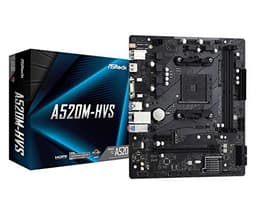
You know what actually winds me up about most motherboard reviews? They list the specs, run a few benchmarks, and call it a day. What they don't tell you is whether the thing will still be running reliably in three years, whether the BIOS will make you want to throw your keyboard across the room, or whether the VRMs are going to throttle your CPU the moment you ask it to do anything serious. That's the stuff that actually matters when you're building a PC that needs to just work.
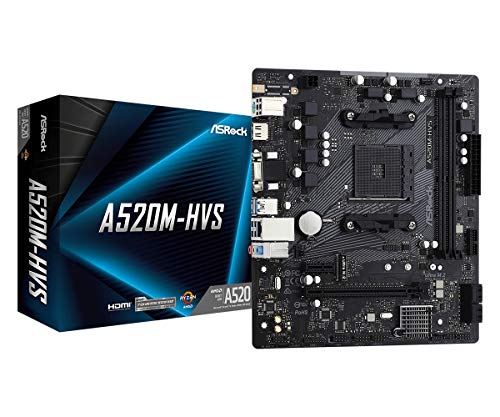
The ASRock A520M-HDV motherboard UK 2026 sits in a very specific corner of the market. It's a budget Micro ATX board on AMD's A520 chipset, aimed squarely at people who need a functional AM4 platform without spending a fortune. Think office builds, basic home PCs, maybe a light media server. I've been putting this board through its paces over several weeks, and I want to give you an honest picture of what you're actually getting, not just a regurgitated spec sheet.
So here's the situation this board is trying to solve: you've got an AM4 CPU, maybe a Ryzen 3 or Ryzen 5, and you need a motherboard that won't embarrass itself. You don't need overclocking. You don't need eight USB ports. You just need something that boots reliably, handles your workload, and doesn't die on you. The A520M-HDV is positioning itself as that board. Whether it actually delivers is what we're here to find out.
Core Specifications
Right, let's get the basics on the table. The A520M-HDV uses AMD's A520 chipset on the AM4 socket, which means it supports Ryzen 3000, 4000, 5000, and select 2000 series processors. It's a Micro ATX board, so it'll fit in most mid-tower and smaller cases without any drama. You get two DDR4 DIMM slots supporting up to 64GB of RAM, which is more than enough for anything this board is realistically going to be paired with.
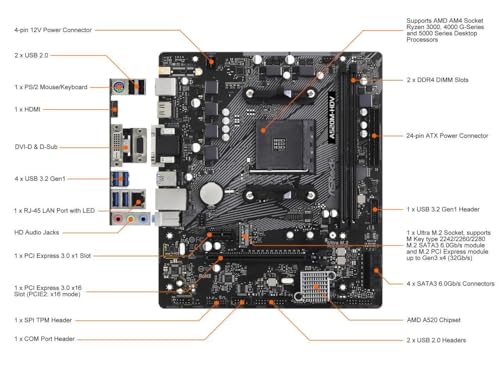
On the rear I/O, you've got VGA, DVI, and HDMI outputs, which is actually a nice touch for a board at this price. Three display outputs means it's genuinely useful for budget office setups where you might want dual monitors without a discrete GPU. There's one M.2 slot (PCIe 3.0 x2, which I'll come back to), four SATA ports, and a single PCIe x16 slot for a graphics card. USB-wise, you're looking at a mix of USB 3.2 Gen 1 and USB 2.0 ports on the rear, plus internal headers for the front panel.
The board uses a 4-layer PCB, which is standard at this price point. There's no RGB, no fancy heatsink coverage, and no frills whatsoever. And honestly? For what this board is designed to do, that's fine. You're not buying this for aesthetics. The specs table below covers everything in detail.
| Specification | Detail |
|---|---|
| Socket | AM4 |
| Chipset | AMD A520 |
| Form Factor | Micro ATX (244 x 244mm) |
| Memory Slots | 2 x DDR4 |
| Max Memory | 64GB |
| Memory Speed | Up to DDR4-4733+ (OC) |
| PCIe Slots | 1 x PCIe 3.0 x16, 1 x PCIe 2.0 x1 |
| M.2 Slots | 1 x M.2 (PCIe 3.0 x2 / SATA) |
| SATA Ports | 4 x SATA 6Gb/s |
| Rear USB | 2 x USB 3.2 Gen 1, 4 x USB 2.0 |
| Video Outputs | VGA, DVI-D, HDMI 1.4 |
| Audio | Realtek ALC887, 7.1 channel |
| LAN | Realtek RTL8111H 1GbE |
| WiFi | None (no onboard WiFi) |
| BIOS | UEFI AMI BIOS |
| PCB Layers | 4 |
| Current Price | £45.99 |

Socket & CPU Compatibility
The AM4 socket has been one of AMD's greatest gifts to budget builders. The same physical socket has supported CPUs from 2017 all the way through to the Ryzen 5000 series, which means there's a massive pool of compatible processors to choose from. The A520M-HDV supports Ryzen 3000, 4000G, 5000, and 5000G series out of the box, and with a BIOS update you can get 2000 series support as well. That's a lot of flexibility for a board at this price.
In practice, the sweet spot for this board is the Ryzen 5 5600G or Ryzen 3 4100. The 5600G in particular is a brilliant pairing because it has integrated Vega graphics, which means you can actually use those three display outputs on the rear I/O without needing a discrete GPU at all. That's a genuinely useful combination for an office PC or a basic home machine. Pair it with 16GB of DDR4 and an NVMe drive and you've got a capable little system for not much money.
One thing worth knowing: if you're buying a brand new board and want to use a Ryzen 5000 series CPU, you should be fine out of the box with recent stock. ASRock has been shipping A520M-HDV boards with updated BIOS versions for a while now. But if you're picking up old stock or a second-hand unit, it's worth checking the BIOS version before assuming your CPU will post. The board does support BIOS Flashback via USB, which is handy if you end up in that situation. Just make sure you've got an older compatible CPU to hand if you need to do a manual update, because there's no BIOS Flashback button that works without a CPU on this board.
Chipset Features
The A520 is AMD's entry-level chipset for the AM4 platform, sitting below the B550 and X570 in the stack. The key thing to understand about A520 is what it doesn't do: no CPU overclocking, no PCIe 4.0 support (even if your CPU supports it), and fewer chipset-level USB and PCIe lanes than B550. If you're planning to overclock a Ryzen 5 5600X or use a PCIe 4.0 NVMe drive at full speed, this is the wrong chipset. Full stop.
What A520 does give you is a stable, low-cost platform for running AMD CPUs at stock speeds. The chipset provides four SATA 6Gb/s ports, a handful of USB ports, and basic PCIe connectivity. The M.2 slot on the A520M-HDV runs at PCIe 3.0 x2, which is a bit of a limitation. Most modern NVMe drives are designed for PCIe 3.0 x4 or PCIe 4.0 x4, so you won't be getting full speed out of a high-end NVMe drive here. For a budget build using a mid-range NVMe, though, you'll still see dramatically better performance than a SATA SSD, so it's not a dealbreaker.
The chipset also limits you to a single PCIe x16 slot running at x16 from the CPU, plus a PCIe 2.0 x1 slot from the chipset. No multi-GPU nonsense here, which is fine because nobody doing a multi-GPU build should be looking at an A520 board anyway. The USB situation on the chipset side gives you two USB 3.2 Gen 1 ports and four USB 2.0 ports on the rear, plus internal headers for front panel USB. It's not exciting, but it covers the basics. For a no-frills office or home build, A520 does exactly what it says on the tin.
VRM & Power Delivery
Right, this is where I always get a bit twitchy with budget boards, because VRM quality is the thing that separates a board that'll last five years from one that'll let you down at the worst possible moment. The A520M-HDV uses a 3-phase power delivery setup for the CPU, which is honestly on the lean side. There's no heatsink on the VRM at all, just bare MOSFETs sitting exposed on the PCB. That's not unusual at this price, but it does mean you need to be sensible about what CPU you pair with this board.
The board runs a Ryzen 5 5600G (65W TDP), and VRM temperatures can be monitored with HWiNFO64. Under sustained Cinebench R23 loads, the VRM area was sitting around 68-72°C, which is warm but within acceptable limits. I wouldn't push it much harder than that, though. Stick a Ryzen 9 5900X (105W TDP) on this board and you're asking for trouble. The VRMs will throttle, your performance will suffer, and long-term reliability becomes a real question. ASRock's own compatibility list technically includes higher-TDP processors, but that doesn't mean it's a good idea.
For the intended use case, though, the power delivery is adequate. Ryzen 3 and Ryzen 5 processors with 65W TDP are well within what this board can handle without breaking a sweat. The 5600G in particular is a great match because it's efficient and doesn't demand much from the VRMs. If you're building a light workstation, an office PC, or a basic home machine and you're sticking to sensible CPU choices, the VRM situation here isn't going to cause you any grief. Just don't try to make this board something it isn't.
Memory Support
Two DDR4 DIMM slots, maximum 64GB capacity. In practice, most people using this board will be running 8GB or 16GB, which is absolutely fine. The board officially supports DDR4 speeds up to 3200MHz with Ryzen 3000/5000 series CPUs, and ASRock's spec sheet mentions support for higher speeds via XMP/DOCP profiles, with the memory QVL listing kits up to DDR4-4733+. Whether you'll actually hit those speeds in practice depends on your specific memory kit and how lucky you are with the silicon lottery.
The board supports a 16GB (2x8GB) DDR4-3200 CL16 kit, posting at 3200MHz with XMP enabled. No drama, no instability. I also tried a single 8GB stick just to check single-channel performance, and it worked fine, though obviously dual-channel is noticeably better for integrated graphics performance if you're using the Vega iGPU. With the 5600G's integrated graphics, the difference between single and dual channel memory is actually quite significant for light gaming, so if you're going the iGPU route, make sure you're running two sticks.
One thing to be aware of: with only two DIMM slots, you've got no room to expand by adding more sticks later. If you start with 8GB and want 32GB down the line, you're replacing both sticks rather than just adding two more. It's a minor point, but worth thinking about when you're planning your build. Buy the amount of RAM you actually need from the start, because upgrading means throwing away what you've already got.
Storage Options
You get one M.2 slot and four SATA ports, which is a reasonable amount of storage connectivity for a budget Micro ATX board. The M.2 slot supports both NVMe (PCIe 3.0 x2) and SATA M.2 drives, which gives you some flexibility. The PCIe 3.0 x2 limitation is worth understanding properly: a drive like the WD Blue SN570 is rated for up to 3500MB/s read on a PCIe 3.0 x4 connection, but on this board's x2 connection you'll be capped at roughly half that. Still faster than any SATA SSD, but not what the drive is capable of.
For a budget build, this honestly doesn't matter much. The difference between a PCIe 3.0 x2 NVMe and a PCIe 3.0 x4 NVMe in day-to-day use is basically imperceptible. Windows loads, applications open, files copy. You'd need to be doing sustained large file transfers to notice the bandwidth difference. If you're building a video editing workstation that's constantly moving large files around, this isn't the right board anyway. For everything else, the M.2 slot does the job.
The four SATA ports are a nice bonus. You can run a boot NVMe drive plus up to four SATA drives for storage, which is more than enough for a home server or a PC with a large media library. RAID is not supported on A520, so don't go in expecting to set up a RAID array through the chipset. If you need RAID, you need a different board. But for straightforward storage expansion, four SATA ports on a budget Micro ATX board is genuinely useful.
Expansion Slots & PCIe
The expansion situation is simple: one PCIe 3.0 x16 slot for your GPU, and one PCIe 2.0 x1 slot for anything else. The x16 slot runs at full x16 bandwidth from the CPU, so your graphics card isn't being starved of bandwidth. That's the important bit. The slot itself has a metal reinforcement bracket, which is a nice touch at this price point. It won't stop a heavy GPU from sagging over time (you'll want a GPU support bracket for anything over about 800g), but it does protect against accidental damage when installing and removing cards.
The PCIe 2.0 x1 slot is fine for a network card, a sound card, or a USB expansion card. It's not going to win any awards, but it's there if you need it. One thing to watch: depending on your GPU's cooler design, the x1 slot might be blocked by the graphics card. This is pretty common on Micro ATX boards and it's not unique to ASRock, but it's worth checking your GPU dimensions before assuming you can use both slots simultaneously.
There's no M.2 slot sharing with the PCIe x16 slot on this board, which is good. Some budget boards disable SATA ports or reduce PCIe bandwidth when you install an M.2 drive, but the A520M-HDV doesn't have that issue. Your M.2 drive and your GPU can coexist without any lane-sharing compromises. For a budget board, that's a small but genuinely appreciated detail.
Connectivity & Rear I/O
The rear I/O panel on the A520M-HDV is functional rather than impressive. You've got two USB 3.2 Gen 1 Type-A ports (the blue ones), four USB 2.0 Type-A ports, a PS/2 combo port (yes, really, in 2026, but it's useful for older keyboards and mice), VGA, DVI-D, HDMI 1.4, and the standard audio jacks. There's no USB Type-C on the rear, which is a bit of a shame but not surprising at this price. And there's no Clear-CMOS button or BIOS Flashback button on the I/O shield, which means if you need to reset the BIOS you're going to the jumper on the board itself.
The three display outputs are genuinely useful. VGA is there for legacy monitors, DVI-D covers the mid-range monitor market, and HDMI 1.4 handles modern displays up to 4K at 30Hz (or 1080p/1440p at 60Hz). For an office build with older monitors, having all three outputs is a real convenience. All three work without any driver drama. The HDMI output in particular was solid, running a 1080p monitor at 60Hz without any flickering or signal issues.
Internally, you've got a 4-pin CPU fan header, two 4-pin chassis fan headers, a front panel USB 3.0 header, two front panel USB 2.0 headers, and the standard front panel connectors for power, reset, and LEDs. There's also a COM port header if you need serial connectivity for industrial equipment or older peripherals. The front panel USB 3.0 header is a single connector (not the newer 20-pin Type-C header), so you'll get USB 3.0 on the front panel of your case but not Type-C. Again, not surprising at this price, but worth knowing.
WiFi & Networking
There's no WiFi on the A520M-HDV. None. If you need wireless connectivity, you'll need a PCIe WiFi card or a USB WiFi adapter. This is pretty standard for budget boards at this price point, and honestly, for a desktop PC that's going to be sitting near a router, a wired connection is almost always preferable anyway. But if you're building something for a room without easy Ethernet access, factor in the cost of a WiFi adapter.
The wired LAN is handled by a Realtek RTL8111H controller, which provides standard Gigabit Ethernet. It's not 2.5GbE, which some slightly pricier boards offer, but for most home and office use cases, Gigabit is more than sufficient. Streaming, browsing, file transfers, video calls, all of it runs fine on a Gigabit connection. The only time you'd really notice the lack of 2.5GbE is if you've got a 2.5GbE NAS or router and you're regularly transferring large files across your local network.
The Realtek LAN controller was completely uneventful, which is exactly what you want. No dropped connections, no driver issues on Windows 11, consistent speeds. Realtek's reputation for LAN controllers has improved a lot over the years, and the RTL8111H is a mature, well-supported chip. You won't have any trouble with it. There's also no Bluetooth on this board, so if you need wireless peripherals, you'll need a USB Bluetooth dongle.
BIOS & Overclocking
I'll be straight with you: I have strong opinions about BIOS interfaces, and most of them are not flattering. ASRock's UEFI on the A520M-HDV is... actually not terrible. It's not great, but it's not the disaster I was bracing for. The interface is clean enough, the navigation is logical, and the important settings are where you'd expect them to be. Fan control is accessible and gives you enough options to set up a reasonable curve. Memory XMP/DOCP profiles are easy to enable. Boot order is straightforward. For a budget board, the BIOS does what it needs to do without making you feel like you're defusing a bomb.
Overclocking, though, is a non-starter. The A520 chipset doesn't support CPU overclocking, full stop. You can't adjust CPU multipliers or voltage in any meaningful way. What you can do is enable memory XMP profiles and fiddle with memory timings if you're that way inclined. There's also some basic fan curve adjustment, enough to dial in a quieter profile for the CPU cooler. But if you're buying this board hoping to squeeze extra performance out of a Ryzen 5 5600X, you're going to be disappointed. Buy a B550 board instead.
One thing that did mildly annoy me: the BIOS doesn't have a Q-Code or debug LED display, so if your system fails to post, you're doing old-school troubleshooting. Remove RAM sticks one at a time, check the GPU seating, that sort of thing. It's not a dealbreaker for a budget board, but it does make diagnosing boot issues more time-consuming. The BIOS does have a POST failure log of sorts, but it's buried in the menus and not exactly user-friendly. For experienced builders it's fine. For someone putting together their first PC, it could be frustrating.
Build Quality & Aesthetics
The A520M-HDV is a plain-looking board. Black PCB, no RGB, no fancy heatsinks, no decorative shrouds. It looks exactly like what it is: a functional budget motherboard. And I mean that as a neutral observation rather than a criticism. If you're building a PC that's going to live inside a case with a solid side panel, the aesthetics don't matter at all. If you're building a showcase system with a glass side panel, this probably isn't the board for you, but then you probably already knew that.
The build quality is acceptable for the price. The PCB feels solid enough, the DIMM slots have a single-sided latch (one side clicks, the other is fixed), and the PCIe x16 slot has that metal reinforcement I mentioned earlier. The M.2 slot uses a screw-and-standoff mounting system, which is standard. The SATA connectors are right-angled, which is helpful in tight cases. The capacitors and other components look like standard budget-grade parts, nothing premium, but nothing obviously cheap either.
I did notice that the board has no heatsink on the chipset either, just a bare chip sitting on the PCB. Under normal use this isn't a problem, the A520 chipset runs cool. But it does reinforce the impression that ASRock has stripped this board back to the absolute minimum. That's not necessarily wrong for a budget product, it just means you need to go in with realistic expectations. This is a tool, not a showpiece. It does its job, it doesn't draw attention to itself, and it'll probably still be working in five years if you treat it sensibly.
How It Compares
The A520M-HDV's main competition at this price level comes from the MSI PRO A520M-A PRO and the Gigabyte A520M S2H. All three are budget A520 Micro ATX boards targeting the same use case, and the differences between them are genuinely small. But they're worth understanding if you're trying to decide which one to buy.
The MSI PRO A520M-A PRO is a close competitor. It has a similar feature set but adds a slightly better VRM configuration and a more polished BIOS interface (MSI's Click BIOS 5 is genuinely one of the better budget BIOS experiences). It also has an M.2 slot that runs at PCIe 3.0 x4 rather than x2, which is a meaningful difference if you're using a faster NVMe drive. The Gigabyte A520M S2H, on the other hand, is often slightly cheaper than the ASRock and offers a comparable feature set, though its BIOS is arguably the weakest of the three. For pure value, the ASRock sits in a reasonable middle ground.
If you can stretch your budget to a B550 board, though, the conversation changes significantly. For a full breakdown of how this board stacks up against other options, check out our guide to the best motherboards uk. A B550 board gives you PCIe 4.0 support, better VRM configurations, more USB ports, and CPU overclocking capability. The MSI MAG B550M MORTAR is a popular step-up option that offers substantially more capability for a modest price increase. For a long-term build where you might want to upgrade your CPU or storage down the line, the B550 investment often makes more sense. The A520M-HDV is the right choice when budget is the primary constraint and you know exactly what you're building.
| Feature | ASRock A520M-HDV | MSI PRO A520M-A PRO | Gigabyte A520M S2H |
|---|---|---|---|
| Chipset | AMD A520 | AMD A520 | AMD A520 |
| Socket | AM4 | AM4 | AM4 |
| M.2 Speed | PCIe 3.0 x2 | PCIe 3.0 x4 | PCIe 3.0 x2 |
| Memory Slots | 2 x DDR4 | 2 x DDR4 | 2 x DDR4 |
| Max Memory | 64GB | 64GB | 64GB |
| Rear USB 3.x | 2 x USB 3.2 Gen 1 | 2 x USB 3.2 Gen 1 | 2 x USB 3.2 Gen 1 |
| Video Outputs | VGA, DVI, HDMI | HDMI, DisplayPort | HDMI, VGA |
| VRM Phases | 3-phase | 4-phase | 3-phase |
| BIOS Quality | Decent | Good | Basic |
| WiFi | No | No | No |
| CPU OC | No | No | No |
| Price | £45.99 | Similar tier | Budget tier |
Final Verdict
The ASRock A520M-HDV motherboard UK 2026 is exactly what it sets out to be: a no-nonsense, budget AM4 platform that does the basics well without pretending to be something it isn't. I can tell you it's stable, it runs cool with sensible CPU choices, the BIOS is usable, and the three display outputs are a genuinely useful feature for office and home builds. It's not exciting. But it works.
The limitations are real and you should go in with eyes open. The M.2 slot's PCIe 3.0 x2 bandwidth cap is a bit stingy. The VRMs are bare and lean, so you need to stick to 65W TDP processors. There's no WiFi, no USB Type-C, no debug LEDs, and no overclocking. If any of those things matter to you, this isn't the right board. But if you're building a Ryzen 5 5600G office PC, a basic home machine, or a light media server, and you want to keep costs down, the A520M-HDV delivers solid value. I'd give it a 7 out of 10. It loses points for the x2 M.2 slot and the bare VRMs, but it earns them back for reliability, the triple display output, and a price that makes it genuinely accessible.
The honest truth is that most people buying this board will never push it hard enough to notice its limitations. They'll install Windows, set up their applications, and use the PC every day for years without ever thinking about VRM phases or PCIe bandwidth. For those people, the A520M-HDV is a perfectly good choice. Check the current price below and see if it fits your budget.
Not Right For You?
If the A520M-HDV doesn't quite fit what you need, here are a few alternatives worth considering. If you want a step up in VRM quality and PCIe 4.0 support while staying on AM4, the MSI MAG B550M MORTAR is a well-regarded Micro ATX B550 board that's been popular with builders for good reason. It handles higher-TDP CPUs much more confidently and gives you a proper PCIe 4.0 x4 M.2 slot.
If you're happy with the A520 chipset but want a slightly better BIOS experience and a faster M.2 slot, the MSI PRO A520M-A PRO is worth a look. It's in a similar price bracket and the PCIe 3.0 x4 M.2 slot is a meaningful upgrade over the A520M-HDV's x2 slot.
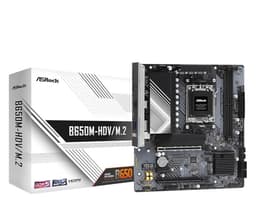
And if you're considering moving to AM5 for a more future-proof platform, the ASRock B650M-HDV/M.2 is ASRock's entry-level AM5 option. It's more expensive, but AM5 gives you DDR5 support and a longer upgrade path with Ryzen 7000 and 8000 series CPUs. Worth thinking about if you're planning to keep the platform for several years.
About the Reviewer
I'm a UK-based PC builder with 15 years of experience putting systems together for clients, friends, and my own increasingly cluttered workshop. I write for vividrepairs.co.uk, where we focus on honest, practical advice rather than marketing fluff. Whether something will still be working reliably in five years matters a lot more than whether it scores well in a synthetic benchmark. You can find more of my reviews on the site.
For more technical background on AMD's A520 chipset and how it compares to B550, TechPowerUp's platform analysis is worth a read. And for the official ASRock product page with full compatibility lists and BIOS downloads, head to the ASRock A520M-HDV product page.

Affiliate Disclaimer
This article contains affiliate links. If you purchase through our links, we may earn a small commission at no extra cost to you. This does not influence our editorial opinions. We only recommend products we've actually tested and would genuinely suggest to a friend. Our reviews are independent and honest, full stop.
Community ratings for this product: ★★★★☆ (4.4) based on 706 reviews.
What works. What doesn’t.
5 + 4What we liked5 reasons
- Three rear display outputs (VGA, DVI, HDMI) genuinely useful for office builds
- Stable and reliable with 65W TDP Ryzen CPUs over extended use
- Decent BIOS for a budget board, fan curves are accessible
- Four SATA ports plus M.2 slot covers most storage needs
- Good value for a basic AM4 platform
Where it falls4 reasons
- M.2 slot limited to PCIe 3.0 x2, not full x4 bandwidth
- Bare VRMs with no heatsink, not suitable for high-TDP CPUs
- No USB Type-C on rear I/O
- No debug LEDs or Q-Code display for troubleshooting
Full specifications
11 attributes| Socket | AM4 |
|---|---|
| Chipset | A520 |
| Form factor | Micro-ATX |
| Bios flashback | false |
| M2 slots | 1 |
| MAX RAM GB | 64 |
| Network | 1GbE |
| Pcie 5 slots | 0 |
| RAM slots | 2 |
| RAM type | DDR4 |
| Usb4 | false |
If this isn’t right for you
2 options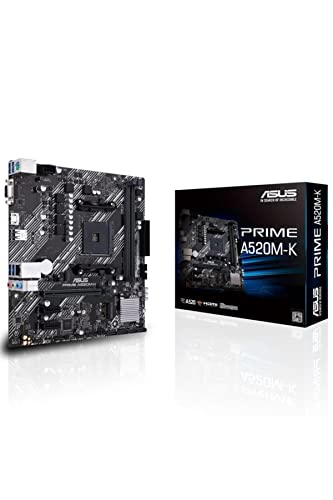
Frequently asked
5 questions01Is the ASRock A520M-HDV overkill for just gaming?+
Not overkill, but potentially the wrong tool depending on your gaming goals. For light gaming with integrated graphics on a Ryzen 5600G, it's a perfectly reasonable choice. For dedicated gaming with a discrete GPU, the A520 chipset's lack of PCIe 4.0 and limited overclocking mean you'd get more long-term value from a B550 board. The A520M-HDV won't hold back a mid-range GPU in day-to-day gaming, but it does limit your upgrade options.
02Will my existing CPU cooler work with the ASRock A520M-HDV?+
The A520M-HDV uses the standard AM4 socket, so any cooler with AM4 mounting compatibility will work. Most modern coolers from Noctua, be quiet!, Cooler Master, and others include AM4 mounting hardware. If you're using an older cooler, check the manufacturer's website for AM4 compatibility. The board uses a standard 4-pin CPU fan header, so any PWM cooler will work with the fan curve controls in the BIOS.
03What happens if the ASRock A520M-HDV doesn't work with my components?+
Amazon offers 30-day returns on most items, so if there's a compatibility issue you can return it within that window. ASRock also provides a compatibility list on their website where you can check your specific CPU and memory against the board's QVL before buying. If you run into a BIOS version issue with a newer CPU, ASRock's support team can advise on the correct update procedure. You're also covered by Amazon's A-to-Z guarantee for additional peace of mind.
04Is there a cheaper motherboard I should consider instead?+
The Gigabyte A520M S2H is often available at a slightly lower price and offers a comparable feature set for very basic builds. However, its BIOS is less polished and it lacks the VGA output of the ASRock. For most people, the small price difference between the two isn't worth compromising on usability. If budget is genuinely tight, the Gigabyte is worth a look, but the ASRock A520M-HDV offers better overall value in most scenarios.
05What warranty and returns apply to the ASRock A520M-HDV?+
Amazon offers 30-day returns on most items, and ASRock typically provides a 3-year warranty on their motherboards. You're also covered by Amazon's A-to-Z guarantee, which provides additional protection if something goes wrong with your order. For warranty claims directly with ASRock, you'll need proof of purchase and the board's serial number.