The best HP laptop for most people in 2026 is the HP Victus 15.6" Gaming Laptop. It delivers genuine discrete GPU performance at a mid-range price, making it the strongest all-round pick whether you game, edit video, or simply want headroom for demanding tasks. For everyday use on a tighter budget, the HP 15.6" Ryzen 3 is the best value. Read on for the full breakdown of six HP laptops compared across every price point, from a £142 entry-level machine to a Copilot+ AI laptop with an OLED screen.
HP's 2026 lineup has shifted noticeably since last year. The OmniBook 5 brings Qualcomm Snapdragon X silicon and an OLED panel to the sub-£600 space, a first for HP at this price. The Victus range has been refreshed with RTX 40-series graphics, and the budget tier now includes Intel N-series chips that replace older Celeron and Pentium parts. This article is aimed at UK buyers who want a reliable HP machine without trawling through dozens of spec sheets, whether you are a student, a home worker, a creative professional, or a gamer.
Quick Verdict
Best Overall: HP Victus 15.6" Gaming (B0F6YRFRCR), RTX 4050 discrete graphics, Ryzen 7 7445H, and 16 GB RAM make this the most versatile HP in the range for 2026.
Best Value: HP 15.6" Ryzen 3 (B0F4DLN17X), Full HD IPS screen, Windows 11, and a modern Ryzen 3 7320U at well under £300 is genuinely hard to beat for everyday use.
The HP Victus 15.6" is the standout pick in HP's 2026 UK lineup for anyone who wants real performance without paying flagship prices. It is aimed squarely at gamers, content creators, and power users who need discrete GPU grunt for tasks that integrated graphics simply cannot handle. With an AMD Ryzen 7 7445H processor and an NVIDIA GeForce RTX 4050 6 GB GPU, this machine sits in a sweet spot that was previously occupied only by laptops costing several hundred pounds more.
The Ryzen 7 7445H is a six-core, twelve-thread processor built on TSMC's 4nm node. In practice it handles multitasking, video encoding, and game loading without breaking a sweat. The RTX 4050 is a genuine step up from integrated graphics: it runs modern titles at 1080p on medium-to-high settings at playable frame rates, and it accelerates GPU-heavy creative workloads in applications like DaVinci Resolve and Blender. The 16 GB of RAM is the right amount for 2026, giving you room to have a game, a browser with multiple tabs, and a communication app open simultaneously without slowdown. Storage is a 512 GB PCIe NVMe SSD, which loads Windows and applications quickly and leaves enough room for a decent game library before you need an external drive.
The 15.6-inch IPS display runs at 1920x1080, which is the correct resolution for a gaming laptop at this price. A higher-resolution panel would tax the RTX 4050 unnecessarily and push the price up. Colour accuracy is adequate for casual photo editing, though professional colour work would benefit from a calibrated external monitor. The chassis is HP's familiar Victus design: predominantly plastic, reasonably rigid, and sensibly styled without the aggressive gamer aesthetic that makes some laptops unsuitable for an office or lecture hall.
Connectivity details were not fully specified in the verified data, so check the product listing for the exact port layout. The operating system is Windows 11, which means you get DirectStorage support and the full Microsoft ecosystem out of the box. Thermals are managed by a dual-fan system that keeps the CPU and GPU within safe operating temperatures under sustained load, though the fans do become audible during gaming sessions.
Verdict: The best HP laptop you can buy in the UK right now if you want discrete GPU performance. It competes with machines from Asus and Acer at the same price and wins on brand reliability and after-sales support.
Pros
- RTX 4050 6 GB handles 1080p gaming and GPU-accelerated creative work
- Ryzen 7 7445H delivers strong multi-core performance for the price
- 16 GB RAM and 512 GB NVMe SSD are the right spec for 2026
Cons
- Fan noise is noticeable under sustained gaming or rendering loads
- 15.6-inch chassis is bulkier than ultrabook-style alternatives
The HP OmniBook 5 is the most interesting laptop in HP's 2026 UK range, and arguably the most forward-looking. It is built around Qualcomm's Snapdragon X1-26-100 processor, which qualifies it as a Microsoft Copilot+ PC. That designation matters because it unlocks a set of AI-accelerated Windows features, including real-time image generation, live captions, and the Recall timeline feature, all processed on-device via the chip's dedicated Neural Processing Unit rather than the cloud.
The headline specification that will catch most buyers' attention is the 16-inch OLED display running at 1920x1200. OLED at this price point is genuinely unusual. The panel delivers perfect blacks, extremely high contrast, and vivid colour reproduction that makes streaming, photo editing, and general media consumption noticeably better than any IPS panel in this price bracket. The 1920x1200 aspect ratio adds a small but useful strip of vertical space compared to standard 1080p, which is welcome when working with documents or web pages.
The Snapdragon X1-26-100 is an Arm-based processor, which means application compatibility deserves a mention. The vast majority of mainstream Windows applications, including Microsoft Office, Chrome, Edge, Zoom, and Adobe's Creative Cloud suite, run natively or via efficient x86 emulation. Where you may encounter issues is with niche professional software or older 32-bit applications that have not been updated for Arm. If your workflow relies on specialist software, check compatibility before purchasing.
RAM is 16 GB and storage is a 512 GB PCIe NVMe M.2 SSD, both soldered to the board as is standard for thin-and-light designs. The port selection is minimal but modern: two USB-C ports running at 10 Gbps, one USB-A at 10 Gbps, and a 3.5mm combo jack. There is no HDMI port, so you will need a USB-C to HDMI adapter for external displays. Battery life on Snapdragon X platforms is a genuine strength, with real-world figures typically exceeding ten hours of mixed use, which is significantly better than Intel or AMD equivalents at this price.
Verdict: The OmniBook 5 is the pick for buyers who prioritise display quality, battery life, and AI features over raw GPU performance. The OLED screen alone justifies serious consideration at this price.
Pros
- 16" OLED display at 1920x1200 is exceptional for the price bracket
- Snapdragon X Copilot+ platform delivers class-leading battery life
- 16 GB RAM and 512 GB NVMe SSD provide ample everyday performance
Cons
- No HDMI port means you need an adapter for external displays
- Arm architecture may cause compatibility issues with niche or legacy software
The HP 14-inch Core i7-1255U is the most capable everyday laptop in HP's current consumer range for buyers who want Intel silicon, a compact 14-inch form factor, and a genuinely useful 16 GB of RAM without spending on a gaming machine or a premium business convertible. It is aimed at home workers, students in demanding courses, and anyone who runs multiple applications simultaneously and has been frustrated by machines with only 8 GB of RAM.
The Intel Core i7-1255U is a 12th-generation Alder Lake processor with two performance cores and eight efficiency cores. The hybrid architecture handles both sustained workloads and bursty tasks efficiently, and the integrated Intel Iris Xe graphics are capable enough for 4K video streaming, light photo editing in Lightroom, and casual gaming at reduced settings. This is not a machine for AAA gaming or heavy 3D rendering, but for everything a typical home or student user needs, it performs well.
The 16 GB of RAM is the key differentiator over the similarly priced Core i5 model lower in this list. With 16 GB you can run a full browser session with thirty or more tabs, a video call, a document editor, and a music streaming app without any perceptible slowdown. The 512 GB PCIe NVMe SSD is fast and spacious enough for most users' local storage needs. The 14-inch IPS display runs at 1920x1080, which is sharp and comfortable for extended use.
The port layout is practical: two USB-A 3.2 Gen 1 ports, one USB-C 3.2 Gen 1 port, HDMI 1.4, a 3.5mm combo audio jack, an SD card reader, and a DC power input. The SD card reader is a useful addition for photographers and content creators who work with camera footage. Note that the USB-C port is data-only and does not support charging or DisplayPort output, so check your peripheral requirements before purchasing.
At just under £580, this machine sits at a price point where it competes with similar-spec machines from Lenovo and Acer. HP's advantage here is build consistency and the reliability of the HP warranty and support network in the UK. The 14-inch chassis is light enough to carry comfortably in a bag and compact enough to use on a train or in a coffee shop.
Verdict: A well-rounded 14-inch laptop for home workers and students who want Intel performance and 16 GB of RAM in a portable form factor. The SD card reader and solid port selection add practical value.
Pros
- 16 GB RAM handles demanding multitasking that 8 GB machines struggle with
- SD card reader and full port set cover most everyday connectivity needs
- 14-inch IPS 1080p display is sharp and comfortable for all-day use
Cons
- USB-C port is data-only, with no charging or DisplayPort support
- Intel Iris Xe graphics are not suitable for gaming or GPU-intensive work
The HP 15.6-inch Ryzen 3 7320U is the best value HP laptop available in the UK right now. At well under £300, it offers a modern AMD processor, a full HD IPS display, Windows 11 Home, and a PCIe SSD in a package that undercuts most comparable machines from any brand. It is aimed at students, first-time laptop buyers, light home users, and anyone who needs a reliable everyday machine without stretching their budget.
The AMD Ryzen 3 7320U is a four-core, eight-thread processor built on a 4nm process node. It is significantly more capable than the Intel Pentium and Celeron chips found in budget laptops from previous years, handling web browsing, document editing, video streaming, and video calls without any frustration. The integrated AMD Radeon graphics are sufficient for casual photo editing and can manage some older or less demanding games at reduced settings. This is not a machine for gaming or creative professional work, but it handles everything a typical everyday user needs.
The 8 GB of RAM is adequate for the target use case, though users who habitually keep many browser tabs open or run several applications simultaneously may occasionally notice the limitation. The 256 GB PCIe SSD is on the smaller side: Windows 11 and a standard set of applications will consume a significant portion of that space, so cloud storage or an external drive is advisable if you store large files locally. The 15.6-inch IPS display at 1920x1080 is a genuine highlight at this price, offering much better colour and viewing angles than the TN panels found on some budget competitors.
The port selection is generous for the price: two USB-A 3.2 ports, one USB-C 5 Gbps data port, one USB-A 2.0 port, HDMI 1.4, a 3.5mm audio jack, an SD card reader, and a DC power input. Having an SD card reader and HDMI on a sub-£300 laptop is a practical bonus. The operating system is Windows 11 Home, which means full access to the Microsoft Store, Office apps, and all standard Windows features without the restrictions of Windows 11 S mode.
Build quality is plastic throughout, as expected at this price, but the chassis is reasonably rigid and the keyboard has a comfortable travel distance. The larger 15.6-inch footprint makes this less ideal for commuting than a 14-inch model, but the bigger screen is welcome for extended home use.
Verdict: The best value HP laptop in the UK for 2026. A modern Ryzen 3 processor, full HD IPS display, and a proper port selection at this price is genuinely impressive.
Pros
- Modern Ryzen 3 7320U processor is a significant step up from older budget chips
- Full HD IPS display with good viewing angles is rare at this price
- SD card reader, HDMI, and multiple USB ports cover everyday connectivity
Cons
- 256 GB SSD is small and will fill quickly without cloud or external storage
- 8 GB RAM can feel limiting with heavy browser use or multiple applications
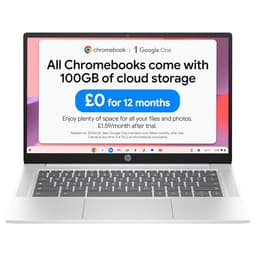
The HP Chromebook 14-inch N100 is the pick for buyers who want the simplest, most maintenance-free laptop experience possible. ChromeOS is a fundamentally different operating system from Windows: it boots in seconds, requires no antivirus software, updates automatically in the background, and is designed around web-based applications and Google's ecosystem. It is aimed at students, families with children, light home users, and anyone who spends the majority of their computing time in a browser or using Google Workspace applications.
The Intel N100 processor is a four-core chip from Intel's Alder Lake-N series, built on a 10nm process. It is a meaningful upgrade over the older Celeron N-series chips that populated previous HP Chromebooks, offering noticeably better performance in everyday tasks. With 8 GB of RAM, this Chromebook handles multiple Chrome tabs, Google Docs, YouTube, and Google Meet simultaneously without the sluggishness that affected earlier budget Chromebooks with 4 GB. The 128 GB of Flash storage is adequate for ChromeOS, which stores most data in the cloud by default, though local storage for Android apps and downloaded files can fill up if you are not careful.
The 14-inch IPS display runs at 1920x1080, which is excellent for a Chromebook at this price. The IPS panel delivers good viewing angles and colour accuracy for a budget screen, making it comfortable for extended use. The port selection is minimal: one USB-C, one USB-A, and a 3.5mm audio jack. This is the most significant hardware limitation of the device. If you need to connect multiple peripherals, a USB-C hub is a necessary purchase.
ChromeOS supports Android apps via the Google Play Store, which extends its functionality considerably. You can run Android versions of Microsoft Office, Adobe Lightroom, and many other applications. However, not all Android apps are optimised for a laptop screen, and some professional applications simply do not exist on ChromeOS. If you are committed to Windows software, this is not the right machine. If your needs are primarily web-based, it is an excellent and very affordable choice.
The automatic update policy for ChromeOS is worth checking: HP Chromebooks receive guaranteed software updates for a defined period, after which security updates cease. Check the Auto Update Expiry date for this model before purchasing.
Verdict: The best HP Chromebook available in the UK right now. The N100 processor and 8 GB RAM make it a genuinely capable everyday machine for users committed to the Google ecosystem.
Pros
- Intel N100 with 8 GB RAM is a substantial upgrade over older 4 GB Chromebooks
- 14" 1080p IPS display is sharp and comfortable for everyday use
Cons
- Only one USB-C and one USB-A port, so a hub is needed for multiple peripherals
- ChromeOS is incompatible with Windows software, limiting professional use cases
- 128 GB Flash storage fills quickly if you rely on local file storage
Buying Guide
How much RAM do you actually need?
RAM is the single most impactful specification for everyday performance, and it is often the area where budget laptops cut corners most aggressively. In 2026, 8 GB is the minimum for a Windows 11 laptop used for everyday tasks. It is workable for light use, but if you regularly keep more than ten browser tabs open, use video calling software, or run multiple applications simultaneously, you will notice slowdowns. 16 GB is the sweet spot for most users: it handles demanding multitasking comfortably and future-proofs the machine for the next few years. 32 GB, as found on the EliteBook x360 in this list, is overkill for most consumers but genuinely useful for developers, data analysts, and power users running virtual machines.
SSD type and capacity
All the Windows laptops in this list use SSD storage rather than a traditional spinning hard drive, which is the correct choice for 2026. PCIe NVMe SSDs are faster than SATA SSDs and significantly faster than older eMMC flash storage. The difference matters most for boot times, application loading, and file transfers. Capacity is equally important: 256 GB is the minimum for a Windows laptop, and even that requires discipline with local file storage. 512 GB is the practical recommendation for most users. If you store large media libraries, video projects, or game installations, consider 512 GB as a floor and plan for external storage or cloud backup.
Display: panel type matters more than resolution
All the laptops in this list run at either 1366x768 or 1920x1080. The 1080p machines are strongly preferable for extended use: text is sharper, images are cleaner, and the extra screen real estate makes multitasking more comfortable. Panel type also matters: IPS panels offer wider viewing angles and better colour accuracy than SVA or TN panels, which is why we have highlighted panel type in the comparison table. The OmniBook 5's OLED display is in a different category entirely, delivering contrast and colour that no IPS panel at this price can match.
Integrated versus discrete graphics
Most HP laptops in this price range use integrated graphics, where the GPU shares memory with the main processor. Integrated graphics are sufficient for web browsing, video streaming, office work, and light photo editing. If you want to game, edit video professionally, or run GPU-accelerated machine learning tasks, you need a discrete GPU. The HP Victus is the only machine in this list with a dedicated GPU, the RTX 4050, and it is the correct choice for those use cases. Do not pay extra for a gaming laptop if your workload is primarily productivity-based.
ChromeOS versus Windows
ChromeOS is not a lesser version of Windows: it is a fundamentally different operating system designed for cloud-first, web-centric use. If you live in Google's ecosystem, use web applications for most tasks, and do not rely on Windows-specific software, a Chromebook is a legitimate and often superior choice for simplicity and security. If you need Windows applications, choose a Windows machine. There is no meaningful middle ground.
New versus refurbished
The EliteBook x360 in this list is a refurbished enterprise machine. Buying refurbished from a reputable seller can deliver significantly better specifications per pound, but it comes with caveats: battery health will be reduced, cosmetic wear is possible, and the warranty terms differ from new. Always check the seller's grading system, returns policy, and whether the device has been factory reset and professionally cleaned before purchasing.
The overall winner is the HP Victus 15.6" Gaming Laptop (B0F6YRFRCR). It is the only HP in this list that combines a modern high-performance processor, discrete GPU, 16 GB of RAM, and a fast NVMe SSD in a machine that handles both gaming and productivity work. For the majority of UK buyers who want a capable, versatile HP laptop that will remain relevant for several years, it offers the best balance of performance, features, and price. If your budget is tighter and your needs are primarily everyday tasks, the HP 15.6" Ryzen 3 (B0F4DLN17X) is the best value pick in HP's range, delivering a modern processor and a proper IPS display at a price that is difficult to argue with.