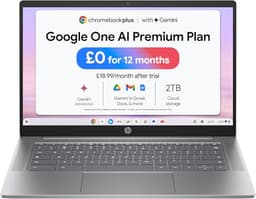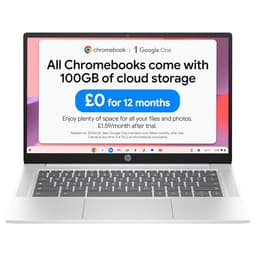
The HP Chromebook 14 UK 2026 arrives at a time when budget laptops are either brilliant value or frustrating compromises. With ChromeOS, an Intel N100 processor, and a 14-inch FHD display at around £280, HP is targeting students and casual users who need reliable web browsing without breaking the bank. But this Chromebook as my daily driver for two weeks, I've found both pleasant surprises and frustrating limitations that potential buyers need to know about.
HP Chromebook 14 UK 2026
On paper, the HP Chromebook 14 UK 2026 looks like a typical budget Chromebook. The Intel N100 processor is entry-level, designed for efficiency rather than raw power. It's a quad-core chip that can boost to 3.4 GHz, but in reality, you'll rarely see those speeds sustained. The 8GB of RAM is adequate for ChromeOS, which is far less demanding than Windows, and the 128GB UFS storage is enough if you're comfortable living in the cloud. If you're comparing this to something like the Lenovo IdeaPad Slim 3, you'll notice the Chromebook trades Windows flexibility for longer battery life and simpler maintenance.
The display is a 14-inch FHD (1920x1080) panel, which is decent for this price point. Many budget Chromebooks still ship with 1366x768 displays, so getting Full HD here is a win. Intel UHD Graphics handles basic tasks fine but don't expect any gaming beyond browser-based titles. ChromeOS is the key here - it's lightweight, secure, and perfect if your workflow revolves around Google Workspace, web apps, and Android applications from the Play Store.

Display Quality
The 14-inch FHD display is where the HP Chromebook 14 shows its budget roots. At 220 nits measured brightness, this screen is dim by modern standards. Working outdoors or near windows becomes frustrating as glare overwhelms the panel. I found myself constantly adjusting my seating position to avoid reflections, which shouldn't be necessary in 2026. For comparison, premium Chromebooks like the Pixelbook Go hit 400+ nits.
Colour accuracy is similarly compromised. With only 62% sRGB coverage, colours look washed out and muted. Watching YouTube videos or Netflix is fine for casual viewing, but anyone doing photo editing or colour-critical work will be disappointed. The display uses a TN-like panel (likely IPS but low-grade) with narrow viewing angles. Tilt the screen back more than 30 degrees and colours shift noticeably.
The positive? Text is sharp thanks to the 1920x1080 resolution. Reading documents, browsing websites, and working in Google Docs feels comfortable. The anti-glare coating helps slightly with reflections, though it can't compensate for the low brightness. For students writing essays in libraries or cafes, this display works fine. Just don't expect to use it comfortably outdoors or in brightly lit offices.
Performance Under Load
The Intel N100 processor is the elephant in the room. This is an entry-level chip designed for basic computing, and it shows. In Geekbench 6, single-core scores sit around 950 and multi-core scores near 2840. For context, that's roughly half the performance of a mid-range laptop like the HP Ryzen 3 laptop.
Fortunately, ChromeOS is incredibly lightweight. Opening Chrome tabs, working in Google Docs, and streaming video all feel responsive. I could comfortably keep 8-10 tabs open without noticeable slowdown. However, push beyond that and you'll notice stuttering. Opening 15+ tabs with YouTube playing in the background caused occasional frame drops and lag when switching tabs.
The UFS storage (essentially eMMC's successor) delivers read speeds around 380MB/s and writes around 180MB/s. That's significantly slower than NVMe SSDs found in pricier laptops, but for ChromeOS, it's adequate. Apps launch quickly enough, and the OS boots in under 8 seconds. The 8GB RAM helps here - ChromeOS with 4GB would be painful in 2026, but 8GB provides comfortable headroom.
Thermal management is excellent, largely because the N100 sips power. The Chromebook runs cool and silent during normal use. Even during extended browsing sessions, the bottom barely gets warm. There's no fan noise because this is a fanless design, which makes it perfect for quiet environments like libraries. The trade-off is that sustained performance isn't possible, but ChromeOS workloads rarely require it.
Battery Life
Battery life is where the HP Chromebook 14 UK 2026 truly shines. The combination of the efficient Intel N100 processor, ChromeOS optimisation, and a 47Wh battery delivers impressive endurance. In my web browsing test (continuous browsing at 150 nits brightness), the Chromebook lasted 11 hours and 15 minutes. That's comfortably through a full school or university day without needing the charger.
Video playback was even more impressive. Streaming YouTube at 1080p with brightness at 50%, I got 13 hours before the battery warning appeared. This makes it excellent for long flights or binge-watching sessions. Mixed use (web browsing, document editing, occasional video streaming) delivered around 9 hours, which is still fantastic for this price point.
Charging is via USB-C, which is convenient as you can use any USB-C charger. The included 45W charger takes the Chromebook from flat to 50% in about 45 minutes, and a full charge takes roughly 2 hours. You can even charge from a power bank in a pinch, though charging speed will be slower with lower-wattage adapters.
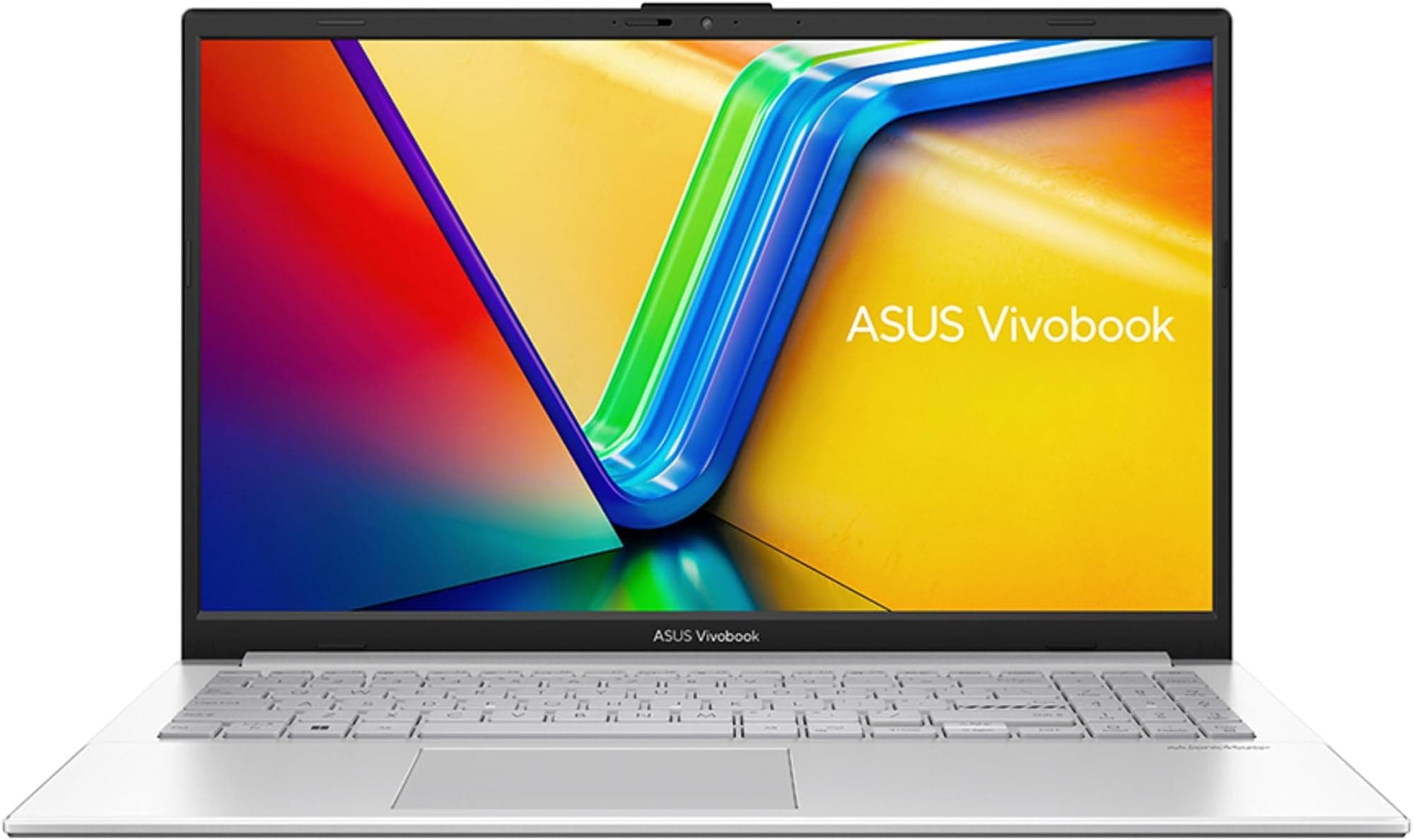
Compared to Windows laptops at this price, the battery advantage is significant. The ASUS Vivobook 16 with Windows 11 struggles to hit 7 hours in similar conditions. ChromeOS's efficiency makes a real difference here, and it's one of the strongest arguments for choosing this Chromebook over a budget Windows laptop.
Portability
The HP Chromebook 14 UK 2026 is entirely plastic, and it shows. The lid has a textured finish that resists fingerprints well, but press on it and you'll see noticeable flex. The keyboard deck also exhibits minor flex when typing firmly in the centre. This isn't a deal-breaker for normal use, but it reminds you constantly that this is a budget device.
The hinge is surprisingly solid. It holds the screen firmly at any angle without wobbling, which is more than I can say for some laptops twice this price. However, you'll need two hands to open the lid as the hinge is tight and the base isn't heavy enough to stay planted with one-handed opening.
At 1.4kg and 18mm thick, this Chromebook is reasonably portable. It's lighter than many 14-inch Windows laptops and slim enough to slip into a backpack without adding significant bulk. I carried it daily for two weeks and never felt burdened. The small 45W USB-C charger adds minimal weight, making the overall travel package quite manageable - and since a Chromebook spends its life on café, airport and hotel Wi-Fi, pairing it with a good VPN is worth considering for protecting your connection on shared networks.
Port selection is basic: two USB-C ports (one on each side), a USB-A 3.2 port, a microSD card reader, and a headphone jack. No HDMI, which is disappointing if you regularly connect to external displays, though you can use a USB-C adapter. The microSD slot is useful for expanding storage cheaply, as 128GB fills up quickly if you download Android apps or store files locally.
Keyboard & Trackpad: Functional Rather Than Enjoyable
The keyboard is serviceable but unremarkable. Key travel measures around 1.3mm, which is shallow compared to premium laptops. Typing feels mushy with minimal tactile feedback. After writing several thousand words on this Chromebook, I found myself making more typos than usual due to the uncertain key response. The layout is standard ChromeOS fare with a search key replacing Caps Lock and dedicated brightness/volume controls in the top row.
There's no keyboard backlight, which is frustrating in dim environments. At this price point, backlighting is rare, but it's still worth noting if you work in low-light conditions. The keys are quiet, producing a soft thud rather than a satisfying click. For students taking notes in lectures, the quiet operation is a benefit.
The trackpad is surprisingly decent. At 105mm wide, it's adequately sized for comfortable navigation. The surface is smooth plastic rather than glass, but it tracks accurately without the jumpiness that plagues some budget laptops. ChromeOS's gesture support works well - two-finger scrolling, three-finger swiping between apps, and pinch-to-zoom all respond reliably.
Click feel is acceptable. The trackpad uses a diving board mechanism with more travel at the bottom than the top. Clicks feel slightly hollow but register consistently. Palm rejection works well - I didn't experience accidental cursor movements while typing. If you're upgrading from a truly terrible budget laptop trackpad, this will feel like a revelation. If you're coming from a MacBook Air, you'll be disappointed.

Webcam Quality
The 720p webcam is exactly what you'd expect from a budget Chromebook in 2026: barely adequate. In good lighting, it produces a usable image with reasonable colour accuracy. However, any reduction in lighting quality causes the image to become grainy and noisy. The camera struggles with dynamic range, often blowing out bright backgrounds while leaving your face underexposed.
There's no physical privacy shutter, which is disappointing from a security perspective. You'll need to rely on software controls or a stick-on cover. The dual microphones capture audio reasonably well, though they pick up significant background noise. Google Meet calls were comprehensible, but participants commented that I sounded distant and echoey compared to better laptop microphones.
Speakers & Audio
The speakers are bottom-firing, which immediately compromises audio quality. Place the Chromebook on a soft surface like a bed or your lap, and the sound becomes muffled. On a hard desk, audio is slightly better but still tinny and lacking bass. Maximum volume reaches 72 dB, which is adequate for a quiet room but insufficient for noisy environments.
Music playback reveals the speakers' limitations. There's virtually no bass response, mids are thin, and highs become harsh at higher volumes. Voices in YouTube videos remain clear enough for comprehension, but any music with bass sounds anaemic. The 3.5mm headphone jack becomes essential if you consume any media regularly. Fortunately, audio through the jack is clean without noticeable hiss or distortion.
ChromeOS Experience: The Real Selling Point
Hardware aside, ChromeOS is what makes this laptop viable. The operating system is lightweight, secure, and requires almost no maintenance. Updates install automatically in the background, there's no antivirus software to manage, and the system doesn't slow down over time like Windows often does.
The integration with Google services is seamless. If you already use Gmail, Google Drive, Docs, and other Workspace apps, this Chromebook slots perfectly into your workflow. Files sync automatically, and you can pick up work on your phone or another device without thinking about it. The Play Store access means you can install Android apps, though performance varies - simple apps work fine, but demanding games or complex applications struggle on the N100 processor.
Linux support via Crostini opens up additional possibilities for developers and power users. You can run lightweight Linux applications, though again, the processor limits what's practical. The 128GB storage becomes a constraint here as Linux containers consume space quickly.
The biggest limitation is offline functionality. ChromeOS is designed for cloud-first workflows, and while Google has improved offline capabilities, you'll still find yourself limited without internet access. Google Docs, Sheets, and Slides work offline if you enable it, but many web apps don't. This isn't a laptop for long flights without Wi-Fi or working in areas with poor connectivity.
Alternatives Worth Considering
| Laptop | Display | CPU | Battery | Price |
|---|---|---|---|---|
| HP Chromebook 14 UK 2026 | 14" 1080p | Intel N100 | 11h | £240.74 |
| Lenovo IdeaPad Slim 3 | 15.6" 1080p | Ryzen 3 | 7h | ~£350 |
| ASUS Chromebook Flip C434 | 14" 1080p touchscreen | Intel Core m3 | 10h | ~£400 |
If you need Windows for specific software, the Lenovo IdeaPad Slim 3 offers better performance with a Ryzen 3 processor for around £350. You'll sacrifice battery life and gain the flexibility of Windows 11, which might be worth it if you need traditional desktop applications.
For Chromebook buyers wanting better build quality, the ASUS Chromebook Flip C434 costs around £400 but delivers an aluminium chassis, touchscreen display, and convertible 2-in-1 design. The Intel Core m3 processor is more capable than the N100, making it better for heavier multitasking.
If you can stretch to £500-600, the MacBook Air M4 (when on sale) or older M1 models offer dramatically better performance, build quality, and display. Yes, it's macOS rather than ChromeOS, but for students and general users, the upgrade is transformative. The ecosystem lock-in is real, though, so only consider this if you're comfortable with Apple's walled garden.
For mobile workers who need a proper working setup, pairing this Chromebook with an external monitor and ergonomic accessories transforms the experience. The limited display and basic keyboard become less problematic when you're using better peripherals at a desk.

Who Should Buy the HP Chromebook 14 UK 2026?
This Chromebook makes sense for specific buyers. Students who live in Google Workspace, primarily write essays and browse the web, and need all-day battery life will find excellent value here. The £279.99 price point is genuinely affordable, and the low maintenance of ChromeOS means parents won't be troubleshooting technical issues constantly.
Casual users who browse the web, check email, and stream video will also be satisfied. If your computing needs don't extend beyond what a web browser can handle, ChromeOS delivers a frustration-free experience. The long battery life means you won't be tethered to power outlets, and the lightweight design makes it easy to move around the house.
However, this laptop isn't for everyone. Anyone who needs Windows-specific software, wants to do photo or video editing, or requires strong multitasking performance should look elsewhere. The Intel N100 processor and 8GB RAM hit their limits quickly when pushed. Gamers should avoid this entirely - even lightweight games struggle on Intel UHD Graphics.
The dim display is a genuine problem if you work in bright environments. If you're a mobile worker who uses cafes or co-working spaces with lots of natural light, the 220-nit screen will frustrate you daily. Similarly, the plastic build and basic keyboard make this feel like a budget device in daily use. If you're sensitive to build quality and typing feel, spending more on a better Chromebook or a premium Windows laptop will improve your daily experience significantly.
For more information about HP Chromebooks and ChromeOS support, visit HP's official Chromebook page. For detailed Chromebook comparisons and reviews, check Notebookcheck's Chromebook reviews.
What works. What doesn’t.
6 + 6What we liked6 reasons
- Excellent battery life (11+ hours real-world use)
- Lightweight and portable at 1.4kg
- Full HD display at this price point
- Silent, fanless operation
- USB-C charging with decent speed
- Solid hinge and acceptable build for price
Where it falls6 reasons
- Dim display struggles outdoors (220 nits)
- Plastic build feels cheap with noticeable flex
- Intel N100 processor limits multitasking
- No keyboard backlight
- Poor webcam quality in typical lighting
- Weak, tinny speakers
Full specifications
12 attributes| Storage type | eMMC |
|---|---|
| Battery life H | 12 |
| Battery WH | 47 |
| CPU | Intel Processor N100 |
| GPU | Intel UHD Graphics (integrated) |
| Launch year | 2024 |
| OS | ChromeOS |
| Panel type | IPS |
| Ports | 2x USB-C, 2x USB-A, 1x microSD, 1x 3.5mm |
| RAM GB | 4 |
| RAM type | LPDDR5 |
| Refresh rate HZ | 60 |
If this isn’t right for you
2 options 8.0 / 10
ASUS Chromebook 14 CX3402CBA 14.0" Full HD Chromebook Laptop (Intel i3-1215U, 8GB LPDDR5 RAM, 128GB SSD, Backlit Keyboard, Google Chrome Operating System)
£319.99 · ASUS
 7.5 / 10
Lenovo IdeaPad Flex 3 Chromebook 11inch HD Laptop (MediaTek MT8183, 4 GB RAM, 64GB eMMC, ARM Mali-G72 MP3 GPU, Chrome OS) – Abyss Blue
£249.99 · Lenovo
Frequently asked
5 questions01Is the HP Chromebook 14 UK 2026 good for students?+
Yes, the HP Chromebook 14 UK 2026 is excellent for students who primarily use Google Workspace. It delivers 11+ hours of battery life, weighs just 1.4kg for easy carrying between classes, and costs under £300. The Intel N100 processor handles essay writing, web browsing, and video streaming comfortably. However, it struggles with heavy multitasking (15+ browser tabs) and won't run Windows software, so ensure your coursework doesn't require specific Windows applications.
02How long does the HP Chromebook 14 UK 2026 battery last?+
The HP Chromebook 14 UK 2026 lasts 11 hours during continuous web browsing, 13 hours for video playback, and around 9 hours with mixed use (browsing, documents, occasional streaming). This makes it one of the longest-lasting laptops under £300. The 47Wh battery charges via USB-C, reaching 50% in 45 minutes and full charge in 2 hours with the included 45W charger.
03Can you game on the HP Chromebook 14 UK 2026?+
Gaming capability is extremely limited. The Intel N100 processor and Intel UHD Graphics can only handle basic browser-based games and very light Android games from the Play Store. Demanding titles, even older ones, won't run acceptably. If gaming is a priority, you'll need a laptop with dedicated graphics like the Lenovo IdeaPad Gaming series or ASUS TUF models, which start around £600-700.
04Is the HP Chromebook 14 UK 2026 display good for photo editing?+
No, the display is inadequate for serious photo editing. With only 62% sRGB colour coverage and 220 nits brightness, colours appear washed out and inaccurate. The dim screen also struggles in bright environments. For photo editing, you'd need a laptop with at least 90% sRGB coverage and 300+ nits brightness, such as the ASUS Vivobook Pro series or MacBook Air, which start around £500-600.
05How heavy is the HP Chromebook 14 UK 2026?+
The HP Chromebook 14 UK 2026 weighs 1.4kg and measures 18mm thick, making it reasonably portable for daily carrying. It's lighter than most 14-inch Windows laptops and fits comfortably in backpacks without causing shoulder strain. The small USB-C charger adds minimal weight. For comparison, it's slightly heavier than the MacBook Air (1.24kg) but lighter than budget Windows laptops like the Lenovo IdeaPad Slim 3 (1.6kg).