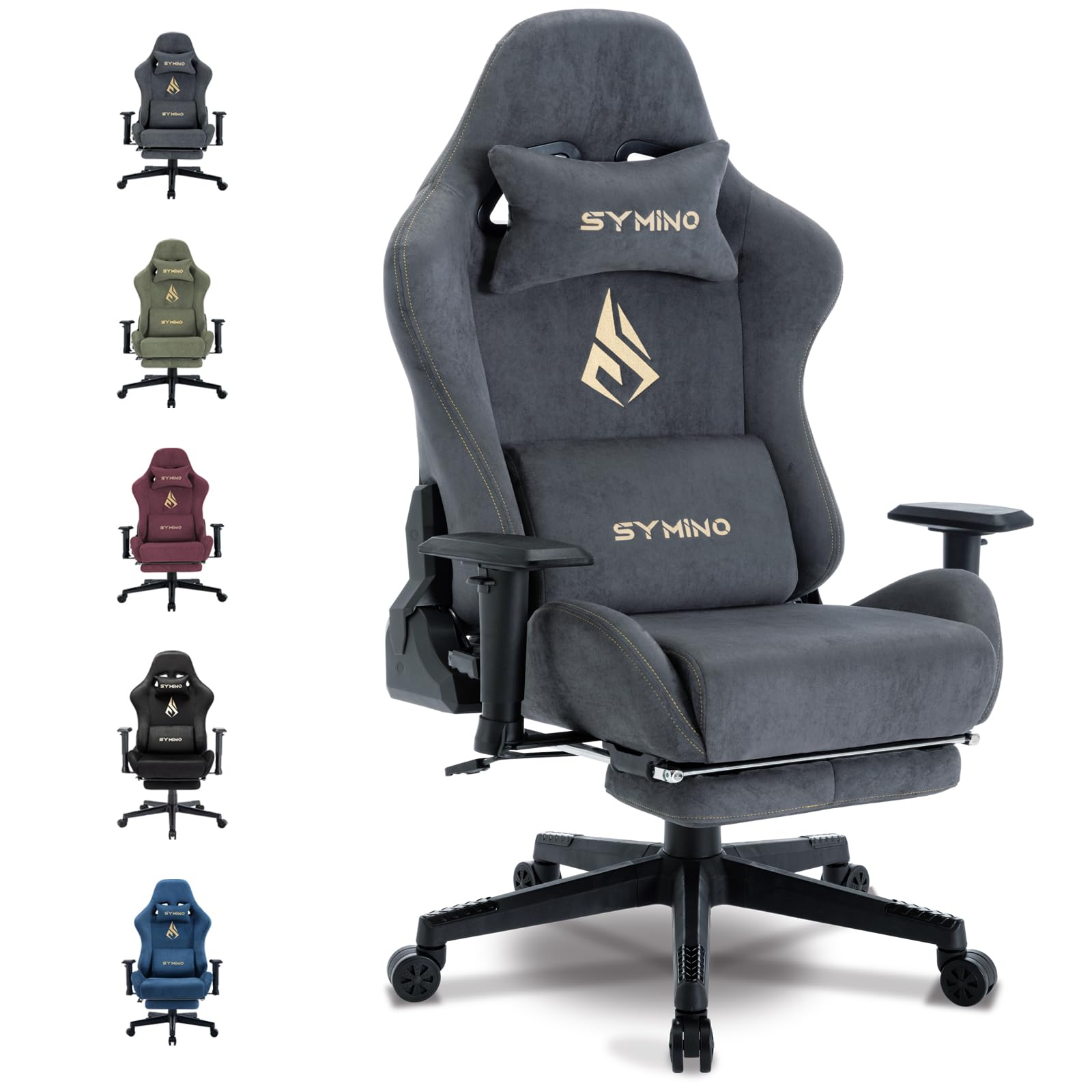
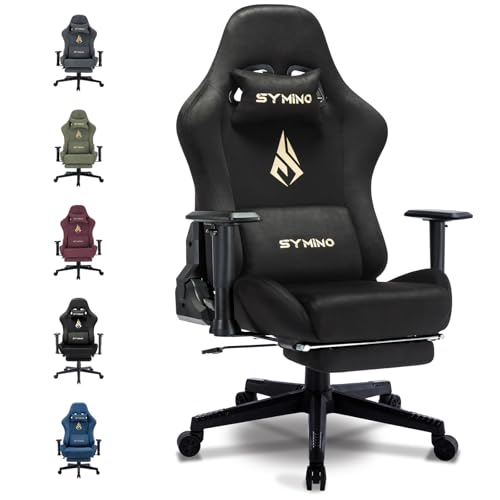
Symino Gaming Chair, Computer Chair with Footrest, Headrest and Lumbar Support, Ergonomic PC Chair, Height Adjustable Rotating Task Chairs, Gray
- Solid steel frame with no flex or wobble after a month of heavy use
- Smooth recline mechanism with a genuinely useful tilt-lock
- Retractable footrest included and stable enough to actually use
- External lumbar cushion migrates and needs repositioning every hour or two
- PU leather gets warm quickly in anything above a cool room
- Seat foam compresses noticeably during upright sessions beyond four hours
Available on Amazon in other variations such as: Small Size / Black Green, Large Size / Black, Standard Size / Green, Small Size / Black Red. We've reviewed the Standard Size / Grey model — pick the option that suits you on Amazon's listing.
Solid steel frame with no flex or wobble after a month of heavy use
External lumbar cushion migrates and needs repositioning every hour or two
Smooth recline mechanism with a genuinely useful tilt-lock
The full review
15 min readThirty days. Ten hours a day, give or take. That's roughly 300 hours I've spent planted in the Symino gaming chair, and by the end of it I could tell you exactly where the foam starts to give up, which recline angle stops feeling supportive, and whether that retractable footrest is a genuine feature or just a box-ticking exercise. I've been reviewing gaming chairs for six years now, and I'll be honest with you: budget chairs in the under-£150 bracket are where I spend most of my time, because that's where most people are actually shopping. The Symino sits squarely in that territory.
The gaming chair market in the UK is absolutely saturated right now. Walk onto Amazon and you'll find dozens of chairs that look almost identical, all wearing the same racing-bucket styling, all promising ergonomic salvation for your back. Most of them are rubbish. A few are decent. The Symino, with its 4.2-star rating across over 1,500 reviews, sits somewhere in the middle of that spectrum, and that's actually a more interesting story than a straightforward pass or fail. This is a chair that gets some things genuinely right, makes some frustrating compromises, and is priced in a way that forces you to think carefully about what you actually need.
I tested this chair primarily at my home desk, using it for a mix of writing, video editing, and yes, actual gaming. I'm 5'10" and around 80kg, which puts me squarely in the sweet spot for this chair's intended user range. I'll flag where things might differ for taller or heavier users throughout this review. The Symino gaming chair UK 2026 market is competitive, and I want to give you a proper picture of where this one lands.
Core Specifications
Before we get into the feel of the thing, let's talk numbers. The Symino is built around a steel frame, which is the right call at this price point. Aluminium bases are nicer but they cost money, and Symino has put the budget where it matters more. The seat itself is upholstered in PU faux leather over high-density foam, and the chair supports users up to around 150kg. Height-wise, the seat height adjusts from roughly 44cm to 54cm from the floor, which gives you a reasonable range, though I'll get into the specifics of who that actually suits in the size section.
The recline goes from an upright 90 degrees all the way to 155 degrees, which is a solid range for a budget chair. You get a tilt-lock mechanism, a retractable footrest, a removable headrest pillow, and an external lumbar cushion. The armrests are 2D adjustable, meaning height and pivot only. No depth adjustment, no lateral slide. The gas lift is a Class 3 unit, which is the standard you'd expect at this price. The base is five-star nylon, and the castors are standard PU wheels.
One thing worth flagging: the overall dimensions put this in the medium-to-large category for gaming chairs. The seat width is around 53cm at its widest point, and the backrest is tall enough to accommodate most people up to about 6'2". The chair weighs in at roughly 22kg assembled, which is fairly typical. Here's the full spec breakdown:
Ergonomics
Right, this is where I get opinionated, because ergonomics is the whole point. The Symino uses an external lumbar cushion rather than a built-in adjustable lumbar mechanism, and that's a genuine limitation. Built-in lumbar systems, like the kind you find on proper office chairs from the likes of Herman Miller or even mid-range task chairs, let you dial in the exact height and depth of the lumbar curve to match your spine. An external cushion is a blunt instrument by comparison. You can move it up or down the backrest by repositioning the strap, which gives you some control, but it's not the same thing. After about two weeks I'd found a position that worked reasonably well for me, but it took some fiddling.
That said, the cushion itself is decent quality. It's firmer than the usual squishy foam you get on budget chairs, and it actually holds its shape after a month of use. The lumbar curve is pronounced enough to push your lower back forward into a more neutral position, which is the right idea. According to guidance from the Health and Safety Executive on display screen equipment, proper lumbar support should maintain the natural inward curve of the lower spine, and this cushion does that reasonably well when positioned correctly. The problem is that if you shift around a lot during a session (and you will), the cushion can migrate. I found myself repositioning it every hour or two.
The headrest pillow is a similar story. It attaches via an elastic loop around the top of the backrest, and it's adjustable in the sense that you can slide it up and down. For me at 5'10", it sat at roughly the right height to support the base of my skull when I reclined. But the headrest pillow on a chair like this is really only useful when you're reclined, not when you're sitting upright and working. When I'm at 90 degrees typing, the headrest is too far back to be useful. That's not unique to Symino, it's a fundamental design issue with racing-style chairs, but it's worth knowing. The seat depth is fixed, which is another ergonomic limitation. Proper ergonomic seating should allow you to adjust seat depth so there's a two-to-three finger gap between the front edge of the seat and the back of your knees. With the Symino, you get what you get, and for shorter-legged users that could mean the front edge cuts into the thighs.
Size and Fit
I've already mentioned I'm 5'10" and 80kg, and the chair fits me well. But let's think about the edges of the range. The seat height range of 44cm to 54cm means that if you're shorter than about 5'3", you might struggle to get your feet flat on the floor even at the lowest setting. That matters because dangling feet put pressure on the underside of your thighs and cut off circulation over long sessions. The footrest helps here, actually, and I'll give Symino credit for including it, because it does solve the problem for shorter users who want to recline.
For taller users, the backrest height of around 85cm is the limiting factor. If you're 6'2" or above, the top of the backrest is going to sit below your shoulder blades, which means you lose upper back support. The headrest pillow won't reach your head at a useful angle either. I'd say the practical upper limit is around 6'1", not the 6'2" that's sometimes quoted. Hip width is another consideration. The seat is 53cm wide, which is generous for most people, but if you're on the broader side you might find the side bolsters of the bucket seat a bit restrictive. Racing-style bucket seats are designed around a narrower hip profile, and that's a genuine ergonomic compromise that affects a lot of people.
The footprint of the chair is worth thinking about too, especially if you're in a smaller room or under a standing desk. The base extends to about 70cm across, which is standard, but the chair does push back quite a bit when you recline. I have about 1.5 metres of clear space behind my desk and I was fine, but if you're working in a tight corner you'll want to measure up. The chair weighs 22kg assembled, so moving it around isn't exactly effortless, but it's manageable. The castors roll smoothly on both hard floors and carpet, which I was pleasantly surprised by at this price point.
Armrests
The armrests are 2D adjustable, which means you can change the height and the angle (pivot). You cannot adjust the depth or the lateral position. For a budget chair, 2D is the minimum I'd accept, and Symino just about clears that bar. The height adjustment range is decent, going from roughly 22cm to 32cm above the seat surface, which covers most people's elbow height when seated. I had mine set at about 27cm and found a comfortable position without too much trouble.
The pivot function is a nice touch. The armrests can rotate inward by about 20 degrees, which lets you angle them to match the natural position of your forearms when typing. This is actually more useful than a lot of people realise. Having your forearms angled slightly inward reduces the strain on your wrists and elbows over long sessions. The NHS guidance on correct sitting posture recommends keeping your elbows at roughly 90 degrees with your forearms parallel to the desk, and the pivot function helps you get closer to that position. So credit where it's due.
The padding on the armrests is where things get a bit disappointing. It's a thin layer of PU-covered foam, and after a month of use it's already showing some compression. Not dramatic, but noticeable. If you rest your elbows on these armrests for hours at a time, you'll feel the hard plastic underneath by the end of a long session. A lot of people solve this by buying aftermarket armrest pads, which cost a few quid and make a real difference. The locking mechanism for the height adjustment is a simple button-and-click system, and it held firm throughout my testing without any slipping. That's more than I can say for some chairs I've tested at this price.
Comfort Over Long Sessions
Here's the honest truth about this chair after 300 hours in it. The first two hours are genuinely comfortable. The foam is firm enough to support you without feeling hard, the lumbar cushion does its job when positioned correctly, and the recline gives you enough movement to shift your posture around. Hours three through six are where you start to notice the limitations. The seat foam, while decent initially, doesn't have the density to maintain its shape under sustained pressure. By hour four I was aware of a slight flattening under my sit bones, and by hour six I was shifting around more than I'd like.
The pressure point issue is most noticeable at the front edge of the seat. The bucket seat design creates a raised lip at the front, and over long sessions this can dig into the underside of your thighs. This is a classic problem with racing-style chairs, and it's one of the reasons I'm generally sceptical of the design for desk work. Proper ergonomic seating, as outlined in ISO 9241 standards for ergonomics of human-system interaction, emphasises pressure distribution across the full seat surface. A raised front lip concentrates pressure at one point, which is the opposite of what you want.
Beyond hour six, I was relying more on the recline and footrest to take pressure off my lower back and legs. And actually, in reclined mode with the footrest out, the chair is genuinely comfortable for extended periods. If you're gaming rather than working, and you're happy to sit at a more relaxed angle, the Symino holds up better. The footrest is sturdy enough to support your legs properly, and the recline at around 130 degrees puts you in a position that reduces spinal load significantly. So the comfort story is nuanced: not great for upright desk work over eight-plus hours, but decent for reclined gaming sessions.
Materials and Breathability
PU faux leather. That's what you're getting here, and I want to be straight with you about what that means in practice. PU leather looks good, it's easy to wipe clean, and it's cheaper to produce than genuine leather or proper mesh. But it doesn't breathe. At all. On a warm day, or in a room that gets afternoon sun, you will get sweaty sitting in this chair. I tested through late April into early May, and even on days that weren't particularly hot, I noticed the seat surface getting warm after a couple of hours. By summer, in a poorly ventilated room, this could be genuinely unpleasant.
The back panel has some perforations in the PU leather, which Symino markets as improving breathability. In my experience, these perforations make a marginal difference at best. The underlying foam still traps heat, and the PU surface still prevents meaningful air circulation. If breathability is a priority for you, you really need to be looking at mesh-backed chairs, which typically start at a higher price point. Brands like Secretlab and Noblechairs offer fabric or hybrid options, but you're paying more for that privilege. At the budget end of the market, PU leather is almost universal, and the Symino is no worse than its competitors in this regard.
Durability of the cover is a legitimate concern with PU leather. Over time, PU leather cracks and peels, particularly at stress points like the seat edges and the areas where your arms contact the backrest. After a month, mine shows no signs of this yet, but I've seen enough budget chairs to know it's coming. The timeline varies, but two to three years of daily use is a reasonable expectation before the surface starts to deteriorate. Some people apply leather conditioner to slow this process, and it does help. The stitching on my test unit was clean and even, with no loose threads or uneven seams, which is a good sign for initial build quality.
Tilt and Recline
The recline mechanism on the Symino is one of its stronger features. The range of 90 to 155 degrees is genuinely useful, and the mechanism itself is smooth. There's no jarring or catching as you move through the range, which isn't always the case on budget chairs. The tilt-tension knob underneath the seat lets you adjust how much resistance you feel as you lean back, and it works well. I had mine set to a medium tension, which meant I could lean back naturally without the chair snapping upright the moment I shifted forward.
The tilt-lock lets you fix the chair at any angle within the recline range, which is useful. I used this a lot, actually. I'd work at around 100 to 110 degrees for most of the day, which takes some pressure off the lower back compared to a strict 90-degree upright position. Research from studies published in the journal Spine has suggested that a slightly reclined posture of around 135 degrees minimises disc pressure in the lumbar spine, and while 135 degrees is too far back for active work, even a modest recline of 100 to 110 degrees is beneficial. The Symino makes it easy to find and lock that sweet spot.
The full 155-degree recline is essentially a lounging position. With the footrest extended, it's comfortable for watching something or taking a break, but you're not going to be doing productive work at that angle. The footrest itself extends smoothly and locks in the extended position. It's rated to support your legs comfortably, and in practice it held up fine throughout testing. One minor gripe: the footrest mechanism is a bit stiff to retract. You need to push it back with some force, and I could see this becoming annoying if you're extending and retracting it frequently throughout the day. Not a dealbreaker, but worth knowing.
Build Quality
For a budget chair, the Symino's build quality is actually pretty solid. The steel frame feels substantial, and there's no flex or wobble in the backrest even when you're pushing against it at full recline. The connection between the backrest and the seat base is tight, with no lateral play. I've tested chairs at similar prices where the backrest wobbles side to side like a loose tooth, so this is worth noting. The gas lift performed consistently throughout the month, holding its set height without any gradual sinking, which is a common failure point on cheap gas lifts.
The nylon base is the right choice at this price. Some manufacturers use aluminium bases as a selling point, but nylon is actually fine for most users and it's lighter. The five-star design is stable, and I never felt like the chair was going to tip, even when leaning hard to one side. The castors are a pleasant surprise. They're dual-wheel PU units that roll quietly on hard floors and don't leave marks. On carpet they're a bit more resistant, but still functional. I've used chairs with cheap single-wheel castors that scratch hardwood floors, so these are a genuine step up.
The overall weight capacity of 150kg gives you a sense of the structural confidence Symino has in this frame, and based on my testing I'd say that's a credible figure rather than marketing puffery. The recline mechanism housing is solid plastic, and the tilt-tension knob has a satisfying, precise feel to it. Where the build quality does fall short is in the smaller details: the armrest padding, as I mentioned, is thin, and the plastic components on the footrest mechanism feel a bit lightweight. These aren't structural concerns, but they do affect the overall impression of quality when you're using the chair day to day.
Assembly Experience
Assembly took me about 25 minutes working alone, which is on the quicker end for gaming chairs. The packaging was well organised, with each component wrapped separately and the hardware in a clearly labelled bag. Nothing was rattling around loose in the box, which sounds like a low bar but you'd be surprised how often budget chairs arrive with components banging around and getting scratched. The instructions are a single illustrated sheet, and they're clear enough to follow without needing to look anything up. All the required tools are included in the box.
The main assembly steps are: attach the base to the gas lift, insert the gas lift into the seat mechanism, attach the backrest to the seat, fit the armrests, and then add the headrest and lumbar cushions. The backrest attachment is the fiddliest part. You need to align four bolts simultaneously while holding the backrest in position, and doing this solo requires a bit of patience. I managed it by propping the backrest against a wall while I got the first bolt started. With two people it would be straightforward. The armrests click into place easily, and the gas lift pops into the base with a satisfying thunk.
One thing I appreciated: the bolts are all standard sizes and the Allen key provided actually fits properly. This sounds trivial, but I've assembled chairs where the included tools are so poorly made that you end up stripping bolt heads. The Symino's hardware is decent quality. By the time I'd finished assembly, nothing felt loose or uncertain. I did go back and check all the bolts after the first week of use, as I always recommend, and everything was still tight. Total time from opening the box to sitting in the chair: 28 minutes. That's a good result.
How It Compares
The Symino gaming chair UK 2026 market is crowded, and to give you a useful comparison I want to look at two chairs that compete directly with it: the Dowinx LS-666801F and the Hbada E3. Both sit in the budget-to-lower-mid-range bracket and target the same audience. The Dowinx is probably the most direct competitor, offering a similar feature set at a similar price. The Hbada E3 sits slightly higher in price but brings a mesh back panel, which is a meaningful ergonomic upgrade.
The Dowinx LS-666801F is a well-established budget option with a strong review count. It uses a similar PU leather construction and external lumbar cushion, but its lumbar cushion has a built-in massage function (vibration motor), which sounds impressive but in practice is more novelty than useful. The Symino's lumbar cushion is firmer and more supportive for sustained sitting. The Dowinx also has a footrest, but it's slightly less stable than the Symino's. Where the Dowinx wins is on armrests: it offers 4D adjustment on some variants, which is a genuine ergonomic advantage. If armrest adjustability is important to you, that's worth knowing.
The Hbada E3 is a different proposition. The mesh back panel genuinely solves the breathability problem, and if you run warm or work in a warm room, that's a significant quality-of-life improvement. The Hbada's lumbar support is also built-in and adjustable in height, which is ergonomically superior to the Symino's external cushion. But you're paying more for it, and the Hbada doesn't include a footrest. For pure gaming use with a reclined posture, the Symino's footrest is a meaningful advantage. For desk work in a warm environment, the Hbada's mesh back is worth the extra outlay.
Final Verdict
After a month of serious daily use, the Symino gaming chair earns a cautious recommendation, but with clear caveats. It's a budget chair that does the basics well: the frame is solid, the recline mechanism is smooth, assembly is painless, and the footrest is a genuinely useful inclusion. For the price, you're getting more than you might expect. But it's not a chair I'd recommend to someone who needs to sit upright at a desk for eight-plus hours a day. The external lumbar cushion migrates, the seat foam compresses over long sessions, and the PU leather gets warm. These are real limitations that affect daily comfort.
Where the Symino genuinely shines is as a gaming chair used in the way gaming chairs were originally designed to be used: reclined, with the footrest out, for extended gaming sessions. In that context, the 155-degree recline, the stable footrest, and the supportive headrest pillow work together well. It's also a reasonable choice for someone who uses their desk chair for mixed tasks, a few hours of work and then some gaming, rather than marathon upright work sessions. The 4.2-star rating from over 1,500 buyers reflects this: most people are happy with it, and that's because most people aren't sitting in it for ten hours straight.
On the ergonomics front, I'd encourage anyone buying this chair to invest a small amount of time in positioning the lumbar cushion correctly, and to consider adding aftermarket armrest pads if you rest your elbows heavily. The BackCare charity has good free resources on setting up your seating position, and the principles apply regardless of what chair you're in. The Symino gives you the adjustability to get into a reasonable position; it just requires a bit more effort than a higher-end chair would. For the price, that's a fair trade-off. I'd give it a 6.5 out of 10: a solid budget option with honest limitations.
Rating: 6.5 / 10
Pros: Solid steel frame with no flex or wobble; smooth recline mechanism with useful tilt-lock; retractable footrest included and genuinely functional; straightforward assembly under 30 minutes; good weight capacity for a budget chair.
Cons: External lumbar cushion migrates during long sessions; PU leather gets warm quickly; seat foam compresses noticeably after four-plus hours upright; armrest padding thin and shows compression after a month.
What works. What doesn’t.
5 + 4What we liked5 reasons
- Solid steel frame with no flex or wobble after a month of heavy use
- Smooth recline mechanism with a genuinely useful tilt-lock
- Retractable footrest included and stable enough to actually use
- Straightforward assembly in under 30 minutes, solo
- Good 150kg weight capacity for a budget-tier chair
Where it falls4 reasons
- External lumbar cushion migrates and needs repositioning every hour or two
- PU leather gets warm quickly in anything above a cool room
- Seat foam compresses noticeably during upright sessions beyond four hours
- Armrest padding is thin and shows compression after a month
Full specifications
9 attributes| MAX weight capacity | 200 |
|---|---|
| Armrest adjustability | 2 inches up/down, 30° left/right |
| Armrest rotation | yes |
| Backrest recline | adjustable |
| Footrest | yes |
| Materials | PU leather/faux leather/breathable fabric |
| NET weight | 21.5 kg |
| Seat material | memory foam |
| Wheels | quiet |
If this isn’t right for you
2 options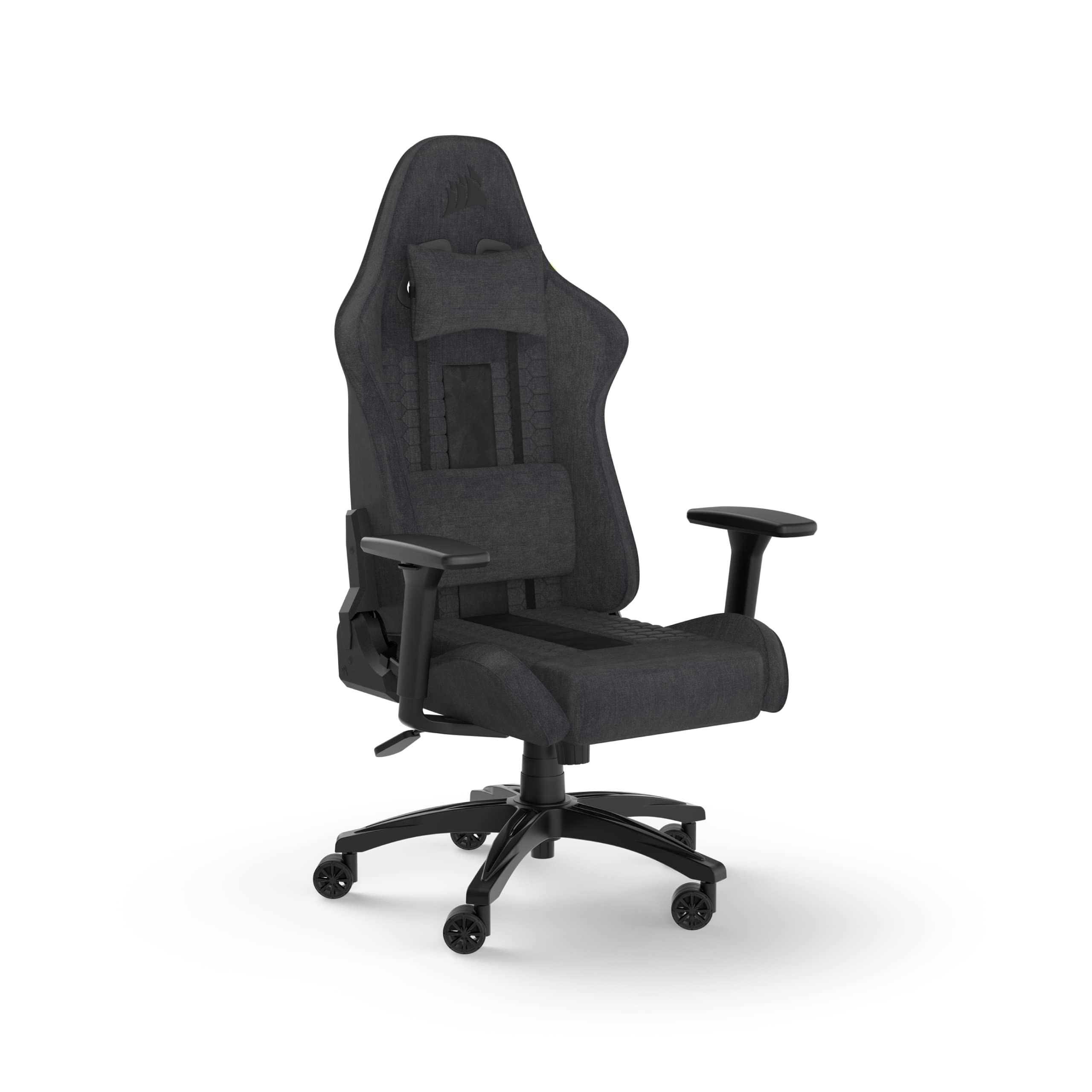 7.5 / 10
Corsair TC100 RELAXED Gaming Chair - Fabric - Racing-Inspired Design - Lumbar Pillow - Detachable Memory Foam Neck Pillow - Adjustable Seat Height - Adjustable Armrests - Grey & Black
£159.99 · Corsair
 7.0 / 10
Subsonic Harry Potter- Junior Rock'n'seat Gaming Chair- Child / Teenager Gamer Seat for bedroom official license (PS5////)
£110.78 · Subsonic
Frequently asked
5 questions01Is the Symino Gaming Chair, Computer Chair with Footrest, Headrest and Lumbar Support, Ergonomic PC Chair, Height Adjustable Rotating Task Chairs, Black comfortable for long gaming sessions?+
For gaming sessions in a reclined position with the footrest extended, the Symino is genuinely comfortable for extended periods. The 155-degree recline and stable footrest work well together. However, for upright desk work beyond four to six hours, the seat foam begins to compress and the external lumbar cushion can migrate, which reduces support. It's better suited to gaming use than all-day office work.
02What height and weight range is the Symino Gaming Chair, Computer Chair with Footrest, Headrest and Lumbar Support, Ergonomic PC Chair, Height Adjustable Rotating Task Chairs, Black suitable for?+
The Symino works best for users between approximately 5'3" and 6'1" (160cm to 185cm). The seat height adjusts from 44cm to 54cm from the floor, and the backrest height of around 85cm provides adequate upper back support up to about 6'1". The weight capacity is rated at approximately 150kg. Shorter users can use the retractable footrest to compensate for the seat height. Users above 6'1" may find the backrest too short for full upper back support.
03Does the Symino Gaming Chair, Computer Chair with Footrest, Headrest and Lumbar Support, Ergonomic PC Chair, Height Adjustable Rotating Task Chairs, Black have good lumbar support?+
The Symino uses a removable external lumbar cushion rather than a built-in adjustable lumbar mechanism. The cushion itself is firm and holds its shape well, and you can reposition it on the backrest strap to adjust the height. However, it tends to migrate during long sessions and needs repositioning every hour or two. It's functional but not as precise or reliable as a built-in lumbar system found on higher-priced chairs.
04Is the Symino Gaming Chair, Computer Chair with Footrest, Headrest and Lumbar Support, Ergonomic PC Chair, Height Adjustable Rotating Task Chairs, Black difficult to assemble?+
Assembly is straightforward and took approximately 25 to 28 minutes working alone. The packaging is well organised, all required tools are included, and the illustrated instructions are clear. The trickiest step is attaching the backrest, which requires aligning four bolts simultaneously and is easier with two people. Overall, it's one of the easier gaming chair assemblies at this price point.
05What warranty applies to the Symino Gaming Chair, Computer Chair with Footrest, Headrest and Lumbar Support, Ergonomic PC Chair, Height Adjustable Rotating Task Chairs, Black?+
Amazon offers 30-day returns on most items. Symino typically provides a 2-5 year warranty on their chairs, though you should check the specific warranty terms on the product listing or contact Symino directly to confirm current coverage for your purchase.