
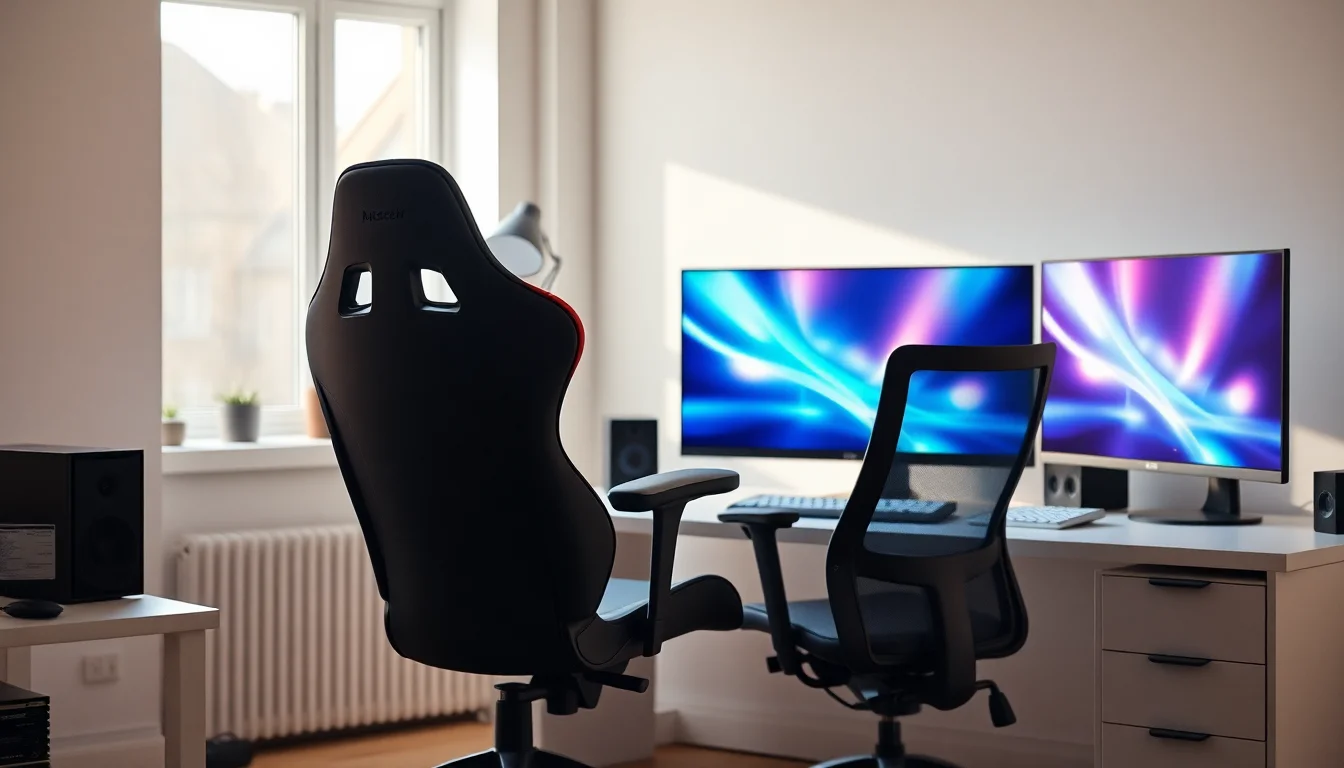
TL;DR
The gaming chair vs office chair debate is really a health and fit question, not an aesthetics one. For long PC sessions in the UK, adjustability and lumbar support science matter far more than whether a chair has a racing stripe or RGB lighting. Your body type, daily use pattern and UK consumer rights protections should drive the decision, not marketing.
Quick Answer
For most UK users spending six or more hours at a PC, an ergonomic office chair with adjustable lumbar support will protect your back better than a typical gaming chair. If you also game, look for a chair that satisfies both DSE regulations and personal comfort rather than choosing a label.
Key Takeaways
- Gaming chair vs office chair is a health decision first: HSE data shows musculoskeletal disorders caused 7.3 million lost working days in 2022/23.
- Body type (height, weight, inseam) is the single most important selection factor, and most buying guides ignore it entirely.
- Fixed lumbar pillows common in gaming chairs can worsen back pain; adjustable lumbar support is the only kind that reliably helps.
- UK ergonomic standard BS EN 1335 sets measurable benchmarks for seat height, depth and backrest range. Office chairs meet it; many gaming chairs do not.
- Under the Consumer Rights Act 2015, your contract is with the retailer, not the manufacturer. You have up to six years to claim in England and Wales.
- Total cost of ownership often favours a premium ergonomic chair over repeated budget replacements.
- Home workers who also game need one chair that satisfies DSE regulations and personal comfort. That crossover use case is where most guides fall short.
You're probably reading this because your back aches after a long session, or because you're setting up a home office that doubles as a gaming station and you can't quite justify two chairs. The gaming chair vs office chair question comes up constantly on forums, and the honest answer is that most of the advice out there is wrong. Not wrong in a subtle way. Wrong in the way that sends people to buy a £130 racing-style chair with a fixed lumbar pillow, which then makes their lower-back pain worse over the following six months.
This guide cuts through the marketing. We'll look at what UK ergonomic standards actually require, what lumbar support science says, how your body dimensions should drive the choice, and what your legal rights are when a chair fails. By the end, you'll have a framework for the decision, not just a product name.
Gaming Chair vs Office Chair: What's the Real Difference?
The labels are almost meaningless on their own. A gaming chair is any chair marketed at PC gamers, typically featuring a high backrest, bucket seat borrowed from motorsport aesthetics, a fixed or semi-fixed lumbar pillow, and faux leather upholstery. An office chair is any chair marketed for workplace use, typically featuring a flatter seat, adjustable lumbar support, mesh or fabric upholstery and a more conservative visual design.
But here's the thing: the design philosophies behind those labels are genuinely different, and that difference matters enormously for long sessions.
Gaming chairs evolved from the gaming peripheral industry, where the priority was creating a product that looked exciting in a streamer's background. The bucket seat design came from racing car seats, which are built for lateral support during cornering, not for eight hours of upright computer work. Racing seats hold you in a reclined, slightly semi-supine posture. That's fine for a 90-minute gaming session. It's not fine for a full working day, and it's actively problematic if you have lower-back issues.
Office chairs, particularly those meeting BS EN 1335:2020, evolved from occupational health research. The standard specifies measurable requirements for seat height range (typically 400 to 520 mm), seat depth (380 to 470 mm), backrest height (360 to 640 mm above the seat) and armrest range. These aren't arbitrary numbers. They're derived from anthropometric data covering the range of adult body dimensions across the working population. An office chair built to this standard can, in theory, accommodate most users in a neutral posture: feet flat on the floor, thighs roughly horizontal, forearms level with the desk, lumbar curve supported without exaggeration.
The gaming chair vs office chair question is therefore not really about aesthetics or price. It's about whether the design philosophy behind the chair aligns with what your body needs during long PC use. A gaming chair with genuinely adjustable lumbar support, seat height, backrest tilt and armrests can be as good as an office chair. Many gaming chairs don't have those features. Many cheap office chairs don't either. The label tells you almost nothing; the specification tells you everything.
One more thing worth flagging: the Health and Safety (Display Screen Equipment) Regulations 1992 require UK employers to assess and reduce risks from display screen work, including provision of seating that allows adjustable height, back support and neutral posture. If you work from home under an employment contract, your employer has legal obligations here. A chair that fails to meet those requirements isn't just uncomfortable. It's a compliance gap.
Body Type Matters More Than You Think: Finding Your Fit
This is where almost every buying guide fails. They produce a list of chairs ranked by price tier or brand prestige, with a generic 'best overall' at the top, and they ignore the single most important variable: whether the chair actually fits the person sitting in it.
Seat height is the foundation. If the seat is too high, your feet dangle and your thighs press against the seat edge, restricting circulation. Too low, and your knees rise above your hips, tilting your pelvis backward and flattening your lumbar curve. Most gaming chairs have a seat height range of roughly 430 to 530 mm. That suits users between about 165 and 185 cm reasonably well. It leaves shorter users (under 165 cm) with dangling feet unless they use a footrest, and it can feel cramped for users over 190 cm.
Seat depth is equally critical and almost never discussed. A deep seat (over 480 mm) forces shorter users to either sit at the front edge (losing back support) or slide back (pressing the seat edge into the back of the knee). BS EN 1335 allows for adjustable seat depth precisely because this varies significantly across the population. Many gaming chairs have fixed, deep bucket seats. That's a design choice that prioritises the look of the chair over fit for a significant portion of users.
For users under 165 cm, the priority should be finding a chair with a lower minimum seat height (ideally under 420 mm), a shallower seat depth and a backrest that doesn't tower above the head, creating neck strain. Our dedicated guide on gaming chairs for short users covers the specific models and measurements that work for this group.
For users over 185 cm, the priorities flip. You need a longer seat depth to support the full length of the thigh, a higher backrest to support the upper back and neck, and a wider seat. Many standard gaming chairs and office chairs simply don't accommodate tall users well. The backrest ends at mid-shoulder-blade level, leaving the upper back and neck unsupported. Our guide on gaming chairs for tall users addresses this specifically, including which chairs offer extended backrest heights and genuine tall-user fit.
For heavier users, weight capacity is the obvious starting point, but it's not the only factor. Foam density matters: cheap foam compresses within months under higher loads, leaving you effectively sitting on a hard base. Frame construction matters: some gaming chairs use thin steel or aluminium that flexes noticeably under heavier use. BS EN 1335 covers users up to a defined weight range; users above 120 kg should look for chairs tested to BS 5459-2:2000+A2:2008, which is designed for persons up to 150 kg. Our guide on heavy-duty gaming chairs and office chairs for larger users covers the specific standards and models that genuinely hold up.
Lumbar Support and Posture: What the Science Says
Lumbar support is the most marketed and least understood feature in the chair industry. Every gaming chair claims to have it. Very few deliver it in a form that's actually useful.
The lumbar spine (the lower five vertebrae) has a natural inward curve called lordosis. When you sit, the pelvis tends to rotate backward, which flattens this curve. A flattened lumbar curve increases disc pressure and loads the posterior spinal ligaments, which is why prolonged sitting correlates with lower-back pain. Good lumbar support fills the gap between the chair and your lower back, maintaining the natural curve without forcing it into excess lordosis.
The key word is 'adjustable'. Every person's lumbar curve sits at a different height from the seat and has a different depth. A fixed lumbar pillow positioned at the wrong height doesn't support your lumbar curve. It pushes against your mid-back or your sacrum, which can actually increase spinal loading. This is why so many people find gaming chairs with fixed lumbar pillows uncomfortable after a few hours: the pillow is in the wrong place for their body.
Adjustable lumbar support, where you can move the support both vertically (to find your lumbar level) and adjust the depth or tension, is significantly more effective. Some premium chairs use inflatable lumbar bladders. Others use a sliding mechanism on the backrest. Either can work, provided you actually adjust it to your body rather than leaving it at the factory default.
Backrest tilt is the other underappreciated factor. A fixed-upright backrest forces your spine into a single posture for hours. A reclinable backrest allows you to shift between positions, which reduces sustained loading on any single spinal structure. HSE guidance recommends the ability to change posture during the working day, and movement breaks every 30 to 60 minutes. No chair, however well designed, offsets the health risks of sitting completely still for six hours.
For a detailed breakdown of how lumbar support design affects back pain specifically, including which adjustable mechanisms are most effective for common conditions, see our guide on gaming chairs for back pain and lumbar support explained.
UK Ergonomic Standards and Health Regulations Explained
Most chair buying guides don't mention UK regulations at all. That's a significant omission, because the regulatory context changes the framing of the decision entirely, particularly for home workers.
BS EN 1335-1:2020 is the current UK standard for office work chairs. It specifies minimum and maximum dimensions for seat height, seat depth, backrest height and armrest range, and sets durability and stability requirements. A chair that meets BS EN 1335 is rated to accommodate a defined range of adult body dimensions and to withstand normal office use. This doesn't mean every BS EN 1335 chair is comfortable for every user, but it does mean the manufacturer has met independently verified minimum requirements.
Most gaming chairs are not tested to BS EN 1335. Some premium gaming chairs now include BS EN 1335 compliance in their specifications, which is a genuine differentiator. But the majority are tested only to basic safety standards, not ergonomic performance standards. If you're buying a chair for a home office where DSE regulations apply, this matters.
The Health and Safety (Display Screen Equipment) Regulations 1992 apply to 'display screen equipment users', which includes anyone who habitually uses a computer as a significant part of their normal work. If you work from home under an employment contract and use a computer for most of your working day, these regulations almost certainly apply to you. Under them, your employer must provide a workstation assessment and ensure your seating allows adjustable height, adequate back support and a neutral posture. A chair that can't be adjusted to allow feet flat on the floor and forearms level with the keyboard doesn't meet this requirement.
There's also the Furniture and Furnishings (Fire) (Safety) Regulations 1988, which require upholstered furniture sold in the UK to meet ignition resistance standards. This applies to chairs sold for domestic use. It's not something most buyers think about, but it's worth checking that any chair you buy from an overseas seller (via Amazon Marketplace, for example) carries appropriate UK compliance markings.
Total Cost of Ownership: Why Cheap Chairs Cost More
The sticker price of a chair is almost never the real cost. This is one of the most practically important things to understand about the gaming chair vs office chair debate, and it's almost entirely absent from mainstream buying guides.
Budget gaming chairs in the £80 to £150 range typically use low-density foam that compresses within 12 to 18 months of regular use, gas lifts that fail within two to three years, and faux leather upholstery that cracks and peels within a similar timeframe. At that point, the chair is effectively unusable. You replace it. The cycle repeats.
A £120 chair that lasts two years costs £60 per year. A £400 ergonomic office chair that lasts seven years costs roughly £57 per year, and delivers better adjustability, better lumbar support and better long-term back health. The premium chair isn't just more comfortable. Over a realistic ownership period, it's cheaper.
The comparison gets sharper when you factor in the hidden costs of a poor chair: physiotherapy appointments, over-the-counter pain relief, lost productivity from discomfort, and in serious cases, time off work. The HSE's 7.3 million lost working days figure from musculoskeletal disorders isn't abstract. It represents real people whose seating contributed to real health problems with real financial consequences.
Mid-range gaming chairs (£200 to £400) occupy an interesting middle ground. Some offer genuine adjustability and reasonable build quality. Others are budget chairs with better upholstery and a higher price tag. The key differentiators at this price point are: adjustable lumbar support (not just a fixed pillow), seat depth adjustment, 4D armrests (adjustable in four directions), and a high-density foam seat that maintains its shape under daily use.
Premium ergonomic office chairs from brands like Herman Miller, Humanscale or Steelcase typically start at £600 and can exceed £1,500. These are genuinely different products from a budget gaming chair, not just more expensive versions of the same thing. They use different materials, different mechanisms and different design philosophies. For someone sitting eight or more hours a day, five days a week, the investment is often justified on health grounds alone.
Hybrid Work and Gaming: Choosing a Chair That Does Both
This is the use case that most guides ignore entirely, and it's probably the most common one in 2026. A huge proportion of UK home workers use the same desk, the same monitor and the same chair for employment during the day and gaming in the evening. Two chairs isn't practical. One chair needs to do both jobs.
The tension here is real. DSE regulations require a chair that supports neutral posture for focused computer work. Gaming comfort often favours a slightly reclined posture, more padding and a more relaxed feel. These aren't completely incompatible, but they do pull in different directions.
The best hybrid chairs share a set of characteristics. Full seat height adjustment (not just a limited range). Adjustable lumbar support that can be positioned for upright work and relaxed gaming. A reclinable backrest with a lockable position, so you can sit upright for work and recline for gaming without the chair dictating the posture. Breathable fabric upholstery (faux leather traps heat during long sessions, which becomes genuinely uncomfortable after a couple of hours). 4D armrests that can be lowered for gaming controllers and raised for keyboard work.
The gaming chair vs office chair binary breaks down completely here. A well-specified gaming chair with adjustable lumbar and recline can satisfy DSE requirements and gaming comfort. An office chair with a reclinable backrest and padded seat can feel perfectly comfortable for evening gaming. The label matters less than the specification.
What to avoid in a hybrid chair: fixed lumbar pillows (they work for one posture, not two), faux leather upholstery (heat retention), very deep bucket seats (they restrict posture variation), and chairs without lockable recline (you can't maintain upright posture for focused work if the backrest floats freely).
For a detailed look at how office chairs perform specifically in gaming contexts, including which features matter most for the crossover use case, see our guide on office chairs for gaming and hybrid use.
Special Cases: Scoliosis, ADHD and Heavy Users
Most chair guides treat all users as interchangeable. They're not. Three groups in particular have needs that standard chair recommendations don't address well.
Users with scoliosis (lateral curvature of the spine) need seating that accommodates asymmetry rather than forcing symmetrical posture. A chair with a rigid, symmetrical backrest can create uneven pressure distribution across the spine, which increases discomfort and can worsen symptoms over time. For scoliosis, the priority is a backrest with enough flexibility to accommodate the curve, adjustable lumbar support that can be positioned asymmetrically if needed, and the ability to shift posture frequently. A physiotherapist or occupational health specialist should be consulted before making a purchase; they may recommend specific features or brands that standard reviews don't cover. Our dedicated guide on gaming chairs for scoliosis and spine health covers the specific considerations in detail.
Users with ADHD often find that the ability to move, fidget and shift posture is not a problem to be solved but a genuine need that affects focus and wellbeing. Chairs with very rigid posture requirements or that penalise movement (through squeaking, instability or resistance) can be actively counterproductive. Some users find that chairs with a degree of dynamic movement, such as a forward-tilt mechanism or a rocking function, help maintain focus by allowing controlled movement without leaving the chair. Seat material matters too: some ADHD users find certain textures distracting or uncomfortable in ways that neurotypical users don't notice. Our guide on gaming chairs for ADHD and fidgeting addresses these specific needs.
Heavier users (above 120 kg) face a straightforward but often ignored problem: most chairs aren't built for them. Standard BS EN 1335 chairs cover a defined weight range; users above 150 kg should specifically look for chairs meeting BS 5459-2:2000+A2:2008, which is designed for persons up to 150 kg and uses reinforced construction accordingly. Beyond the weight limit, look for: high-density foam (not standard foam, which compresses faster under higher loads), reinforced five-point bases (cheap nylon bases crack under sustained higher loads), and wider seats (a standard 450 mm wide seat is uncomfortable for larger users). Our guide on heavy-duty gaming and office chairs covers the specific standards and models in detail.
Gaming Chairs for Long Hours: Comfort vs Health
There's an important distinction between a chair feeling comfortable and a chair being good for you. These overlap, but they're not the same thing.
A heavily padded gaming chair with a deep bucket seat can feel very comfortable for the first hour. The padding feels supportive, the high backrest feels secure, the recline feels relaxed. But by hour four, the picture often changes. The bucket seat restricts posture variation, so you're locked into the same position. The fixed lumbar pillow, if it's in the wrong position for your spine, has been pressing against the wrong part of your back for four hours. The faux leather upholstery has been trapping body heat, and you're noticeably warmer than you'd be in a fabric chair. The armrests, if they're fixed, have been at the wrong height for your desk, causing shoulder elevation or wrist extension.
For genuinely long gaming sessions (six hours or more), the features that matter are: adjustable lumbar support (not fixed), seat height adjustment across a range that fits your body, backrest recline with a lockable position, breathable fabric upholstery, and armrests that can be adjusted to match your desk height. These are the same features that matter for office work, because the ergonomic demands of six hours of gaming are essentially the same as six hours of office work.
The gaming chair industry has started to respond to this. Premium gaming chairs from brands like Secretlab, Herman Miller x Logitech and others now include genuinely adjustable lumbar mechanisms, 4D armrests and breathable fabric options. These are meaningfully different products from the budget racing-style chairs that dominate the lower end of the market. But they're also priced accordingly, and at their price point they compete directly with premium ergonomic office chairs.
For an in-depth look at which ergonomic features in gaming chairs are genuinely effective versus marketing claims, see our guide on ergonomic gaming chairs with adjustable lumbar support and recline.
UK Consumer Rights and Warranty: What You're Actually Protected By
Warranty claims on chairs are more common than most people expect. Gas lifts fail. Foam compresses. Armrests crack. Upholstery peels. Understanding your rights before you buy (and before you need to make a claim) is genuinely useful.
Under the Consumer Rights Act 2015, your contract is with the retailer, not the manufacturer. This is a critical distinction. If you buy a chair from Currys, John Lewis or Argos and it develops a fault, your claim is against that retailer, not against the manufacturer whose name is on the box. The manufacturer's warranty is a separate, additional promise, and it's often more limited than your statutory rights.
Your statutory rights work in tiers. In the first 30 days after purchase, you have an absolute right to reject faulty goods and receive a full refund. Between 30 days and six months, the retailer must repair or replace the item (or refund you if neither is possible). During this period, the burden of proof is on the retailer: if you report a fault, they must prove the goods were not faulty at delivery if they want to dispute your claim. After six months, the burden shifts to you: you can still claim up to six years in England and Wales (five years in Scotland) under the principle that goods should last a reasonable length of time, but you'll need to demonstrate the fault existed at delivery, typically through an independent assessment.
What does 'a reasonable length of time' mean for a chair? Courts and the ombudsman have generally taken the view that a chair used daily for office or gaming purposes should last several years. A gas lift failing after 18 months of normal use would likely be considered a fault. Foam compressing to the point of being unusable within a year would likely be considered a fault. Faux leather peeling after two years of normal use is less clear-cut, but a credible case could be made.
Manufacturer warranties vary enormously. Some gaming chair brands offer two-year warranties on the mechanism and one year on upholstery. Others offer five years on the frame. Read the warranty terms carefully before buying, and note what's excluded (commercial use, weight limits exceeded, normal wear). Also check the retailer's returns policy for change-of-mind returns: under the Consumer Rights Act, you have no automatic right to return goods that aren't faulty, so a generous 30-day returns window (as offered by John Lewis and some online retailers) is a genuine benefit when buying a chair you can't try in person.
For a detailed breakdown of UK warranty terms, what to do if a retailer disputes your claim, and how to escalate to the ombudsman, see our guide on gaming chair warranty and UK consumer rights.
Where to Go Next
The framework above should give you enough to make a genuinely informed decision about the gaming chair vs office chair question for your specific situation. But the framework is only the start. The right chair for a 190 cm tall user is a different product from the right chair for someone who is 158 cm. The right chair for someone with scoliosis is different from the right chair for a healthy user who simply wants to avoid developing back problems. And the right chair for a hybrid worker who games in the evenings is different from the right chair for a dedicated weekend gamer who sits for marathon sessions.
If you're on the taller side and struggling to find a chair where the backrest actually reaches your upper back, our guide on gaming chairs for tall users in the UK covers the specific measurements and models that genuinely fit. If you're shorter and finding that most chairs leave your feet dangling or the seat edge pressing into the back of your knee, our guide on gaming chairs for short users addresses that directly. If back pain is your primary concern and you want to understand which lumbar mechanisms are actually supported by evidence versus which are marketing, our guide on gaming chairs for back pain and lumbar support goes deep on the science. And if you're trying to balance DSE compliance for your day job with gaming comfort for the evenings, our guide on office chairs for gaming and hybrid use is exactly where to go next.
The gaming chair vs office chair debate doesn't have a universal answer. But it does have a framework: start with your body dimensions, layer in your use case and health needs, check the regulatory requirements that apply to you, and then evaluate chairs against those criteria rather than against a marketing category. Do that, and you'll end up with a chair that serves you well for years, not one you're replacing in eighteen months.
Frequently Asked Questions
Neither is inherently better. It depends on your body type, use case and health needs. Office chairs typically prioritise adjustability and neutral posture in line with HSE guidance, while gaming chairs often trade adjustability for padding and aesthetics. For sessions of eight hours or more, adjustability and proper lumbar support matter far more than the label on the chair. If you work from home, an office chair usually satisfies both DSE regulations and gaming comfort. If you game casually for a few hours, a gaming chair may feel more immersive, but fixed lumbar pillows and bucket seats can cause posture problems over time.
A gaming chair can reduce back pain if it provides adjustable lumbar support matched to your spine's natural curve. But many gaming chairs use fixed lumbar pillows that push the lower back into excess lordosis, which can actually worsen pain for certain body types. Back pain relief depends on seat depth, backrest height, adjustability and your individual dimensions. If you have existing back pain, speak to a physiotherapist or occupational health professional before buying. They may recommend a chair meeting BS EN 1335 standards rather than a gaming chair. No chair alone resolves back pain caused by prolonged sitting; movement breaks every 30 to 60 minutes are essential.
Budget gaming chairs in the £80 to £150 range typically last two to three years before the gas lift fails or the foam compresses noticeably. Mid-range options from £200 to £400 may last four to five years. Premium ergonomic office chairs at £300 to £600 or more often last seven-plus years under normal daily use. Calculate cost per year: a £120 chair lasting two years costs £60 per year, while a £400 chair lasting seven years costs roughly £57 per year, and the premium option usually delivers better adjustability and health outcomes. If you work from home full-time, spending £300 to £400 on a proper ergonomic chair is almost always better value than replacing a cheap gaming chair every couple of years.
Yes, if it meets the requirements of the Health and Safety (Display Screen Equipment) Regulations 1992: adjustable seat height, adjustable backrest (height and tilt), a stable five-point base, and support for neutral posture with feet flat, thighs horizontal and forearms level. Many gaming chairs lack full adjustability, making them unsuitable for full working days or DSE compliance. If you work from home, check whether your employer's occupational health policy accepts gaming chairs; some require chairs meeting BS EN 1335 standards. A gaming chair with full adjustability and breathable fabric can work for hybrid use, but an office chair remains the safer choice for employment purposes.
Under the Consumer Rights Act 2015, the retailer (not the manufacturer) is legally responsible if a chair is faulty. You have a 30-day right to reject faulty goods outright for a full refund. Between 30 days and six months, the retailer must prove the goods were not faulty at delivery if you raise a dispute. After six months, you can still claim up to six years in England and Wales (five years in Scotland) if the chair does not last a reasonable length of time, but the burden of proof shifts to you. Manufacturer warranties are separate and often more limited. Always check what the retailer's returns policy covers, including the mechanism, upholstery and courier costs.
An ergonomic chair prioritises adjustability, neutral posture and long-term musculoskeletal health. It typically features a flat or gently contoured seat, adjustable lumbar support, backrest tilt and height-adjustable armrests, and is designed to comply with standards like BS EN 1335. A gaming chair prioritises immersion and aesthetics, often featuring a bucket seat, fixed lumbar pillow, high backrest and racing-style design. Ergonomic chairs are better suited to eight-plus hour workdays and back health. Gaming chairs feel more immersive for shorter sessions but can cause posture problems over time. Many premium gaming chairs now include ergonomic features, which blurs the line considerably. For long PC sessions, prioritise adjustability and lumbar support science over the marketing label.
Measure your height, weight and inseam, then check the chair's seat height range, seat depth, backrest height and weight limit. Users under 165 cm need a lower seat height range and shallower seat depth to avoid leg strain. Tall users over 185 cm need a higher backrest and longer seat depth. Heavier users above 120 kg should look for reinforced bases, higher weight limits and durable foam. For users over 150 kg, look for chairs meeting BS 5459-2:2000 standards. Always verify that lumbar support is adjustable rather than fixed. Read UK reviews that mention your body type; generic best-chair lists often ignore fit entirely. If possible, try before buying, or choose a retailer offering a 30-day return window under the Consumer Rights Act 2015.