Racingreat Ergonomic Gaming Chair Review UK 2026
- Solid steel frame that feels genuinely sturdy for the price
- Smooth tilt-tension mechanism with reliable locking
- Straightforward 25-minute solo assembly with clear instructions
- PU leather gets warm quickly in summer - skip if you run hot
- Seat bolsters too narrow for broader hip widths over 40cm
- Armrests are height-only - skip if you need proper wrist support
Solid steel frame that feels genuinely sturdy for the price
PU leather gets warm quickly in summer - skip if you run hot
Smooth tilt-tension mechanism with reliable locking
The full review
14 min readHere's something I've learned after six years of sitting in gaming chairs for a living: your spine doesn't care how cool a chair looks. It doesn't care about the racing stripes, the bucket-seat silhouette, or the logo stitched into the headrest. What it cares about is whether you've given it proper support during those long hours at the desk. And if you haven't, it will absolutely let you know about it, usually around the three-year mark when you're booking your first physio appointment and wondering where it all went wrong.
The Racingreat Ergonomic Gaming Chair landed on my doorstep at the start of May, and I've been using it as my primary seat for about a month now. I want to be upfront from the off: this is a budget chair. It sits firmly in the sub-£150 tier, and I'm reviewing it as exactly that. Not as a competitor to the Secretlab Titan or the Herman Miller x Logitech. But as an honest answer to the question: "I'm a student, or I'm just starting out, and I need something better than my kitchen chair. Is this it?" That's the question I'm here to answer.
Spoiler: for the right person, yes. For others, absolutely not. Let me break it all down after about a month of daily use, including some genuinely long gaming sessions and a fair bit of desk work.
Core Specifications
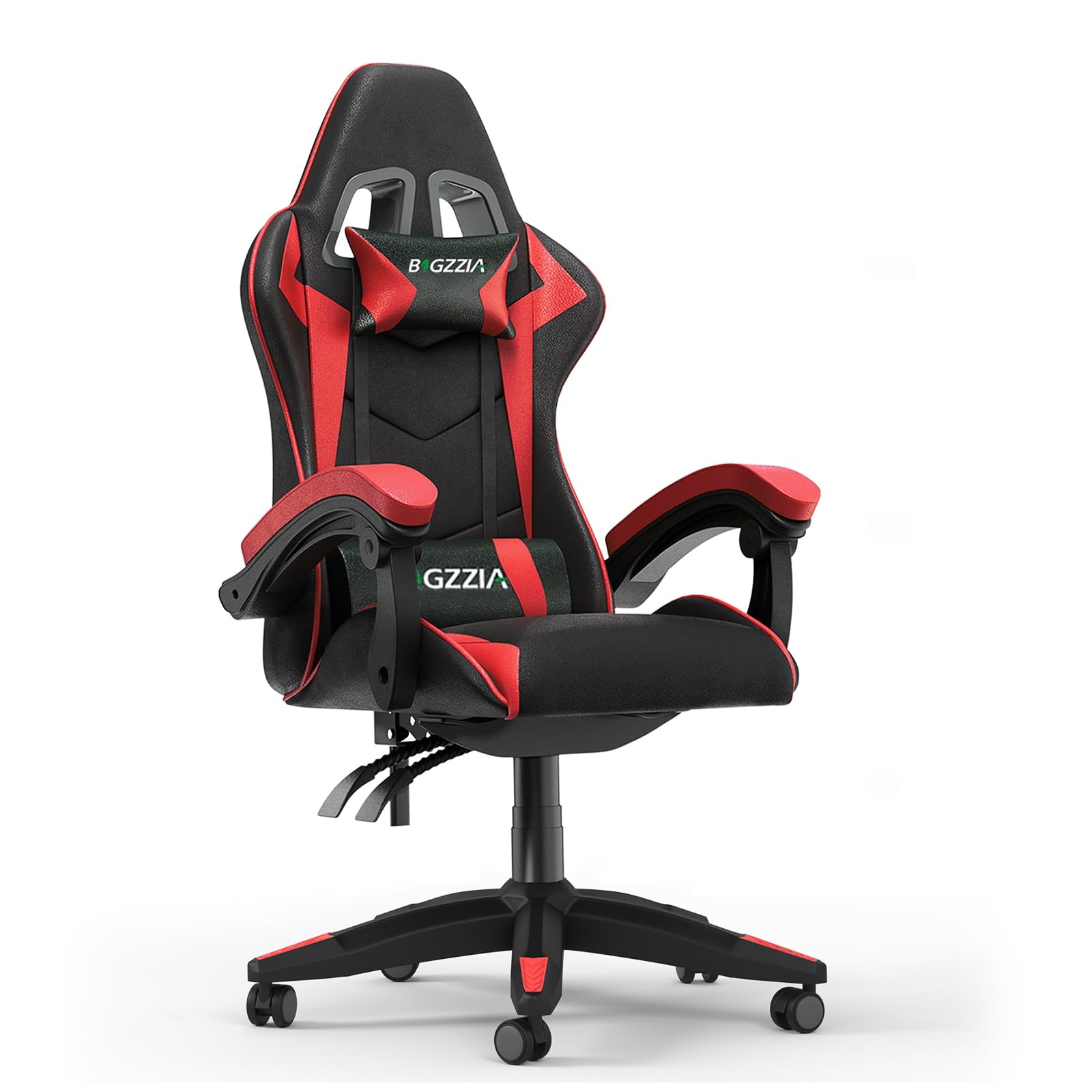
Before getting into how it feels, let's talk about what you're actually getting. The Racingreat Ergonomic Gaming Chair follows the classic racing-style form factor: high backrest, winged seat, a detachable lumbar cushion, and a detachable neck pillow. The frame is steel, which is good to see at this price point. Some budget chairs cut corners with cheaper alloys or even plastic internal frames, so steel is a reassuring baseline. The base is a five-point nylon star, and the castors are standard PU-coated wheels.
The chair reclines, has a tilt-tension knob, and the armrests are adjustable. I'll go into detail on all of those in their own sections, but the headline specs are broadly what you'd expect from a chair in this category. Weight capacity sits at around 120kg, and the recommended height range is roughly 160cm to 185cm. The seat-to-floor height is adjustable via the gas lift, which is a Class 3 unit. That's the standard for most chairs in this range, and it's perfectly adequate for everyday use.
One thing I want to flag early: the product listing uses the word "ergonomic" quite liberally. I'd call it ergonomic-adjacent. It has ergonomic features, yes. But true ergonomic design, the kind you'd find in an office chair from Herman Miller or Steelcase, involves adjustable lumbar depth, seat-pan depth adjustment, and dynamic support mechanisms. This chair has none of that. What it has is a cushion you can strap to your lower back and move around a bit. That distinction matters, and I'll keep coming back to it.
Ergonomics: Racingreat Ergonomic Gaming Chair Review UK 2026
Right, this is where I need to be honest with you, because the word "ergonomics" is doing a lot of heavy lifting in this chair's marketing. Proper ergonomics, as defined by organisations like the Health and Safety Executive in their display screen equipment guidance, involves adjustable lumbar support that moves both vertically and in depth, seat-pan depth adjustment to accommodate different leg lengths, and armrests that can move in multiple axes to keep your shoulders relaxed. The Racingreat doesn't tick all of those boxes. But here's the thing: neither do most chairs at this price. And it does better than nothing, which is what a lot of people are currently sitting on.
The lumbar cushion is the main event here. It attaches via two elastic straps that loop around the backrest, and you can slide it up or down to find a position that works for your lower back. I'm 178cm and found a position that felt decent within about five minutes of fiddling. The cushion itself is reasonably firm, which I actually prefer. Soft lumbar cushions tend to compress quickly and stop doing anything useful. This one holds its shape better than I expected for the price. The neck pillow is similarly straightforward: it clips onto the top of the backrest and you can adjust its height by moving the strap. It's not going to win any awards, but it keeps your head from lolling forward during a long session.
The seat itself is where the racing-chair design philosophy creates problems. The pronounced side bolsters, those raised wings on either side of the seat pan, are designed to look like a sports car seat. In practice, they can push against your thighs if you're on the wider side, which creates pressure points over time. I noticed this during longer sessions. If you're slim and within the recommended height range, the bolsters won't bother you much. But if you're broader in the hip, they'll become annoying by hour three. The seat foam is adequate initially, though I have real concerns about how it'll hold up after six months of daily use. More on that in the materials section.
Size and Fit
Getting the fit right on any gaming chair is crucial, and budget chairs often have a narrower sweet spot than they'd like to admit. The Racingreat is best suited to users between roughly 160cm and 185cm in height. I'm at the upper end of that range and it works fine for me, but I wouldn't want to be much taller. The backrest height is fixed, so if you're 190cm or above, the headrest pillow is going to sit at a slightly awkward angle relative to your neck. Not a dealbreaker, but worth knowing.
The seat width between the bolsters is approximately 35cm at its narrowest point. That's fairly typical for a racing-style chair, and it means users with hip widths above around 40cm may find the seat uncomfortable over longer periods. The seat depth is fixed at roughly 48cm, which suits average leg lengths well. If you've got shorter legs, you might find yourself sitting slightly forward to keep your feet flat on the floor, which can reduce the effectiveness of the backrest. A seat-depth adjustment would solve this, but that's a feature you won't find until you're spending considerably more.
The gas lift gives you a seat-to-floor height range of approximately 43cm to 53cm, which covers most average-height adults comfortably. I had mine set at around 47cm for desk work, which kept my thighs roughly parallel to the floor and my feet flat. That's the correct position according to NHS guidance on preventing back pain, and it's achievable with this chair if you're in the right height range. The footprint of the chair is fairly standard, roughly 70cm across the base, so it won't dominate a small room but it's not compact either.
Armrests
The armrests on the Racingreat are height-adjustable, which is the bare minimum I'd expect from any chair claiming ergonomic credentials. You push a button on the underside and slide them up or down through a few fixed positions. They don't pivot, they don't move laterally, and they don't slide forward or back. So if you're hoping for 4D armrests, you're in the wrong price bracket. But within their limitations, they work.
The padding on the armrests is a thin layer of foam covered in a hard plastic shell with a small padded top surface. It's adequate for resting your arms between tasks, but I wouldn't want to spend hours with my forearms planted on them. The surface area is small enough that it can create pressure points on the underside of your forearm if you lean on them heavily. I found myself using them more as a reference point than as actual support during long sessions. That's probably the right approach with chairs at this level.
The locking mechanism on the height adjustment is reasonably solid. I didn't experience any unexpected dropping or wobbling during my testing, which is more than I can say for some budget chairs I've reviewed. The click between positions is positive and the armrests feel stable once set. They're not going to satisfy anyone who needs proper armrest positioning for wrist health, but for casual use they're functional. If armrest quality matters to you, and it should if you're gaming for more than a couple of hours daily, budget an extra £100-150 for a chair with proper multi-axis adjustment.
Comfort Over Long Sessions
This is the section that matters most, and I want to give you a genuinely honest account. During my testing month I used this chair for sessions ranging from a couple of hours to one particularly ill-advised nine-hour day (I was deep into a game and lost track of time, we've all been there). The short sessions, up to about three hours, were actually pretty comfortable. The foam felt supportive, the lumbar cushion did its job, and I didn't notice any significant discomfort.
Beyond the three-hour mark, things start to get more complicated. The seat foam begins to compress noticeably, and you become more aware of the hard shell beneath. The bolsters, which were fine initially, start to feel more intrusive as your posture naturally shifts during a long session. I also noticed some warmth building up in the lower back area, which is a function of the PU leather cover rather than anything specific to the foam. By hour five or six, I was shifting position more frequently than I would in a proper ergonomic office chair. That's not a surprise at this price, but it's worth being clear about.
The nine-hour day left me with some mild lower back stiffness by the evening. Nothing serious, and a short walk sorted it out, but it's a reminder that this chair is not designed for marathon sessions. If your typical day involves eight-plus hours at a desk, this chair is not the right tool. But for students who are at their desk for a few hours of study and a couple of hours of gaming? It's genuinely fine. The comfort level is appropriate for the use case it's actually designed for, and I think that's the honest framing here. Don't buy a budget chair and expect premium endurance. That's not how it works.
Materials and Breathability
The Racingreat uses PU faux leather across the seat, backrest, and armrest surfaces. This is standard for gaming chairs at this price, and it has a familiar set of trade-offs. On the positive side, it's easy to wipe clean, it looks reasonably smart, and it doesn't snag on clothing. On the negative side, it doesn't breathe. At all. If you're gaming in a warm room in summer, you will notice heat building up against your back and thighs within about 45 minutes.
I tested this chair through a warm spell in early May, and the breathability issue was real. I was wearing a light cotton t-shirt and still found myself peeling away from the backrest after a couple of hours. This is a fundamental limitation of PU leather as a material, and it's not unique to Racingreat. The only real solution at this price is to either accept it or look for chairs with a fabric or mesh back panel. Mesh-back chairs tend to start at a higher price point, but they make a meaningful difference to comfort in warm conditions. The polyurethane coating on budget faux leather also has a tendency to crack and peel after 12-18 months of daily use, particularly at stress points like the seat edge and the armrest tops. I can't confirm that from one month of testing, but it's a pattern I've seen repeatedly across chairs in this category.
The foam density feels adequate right now, but I have the same concern I always have with budget chair foam: it's going to compress faster than you'd like. Premium chairs use high-density cold-cure foam that maintains its shape for years. Budget chairs use lower-density foam that does the job initially but flattens out over months of use. By the time you're a year in, you may find yourself sitting noticeably lower and with less support than when the chair was new. It's not a reason to avoid the chair entirely, but it's a reason to be realistic about its lifespan. Think of it as a two-to-three year chair rather than a five-year one.
Tilt and Recline
The recline range on the Racingreat is generous, going from a standard upright position of around 90 degrees all the way back to approximately 155 degrees. That's enough to have a proper lean-back during a film or a casual gaming session. The recline mechanism is smooth enough, with no jarring catches or sudden drops. You unlock it with a lever on the right side of the seat, lean back to your desired angle, and then lock it in place. Straightforward.
The tilt-tension knob sits underneath the seat and lets you adjust how much resistance you feel when reclining. I found the range of adjustment reasonable. At its lightest setting, the chair reclines with very little effort, which is fine for relaxed use but can feel a bit unstable if you're leaning forward to type. At its firmest setting, it holds a more upright position well. I settled on a middle tension for most of my testing, which gave a slight dynamic feel without being floppy. The tilt-lock, which holds the chair at a fixed recline angle, worked reliably throughout my testing period with no unexpected releases.
One thing I'll flag: the chair doesn't go fully flat. The 155-degree maximum is good for a reclined gaming position but it's not a nap chair. Some budget chairs advertise a 180-degree flat recline, which sounds appealing but is usually achieved by compromising the structural integrity of the recline mechanism. I'd rather have a solid 155 degrees than a wobbly 180. The rocking function, where the chair tilts freely without locking, is also present and works as expected. It's a nice touch for those moments when you're thinking through a problem and want to rock gently. Probably not a feature you'll use constantly, but it's there.
Build Quality
For a chair at this price, the build quality is better than I expected in some areas and exactly as expected in others. The steel frame is the highlight. You can feel the solidity when you sit down, and there's no flex or creak from the main structure during normal use. I put the chair through some deliberate stress testing, leaning hard to one side, rocking aggressively, and it held up without complaint. The welds look clean and the frame feels like it'll last, which is genuinely reassuring.
The base and castors are where the budget shows more clearly. The nylon base is functional but it's not going to win any durability prizes. Nylon bases can crack under heavy use or if the chair is dropped, and they don't have the premium feel of an aluminium base. The castors roll smoothly on both hard floors and carpet, which is good, but the PU coating on budget wheels tends to wear down faster than the polyurethane wheels you'd find on more expensive chairs. On hard floors, I'd recommend getting a chair mat regardless, both to protect your floor and to reduce wear on the wheels.
The gas lift is a Class 3 unit, which is the standard for most office and gaming chairs. It's not the highest class available, but it's adequate for the weight capacity and daily use. I didn't experience any sinking during my testing, which is the main failure mode for cheap gas lifts. The overall assembly feels solid once everything is bolted together, and I didn't notice any loosening of bolts or joints over the course of the month. That's a good sign. Some budget chairs start to rattle and wobble within weeks. This one stayed tight.
Assembly Experience
Assembly took me about 25 minutes working alone, which is pretty typical for a chair like this. The packaging was decent, with the components wrapped in foam and plastic to prevent transit damage. Everything arrived undamaged in my case, which isn't always guaranteed with budget chairs that sometimes have questionable packaging. The instructions are a simple illustrated sheet, no written language required, which is either a sign of good universal design or a sign that the manufacturer didn't want to pay for translation. Probably both.
The process is: attach the base to the gas lift, insert the gas lift into the seat mechanism, bolt the backrest to the seat, attach the armrests, and add the pillows. The bolts are all included and the Allen key is in the box. I didn't need any additional tools. The bolt holes lined up correctly on my unit, which sounds like a low bar but isn't always the case with budget flat-pack furniture. One of the armrest bolts required a bit of persuasion to get started, but nothing that caused real frustration.
One person can absolutely do this alone, though having a second pair of hands for the backrest attachment step makes it easier. The backrest is the heaviest single component and holding it in position while simultaneously aligning the bolts is a bit awkward solo. I managed it by propping the backrest against a wall while I got the first bolt started. Total time from opening the box to sitting in the chair: about 25 minutes. That's a reasonable assembly experience for the price, and the instructions, while basic, are clear enough that you won't be scratching your head at any point.
How It Compares
To give this chair proper context, I'm comparing it against two alternatives that a budget-conscious buyer might also be considering. The first is the Dowinx LS-668801F, a similarly priced racing-style chair that's been a consistent budget recommendation for a couple of years. The second is the GTRacing GT099, which sits at a slightly higher price point but is often discounted to a comparable level. Neither of these is a premium chair, but they represent the realistic competition for the Racingreat.
The Dowinx LS-668801F has a similar feature set but uses a slightly different lumbar support system, a built-in massage function powered by a USB cable. In practice, the massage function is more of a novelty than a genuine ergonomic feature, but some people love it. The GTRacing GT099 has a slightly wider seat, which makes it a better option for broader users who find the Racingreat's bolsters too restrictive. Both chairs use similar PU leather covers and similar foam densities, so the breathability and longevity concerns apply equally across all three.
Where the Racingreat holds its own is in the frame quality and the tilt mechanism. The steel frame feels more substantial than the Dowinx at a comparable price, and the tilt-tension adjustment is smoother than the GTRacing's in my experience. None of these chairs are going to replace a proper ergonomic office chair for serious long-term use. But if you're choosing between budget options, the Racingreat is a legitimate contender rather than a clear loser. The honest answer is that they're all broadly similar, and the differences come down to personal preference on seat width and whether you want a massage function you'll use twice.
Final Verdict: Racingreat Ergonomic Gaming Chair Review UK 2026
Here's the honest summary: the Racingreat Ergonomic Gaming Chair is a decent budget chair for students, casual gamers, and anyone upgrading from a dining chair or a knackered old office chair. It's not trying to be a Secretlab. It's not trying to be a Herman Miller. It's trying to be a functional, presentable gaming chair that doesn't cost a fortune, and at that specific task, it largely succeeds.
The steel frame is genuinely solid for the price. The tilt mechanism works properly. The lumbar cushion, while not a substitute for real adjustable lumbar support, does provide some meaningful lower back assistance during shorter sessions. Assembly is straightforward. And the overall package looks the part without being embarrassing. For someone who spends two to four hours a day at their desk and wants something better than what they've got, this chair delivers real value.
But I'd be doing you a disservice if I didn't flag the limitations clearly. The PU leather will get warm in summer. The foam will compress over time. The bolsters may bother you if you're broader in the hip. The armrests are basic. And if you're regularly putting in six-plus hour sessions, you'll feel the chair's limitations before the session ends. Understanding ergonomics properly means knowing that no budget chair fully replaces a purpose-built ergonomic seat, and the research on display screen equipment and musculoskeletal health is pretty clear on the long-term risks of inadequate seating. This chair reduces those risks compared to a kitchen chair. It doesn't eliminate them the way a proper ergonomic chair would.
My editorial score for the Racingreat, assessed as a budget chair against budget-chair criteria, is 6.5 out of 10. It does what it says on the tin, mostly. It's priced honestly. It's built well enough to last a couple of years with reasonable use. And for the right buyer, it's a perfectly sensible purchase. Just go in with clear eyes about what you're getting.
What works. What doesn’t.
5 + 4What we liked5 reasons
- Solid steel frame that feels genuinely sturdy for the price
- Smooth tilt-tension mechanism with reliable locking
- Straightforward 25-minute solo assembly with clear instructions
- Lumbar cushion holds its shape better than expected at this budget
- Competitively priced against comparable budget alternatives
Where it falls4 reasons
- PU leather gets warm quickly in summer - skip if you run hot
- Seat bolsters too narrow for broader hip widths over 40cm
- Armrests are height-only - skip if you need proper wrist support
- Foam will compress noticeably within 12-18 months of daily heavy use
Full specifications
5 attributes| Key features | 【Comfortable Computer Chair】:The seat cushion is filled with soft and high-density thick sponge to prevent discomfort from prolonged sitting,allowing for the same elasticity and comfort as a sofa. |
|---|---|
| 【Protect your Spine】:The ergonomically designed high backrest provides excellent lumbar support and naturally conforms to your shoulders, head, and neck. Even during extended periods of sitting, you won't feel tired or fatigued. | |
| 【High Quality Guarantee】:We have upgraded the backrest fixtures on this gaming desk chair. The steel plate backrest can withstand over 200lbs of impact. This big and tall gaming chair fixing screws are triangular in shape, which greatly improves the stability of the backrest. | |
| 【Flexible adjustment function 】:This multi-functional gaming chair comfortable, Height adjustable from 105cm to 115cm, allowing you to maintain a comfortable state at all times for working, gaming, reading or napping. | |
| 【Customer Service】If you encounter any problems during the assembly process, One-month replacement service, and 1-year parts quality warranty as promised.All necessary hardware and instructions are included.You can assemble the whole game chair according to the instructions.Whole racing chair estimated assembly time in about 20 minutes. |
If this isn’t right for you
2 options

Frequently asked
5 questions01Is the Racingreat Ergonomic Gaming Chair comfortable for long gaming sessions?+
For sessions up to about three hours, it's genuinely comfortable. Beyond that, the seat foam begins to compress noticeably and the PU leather cover can get warm. After testing a nine-hour session, there was mild lower back stiffness by the evening. It's best suited to two-to-four hour sessions rather than marathon gaming days.
02What height and weight range is the Racingreat Ergonomic Gaming Chair suitable for?+
The chair is best suited to users between 160cm and 185cm in height. The weight capacity is approximately 120kg. Users above 185cm may find the headrest pillow sits at an awkward angle, and users with hip widths above around 40cm may find the seat bolsters uncomfortable over longer periods.
03Does the Racingreat Ergonomic Gaming Chair have good lumbar support?+
It has a detachable lumbar cushion that attaches via elastic straps and can be positioned up or down the backrest. The cushion is reasonably firm and holds its shape better than some budget alternatives. It's not comparable to the adjustable lumbar mechanisms found in proper ergonomic office chairs, but it provides meaningful lower back support for shorter sessions.
04Is the Racingreat Ergonomic Gaming Chair difficult to assemble?+
Assembly takes approximately 25 minutes for one person. All required bolts and an Allen key are included in the box. The illustrated instructions are clear enough to follow without any written language. One person can do it alone, though having a second pair of hands for the backrest attachment step makes it easier.
05What warranty applies to the Racingreat Ergonomic Gaming Chair?+
Amazon offers 30-day returns on most items. Racingreat typically provides a manufacturer warranty of between 1 and 2 years on their chairs. Check the product listing for the current warranty terms, as these can vary by product and region.