Screen tearing. That horrible visual glitch where your display splits into two misaligned halves mid-frame, usually right when something fast is happening on screen. It's distracting, it's ugly, and the frustrating part is that Windows 11 gives you a dozen different levers to pull, but most guides only mention one or two of them. This collection covers the real fixes, from the obvious to the genuinely obscure, so you can work through them systematically until your display is clean.
Enable Game Mode and Hardware-Accelerated GPU Scheduling

Two toggles. That's often all it takes to stop screen tearing in its tracks, because both settings fundamentally change how Windows hands work off between the CPU and GPU.
Screen tearing happens when your GPU sends a new frame before the monitor has finished drawing the previous one. Game Mode helps by clearing background CPU noise that causes irregular frame timing. Hardware-Accelerated GPU Scheduling (HAGS) goes further: it lets the GPU manage its own memory queue directly, cutting the latency that produces those misaligned frame boundaries. Together they're the single highest-impact starting point.
- Open Settings > Gaming > Game Mode and toggle Game Mode on.
- Go to Settings > System > Display > Graphics > Change default graphics settings and enable Hardware-Accelerated GPU Scheduling.
- Reboot. HAGS doesn't activate until after a restart, and skipping this step is the most common reason people say it "didn't work".
- Check your GPU driver version first: NVIDIA needs 451.48 or newer, AMD needs an equivalent RDNA-era driver. If you're below that, update before enabling HAGS or you'll trade tearing for crashes.
How to verify it's working
Run a GPU-intensive game or the TestUFO browser benchmark at full screen. Frame pacing should feel smoother. You can also open Task Manager, go to the Performance tab, and watch the GPU graph: with HAGS on, the line should be steadier under load rather than spiking erratically.
Gotchas
- HAGS can cause instability on older GPU drivers. Update before enabling, not after you notice problems.
- Game Mode may conflict with recording software like OBS that relies on background priority. Test a recording session before going live.
- Some niche GPUs (older integrated graphics, certain Quadro cards) don't support HAGS. The toggle simply won't appear if yours doesn't qualify.
Switch to High Performance or Ultimate Performance Power Plan

The Balanced power plan is quietly sabotaging your frame rate. It throttles your CPU to save electricity, and those micro-throttles are a direct cause of inconsistent frame timing and tearing.
When the CPU can't deliver frames at a consistent cadence, the GPU starts sending partial frames to the display. The result is tearing. Switching to High Performance keeps clock speeds steady. Ultimate Performance (a hidden plan intended for workstations) takes it even further, eliminating the micro-latency from power state transitions entirely. For desktops, this is a permanent change worth making. For laptops, use it plugged in only.
- Open Settings > System > Power & sleep > Additional power settings, or search Choose a power plan in the Start menu.
- If High Performance is listed, select it now. That alone is often enough.
- To unlock Ultimate Performance, open an elevated PowerShell (right-click Start, select Terminal (Admin)) and run:
powercfg -duplicatescheme e9a42b02-d5df-448d-aa00-03f14749eb61. Then return to the power plan list and select it. - Laptop users: create a desktop shortcut to switch plans quickly so you're not draining battery on balanced settings when you need performance, or wasting power when you don't.
How to verify it's working
In Task Manager's Performance tab, watch CPU speed under load. On Balanced it'll fluctuate. On High Performance or Ultimate Performance, it should sit at or near maximum rated clock speed consistently.
Gotchas
- Ultimate Performance is deliberately hidden on battery-powered devices. The PowerShell command unlocks it but Windows may warn you or revert it on battery.
- Higher CPU temperatures are normal under these plans. Make sure your cooling is adequate before running intensive workloads for extended periods.
- Always switch back to Balanced on a laptop when not gaming or doing GPU-heavy work. Battery drain under Ultimate Performance is significant.
Disable Background Telemetry and Startup Programs to Stabilise Frame Timing
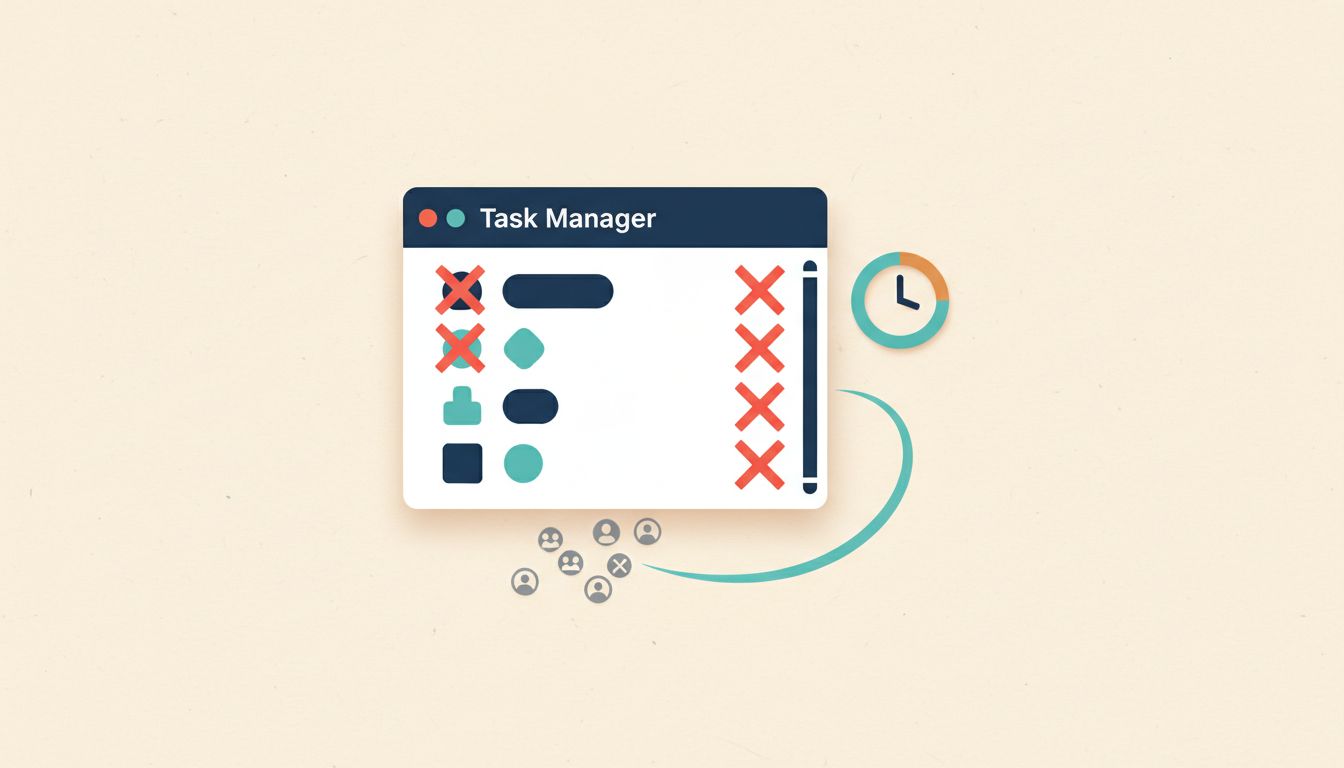
You've got a powerful GPU. So why is it tearing? Sometimes the answer is a CPU that's too busy servicing background junk to feed it frames on time.
Windows Compatibility Telemetry (part of broader Windows 11 privacy settings), unnecessary startup applications, and idle services all consume CPU cycles. Beyond fixing tearing, these optimizations are part of broader Windows 11 productivity tricks that improve overall system responsiveness. That background noise creates irregular intervals between frames delivered to the GPU, which then delivers inconsistent frames to the monitor. Tearing follows. Cleaning up startup is one of the fastest, highest-return fixes available, and it costs nothing except five minutes in Task Manager.
- Press Ctrl+Shift+Esc to open Task Manager. Go to the Startup apps tab, sort by Startup impact, and disable anything you don't need at login by right-clicking and selecting Disable.
- Open Task Scheduler (search for it in Start). Navigate to Task Scheduler Library > Microsoft > Windows > Application Experience. Right-click Microsoft Compatibility Appraiser and ProgramDataUpdater and disable both.
- Alternatively, in an elevated PowerShell run:
Get-ScheduledTask -TaskName 'Microsoft Compatibility Appraiser' | Disable-ScheduledTask - Open services.msc. Find genuinely unused services like Fax and set them to Disabled. Don't touch anything you're not certain about.
How to verify it's working
After rebooting, open Task Manager and check CPU usage at idle. It should sit below 5% on a clean system. Boot time should also feel noticeably shorter.
Gotchas
- Never disable Windows Update, Windows Defender, or cryptographic services. The performance gain isn't worth the security exposure.
- Telemetry tasks sometimes re-enable themselves after major Windows feature updates. Recheck Task Scheduler after any big update.
- Some startup entries belong to hardware drivers (audio, GPU software). Be cautious disabling those, as they may affect functionality.
Update or Roll Back Your GPU Driver to a Known-Stable Version

A bad GPU driver is one of the most common causes of screen tearing that appears suddenly, seemingly out of nowhere. And Windows Update loves to install them silently.
Driver bugs can break VSync signalling, corrupt frame buffer handling, or introduce frame pacing issues that didn't exist in the previous version. The fix is either moving forward to a newer, patched release or going backward to a version that was stable for you. Both are valid. The key is knowing how to do either deliberately, rather than letting Windows decide for you.
- Open Device Manager (press Win+X and select it from the menu). Expand Display adapters, right-click your GPU, and select Update driver > Search automatically to get the latest version Windows knows about.
- For NVIDIA, download the latest Game Ready Driver directly from nvidia.com. For AMD, use amd.com/support. Always prefer a manual download over Windows Update for GPU drivers.
- If tearing started after a recent driver update, roll back: in Device Manager, right-click your GPU, select Properties > Driver tab > Roll Back Driver. Windows keeps the previous version for exactly this purpose.
- Use DDU (Display Driver Uninstaller) in Safe Mode for a completely clean driver install if partial corruption is suspected. Boot into Safe Mode, run DDU, reboot, then install fresh.
How to verify it's working
After updating or rolling back, run a fullscreen game or video for 10 minutes. Note whether tearing recurs at the same points it did before. If it's gone, you've found your culprit.
Gotchas
- Windows Update can re-install a newer (problematic) driver automatically. To prevent this, use the "Show or hide updates" troubleshooter to block the specific driver version.
- DDU must be run in Safe Mode to be effective. Running it in normal Windows mode leaves residual files.
- HAGS (from Tip 1) requires a minimum driver version. If you roll back too far, you may need to disable HAGS again.
Force VSync or Enable Adaptive Sync Through Your GPU Control Panel
VSync is the oldest fix for screen tearing and it still works. The problem is that games often need it forced globally rather than set per-game, and that's done in your GPU's own software, not in Windows Settings.
VSync synchronises the GPU's frame output to your monitor's refresh rate. No frame gets sent mid-draw. Tearing disappears. The trade-off is input lag and stuttering if your frame rate dips below the monitor's refresh rate, which is why Adaptive Sync (G-Sync or FreeSync) is the more elegant solution if your hardware supports it. It gives you tear-free output without the input lag penalty.
- NVIDIA users: Open NVIDIA Control Panel (right-click desktop). Go to Manage 3D Settings > Global Settings. Set Vertical sync to On or Adaptive. Apply.
- AMD users: Open AMD Software: Adrenalin Edition. Go to Gaming > Display. Enable Wait for Vertical Refresh (set to Always On or Enhanced Sync for a low-lag alternative).
- If your monitor supports G-Sync or FreeSync, enable it: in NVIDIA Control Panel go to Display > Set up G-SYNC. For AMD, enable FreeSync in the Adrenalin Display tab. Also enable it in your monitor's own OSD menu.
- In Windows, confirm your monitor's refresh rate is set correctly: Settings > System > Display > Advanced display > Choose a refresh rate. A mismatch here undermines everything else.
How to verify it's working
The TestUFO benchmark at testufo.com has a specific screen tearing test. With VSync or Adaptive Sync active, the horizontal bar should move cleanly with no split. You can also enable the G-Sync or FreeSync indicator overlay in the respective GPU software to confirm it's active during gameplay.
Gotchas
- Traditional VSync introduces input lag. In competitive games where response time matters, Adaptive Sync or Enhanced Sync is a better choice.
- FreeSync requires an AMD GPU and a FreeSync-compatible monitor connected via DisplayPort or HDMI 2.0+. VGA or DVI connections won't support it.
- G-Sync certified monitors work best with NVIDIA's implementation. "G-Sync Compatible" (FreeSync monitors approved by NVIDIA) also works but may have a narrower VRR range.
Use the Win+X Power User Menu to Reach Display and Device Settings Instantly

Half the battle with fixing screen tearing is navigating to the right settings quickly. Windows 11 buries things. The Win+X menu cuts straight through the clutter.
When you're troubleshooting tearing, you'll be bouncing between Device Manager, Display Settings, and Terminal constantly. The Power User Menu (Win+X) consolidates direct shortcuts to all of them in a single keystroke. For a comprehensive guide to other hidden Windows 11 keyboard shortcuts that can speed up your workflow, check out our dedicated resource. It's not glamorous. But it saves a surprising amount of time when you're iterating through fixes.
- Press Windows key + X, or right-click the Start button. The Quick Link menu opens immediately.
- Select Device Manager to access GPU driver settings, Terminal (Admin) for PowerShell commands, or Settings to reach display configuration.
- To customise which tools appear, install Win+X Menu Editor (free, search for it). It reads from the underlying shortcut folders Windows uses and lets you add, remove, or reorder entries.
- Back up the Win+X shortcut folder before making changes: it lives at
%LocalAppData%\Microsoft\Windows\WinX. Copy that folder somewhere safe first.
How to verify it's working
Press Win+X and confirm Device Manager and Terminal (Admin) are both accessible in two clicks or fewer. If you've added custom shortcuts via the editor, they should appear in the group you assigned them to.
Gotchas
- Third-party editors modify system shortcut folders. Always back up before editing.
- Some entries differ between Windows 11 Home and Pro. Home users won't see certain administrative tools like Group Policy Editor links.
- After a major Windows Update, the Win+X menu can reset to defaults. Recheck your customisations after feature updates.
Enable God Mode to Find Every Obscure Display and Graphics Setting Fast

Some of the settings that affect screen tearing are buried in places you'd never think to look. God Mode surfaces all ~200 Control Panel and Settings tasks in one searchable folder. Sounds silly. Genuinely useful.
Windows 11 splits display and graphics configuration across Settings, Control Panel, Device Manager, and the GPU's own software. God Mode doesn't add any new settings, but it puts every existing one in a single place with a search box. When you're hunting for something like colour management, display calibration, or screen refresh options, it's considerably faster than clicking through menus hoping you're in the right place.
- Right-click the Desktop, select New > Folder.
- Rename the folder to exactly:
GodMode.{ED7BA470-8E54-465E-825C-99712043E01C}(include the dot, include the curly braces, no spaces anywhere in the name). - Press Enter. The folder icon changes to a Control Panel icon. If it stays as a normal folder, there's a typo in the name.
- Open it and use the File Explorer search box (top right) to search terms like display, colour, refresh, or graphics to find relevant settings pages in seconds.
How to verify it's working
Search for "display" inside the God Mode folder. You should see entries like "Adjust screen resolution", "Calibrate display colour", and "Connect to a projector" all in one list. If you see those, it's working correctly.
Gotchas
- The folder name must be typed exactly. One wrong character and you get a normal folder, not the shell namespace.
- God Mode is a shortcut layer only. It doesn't grant elevated privileges beyond what your current user account has. You'll still get UAC prompts for admin actions.
- Some entries link to legacy Control Panel pages that Microsoft has partially deprecated in Windows 11. They still work, but the UI may look dated.
Verify and Correct Your Monitor Refresh Rate in Windows Display Settings

This one gets missed constantly. Your monitor might be capable of 144Hz. But if Windows thinks it's running at 60Hz, your GPU is sending frames at the wrong cadence and tearing is almost guaranteed.
Windows 11 doesn't always set the correct refresh rate automatically, especially after driver updates, hardware changes, or connecting a new monitor. If the refresh rate in Display Settings doesn't match what your monitor actually runs at, the synchronisation between the GPU and display is off before you've even started. Check this first. It's a thirty-second fix that sometimes resolves everything.
- Go to Settings > System > Display > Advanced display.
- Under Choose a refresh rate, check the current value. If your monitor supports 144Hz or higher and Windows shows 60Hz, it's wrong.
- Open the dropdown and select the correct (highest supported) refresh rate for your monitor. Apply the change.
- Also confirm the resolution is correct. Running below native resolution at a high refresh rate can sometimes cause display pipeline issues depending on the GPU and monitor combination.
How to verify it's working
Visit testufo.com and check the reported frame rate. It should match the refresh rate you set in Windows. If it reports 60fps when you've set 144Hz, something in the display chain is still wrong.
Gotchas
- Some monitors only support high refresh rates over DisplayPort, not HDMI, or only over HDMI 2.1, not 2.0. If you can't select the expected rate, check your cable type and port.
- After a major Windows Update, refresh rate settings have been known to reset. Recheck Advanced display after any feature update.
- Multi-monitor setups can be tricky. Each display has its own refresh rate setting. Confirm the correct monitor is selected in the dropdown at the top of the Advanced display page.
Create a System Restore Point Before Making Any Driver or Registry Changes

Fixing screen tearing sometimes means touching drivers, registry keys, or GPU software settings. Any of those can go sideways. A restore point is your five-minute insurance policy.
This isn't a tearing fix by itself. It's the safety net that makes trying every other fix on this list far less stressful. A bad driver install or a registry tweak that produces a black screen on boot is recoverable in minutes if you have a restore point. Without one, you're reinstalling Windows. The maths here are obvious.
- Search for Create a restore point in the Start menu and open it.
- Select your system drive (C:), click Configure, and make sure protection is turned On. Allocate at least 5 to 10 GB of space.
- Click Create, give the restore point a descriptive name (e.g. "Before GPU driver update 2026-07"), and let it run. Takes under a minute.
- To recover after a bad change, open the same dialog, click System Restore, and choose your named restore point. Windows handles the rest and reboots into the previous state.
How to verify it's working
After creating the restore point, open the System Restore dialog again and click System Restore. Your named point should appear in the list with the correct timestamp. If it does, it's ready to use.
Gotchas
- System Restore reverts system and application files only. It doesn't touch personal documents, so you won't lose work, but you also won't recover deleted personal files this way.
- If Windows fails to boot entirely, access System Restore via Advanced Startup Options: hold Shift while clicking Restart, then go to Troubleshoot > Advanced options > System Restore.
- Restore points consume disk space. On drives under 256 GB, keep the allocation lean (5 GB) and only keep a few points at a time.
Use Registry Tweaks to Disable Desktop Window Manager Animations and Reduce Compositor Overhead

Desktop Window Manager (DWM) is the compositor that draws everything you see in Windows 11. It also introduces a thin layer of latency between your GPU's output and your monitor. Some targeted registry tweaks cut that overhead.
DWM can't be fully disabled in Windows 11 (unlike Windows 7, where you could), but you can reduce the visual effects it processes. Disabling animations and transparency effects lowers the compositor's frame processing burden. The practical result is more consistent frame delivery and less tearing, particularly on mid-range hardware or systems running multiple monitors. The gains are modest, but combined with the other fixes in this list, they add up.
- Go to Settings > System > Display > Advanced display and ensure your refresh rate is correct first (see Tip 8). No point optimising the compositor if the basics are wrong.
- Open Settings > Accessibility > Visual effects and turn off Animation effects and Transparency effects. This is the safe, non-registry route to reducing DWM overhead.
- For a deeper tweak, press Win+R, type
sysdm.cpl, press Enter. Go to Advanced > Performance > Settings. Select Adjust for best performance, then manually re-enable only Smooth edges of screen fonts (so text stays readable). Click OK. - To confirm DWM is not being interrupted by third-party overlays (Discord, GeForce Experience, Xbox Game Bar), disable any overlays you don't actively use. Each one hooks into DWM and can introduce frame timing irregularities.
How to verify it's working
With animations disabled, window open and close transitions should be instant rather than animated. Under GPU load, check Task Manager's GPU graph: the compositor workload (shown as "Desktop Window Manager" in the GPU processes list) should drop measurably compared to the fully-animated state.
Gotchas
- Disabling all visual effects makes Windows look quite stark. You can re-enable individual effects from the Performance Options dialog without losing the performance benefit of disabling the heaviest ones.
- Some overlay applications (e.g. Discord's in-game overlay) reactivate themselves after updates. Check periodically if tearing returns unexpectedly.
- On high-end hardware (RTX 4080+, Radeon RX 7900+), the DWM compositor overhead is negligible. This tip has the most impact on mid-range systems or integrated graphics setups.