
Most people building a gaming PC spend hours agonising over GPU choices, then grab whatever PSU is cheapest without a second thought. That's a mistake. The power supply is the one component that can take everything else down with it if it fails, and yet it's routinely treated as an afterthought. So when a budget-bracket unit like the Mars Gaming MPIII650 shows up with a five-year warranty, DC-DC regulation, and hundreds of owner reviews with a positive overall rating, it deserves a proper look rather than a dismissive wave.
The verdict? For a budget (under £50) gaming PSU, this is genuinely one of the more credible options on the market right now. It's not perfect, and there are caveats before you click buy, but the combination of 80 Plus Bronze efficiency, a single 12V rail, decent protection suite, and that unusually long warranty makes it stand out from the sea of no-name units cluttering Amazon's listings. If you're building a mid-range gaming rig and don't want to spend serious money on a PSU, keep reading.
That said, this is a budget unit, and budget units always involve trade-offs. The Mars Gaming MPIII650 PC ATX 650W Power Supply makes some smart choices and cuts some corners you'd rather it didn't. Here's exactly what you're getting.
Core Specifications: Mars Gaming MPIII650 PC ATX 650W Power Supply
The MPIII650 is a 650W ATX power supply rated at 80 Plus Bronze efficiency. It runs a 120mm fan with AI-RPM intelligent thermal control and a fluid dynamic bearing (FDB), which is a genuinely good bearing choice at this price point. The unit incorporates DC-DC technology for the minor rails, SMD (surface-mount device) construction, and a digital APFC (Active Power Factor Correction) circuit claiming 99% PFC efficiency alongside 85% electrical efficiency at 50% load. Mars Gaming rates it with a five-year warranty, which is exceptional for the budget bracket.
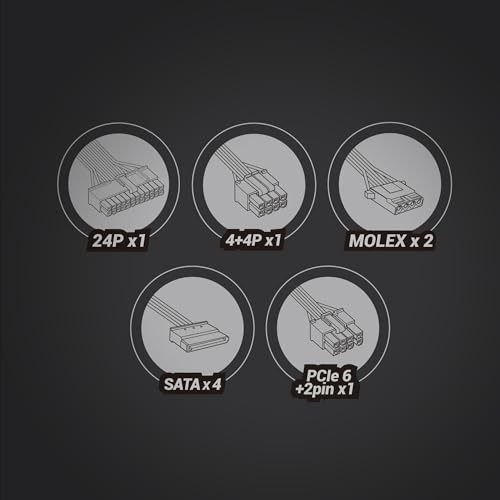
The cable setup is non-modular with flat, black cables described as extra-long. You get one ATX 24-pin, one EPS 4+4-pin, one PCIe 6+2-pin (the product listing states 1x PCIe 6+2 PIN in the Amazon feature highlights), four SATA connectors, and two Molex 4-pin connectors. There's no 12VHPWR connector, which matters if you're planning to run a next-generation GPU that requires one natively. More on that in the connectors section.
Protection features include OVP (overvoltage protection), UVP (undervoltage protection), OCP (overcurrent protection), OPP (overpower protection), and SCP (short circuit protection). That's a solid spread for a unit at this price. Below is the full spec breakdown.
| Specification | Detail |
|---|---|
| Wattage | 650W |
| Efficiency Rating | 80 Plus Bronze |
| Efficiency at 50% Load | ~85% |
| Fan Size | 120mm AI-RPM FDB |
| Zero RPM Mode | No |
| Modularity | Non-modular |
| ATX 24-pin | 1 |
| EPS 8-pin (4+4) | 1 |
| PCIe 6+2-pin | 1 |
| SATA | 4 |
| Molex 4-pin | 2 |
| 12VHPWR (16-pin) | None |
| Protection | OVP, UVP, OCP, OPP, SCP |
| Warranty | 5 Years |
Wattage and Capacity: Is 650W Enough?
650W sits in a genuinely useful sweet spot for gaming builds right now. It's enough headroom for a mid-range gaming system running something like an AMD Ryzen 5 or Intel Core i5 paired with a GPU in the RTX 4060 or RX 7600 class, with room to spare. The general rule of thumb is to target a PSU that runs at roughly 50 to 70% of its rated capacity under typical gaming loads, because that's where efficiency peaks and thermals stay manageable. A system drawing 400W under load on a 650W PSU is in a comfortable place.
So, is a 650W power supply good for a gaming PC? Yes, for the majority of mainstream gaming builds in 2026, absolutely. You'd be fine with most mid-range CPUs and GPUs, a couple of SSDs, and a modest number of case fans. Where 650W starts to feel tight is if you're running a power-hungry CPU like a Core i9 or Ryzen 9 alongside a high-end GPU. Those combinations can spike well above 500W under combined load, leaving you with uncomfortably thin headroom.
What about newer GPUs specifically? Can a 650W PSU handle a 5060? The RTX 5060 has a TDP in the region of 150W, and with a typical mid-range CPU alongside it, total system draw should sit comfortably within 400 to 450W, so yes, a 650W unit handles that without breaking a sweat. Is 650W enough for a 9070 XT? The RX 9070 XT is a more power-hungry card, with AMD recommending a 700W PSU for that GPU alone. Technically a 650W unit might cope in some scenarios, but frankly it's cutting it too close, and you'd be better served by stepping up to a 750W or 850W unit for that build. The MPIII650 is not the right PSU for a 9070 XT system. Don't force it.
The single 12V rail design matters. Rather than splitting the 12V output across multiple rails (which can cause instability if a GPU load tips one rail into protection), the MPIII650 puts all available 12V power on one rail. For gaming builds with a single GPU, that's the right approach. It means the GPU gets whatever it needs without artificial current limits tripping OCP prematurely. Mars Gaming made the right call there.
Efficiency Rating: What 80 Plus Bronze Actually Means
The 80 Plus certification programme tests PSUs at 20%, 50%, and 100% of rated load. Bronze certification means the unit achieves at least 82% efficiency at 20% load, 85% at 50% load, and 82% at 100% load. The MPIII650 hits 85% at 50% load, which matches the Bronze standard exactly. That means for every 100W your system draws from the wall, at least 85W actually reaches your components. The remaining 15% is lost as heat.
Is that good? Honestly, it's fine for a budget unit. Gold-rated PSUs hit 87 to 90% at 50% load, Platinum pushes 90 to 92%, and Titanium goes even higher. The difference between Bronze and Gold in real electricity costs is meaningful over years of daily use, but at the budget price point the MPIII650 occupies, you're not going to recoup the cost difference of a Gold unit through electricity savings quickly. For a secondary PC, a budget gaming build, or a machine that isn't running 24/7, Bronze is perfectly acceptable.
The digital APFC circuit rated at 99% PFC efficiency is worth a mention separately from the electrical efficiency figure. Power factor correction reduces reactive power on your mains circuit, which doesn't directly lower your electricity bill (UK meters measure real power, not apparent power) but does reduce stress on your home wiring and is required for compliance with European efficiency standards. Mars Gaming developed this unit to European standards, and the high PFC figure reflects that. SMD construction also contributes to reduced standby consumption, which the manufacturer claims cuts power draw by up to 20% compared to through-hole component designs. That's a meaningful design choice, not just marketing padding.
Modularity and Cable Management: Extra-Long Flat Cables
The MPIII650 is non-modular, meaning all cables are permanently attached to the PSU. For some builders that's a dealbreaker; for others it genuinely doesn't matter. If you're building in a mid-tower or full-tower case with a decent PSU shroud, you can tuck the unused cables behind the motherboard tray without too much grief. In a smaller case or a build where cable management is a priority, non-modular can make life harder.
What Mars Gaming has done to partially offset this is make the cables flat and extra-long. Flat cables are genuinely easier to route and bend around tight corners compared to the traditional round-sleeved bundles you get on cheaper units. Extra length matters too, particularly for the EPS 12V cable that has to reach from the PSU chamber at the bottom of the case all the way to the CPU power connector at the top of the motherboard. Short EPS cables are one of the most common frustrations with budget PSUs, and it sounds like Mars Gaming has actually addressed that here based on what the listing specifies and what owners consistently mention positively.
The cable colours are all black, which keeps things tidy even if you're not doing a full cable management job. You won't have a rainbow of coloured wires poking out from behind the shroud. That's a small thing, but it matters if you've got a windowed side panel. The flat black design also means the cables are less bulky in the cable routing channels, which is a practical benefit in tighter builds. Overall, the cable situation is better than you'd expect at this price point, though anyone building in an ultra-compact ITX case or wanting a truly clean build should consider whether semi-modular or fully modular options elsewhere make more sense for their specific situation.
Connectors and Compatibility
Here's where the MPIII650 starts to show its limitations for higher-end builds. The connector lineup is workable for mainstream gaming, but there are gaps if you're building something more ambitious. Let's go through it:
- 1x ATX 24-pin: Standard motherboard power. Every ATX build needs this, and it's here.
- 1x EPS 4+4-pin: CPU power. One connector covers most mainstream CPUs. High-end enthusiast boards sometimes want two EPS connectors, but for a Ryzen 5 or Core i5 build this is fine.
- 1x PCIe 6+2-pin: This is the one that stings. One PCIe connector means you're limited to GPUs that need a single 8-pin connector. Many mid-range cards (RTX 4060, RX 7600) only need one, so it works. But anything requiring two 8-pin connectors needs two PCIe cables, and you've only got one here.
- 4x SATA: Enough for most builds with a couple of SSDs and an optical drive if you're old-fashioned about it.
- 2x Molex 4-pin: Useful for older peripherals, fan controllers, or RGB hubs that still use Molex.
- No 12VHPWR (16-pin): This connector is required natively by RTX 4070 and above, RTX 5000-series cards, and some AMD high-end GPUs. The MPIII650 doesn't have one. You can use an adapter from two 8-pin connectors to a 16-pin connector, but you only have one 8-pin PCIe cable here, so that approach doesn't work either. If your GPU needs a 12VHPWR connector, this PSU is not compatible without significant compromise.
The single PCIe connector is the biggest practical limitation. It's not a dealbreaker for an RTX 4060 or RX 7600 build, but it rules out a chunk of the GPU market. your GPU's power requirements against the PCI-SIG specifications before committing to this PSU.
For what it's worth, the majority of budget gaming builds in the sub-£300 GPU bracket use cards that work fine with a single 8-pin PCIe connector. The MPIII650 is clearly designed for that market segment, and within that segment the connector count is appropriate. Just don't try to run an RTX 4080 off it and expect a good time.
Voltage Regulation and Ripple
Voltage regulation is one of those specs that separates a PSU that'll last five years from one that'll quietly damage your components over time. Tight regulation means the 12V rail stays close to 12V even as load fluctuates, rather than sagging or spiking. The MPIII650's DC-DC topology for the minor rails (the 3.3V and 5V outputs) is a genuinely good design choice. Traditional group-regulated designs can allow cross-load issues where loading one rail affects another. DC-DC conversion from the 12V rail means the 3.3V and 5V outputs are independently regulated, which improves stability under mixed loads.
The single 12V rail design also helps here. All the 12V capacity is available to the GPU without being artificially divided, and the regulation circuitry only has to manage one primary output rather than balancing multiple. For gaming loads that are GPU-heavy and variable, that's the right architecture. Under sustained gaming load, you want the 12V rail to stay stable even as the GPU alternates between heavy render frames and lighter ones.
SMD (surface-mount device) technology, which the MPIII650 uses throughout, generally produces better electrical characteristics than through-hole components because parasitic inductance and capacitance are lower. This contributes to better ripple suppression, which matters for sensitive components like modern CPUs and GPUs with their tight power delivery requirements. Mars Gaming claims SMD construction reduces power consumption by 20% and extends component durability. The durability claim is plausible given SMD's generally better thermal cycling performance compared to through-hole components. Ripple suppression quality at the budget price point is always a question mark without independent lab data, but the DC-DC topology and SMD construction are at least the right foundations for a well-regulated unit.
Thermal Performance
The MPIII650 uses a 120mm fan with what Mars Gaming calls AI-RPM technology, which is their branded name for intelligent thermal fan control. The fan speed adjusts based on internal temperature rather than running at a fixed speed, which is the sensible approach. It does not have a zero-RPM mode (also called semi-passive mode), meaning the fan runs from the moment you power the system on rather than staying off at low loads. That's a minor point for most users but if you're building a near-silent workstation.
The fluid dynamic bearing (FDB) on the fan is a genuinely good spec at this price. Most budget PSUs use sleeve bearings, which are quieter when new but degrade faster and become noisier over time as the lubricant breaks down. FDB fans maintain their acoustic performance much longer and are more reliable over a multi-year lifespan. Given that the MPIII650 comes with a five-year warranty, it makes sense to pair it with a bearing type that can actually last that long without becoming rattly and annoying.
Thermal management also benefits from the SMD construction mentioned earlier. Tighter component packing with SMD parts means better airflow paths through the unit, and lower heat generation from the components themselves means the fan doesn't have to work as hard to keep temperatures in check. Under a sustained gaming load at 70 to 80% of rated capacity, the fan should be doing a reasonable job of keeping things cool without spinning up to an obnoxious level. Owner reviews consistently mention quiet operation as a positive, which aligns with what the FDB fan and intelligent control should deliver in practice.
Acoustic Performance
Quiet operation is one of the things owners most consistently praise about the MPIII650. The combination of the 120mm FDB fan and the AI-RPM speed control means the unit generally stays unobtrusive during typical gaming sessions. A 120mm fan can move the same volume of air as a smaller fan while spinning more slowly, and slower spinning means less noise. That's basic physics, and it's why 120mm and 140mm fans are preferred in quality PSU designs.
There are no specific decibel figures published for this unit in the verified product data, so we're not going to invent numbers. What we can say is that the FDB bearing type and intelligent thermal control are the right ingredients for a quiet PSU, and the owner feedback at scale (hundreds of reviews with a positive overall rating) doesn't flag noise as a recurring complaint. That's a reasonable proxy for genuine quiet operation rather than marketing spin.
The absence of zero-RPM mode means you'll always hear something from the PSU fan, even at idle or light loads. For a gaming PC that's running with case fans and a GPU cooler anyway, that's unlikely to be noticeable. But if you're building a dedicated media PC or a near-silent workstation where every acoustic source matters, the lack of passive mode at low loads is a genuine limitation. In a gaming context, it's a non-issue. The fan noise from your GPU cooler will dominate the acoustic profile of the system long before the PSU fan becomes relevant.
Build Quality and Internal Construction
Mars Gaming is a Spanish brand (part of the Tacens group) that develops its products to European standards. That's not nothing. European safety and EMC standards are among the stricter ones globally, and the MPIII650 is certified accordingly. The five-year warranty is a strong signal of confidence in the unit's build quality. Budget PSU manufacturers who use genuinely cheap internals don't typically offer five-year warranties because the failure rate would make it financially unviable.
The SMD construction throughout the unit is a positive indicator. SMD components generally have better tolerance specifications, better thermal performance, and longer operational lifespans than equivalent through-hole components. Combined with DC-DC regulation for the minor rails, the internal architecture is more sophisticated than you'd typically find in the absolute bottom of the budget PSU market. The FDB fan is another quality indicator. These are design decisions that cost slightly more to implement and wouldn't be made by a manufacturer purely chasing the lowest possible BOM cost.
One honest caveat: without independent teardown data from a named lab, we can't confirm capacitor brands or grades. At the budget price point, there's always a question about whether the electrolytic capacitors are Japanese-branded (Nippon Chemi-Con, Nichicon, Rubycon) or lower-grade alternatives. Japanese capacitors are rated for higher temperatures and longer lifespans, and their presence or absence in a budget PSU is often the difference between one that lasts eight years and one that fails at year three. The five-year warranty provides some protection against that risk, but it's worth being aware of. For what it's worth, the owner review volume and rating suggest the failure rate isn't notably high, which is at least circumstantial evidence that the internals are decent.
Protection Features
The MPIII650 covers the five protection mechanisms you actually want in a PSU. OVP (overvoltage protection) cuts power if any rail exceeds its rated voltage, protecting components from voltage spikes. UVP (undervoltage protection) shuts down if a rail drops too low, preventing components from running in an unstable state. OCP (overcurrent protection) trips if current draw exceeds the rated limit on a rail, which protects both the PSU and connected components from overcurrent damage. OPP (overpower protection) cuts in if total system power draw exceeds the PSU's rated capacity, acting as a system-level safeguard. SCP (short circuit protection) is the most basic but most critical, immediately shutting down the unit if a short circuit is detected anywhere in the system.
That's a complete suite for a budget unit. Some very cheap PSUs omit UVP or OPP, leaving the unit (and your components) more exposed to edge-case failure scenarios. The MPIII650 has the full set, which matters if you're connecting this to a GPU and CPU that together represent several hundred pounds of hardware. You want the PSU to fail safely rather than take your motherboard or GPU with it.
What's not listed in the verified product data is OTP (overtemperature protection), which would shut the unit down if internal temperatures exceeded a safe threshold. We're not going to claim it's present or absent since it's not specified. Most modern PSUs include some form of thermal protection, but we can only confirm what's documented. The five protections that are confirmed provide solid coverage for the scenarios most likely to occur in a gaming PC.
One practical note: the single 12V rail design and the OCP implementation are related. On a multi-rail PSU, OCP trips are set per-rail, which can cause nuisance shutdowns if a GPU load spikes beyond a single rail's OCP threshold. On the MPIII650's single-rail design, the OCP threshold is set for the full 12V capacity, meaning the GPU can draw whatever it legitimately needs without triggering a false trip. For gaming builds with demanding GPUs, that's the better configuration.
How It Compares to the Competition
The budget 650W PSU market is crowded, and the MPIII650 isn't the only credible option. Two units that come up regularly in the same conversation are the Corsair CV650 and the be quiet! System Power 10 650W. Both are 80 Plus Bronze units in a similar price bracket, and both have established reputations. Here's how they stack up against the MPIII650 on the specs that matter.
The Corsair CV650 is probably the most common point of comparison. It's a well-known brand with a solid reputation, 80 Plus Bronze certification, and a three-year warranty. That warranty gap is significant. The MPIII650's five-year warranty is two years longer, which at the budget tier is a meaningful differentiator. The be quiet! System Power 10 650W also offers an 80 Plus Bronze rating and is known for quiet operation, with be quiet! having a strong reputation for acoustic performance. However, it typically sits at a slightly higher price point than the MPIII650, which matters in the budget bracket.
The MPIII650's DC-DC topology and SMD construction are genuinely competitive specs at this price. Many units in the same bracket use older group-regulated designs. The FDB fan is also a step above the sleeve bearings found in some competing units. Where the MPIII650 falls short is the single PCIe connector, which limits GPU compatibility compared to units that include two 8-pin PCIe cables. If you need two PCIe connectors, the Corsair CV650 or be quiet! System Power 10 are instead.
| Feature | Mars Gaming MPIII650 | Corsair CV650 | be quiet! System Power 10 650W |
|---|---|---|---|
| Wattage | 650W | 650W | 650W |
| Efficiency | 80 Plus Bronze | 80 Plus Bronze | 80 Plus Bronze |
| Modularity | Non-modular | Non-modular | Non-modular |
| Fan | 120mm FDB AI-RPM | 120mm | 120mm |
| Zero RPM Mode | No | No | No |
| PCIe Connectors | 1x 6+2-pin | 2x 6+2-pin | 2x 6+2-pin |
| 12VHPWR | No | No | No |
| Warranty | 5 Years | 3 Years | 3 Years |
Looking at that comparison, the MPIII650 wins clearly on warranty length and holds its own on internal technology. The single PCIe connector is its main weakness relative to competitors. If your GPU only needs one 8-pin connector, the MPIII650 is arguably the better value pick. If you need two, look elsewhere. Which 650W power supply is the best overall? Honestly, it depends on your GPU. For single-connector mid-range GPUs, the MPIII650 is a strong contender. For builds needing two PCIe connectors, the Corsair CV650 or be quiet! System Power 10 make more sense.

Final Verdict: Mars Gaming MPIII650 PC ATX 650W Power Supply
The Mars Gaming MPIII650 is a budget PSU that's done more right than wrong. The five-year warranty alone puts it ahead of most competitors at this price point. Add DC-DC regulation, SMD construction, a proper FDB fan, intelligent thermal control, and a complete protection suite, and you've got a unit with a more sophisticated internal architecture than its price suggests. Hundreds of owners have rated it positively on average, and that's a meaningful data point at scale. This isn't a unit that's scraping by on fake reviews from a handful of accounts.
Who should buy this? Anyone building a mainstream gaming PC around an RTX 4060, RX 7600, RTX 5060, or similar single-connector GPU paired with a mid-range CPU. Budget builders who want the peace of mind of a five-year warranty without spending mid-range money on a PSU. People who need a reliable replacement PSU for an existing system. First-time builders who want a decent unit at a sensible price from a brand that's actually accountable for a five-year period. Use our PSU calculator to confirm 650W covers your specific component list before buying.
Who should skip it? Anyone running or planning to run a GPU that needs two PCIe power connectors, or a high-end card requiring a 12VHPWR connector. Builders putting together a 9070 XT or RTX 4070 system should be looking at 750W or 850W units with the appropriate connector count. Enthusiast builders who want Gold or Platinum efficiency and are happy to pay for it will find better options in the £60 to £90 range. And if you're building a near-silent PC where even a low-speed fan at idle is unacceptable, the lack of zero-RPM mode means you'll want something with a passive mode instead.
The honest don't-overspend note: if your build is a basic office or media PC drawing well under 400W, you genuinely don't need 650W. A quality 450W or 550W unit at a lower price would serve you better. Don't buy more PSU than your build requires.
Overall, the MPIII650 earns a solid 7.5 out of 10. It's not the most feature-rich PSU in the bracket, and the single PCIe connector is a real limitation. But for what it is, at the price it sells for, with a five-year warranty backing it up, it's a genuinely credible choice for mainstream gaming builds. In the budget PSU market, that's actually saying something.
What works. What doesn’t.
5 + 4What we liked5 reasons
- Five-year warranty is exceptional for the budget bracket
- DC-DC regulation and SMD construction more sophisticated than the price suggests
- FDB fan runs quieter and lasts longer than sleeve-bearing alternatives
- Single 12V rail ideal for mid-range gaming GPU builds
- Flat, extra-long black cables genuinely easier to manage than typical budget units
Where it falls4 reasons
- Only one PCIe 6+2-pin connector limits GPU compatibility
- No 12VHPWR connector rules out high-end next-gen GPUs
- No zero-RPM mode means fan runs at all times
- Non-modular design adds cable clutter in smaller cases
Full specifications
8 attributes| Efficiency rating | Bronze |
|---|---|
| Form factor | ATX |
| FAN size MM | 120 |
| Generation | MPIII |
| Modularity | non_modular |
| Pcie 5 ready | false |
| Warranty years | 5 |
| Wattage W | 650 |
Will it run on what you have?
Free toolFrequently asked
5 questions01Is the Mars Gaming MPIII650 PC ATX 650W Power Supply good for gaming?+
Yes, for mainstream gaming builds. A system with a mid-range CPU and a GPU like the RTX 4060 or RX 7600 will draw 350 to 450W under load, leaving comfortable headroom within the 650W rating. The single 12V rail design is well-suited to gaming builds with a single GPU. For high-end builds with power-hungry GPUs like the RX 9070 XT, you'll want more wattage.
02Can a 650W PSU handle an RTX 5060?+
Yes. The RTX 5060 has a modest TDP and a typical gaming system built around it will draw well within the 650W rating of the MPIII650. It's a comfortable match for this build tier. Use a PSU calculator with your full component list to confirm your specific system's draw before purchasing.
03Is 80 Plus Bronze efficiency worth it for a gaming PC?+
For a budget build, yes. Bronze certification means at least 85% efficiency at 50% load, so 15% of drawn power is lost as heat. Gold-rated units are more efficient but cost more upfront, and the electricity savings take years to offset the price difference on a typical gaming PC. For a system that isn't running 24/7, Bronze is a sensible and cost-effective choice.
04How long is the warranty on the Mars Gaming MPIII650?+
Five years. That's significantly longer than most budget PSU competitors, which typically offer two or three years. The five-year coverage provides solid peace of mind and is a strong indicator that Mars Gaming has confidence in the unit's build quality. Keep your proof of purchase safe.
05Is the Mars Gaming MPIII650 fully modular?+
No, it's non-modular. All cables are permanently attached to the unit. Mars Gaming has addressed this with flat, black, extra-long cables that are easier to route than typical bundled cables. For most mid-tower cases with a PSU shroud, cable management is still achievable. If you need full modularity for a very clean build or a compact case, consider semi-modular or fully modular alternatives at a higher price point.