
Specs on a box are written in ideal conditions. A bright showroom, a perfectly calibrated display, nobody questioning the numbers. But you're going to use this monitor in your actual bedroom, or your home office with the window behind you, or a living room where the lighting changes depending on whether it's 2pm or 2am. So the real question isn't whether the Z-Edge 24 Inch Curved Monitor looks good in a product photo. It's whether it holds up when you're actually using it, day to day, for work and gaming and everything in between.
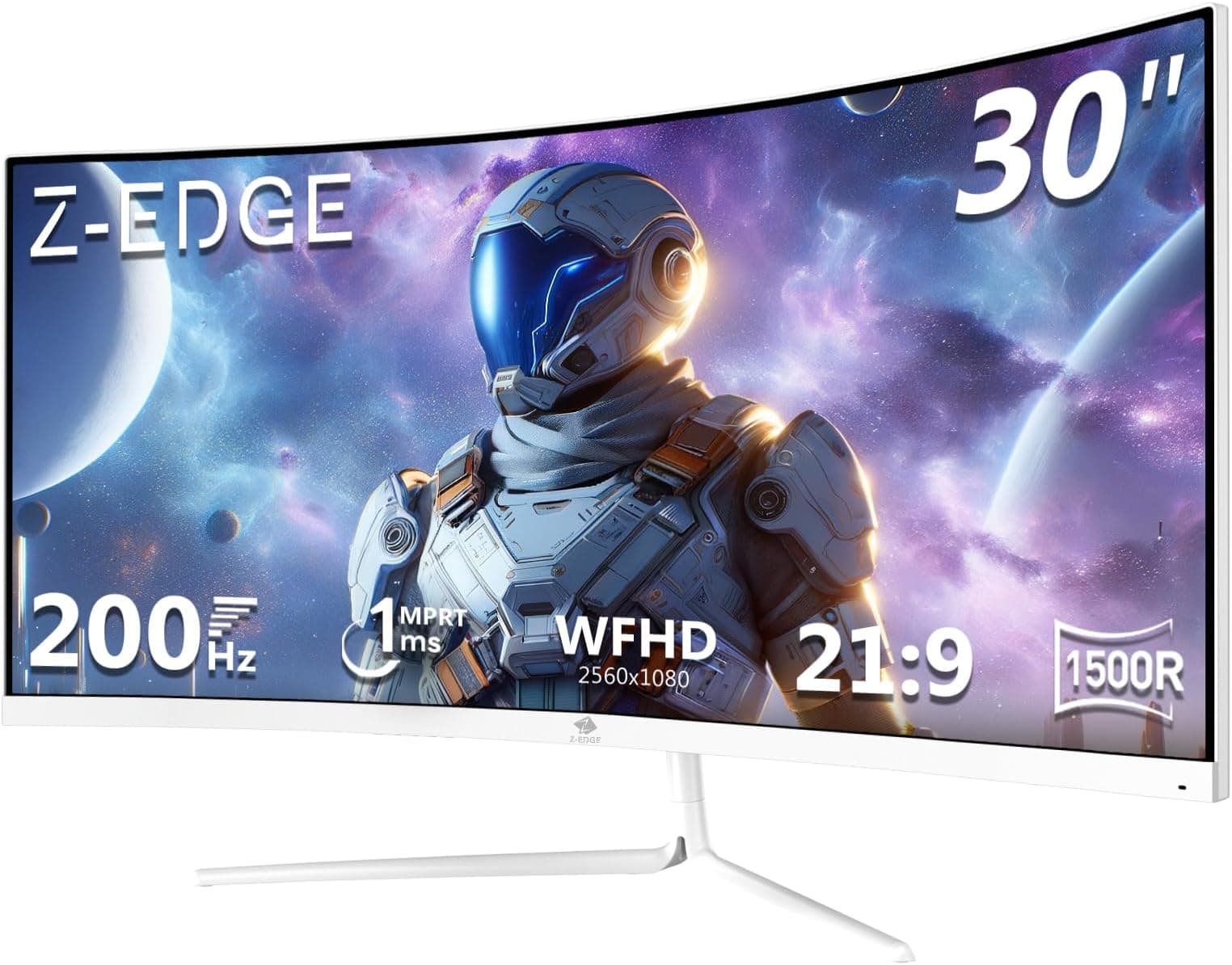
The Z-Edge 24 Inch Curved Monitor Full HD 1920x1080 LED Computer Monitor 75Hz, VA Panel, Ultra-Thin Bezel, Flicker-Free Eye-Care, 178° Wide Viewing Angle, VGA HDMI Port, White is a monitor that's clearly aimed at people upgrading from something old and flat and honestly a bit grim. It's got a 1800R curve, a VA panel, 75Hz refresh, and it comes in white, which is still surprisingly rare in this category. At the mid-range price point it sits at, it's competing with some decent alternatives. So is it worth it?
With 829 owner reviews averaging ★★★★☆ (4.1) on Amazon, there's a solid base of real-world feedback to work with here. That's not a handful of early adopters being generous. That's a proper crowd of people who've actually lived with this thing. So alongside the spec sheet, that's what this review is grounded in.
Core Specifications
The headline numbers are straightforward. You get a 24-inch VA panel running at 1920x1080, with a 75Hz refresh rate and a quoted 5ms response time. The 1800R curve is fairly aggressive for a 24-inch screen, which some people love and others find a bit much at close range. The resolution at this screen size gives you a pixel density of around 92 PPI, which is fine for everyday use but not exactly razor-sharp if you're used to anything above 1080p.
Connectivity is kept simple. There's one HDMI port and one VGA port. No DisplayPort, no USB-C, no built-in USB hub. For a lot of people upgrading from an older setup, VGA is actually useful here since older laptops and desktop GPUs still have it. But if you're running a modern rig and want to daisy-chain monitors or use a docking station, you'll feel the pinch. The white finish and ultra-slim bezel design are genuinely nice touches that make it stand out from the sea of black plastic monitors at this price.
The 4000:1 contrast ratio is one of the standout figures here, and it's a direct result of the VA panel underneath. That's significantly better than what you'd get from a typical IPS panel at this price, which usually lands around 1000:1. The 178-degree viewing angle claim is worth some scepticism (more on that in the panel section), but the contrast figure is real and makes a meaningful difference in everyday use. Here's the full spec breakdown:
| Specification | Detail |
|---|---|
| Screen Size | 24 inches |
| Resolution | 1920x1080 (Full HD) |
| Panel Type | VA (Vertical Alignment) |
| Refresh Rate | 75Hz |
| Response Time | 5ms (GtG) |
| Curve Radius | 1800R |
| Contrast Ratio | 4000:1 |
| Colour Depth | 16.7M colours |
| Viewing Angle | 178 degrees (H/V) |
| Ports | 1x HDMI, 1x VGA |
| Eye Care | Flicker-Free, Low Blue Light |
| Bezel | Ultra-slim |
| Colour | White |
| Current Price | Check price |

Panel Technology
The VA panel is the defining choice here, and it's one that cuts both ways. Vertical alignment panels are known for two things above all else: excellent native contrast and slower pixel response times compared to IPS. The 4000:1 contrast ratio Z-Edge quotes is a genuine VA strength. IPS panels at this price typically sit around 1000:1, sometimes a bit higher, but rarely close to what VA delivers. That extra contrast depth means blacks look properly dark rather than washed-out grey, which matters a lot when you're watching films or playing games with dark scenes.
The 178-degree viewing angle claim needs a bit of unpacking. VA panels do technically support wide viewing angles, but they suffer from a phenomenon called black crush at off-axis views, where dark content loses shadow detail when you're not sitting directly in front of the screen. This is different from IPS glow (that milky sheen you get at the corners of IPS panels) but it's its own issue. If you're sitting straight on, you're fine. If you're sharing the screen with someone sitting to your side, they might notice colours shift and dark areas flatten out. The 178-degree spec is technically correct but doesn't tell the whole story.
The 1800R curve is worth talking about specifically because it's quite aggressive. On a 27-inch or larger screen, an 1800R curve feels natural and pulls your peripheral vision in nicely. On a 24-inch panel, it's more pronounced and noticeable. Some people genuinely prefer it, especially for gaming, because it does create a more enveloping feel. Others find it slightly odd for productivity work, particularly if you're reading a lot of text or working with spreadsheets where straight horizontal lines matter. Owner reviews are fairly split on this, with most gamers approving and a handful of office users finding it takes some getting used to.
Display Quality
At 1920x1080 across 24 inches, you're looking at roughly 92 pixels per inch. That's been the standard for budget and mid-range monitors for a long time, and it's perfectly usable. Text is readable, images look fine, and for gaming at this screen size it's not going to bother most people. Where you start to notice the resolution limit is if you sit very close, or if you're coming from a 1440p or 4K display. The step down is real. But for someone upgrading from an old 1080p flat panel, or setting up a secondary monitor, it's absolutely adequate.
The VA panel's anti-glare coating does a decent job in mixed lighting conditions. Matte coatings scatter reflections rather than eliminating them, so in a very bright room with direct sunlight hitting the screen you'll still see some diffuse glare, but it won't be the mirror-like reflections you'd get from a glossy panel. For most home setups this is a practical win. The flicker-free backlight is a genuine comfort feature too, not just a marketing checkbox. PWM flicker (where the backlight pulses rapidly to control brightness) causes headaches and eye strain in some people, and avoiding it is a real benefit for long sessions.
Brightness uniformity is something VA panels can sometimes struggle with, particularly around the edges of the panel where backlight bleed can show up as lighter patches in dark scenes. Owner feedback on the Z-Edge is generally positive here, with most people reporting acceptable uniformity for the price. A few reviews mention minor backlight bleed in the corners, which is pretty normal for this price bracket and panel type. It's the kind of thing you notice in a completely dark room with a black screen, but it won't bother you during normal use. The low blue light mode is worth using for evening sessions, since blue-heavy light in the evening genuinely disrupts sleep patterns, and having it built in as a mode rather than needing third-party software is handy.
Refresh Rate and Adaptive Sync
75Hz is the refresh rate here, and it's a step up from a 60Hz panel but nowhere near the 144Hz or 165Hz that gaming monitors at higher price points offer. For casual gaming, everyday desktop use, and watching video, 75Hz is noticeably smoother than 60Hz. You'll feel it when scrolling through web pages or moving windows around. For competitive gaming in fast-paced titles like first-person shooters, 75Hz is a bit of a ceiling. You can play at 75Hz, but if you've ever used a 144Hz monitor you'll immediately feel the difference.
There's no mention of AMD FreeSync or NVIDIA G-Sync compatibility in Z-Edge's spec sheet for this model. That's a notable omission at this price point because adaptive sync, which matches the monitor's refresh rate to your GPU's frame output to eliminate screen tearing, is increasingly common even on budget panels. Without it, you're relying on V-Sync in your game settings, which caps your frame rate and can introduce input lag, or you accept the occasional screen tear. For casual gaming it's manageable. For anyone who cares about a smooth, tear-free experience, the lack of adaptive sync is a genuine downside worth knowing about before you buy.
The 75Hz ceiling also means this monitor isn't going to be a long-term home for anyone who gets seriously into gaming. It's fine right now, but as games and hardware improve and 144Hz becomes the baseline expectation, this panel will start to feel dated faster than a higher-refresh alternative. That's not a dealbreaker for the target audience here, which is someone who wants a decent everyday monitor rather than a dedicated gaming display. But it's worth being honest about the limitation so you're not surprised by it six months down the line.
Response Time and Motion
The 5ms GtG (grey-to-grey) response time is the quoted figure, and it's a VA panel number, which means it needs some context. GtG measures how fast a pixel transitions between two grey shades. VA panels are historically slower than IPS at pixel transitions, particularly in dark-to-dark transitions, which is where you get the most noticeable ghosting. The 5ms figure here is the best-case scenario, and in practice, dark scene transitions on VA panels often take longer than the quoted number suggests.
What does that mean in real use? In fast-paced games with lots of dark environments, you may see some trailing or ghosting behind moving objects. It's not catastrophic, and plenty of owner reviews don't mention it at all, which suggests it's not severe enough to be a constant annoyance. But if you're playing something like a dark dungeon crawler or a night-time racing game and you're particularly sensitive to motion blur, it's something to be aware of. For slower-paced games, strategy titles, RPGs, or anything that isn't a twitch-reflex shooter, it won't be an issue at all.
The MPRT (moving picture response time) figure isn't quoted, which is fairly common at this price point. MPRT is a different measurement that factors in backlight strobing to reduce perceived motion blur, and monitors that use it often quote much lower numbers (sometimes "1ms MPRT") as a marketing figure. The Z-Edge doesn't appear to use backlight strobing, which is actually fine from a comfort standpoint since strobing can cause its own eye strain issues. The honest takeaway here is that 5ms on a VA panel is acceptable for casual gaming and general use, but it's not a panel you'd choose if competitive gaming with minimal ghosting is your priority.
Color Accuracy and Gamut
Z-Edge quotes 16.7M colours for this panel, which corresponds to an 8-bit colour depth. That's the standard for most monitors in this category and it's perfectly fine for general use, gaming, and watching video. Where it becomes relevant is if you're doing any serious photo editing or colour-critical work. For that, you'd want to know the sRGB coverage percentage and the Delta-E accuracy figures, and Z-Edge doesn't publish those numbers. Based on typical VA panels at this price point, you'd expect somewhere in the region of 90 to 95 percent sRGB coverage, which is decent but not exceptional.
Factory calibration on budget and mid-range monitors is rarely impressive. Most monitors in this bracket ship with some colour temperature bias, often slightly warm or slightly cool depending on the default settings. The Z-Edge doesn't come with any calibration report, so you're relying on the default colour modes and your own adjustments via the OSD (on-screen display). Owner reviews generally describe the colours as vibrant and punchy, which is typical of VA panels with their high contrast. That punchiness can look great for gaming and media consumption, but it does mean colours aren't necessarily accurate out of the box.
For content creators who need accurate colour reproduction, this monitor isn't the right tool. The lack of published sRGB/DCI-P3 coverage figures, no factory calibration, and the inherent limitations of a budget VA panel mean you'd be working somewhat blind. But for the audience this monitor is actually aimed at, which is someone who wants a good-looking everyday display for work, browsing, and gaming, the colour output will likely be perfectly satisfying. The 4000:1 contrast ratio does make colours appear richer and more saturated than they would on a lower-contrast IPS panel, which is a subjective win even if the absolute accuracy isn't there.
HDR Performance
There's no HDR certification listed for this monitor. No HDR10, no DisplayHDR 400, nothing. That's actually the honest answer, and it's more respectable than slapping a "HDR" badge on a panel that can't deliver real HDR performance. True HDR requires peak brightness well above 400 nits with local dimming, and budget monitors that claim HDR without meeting those thresholds are essentially lying to you. The Z-Edge doesn't make that claim, which means you know exactly what you're getting.
The VESA DisplayHDR certification tiers start at DisplayHDR 400, which requires a minimum peak brightness of 400 nits and certain colour gamut coverage. Even at that entry level, the HDR effect is fairly subtle. Real HDR impact starts at DisplayHDR 600 and above, where local dimming zones and higher peak brightness can create genuinely striking highlights alongside deep blacks. None of that applies here, and that's fine because this monitor isn't sold as an HDR display.
In practice, this means HDR content will either be tone-mapped to SDR by your system, or it'll look a bit washed out if you force HDR mode through Windows. The best approach is to leave HDR off and enjoy the monitor's native SDR performance, where the 4000:1 contrast ratio actually does deliver impressive dark scenes without any HDR trickery needed. For Netflix, YouTube, gaming in SDR, or everyday use, you won't miss HDR at all. It's only if you specifically want to watch HDR Blu-ray content or play HDR-optimised games as intended that the absence becomes relevant.
Contrast and Brightness
The 4000:1 native contrast ratio is genuinely one of the best things about this monitor. To put that in perspective, most IPS panels at this price sit around 1000:1, and even premium IPS panels rarely exceed 1500:1 without local dimming. VA panels win this comparison comfortably, and the Z-Edge's 4000:1 spec means blacks look properly dark rather than grey. In a dim room, watching a film with dark scenes, the difference between a 1000:1 IPS and a 4000:1 VA is actually visible and meaningful.
Peak brightness isn't quoted in the spec sheet, which is a bit annoying. Most monitors in this category land somewhere between 250 and 350 nits for SDR peak brightness. For a well-lit office environment or a room with lots of natural light, you'd want to be at the higher end of that range to maintain visibility. Owner reviews don't flag brightness as a major complaint, which suggests it's adequate for typical indoor use, but if you work in a very bright environment or have a window directly behind your desk, it's worth bearing in mind that this isn't going to be the brightest panel around.
The combination of high contrast and the 1800R curve does create a genuinely immersive feel for dark content. Films with lots of shadow detail, games with atmospheric lighting, even just a dark desktop wallpaper, all benefit from that deep black floor. It's one area where the Z-Edge punches above its weight compared to IPS alternatives at the same price. The flicker-free backlight means you can drop brightness to comfortable levels for evening use without introducing the PWM flicker that cheaper panels use, which is a real comfort benefit for anyone who spends long hours in front of a screen.

Ergonomics and Build
The stand on the Z-Edge is, to be blunt, basic. You get tilt adjustment, which is the bare minimum, and that's about it. No height adjustment, no swivel, no pivot for portrait mode. For a lot of people that's fine, especially if the default height works for your desk and chair setup. But if you're taller or shorter than average, or if you need to angle the monitor to avoid glare from a window, you're going to be shimming it up with books or buying a monitor arm. A VESA mount option would solve this, but the spec sheet doesn't confirm VESA compatibility, so check before assuming you can swap the stand out.
The white finish and ultra-slim bezel are genuinely nice design choices. Most monitors in this price range come in generic black plastic, and the white option makes the Z-Edge stand out on a desk, especially if you're pairing it with a white PC build or a clean, minimal setup. The slim bezel helps with the immersive feel too, reducing the visual border between you and the content. Build quality from owner reviews is generally described as solid for the price, with no widespread complaints about creaking or flex. It's not a premium build, but it doesn't feel cheap either.
The overall footprint is reasonable for a 24-inch curved monitor. The stand base isn't massive, which is good news if your desk space is limited. The 1800R curve does mean the panel extends back a bit more than a flat monitor of the same size, so factor that in if you're working with a shallow desk. Cable management isn't mentioned as a feature, so you'll be routing cables yourself. For a monitor at this price that's expected, but worth knowing if you're particular about a tidy setup. Overall, the build is functional and the design is attractive, even if the ergonomic adjustability leaves something to be desired.
Connectivity and Ports
The connectivity on this monitor is deliberately simple. You get one HDMI port and one VGA port. That's it. No DisplayPort, no USB-C, no audio jack, no USB hub. For a single-monitor setup connected to a modern PC or laptop with HDMI output, that's perfectly sufficient. The HDMI port handles your video and audio signal in one cable, and you're sorted. The HDMI version isn't specified by Z-Edge, but at 1080p and 75Hz the bandwidth requirements are well within even older HDMI 1.4 spec, so compatibility shouldn't be an issue with any modern source device.
The VGA port is there for legacy connections, and it's actually a thoughtful inclusion for this market. Plenty of older laptops, business desktops, and even some newer budget machines still have VGA outputs, and having the option means you're not forced to buy an adapter on day one. VGA is an analogue signal though, so if you have the choice between HDMI and VGA, always use HDMI. The image quality through VGA can look slightly softer due to the analogue conversion, and at 1080p that softness is noticeable if you're doing any text-heavy work.
The absence of DisplayPort is worth noting for anyone planning to use this monitor long-term or in a multi-monitor setup. DisplayPort supports daisy-chaining, higher bandwidth for future resolutions, and is generally preferred for desktop GPU connections. At 1080p and 75Hz it doesn't matter practically, but it does limit your flexibility. No USB hub means you can't plug peripherals into the monitor, which is a minor inconvenience if your PC is under the desk. And no audio output means if you want speakers or headphones connected through the monitor, you'll need to run audio separately from your PC. None of these are dealbreakers, but they're worth knowing.
How It Compares
The Z-Edge sits in a competitive part of the market. At the mid-range price point, you've got a lot of options, and two that come up regularly as alternatives are the AOC C24G1A and the Samsung C24F390. The AOC C24G1A is a 24-inch curved VA panel with 165Hz refresh rate and AMD FreeSync Premium, which is a significant step up for gaming. The Samsung C24F390 is another 24-inch curved VA option, slightly older but widely available and often cheaper, with a similar 1080p resolution but a 60Hz cap.
Against the AOC C24G1A, the Z-Edge loses on refresh rate (75Hz vs 165Hz) and adaptive sync, but the white finish and slightly different aesthetic might tip the balance for some buyers. The AOC is the better gaming monitor, full stop. Against the Samsung C24F390, the Z-Edge holds its own more comfortably, offering 75Hz versus Samsung's 60Hz and a more modern design. The white colour option is also unique to the Z-Edge in this comparison, which genuinely matters if you care about desk aesthetics.
The 837 averaging 4.2 stars tell a story of a monitor that delivers on its core promise for its target audience. It's not trying to be a 144Hz gaming powerhouse. It's a well-designed, good-looking everyday monitor with solid contrast and a distinctive white finish, and on those terms it competes well. Where it falls short is in the features that matter to more demanding users: adaptive sync, higher refresh rate, and more connectivity options. Know what you need, and the comparison becomes straightforward.
| Feature | Z-Edge 24" Curved | AOC C24G1A | Samsung C24F390 |
|---|---|---|---|
| Screen Size | 24 inches | 24 inches | 24 inches |
| Resolution | 1920x1080 | 1920x1080 | 1920x1080 |
| Panel Type | VA | VA | VA |
| Refresh Rate | 75Hz | 165Hz | 60Hz |
| Response Time | 5ms | 1ms MPRT | 4ms |
| Adaptive Sync | Not specified | FreeSync Premium | FreeSync |
| Curve | 1800R | 1500R | 1800R |
| Ports | HDMI, VGA | HDMI, DisplayPort | HDMI, VGA |
| Colour Option | White | Black | Black/Silver |
| Price | Check price | Check current price | Check current price |
What Buyers Say
With 837 and a 4.2 average, the Z-Edge has a genuinely strong approval rating. The most common praise across owner reviews centres on three things: the picture quality, the white design, and the value for money. A lot of buyers specifically mention upgrading from an older flat monitor and being pleasantly surprised by how much the curve and the contrast improve the viewing experience. Several reviews call out the blacks as notably deep, which is exactly what you'd expect from a 4000:1 VA panel and confirms that the contrast spec isn't just marketing.
The white finish gets mentioned a lot, and almost always positively. It's clearly a differentiator that resonates with buyers who've been frustrated by the sea of black monitors available. A few people mention it as the primary reason they chose this over alternatives. The slim bezel also gets positive mentions, with buyers noting it looks more premium than the price suggests. Setup is described as straightforward, with most people getting it up and running quickly without needing to dig through a manual.
The complaints that do show up are fairly consistent. A handful of reviews mention the stand's limited adjustability, specifically the lack of height adjustment. A few buyers note that the default colour settings are a bit warm and needed tweaking through the OSD. There are occasional mentions of minor backlight bleed in the corners, which as noted earlier is typical for VA panels at this price. One recurring theme in the more critical reviews is that 75Hz feels limiting for gaming, with some buyers wishing they'd spent a bit more for a higher refresh rate. None of these are catastrophic issues, and they're all things a well-informed buyer can anticipate and accept or avoid accordingly.
Value Analysis
In the mid-range monitor bracket (broadly £150 to £300), the Z-Edge 24-inch curved monitor is a specific kind of proposition. It's not the best gaming monitor at this price. It's not the most colour-accurate display. It doesn't have the most connectivity or the most ergonomic stand. What it does offer is a well-built, good-looking monitor with genuinely impressive contrast for the money, a distinctive white finish that's hard to find elsewhere, and a solid real-world reputation backed by nearly 900 owner reviews.
For the target buyer, which is someone coming from an old flat panel, setting up a home office, or wanting a secondary monitor that looks good on a desk, the value proposition is strong. The 4000:1 contrast ratio delivers a noticeably better picture in dark scenes than most IPS alternatives at the same price. The flicker-free backlight and low blue light mode are genuine comfort features for long sessions. The 1800R curve and slim bezel make it feel more premium than the price suggests.
Where the value equation gets shakier is if you're a gamer who cares about smooth, tear-free performance. The 75Hz cap and the lack of adaptive sync mean you'd be better served by something like the AOC C24G1A, which offers 165Hz and FreeSync Premium for a modest premium. The Z-Edge is genuinely good value for what it is. The key is being clear about what it is, and what it isn't, before you buy. At the current price point, it's a solid pick for everyday use. For competitive gaming, look elsewhere.
Final Verdict
The Z-Edge 24 Inch Curved Monitor Full HD 1920x1080 LED Computer Monitor 75Hz, VA Panel, Ultra-Thin Bezel, Flicker-Free Eye-Care, 178° Wide Viewing Angle, VGA HDMI Port, White is a monitor that knows its audience and largely delivers for them. If you're upgrading from an old flat panel, setting up a home office, or just want a good-looking display that won't cost a fortune, this ticks most of the boxes. The VA panel's 4000:1 contrast ratio is the headline feature in practice, not just on paper, and the white finish with slim bezel genuinely looks good on a desk.
The limitations are real and worth being upfront about. No adaptive sync, 75Hz refresh rate, basic stand adjustability, and minimal connectivity beyond HDMI and VGA. These aren't flaws exactly, they're choices that reflect the monitor's price and purpose. A casual user, a home worker, or someone who games occasionally in slower-paced titles will be perfectly happy here. A competitive gamer, a content creator who needs colour accuracy, or someone who wants a monitor they won't outgrow in a year or two should probably spend a bit more and look at higher-refresh options with adaptive sync.
Four-point-two stars from 829 buyers is a meaningful signal. That's not a fluke. People who bought this for the right reasons are happy with it, and the complaints that do exist are predictable and consistent with the spec sheet. So the verdict is: good monitor, right buyer. Know what you need, check that this delivers it, and you won't be disappointed.
- Buy it if: You want a stylish, curved everyday monitor with great contrast and don't need high refresh rate gaming performance
- Skip it if: You're a competitive gamer who needs 144Hz and adaptive sync, or you need more than two video inputs
- Score: 7.5 out of 10 for its intended audience

Full Specifications
| Specification | Detail |
|---|---|
| Model | Z-Edge 24 Inch Curved Monitor |
| ASIN | B08L3H5DSR |
| Screen Size | 24 inches |
| Resolution | 1920x1080 (Full HD / 1080p) |
| Panel Type | VA (Vertical Alignment) |
| Refresh Rate | 75Hz |
| Response Time | 5ms (GtG) |
| Curve Radius | 1800R |
| Contrast Ratio | 4000:1 |
| Colour Depth | 16.7M colours (8-bit) |
| Viewing Angle | 178 degrees horizontal and vertical |
| Video Ports | 1x HDMI, 1x VGA |
| HDR | Not specified |
| Adaptive Sync | Not specified |
| Eye Care | Flicker-Free, Low Blue Light |
| Bezel | Ultra-slim |
| Colour | White |
| Amazon Rating | ★★★★☆ (4.1) (837 reviews) |
| Current Price | Check price |
What works. What doesn’t.
6 + 6What we liked6 reasons
- Exceptional 4000:1 native contrast ratio makes dark scenes look genuinely impressive compared to IPS rivals at this price
- White finish with ultra-slim bezel is a rare and attractive design choice that stands out on any desk
- Flicker-free backlight and built-in low blue light mode offer real comfort benefits during long sessions
- 1800R curve adds immersion for gaming and media consumption without a significant price premium
- VGA port is a thoughtful inclusion for users upgrading from older machines that lack HDMI output
- Strong real-world approval rating of 4.2 stars from 829 verified buyers confirms it delivers for its target audience
Where it falls6 reasons
- No adaptive sync support means screen tearing in games must be managed via V-Sync, which can introduce input lag
- 75Hz refresh rate is adequate for casual use but will frustrate anyone accustomed to 144Hz or higher
- Stand offers tilt only, with no height adjustment or swivel, limiting ergonomic flexibility for taller or shorter users
- Only two video inputs (HDMI and VGA) with no DisplayPort, USB-C, USB hub, or audio output
- VA panel ghosting in dark-to-dark transitions can produce trailing behind fast-moving objects in atmospheric games
- No published sRGB coverage figures or factory calibration data makes it unsuitable for colour-critical work
Full specifications
12 attributes| Refresh rate | 75 |
|---|---|
| Screen size | 24 |
| Panel type | VA |
| Aspect ratio | 16:9 |
| Curvature | 1800R |
| HDR | none |
| Launch year | 2020 |
| Ports | 1x HDMI, 1x VGA |
| Refresh rate HZ | 75 |
| Resolution | 1920x1080 |
| Response time | 5ms |
| Response time MS | 5 |
If this isn’t right for you
2 options
Frequently asked
7 questions01Does the Z-Edge 24 Inch Curved Monitor support AMD FreeSync or NVIDIA G-Sync?+
No. Z-Edge does not list adaptive sync support for this model. Neither AMD FreeSync nor NVIDIA G-Sync compatibility is specified, which means you will need to use V-Sync in game settings to manage screen tearing, potentially at the cost of some input lag.
02Is the white finish durable, and does it yellow or scratch easily?+
Owner reviews do not widely report yellowing or scratching under normal use. The finish is described as solid for the price bracket. That said, white plastics can show dust and fingerprints more readily than black alternatives, so occasional wiping is worth building into your routine.
03Can the stand be replaced with a VESA monitor arm?+
Z-Edge does not confirm VESA mount compatibility in the published specifications for this model. Before purchasing a monitor arm, verify VESA compatibility with the retailer or Z-Edge directly, as assuming compatibility and finding it absent would require returning the arm.
04How noticeable is the 1800R curve on a 24-inch panel at typical desk distances?+
At normal desk distances of 50 to 70 centimetres, the 1800R curve is perceptible and more pronounced than it would feel on a 27-inch or larger panel. Most gamers find it adds a pleasing sense of immersion. Some users doing text-heavy productivity work report it takes a short adjustment period, particularly when reading long horizontal lines.
05Is 75Hz a significant improvement over 60Hz for everyday use?+
Yes, in practice. Scrolling web pages, moving windows, and general desktop navigation feel noticeably smoother at 75Hz than at 60Hz. The step up is real and welcome for everyday computing. However, if you have previously used a 144Hz or faster display, 75Hz will feel like a step back during gaming.
06Does the VA panel suffer from noticeable ghosting in games?+
VA panels are slower than IPS at dark-to-dark pixel transitions, and the 5ms GtG figure quoted is the best-case measurement. In practice, fast-moving objects in dark environments may show some trailing. Most owner reviews do not flag ghosting as a major issue, suggesting it is not severe enough to be a constant irritation, but players who are sensitive to motion blur in atmospheric or fast-paced games should be aware of the limitation.
07What is the best cable to use with this monitor?+
HDMI is the recommended connection. It carries both video and audio in a single cable and delivers a clean digital signal at 1080p and 75Hz without any quality loss. VGA is available for legacy devices but uses an analogue signal that can produce a slightly softer image, particularly with text-heavy content, so use HDMI whenever possible.