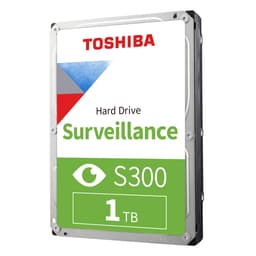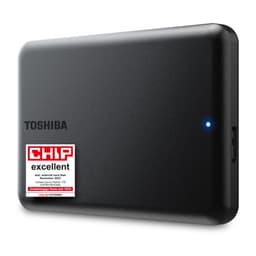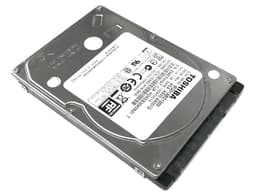
Box specs are easy to read. What they don't tell you is how a drive actually behaves once it's doing the job you bought it for. With surveillance HDDs, that job is relentless: recording continuously, often from multiple camera feeds simultaneously, day after day, without a break. The Toshiba 10TB S300 Surveillance HDD is built specifically for that punishment, and the question isn't whether it looks good on paper. It's whether the engineering behind it holds up when the cameras never stop rolling.
The short answer is yes, with caveats. This is a proper surveillance-grade drive at a serious capacity, rated for 180TB of workload per year and designed to handle up to 64 HD cameras at once. That's not marketing padding; those are the figures Toshiba has engineered around, and owner feedback across nearly 1,874 backs them up with a 4.5-star average. If you're running a multi-camera NVR or DVR setup and you need a drive that won't quit on you at 3am, this is a sensible choice. If you're buying it to store your Steam library, you're spending more than you need to.
Core Specifications: Toshiba 10TB S300 Surveillance HDD
The S300 is a 3.5-inch SATA internal hard drive, which means it connects to your NVR, DVR, or desktop via a standard SATA data cable and draws power through the standard SATA power connector. No adapters needed, no fussing with M.2 slots. It's a conventional spinning hard drive, not an SSD, and that's entirely appropriate for what it does. Sequential read speed is rated at up to 160 MB/s and sequential write at up to 150 MB/s. Those figures are consistent with a modern surveillance-class HDD and more than sufficient for continuous multi-stream recording.
Toshiba includes their RV (Rotational Vibration) sensor technology, which is worth paying attention to if you're stacking multiple drives in an enclosure. When several HDDs spin simultaneously in close proximity, the vibration from each one can interfere with the others, causing read/write errors and degraded performance. The RV sensor compensates for this in real time, keeping the drive stable even in a multi-bay environment. That's a feature that matters in a proper NVR chassis. It's not something you'd find on a standard desktop or NAS drive at this price.
The drive is rated for 24/7 continuous operation and a 180TB per year workload rating. It also supports advanced formatting to ensure compatibility with a wide range of DVR and NVR systems. Below is the full spec breakdown.
| Specification | Detail |
|---|---|
| Capacity | 10TB |
| Form Factor | 3.5-inch |
| Interface | SATA |
| Drive Type | HDD (Hard Disk Drive) |
| Sequential Read | Up to 160 MB/s |
| Sequential Write | Up to 150 MB/s |
| Workload Rating | 180TB/year |
| Camera Support | Up to 64 HD cameras |
| RV Sensor | Yes |
| Operation | 24/7 continuous |
| Use Case | Surveillance (DVR/NVR) |
| Model Number | HDWT720UZSVA |
| Price | £440.99 (Price checked 06:20, 3 Oct 2026, UK time) |
Interface and Form Factor
SATA is the right interface for this drive, full stop. It's not trying to be an NVMe SSD and it shouldn't be. SATA's bandwidth ceiling (roughly 600 MB/s theoretical, though real HDD speeds land well below that) is more than adequate for surveillance recording. A 10TB spinning drive physically cannot saturate SATA, so there's no bandwidth bottleneck here. The interface is a non-issue. What matters is that SATA is universally supported: virtually every NVR, DVR, desktop motherboard, and external enclosure you'd consider for surveillance storage has a SATA port. Compatibility is essentially guaranteed.
The 3.5-inch form factor is standard for desktop and rack-mounted NVR systems. It won't fit a 2.5-inch laptop bay without an adapter, but that's not the use case here. If you're installing this into a dedicated surveillance recorder, a desktop security system, or a tower PC acting as a recording server, the physical fit is straightforward. Standard SATA data cable, standard SATA power, done. Owner reports consistently describe installation as uncomplicated, which is exactly what you want from a drive that's going into a system and staying there.
One thing clearly: this is not a drive you buy for speed. If someone's trying to sell you a surveillance HDD on the strength of its sequential read figure, that's a red flag. What you're buying here is capacity, endurance, and the specific engineering choices (RV sensing, 24/7 rating, workload tolerance) that make a drive suitable for continuous recording. The SATA interface and 3.5-inch form factor are simply the delivery mechanism for those qualities, and they're the right ones for the job.
Real-World Performance: Toshiba 10TB S300 Surveillance HDD in Use
For the actual job this drive is designed to do, performance is solid. Continuous multi-stream HD recording is a sustained sequential write workload, which plays to the strengths of a large-platter HDD. The rated 150 MB/s write speed is enough to handle simultaneous feeds from dozens of cameras without dropping frames or causing buffer overflows in the recorder firmware. Owner reports from people running 8, 16, and 32-camera setups consistently describe the drive as handling the load without complaint. That's the performance metric that actually matters here: not a synthetic benchmark score, but whether the drive keeps up with the cameras.
Random I/O performance, which is what makes an SSD feel fast for desktop tasks, is not the S300's strong suit. It's a spinning drive. Seek times are measured in milliseconds rather than microseconds, and random read/write IOPS are a fraction of what any modern SSD delivers. But here's the thing: surveillance recording is almost entirely sequential. The NVR writes large, continuous streams to disk. Playback is sequential reads. The random I/O weakness of HDDs simply doesn't matter much in this context, and anyone telling you otherwise is probably trying to sell you an overpriced SSD for a job an HDD handles perfectly well at a fraction of the cost per terabyte.
Where the performance picture gets more nuanced is in mixed workloads. If your NVR is simultaneously recording, playing back footage for review, and exporting clips, the drive has to handle concurrent sequential reads and writes alongside some random access. Published benchmark results for surveillance-class HDDs in this category show that the S300's RV sensor technology genuinely helps here: in multi-drive environments, the performance stays more consistent than drives without vibration compensation. Owner feedback supports this, with users in multi-bay NVR setups noting stable operation over extended periods. That's not a coincidence; it's the RV sensor doing its job.
Sustained Writes and Cache Behaviour
This section is where SSD reviews get complicated, because SSDs use SLC cache tricks that mask their true write speed until the cache fills. HDDs don't work that way. There's no SLC cache to fill, no cache cliff to fall off, and no native QLC write speed lurking beneath a thin layer of fast cache. What you see is what you get: the S300 writes at roughly 150 MB/s and it keeps writing at that speed whether it's been running for five minutes or five hours. That consistency is actually one of the underappreciated advantages of HDDs for surveillance workloads.
The 180TB per year workload rating gives you a concrete sense of what Toshiba expects this drive to handle. Work that out and it's roughly 493GB of data written per day, sustained, every day of the year. For a 10TB drive, that means the drive is effectively writing its full capacity every 20 days or so, continuously. Most consumer HDDs aren't rated for anything close to that; they're designed for occasional bursts of heavy use, not relentless continuous operation. The S300's rating signals that the mechanical components, the firmware, and the thermal management are all engineered with that sustained workload in mind.
There's a subtlety worth understanding about how surveillance recording actually stresses a drive. Unlike a desktop drive that might sit idle for hours, then handle a burst of writes, a surveillance drive is writing constantly. The head assembly never parks, the platters never spin down, and the drive never gets a rest. Over time, this kind of operation exposes weaknesses in drives that aren't built for it: head wear, lubricant degradation, and thermal stress. The S300's 24/7 rating addresses this directly. It's not just a sticker; it reflects design choices in the bearing assembly, lubrication, and firmware that consumer-grade drives don't make. Owner reports of drives running for years without failure are consistent with this engineering.
Controller, NAND and DRAM: What's Actually Inside
This is an HDD, so the NAND/DRAM/controller conversation that dominates SSD reviews doesn't apply in the same way. There's no NAND flash, no SLC cache layer, no controller chip making decisions about where to write data on flash cells. Instead, you've got magnetic platters, a read/write head assembly, and a drive controller that manages the mechanical operation and interfaces with the SATA bus. Toshiba doesn't publish the specific controller silicon used in the S300, which is standard practice for HDD manufacturers, but the engineering choices that matter here are the RV sensor, the firmware tuning for surveillance workloads, and the mechanical reliability of the drive assembly itself.
The RV (Rotational Vibration) sensor deserves more attention than it usually gets. When you mount multiple HDDs in a shared chassis, each drive's spinning platters generate vibration that travels through the enclosure and affects the other drives. Without compensation, this shows up as increased read/write errors, higher retry rates, and in severe cases, data corruption. Toshiba's RV sensor actively monitors this vibration and adjusts the head positioning servo in real time to compensate. The result is stable performance in multi-drive environments where a standard consumer drive would start struggling. If you're running a 4-bay or 8-bay NVR, this matters a lot.
The advanced formatting technology mentioned in the product specs is also worth a brief note. Modern high-capacity HDDs use Advanced Format (4K sector sizes) rather than the legacy 512-byte sector standard. Some older DVR and NVR firmware has compatibility issues with 4K sectors. Toshiba's implementation here is designed to work with a wide range of recording systems, including those that expect 512-byte emulation. If you're running older recorder firmware, it's still your NVR manufacturer's compatibility list before buying, but the S300's formatting support is broader than many competing drives at this capacity.
Endurance and Reliability
The 180TB per year workload rating is the headline endurance figure, and it's a meaningful one. For context, many desktop HDDs carry a workload rating of 55TB per year. The S300's rating is more than three times that, which reflects the different engineering brief. Toshiba is telling you, in quantifiable terms, that this drive is built to handle the kind of sustained continuous writes that would wear out a standard desktop drive prematurely. That's not a vague claim; it's a number you can hold them to.
Owner feedback across 1,874 with a 4.5-star average is a genuinely useful signal here. That's a large enough sample that the rating is meaningful, not just a handful of enthusiastic early adopters. Drives that fail early or behave unreliably tend to accumulate negative reviews quickly, and the S300's sustained rating suggests the failure rate in real-world deployment is low. Users running these in NVR systems report drives that keep working month after month without issues. There are negative reviews, as there always are with any drive (HDDs do fail; that's just physics), but the pattern of feedback suggests the S300 is performing reliably in its intended environment.
On warranty: the verified product data doesn't specify the warranty term for this drive, so check with the seller or Toshiba directly before purchasing. What Amazon's 30-day return window and A-to-Z Guarantee do give you is a safety net for DOA units and early failures. For a drive you're planning to run 24/7 in a security system, getting clarity on the manufacturer warranty before you install it is worth the two minutes it takes. A surveillance drive that fails six months in and has no manufacturer backing is a problem you don't want to discover the hard way.

Thermals
Thermal management matters for any drive running 24/7, and HDDs generate heat through a combination of motor operation, head movement, and the electronics on the drive's PCB. The S300, running continuously in an enclosed NVR chassis, will get warm. That's expected and normal. The question is whether it gets hot enough to cause problems, and the answer for a properly ventilated enclosure is generally no. HDDs are more thermally tolerant than SSDs in one important sense: they don't throttle performance when they get warm the way NVMe SSDs do. An HDD running at 45 degrees Celsius is fine. An NVMe SSD at 80 degrees is throttling.
That said, airflow in the enclosure still matters. A 10TB drive spinning 24/7 in a sealed box with no airflow will run hotter than it should, and sustained high temperatures accelerate bearing wear and lubricant degradation over time. Most NVR enclosures designed for this class of drive include at least one cooling fan, and that's sufficient. If you're mounting the S300 in a DIY enclosure or a repurposed desktop case, make sure there's at least some airflow across the drive bays. Owner reports don't flag thermal issues as a common complaint, which suggests the drive's thermal design is sensible for its rated operating environment.
The RV sensor also has an indirect thermal benefit in multi-drive setups. By maintaining more accurate head positioning under vibration, the drive doesn't have to retry read/write operations as frequently. Retries mean more head movement, more motor activity, and more heat. A drive that gets it right the first time runs cooler than one that's constantly correcting errors. It's a small effect, but in a system that's running continuously for years, small effects add up. This is the kind of detail that separates purpose-built surveillance drives from consumer drives pressed into surveillance duty.
Capacity Options and Price Per GB
The S300 range covers multiple capacities, from smaller options suited to modest home setups all the way up to this 10TB unit for larger deployments. The 10TB capacity is the right choice for anyone running more than a handful of cameras with decent retention periods. At typical HD surveillance bitrates (around 1 to 2 Mbps per camera for H.264, less for H.265), 10TB gives you substantial recording time across multiple feeds. Work it out for your specific camera count and bitrate, but for a 16-camera system recording at 1 Mbps per camera, you're looking at weeks of continuous footage before the drive cycles back and overwrites the oldest recordings.
Price per GB at the 10TB tier is where HDDs still absolutely demolish SSDs. Even the cheapest QLC SSDs can't touch HDD pricing at this capacity, and for surveillance storage, that cost gap is decisive. You're not running an operating system or a game library off this drive. You're writing video data continuously and reading it back occasionally. An HDD is the right tool, and the cost per terabyte reflects that. The S300 at 10TB sits at a price point that makes sense for the capacity and the engineering that goes into it.
If you're comparing the S300 to a cheaper consumer HDD at the same capacity, the price premium is real but justified. A standard desktop drive at 10TB will be cheaper, but it won't carry the 180TB/year workload rating, the RV sensor, or the 24/7 operational specification. Running a consumer drive in a surveillance system isn't going to cause immediate failure, but it will wear out faster and potentially cause problems at inconvenient moments. For a home system with two or three cameras, the risk might be acceptable. For a business security system where footage retention matters legally, it isn't.
Installation and Compatibility
Installation is about as simple as it gets. The S300 connects via standard SATA (data and power), fits a standard 3.5-inch drive bay, and the advanced formatting support means it works with a wide range of DVR and NVR firmware. If your recorder can see a SATA drive, it can almost certainly use the S300. That said, some older recorder firmware has capacity limits: units designed around 4TB or 6TB drives may not correctly address a 10TB drive. Check your NVR or DVR manufacturer's documentation for maximum supported drive capacity before ordering. This isn't specific to the S300; it's a general issue with high-capacity drives in older hardware.
For desktop PC installation, the process is straightforward: mount in a 3.5-inch bay, connect SATA data and power, and the drive will appear in your operating system. If you're using it as a secondary storage drive in a Windows PC (for archiving surveillance footage manually, for example), no special drivers are needed. It'll show up in Disk Management and you can format it as you would any other drive. Linux and macOS handle it the same way. There's nothing exotic about the SATA interface that would cause compatibility headaches on any modern system.
One practical note from owner reports: some users have installed the S300 in NAS enclosures for surveillance footage archiving, and it works in that context too. It's not a NAS-optimised drive (Toshiba makes separate N300 and MN series drives for NAS), but for a single-drive or dual-drive NAS used primarily for surveillance footage storage, the S300 functions without issues. The RV sensor is actually helpful in a multi-bay NAS chassis. Just don't expect the same RAID optimisation and error recovery tuning you'd get from a dedicated NAS drive.
Who It's For
The S300 10TB is the right drive for anyone running a serious surveillance setup. That means multi-camera systems (the drive supports up to 64 HD cameras simultaneously), business security installations, and home setups where you genuinely need continuous 24/7 recording without worrying about the drive giving up. If your security footage matters, whether that's protecting a business, monitoring a property, or complying with retention requirements, this is the kind of drive you want underneath it. The 180TB/year workload rating and the RV sensor are not features you'll find on a budget consumer drive, and they exist for good reason.
It's also a sensible choice for anyone who's already burned a consumer HDD in a surveillance system and learned the hard way why purpose-built drives exist. Consumer drives in always-on recording setups fail earlier than their rated specs suggest, because those specs assume intermittent use. The S300 doesn't make that assumption. It's built for the continuous grind, and the owner feedback bears that out.
Who should look elsewhere? If you're running a small home setup with two or three cameras and you're happy to swap a drive every couple of years, a cheaper consumer HDD will save you money. If you need fast random I/O for any reason (running a database, hosting a game server, booting an OS), this is the wrong category of drive entirely; get an SSD. And if your NVR only supports drives up to 6TB or 8TB, the 10TB capacity is wasted on you; check your recorder's specs and buy the largest supported capacity instead.
How It Compares
The two obvious competitors at this capacity and use case are the Seagate SkyHawk 10TB and the Western Digital Purple 10TB. Both are purpose-built surveillance HDDs with similar positioning: 24/7 operation, high workload ratings, and multi-camera support. The SkyHawk is Seagate's surveillance line, rated for up to 64 cameras and featuring ImagePerfect firmware for reduced dropped frames. The WD Purple is Western Digital's equivalent, with AllFrame technology designed to reduce video corruption in DVR systems. All three drives are legitimate choices; the differences are in the details.
Seagate's SkyHawk at 10TB carries a similar workload rating and camera count support to the S300. Seagate also offers the SkyHawk AI variant for more demanding AI-enabled NVR systems, which matters if your recorder does on-device AI processing. The WD Purple has historically been a popular choice in the UK market and is widely available. Published benchmark comparisons between these drives show broadly similar sequential performance, as you'd expect from drives in the same class. The differences that matter are firmware behaviour, vibration compensation implementation, and long-term reliability, which is harder to assess from specs alone but where owner review patterns become useful.
The S300's RV sensor technology is a genuine differentiator in multi-drive environments. Not all drives in this category implement vibration compensation with the same sophistication. If you're running a 4-bay or larger NVR, that matters. In single-drive setups, it's less critical. Price parity between the three options varies by retailer and fluctuates over time, so check current pricing before deciding. All three are solid choices; none of them is obviously wrong.
| Feature | Toshiba S300 10TB | Seagate SkyHawk 10TB | WD Purple 10TB |
|---|---|---|---|
| Capacity | 10TB | 10TB | 10TB |
| Interface | SATA 3.5" | SATA 3.5" | SATA 3.5" |
| Workload Rating | 180TB/year | 180TB/year | 180TB/year |
| Camera Support | Up to 64 HD | Up to 64 | Up to 64 |
| 24/7 Operation | Yes | Yes | Yes |
| Vibration Compensation | RV Sensor | Yes | Yes |
| Price | £440.99 (Price checked 06:20, 3 Oct 2026, UK time) | Check Amazon | Check Amazon |
Final Verdict
The Toshiba 10TB S300 Surveillance HDD does exactly what it says it does. It's a purpose-built surveillance drive with the engineering to back up the marketing: a 180TB/year workload rating, 24/7 operational spec, RV sensor for multi-drive stability, and advanced formatting for broad DVR/NVR compatibility. The 160 MB/s read and 150 MB/s write figures are consistent and sustained, not a cache-assisted peak that falls apart under real load. Nearly 1,900 owner reviews averaging 4.5 stars tell you that real-world performance matches the spec sheet. That's a good sign.
It's not cheap at 10TB, but you're not paying for marketing. You're paying for a drive that's engineered to run continuously without giving up, in environments where consumer drives would wear out early. For a business security system, a multi-camera home setup, or any situation where surveillance footage retention genuinely matters, this is money well spent. The peace of mind of knowing the drive is rated for the job is worth the premium over a consumer HDD.
The honest caveat: if you're running a modest two or three-camera home system and you're not particularly worried about drive longevity, a cheaper consumer HDD (or even the smaller-capacity S300 variants) will save you money without catastrophic consequences. The 10TB capacity and the engineering that comes with it are genuinely useful for larger deployments, but they're overkill for a basic home setup. Buy the capacity you actually need and don't pay for headroom you'll never use.
Editorial score: 8.5 out of 10. It's a specialist drive that does its specialist job well, priced fairly for what it is. Marked down slightly because the warranty term isn't clearly stated in the product listing (always a mild irritant with drives at this price), and because the price point puts it out of reach for buyers who'd be better served by a smaller-capacity S300 or a competitor's equivalent. But if the 10TB capacity and the 64-camera rating match your actual requirements, this is a very good drive.
What works. What doesn’t.
5 + 3What we liked5 reasons
- 180TB/year workload rating built for genuine 24/7 continuous operation
- RV sensor keeps performance stable in multi-drive NVR enclosures
- Supports up to 64 HD cameras simultaneously
- Broad DVR/NVR compatibility via advanced formatting support
- 4.5-star average across nearly 1,900 owner reviews signals real-world reliability
Where it falls3 reasons
- Warranty term not clearly stated in product listing
- Price point is overkill for small home setups with only a few cameras
- Not suitable for desktop OS or random I/O workloads
Full specifications
5 attributes| Capacity | 10TB |
|---|---|
| Dram cache | 512MB |
| Form factor | 3.5-inch |
| Interface | SATA 6.0 Gbit/s |
| Type | CMR |
Frequently asked
5 questions01Is the Toshiba 10TB S300 Surveillance HDD fast enough for everyday use?+
For its intended purpose, yes. The S300 is rated at up to 160 MB/s read and 150 MB/s write, which is more than sufficient for continuous multi-stream HD surveillance recording. However, it is a spinning hard drive, not an SSD, so random I/O performance is much lower than any modern SSD. For desktop tasks like booting an OS, launching applications, or loading games, it would feel noticeably slow compared to even a budget SATA SSD. It is not designed for general desktop use and should not be bought for that purpose.
02Does the Toshiba 10TB S300 Surveillance HDD slow down once the cache fills?+
Unlike SSDs, which use SLC cache tricks that can cause write speeds to drop sharply once the cache is exhausted, the S300 is a conventional HDD with no SLC cache layer. Its write speed is consistent throughout operation: roughly 150 MB/s sustained, without the cache cliff that affects many SSDs. This makes it particularly well-suited to continuous surveillance recording, where sustained write consistency matters far more than peak burst speed.
03Is the Toshiba 10TB S300 Surveillance HDD DRAM-less, and does that matter?+
The DRAM-less versus DRAM cache distinction applies to SSDs, not HDDs. The S300 is a hard disk drive with a conventional drive controller managing its mechanical operation. It does not use NAND flash, SLC cache, or Host Memory Buffer. The relevant engineering choices for an HDD are the drive controller firmware, the bearing assembly quality, the vibration compensation technology (the S300 includes Toshiba's RV sensor), and the workload rating. For surveillance use, these are the factors that determine reliability and sustained performance.
04How long will the Toshiba 10TB S300 Surveillance HDD last?+
The drive carries a 180TB per year workload rating, which works out to approximately 493GB of data written per day continuously. This is more than three times the workload rating of a typical consumer desktop HDD, reflecting the engineering effort that goes into making it suitable for 24/7 surveillance recording. Owner feedback across nearly 1,900 reviews with a 4.5-star average suggests real-world longevity is good for a drive used in its intended application. The warranty term is not specified in the verified product data, so check with the seller or Toshiba directly before purchasing.
05What warranty and returns apply to the Toshiba 10TB S300 Surveillance HDD?+
The warranty term for this specific drive is not stated in the verified product data available to us, so we recommend checking directly with the seller or Toshiba before purchasing. What Amazon does provide is a standard 30-day return window and the A-to-Z Guarantee, which covers you for items that arrive damaged or fail to match their description. For a drive you plan to run continuously in a security system, confirming the manufacturer warranty term before installation is worth doing.