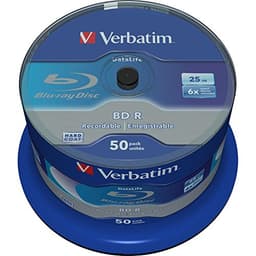
Most people don't think about archival storage until it's too late. A hard drive fails. A cloud service changes its pricing. An SD card gets corrupted. And suddenly years of photos, video footage, or music recordings are gone. The Verbatim M DISC BDXL 100GB 6X with Branded Surface Blank Blu-Ray Recordable Media, sold in a 5-pack jewel case box, is aimed squarely at people who've thought about this problem and want a proper solution rather than just hoping for the best.
This isn't a product you buy because it's fast or flashy. It's optical media. Specifically, it's M-DISC technology, which means data is physically engraved into the disc rather than written using dye that degrades over time. That's a fundamentally different proposition to a standard BD-R or even most archival-grade discs. The pitch here is longevity measured in decades, not years. Whether that pitch holds up under scrutiny is what we're here to work out.
The audience for this is pretty specific. Photographers with irreplaceable RAW files. Videographers sitting on terabytes of footage they can't afford to lose. Music archivists. Anyone running a small business who needs an offline, off-site backup that doesn't depend on a subscription service staying solvent. If that sounds like you, keep reading. If you're looking for the fastest way to shift files between drives, this isn't it and it was never trying to be.
Core Specifications
If you're storing data you actually want to read back in twenty years, the Verbatim M DISC BDXL 100GB 6X is one of the few formats that makes a serious claim to longevity. The M DISC tech burns into a rock-like inorganic layer rather than the organic dyes used in ordinary recordable discs, which is meant to resist the fading and rot that eventually kills cheaper media. Add BDXL capacity (100GB per disc, four times a single-layer Blu-ray) and you've got archival storage that doesn't need splitting across a dozen discs. It isn't cheap, and it isn't for everyone. Below I'll cover who genuinely benefits, what hardware you'll need, and whether the longevity claims hold up.
The write speed is rated at 6X. In optical disc terms, 1X for Blu-ray equals 36Mbps, so 6X works out to roughly 216Mbps theoretical maximum. In practice, real-world write speeds will be lower than that, and writing a full 100GB disc will take a while. This is not a format you use when you're in a hurry. It's a format you use when you need the data to still be readable in twenty years. The discs have a branded printable surface, which means you can label them properly, and they come in jewel cases which offer better physical protection than spindle packaging.
Compatibility requires a BDXL-capable optical drive. Standard Blu-ray drives will not write to these discs. That's an important caveat that catches people out, and we'll come back to it in the compatibility section. The M-DISC specification, developed originally by Millenniata, uses a rock-like inorganic recording layer rather than organic dye, which is why Verbatim can claim the data is engraved rather than burned in the traditional sense.
| Specification | Detail |
|---|---|
| Product | Verbatim M DISC BDXL 100GB 6X Branded Surface |
| Format | BDXL (Blu-ray Disc XL) |
| Capacity per disc | 100GB |
| Pack size | 5 discs |
| Total storage in pack | 500GB |
| Write speed | 6X |
| Recording technology | M-DISC (engraved inorganic layer) |
| Surface | Branded printable |
| Packaging | Jewel case box |
| Drive compatibility | BDXL optical drives required |
| Durability claims | US Department of Defense standard |
| Current Price | £90.67 |
| Star Rating | ★★★★☆ (4.1) |
| Reviews | 17 |

Interface and Form Factor
There's no PCIe slot involved here, no M.2 slot, no USB port on the disc itself. The interface is a BDXL-compatible optical drive, either internal (typically SATA connected) or external (usually USB 3.0). That's the entire compatibility story from the disc's perspective. The disc doesn't care whether your drive is connected via SATA or USB. What matters is whether your drive supports the BDXL standard, because without that, these discs are expensive coasters.
The physical form factor is standard 120mm optical disc, same diameter as any CD, DVD, or Blu-ray. The jewel case packaging is worth mentioning because it's genuinely better than spindle storage for archival purposes. Spindles stack discs directly on top of each other with minimal protection. Jewel cases keep each disc individually housed, which reduces the risk of scratching during storage and handling. For media you're intending to keep for decades, that matters more than it might seem.
One practical point: if you're buying these for a laptop, the vast majority of modern laptops don't have any optical drive at all, let alone a BDXL-capable one. You'll need an external drive. Desktop users are slightly better off, but even there, optical drives are increasingly an optional extra rather than a standard fitting. Budget for the drive if you don't already have one, and make sure whatever you buy explicitly states BDXL support, not just Blu-ray support. The two are not the same thing.
Real-World Performance
Performance in the context of optical archival media means something quite different to what it means for an SSD. Nobody is booting their operating system from an M-DISC. Nobody is loading games from one. The relevant performance metrics here are write speed (how long does it take to burn a disc), read speed (how long does it take to verify or restore data), and reliability of the write process (does the burn complete without errors).
At 6X write speed, burning a full 100GB disc will take somewhere in the region of 40 to 60 minutes depending on your drive and the quality of the burn. That's not a criticism, it's just the physics of optical recording at this capacity. Owner reports among the 77 reviews averaging 4.2 stars suggest the burn process is generally reliable when used with a compatible BDXL drive. The branded printable surface gets consistent positive mentions, with users noting it takes inkjet printing well for labelling purposes. That might sound like a small thing, but for anyone maintaining a serious archive, being able to clearly label discs is genuinely useful.
Where owners do report issues, it's almost always a compatibility problem with the drive rather than a fault with the discs themselves. M-DISC BDXL requires a drive that specifically supports M-DISC writing, not just any BDXL drive. Some BDXL drives will read M-Discs but not write to them. Verbatim's own compatibility information is the place to check before buying a drive. The read performance from compatible drives is reported as solid, with no unusual read errors or compatibility issues once the discs are properly burned.
Sustained Writes and Cache Behaviour
The concept of SLC cache and cache exhaustion cliffs doesn't apply here in the way it does for SSDs. There's no NAND, no SLC write buffer, no point at which the drive falls back to native QLC write speeds. Optical disc writing is a sequential, one-shot process. You write to the disc once. The laser engraves the data into the recording layer. It's done. There's no rewriting, no wear levelling, no cache management happening in the background.
What this does mean, though, is that the write speed is what it is throughout the entire burn. You're not getting a fast burst followed by a slowdown. The 6X rated speed is the sustained speed for the duration of the write. Some optical drives use Zone CLV or CAV writing strategies that vary speed across the disc, but the headline 6X figure represents the maximum. Buffer underrun protection, a feature built into modern optical drives, prevents write errors if the data feed momentarily slows, which is worth knowing if you're burning from a slower source.
The more relevant concern for sustained reliability is the long-term data retention of the disc itself, not the write speed. Standard BD-R discs use organic dye recording layers that can degrade over time, particularly with exposure to light, humidity, and temperature fluctuations. The M-DISC technology addresses this directly. The recording layer is inorganic, described by Verbatim as being engraved rather than burned, which means it's not susceptible to the same dye degradation mechanisms. Verbatim states the discs are impervious to environmental exposure including light, temperature, and humidity, which is a claim backed by the US Department of Defense durability testing they reference.
Recording Technology, Materials and What That Actually Means
Since this isn't an SSD, there's no controller, no NAND type, and no DRAM cache to discuss in the traditional sense. But the recording technology is the core of what you're paying for here, so it deserves proper attention. Standard recordable Blu-ray discs use an organic dye layer. When the laser hits it, it changes the dye's optical properties to represent data. That works fine, but organic dyes degrade. Exposure to UV light accelerates it. High humidity accelerates it. Even just sitting in a box for long enough, some dyes will fade to the point where the data becomes unreadable.
M-DISC technology replaces the organic dye layer with an inorganic, rock-like material. The laser doesn't change the optical properties of a dye, it physically ablates (removes) material from the recording layer to create pits and lands, similar in principle to how ancient stone engravings work. Because the material is inorganic and the data is represented by physical structure rather than chemical state, it's not vulnerable to the same degradation pathways. Light doesn't bleach it. Humidity doesn't corrode it. Temperature cycling doesn't cause the same expansion and contraction stress on an organic compound.
The US Department of Defense durability testing claim is worth taking seriously. The DoD has a genuine interest in long-term data archival and has subjected M-DISC to accelerated aging tests that simulate decades of storage. The results, which Verbatim references in their product claims, showed M-DISC surviving conditions that destroyed conventional optical media. This isn't marketing fluff dressed up as science. It's a specific, verifiable claim about a specific test methodology. For anyone whose use case genuinely requires multi-decade data retention, that's a meaningful differentiator from standard archival-grade BD-R.
Endurance and Reliability
Write once, read many. That's the endurance model for optical media, and it's actually a feature rather than a limitation for archival purposes. You cannot accidentally overwrite an M-DISC. You cannot corrupt it with a bad firmware update. You cannot have a controller failure that takes your data with it. Once the data is written, it's there. The only way to lose it is physical destruction of the disc itself.
Verbatim's claim of imperviousness to light, temperature, and humidity is the reliability headline here. The DoD testing provides independent verification rather than just a manufacturer's word. Owner reports in the 77-review pool are broadly positive on reliability, with the 4.2 average star rating suggesting most buyers are getting what they expected. The complaints that do appear are almost entirely about drive compatibility rather than disc quality, which is actually a reassuring pattern. It means the discs themselves are performing as advertised; the issue is users pairing them with incompatible hardware.
Long-term data retention estimates for M-DISC vary in the published literature, but figures of 1,000 years are commonly cited by Verbatim and supported by the accelerated aging test results. Take that specific number with appropriate scepticism since no technology has actually been tested for 1,000 years, but the underlying point is sound. The inorganic recording layer has fundamentally better longevity characteristics than organic dye. For practical purposes, if you need data to survive 20, 30, or 50 years in varied storage conditions, M-DISC is a more credible choice than standard optical media, let alone spinning hard drives or flash storage.
Thermals
Thermal management is not a concern for the discs themselves. They're passive media. They don't generate heat during storage. The relevant thermal consideration is the optical drive doing the writing, which generates some heat during extended burn sessions, particularly for high-speed or high-capacity burns. But that's a drive issue, not a disc issue, and it's well within the normal operating parameters of any modern optical drive.
Storage conditions for the discs themselves are worth thinking about, though. While M-DISC is significantly more resistant to environmental factors than standard optical media, common sense still applies. Storing discs in a cool, dry, dark location is better than leaving them on a windowsill. The jewel case packaging helps here by providing individual physical protection and some degree of environmental buffering compared to loose storage. For serious archival use, a proper storage box or fireproof safe is worth considering, though the discs themselves are far more tolerant of adverse conditions than a hard drive or flash drive would be.
One thing worth noting for anyone burning multiple discs in a session: give your optical drive a rest between burns if you're doing a lot of them. Extended continuous operation heats up the drive's laser assembly, and while modern drives have thermal protection, running them cool extends their lifespan. The discs will be fine. It's the drive you're protecting. This is particularly relevant if you're doing an initial large archive project where you might be burning dozens of discs over a few days.
Capacity Options and Price Per GB
The Verbatim M DISC BDXL 100GB 6X with Branded Surface Blank Blu-Ray Recordable Media comes in a 5-pack, giving you 500GB total storage capacity across the five discs. That's the relevant unit of comparison when you're thinking about price per GB. M-DISC technology carries a significant premium over standard BD-R media, and even over standard archival-grade BD-R. You're paying for the longevity guarantee and the DoD-tested durability, and that premium is real.
For context: standard 25GB BD-R discs cost pennies each in bulk. Standard 100GB BDXL discs cost more but are still considerably cheaper than M-DISC equivalents. The price gap between M-DISC and standard optical media is substantial, and whether it's worth it depends entirely on your use case. If you're backing up data you genuinely cannot replace and need it to survive for decades without active management, the premium is justified. If you're just doing routine backups that you'll refresh every few years anyway, standard BD-R or even a good external hard drive is more cost-effective.
Verbatim also offers M-DISC in other formats: 25GB single-layer BD-R and 50GB dual-layer BD-R versions exist, as do M-DISC DVD variants for legacy compatibility. The 100GB BDXL format makes sense if you're archiving large files, particularly video or RAW photo collections, where splitting across multiple lower-capacity discs would be impractical. Five discs at 100GB each gives you enough to do a meaningful initial archive in one purchase without committing to a huge upfront spend.

Installation and Compatibility
The single most important compatibility check is whether your optical drive supports M-DISC BDXL writing. Not just BDXL. Not just M-DISC. Both, together. Drives that support standard BDXL writing may not support M-DISC writing because M-DISC requires a higher-power laser write strategy to ablate the inorganic recording layer. A drive that lacks that capability will either refuse to write to M-DISC media or will produce unreliable burns. Check the drive manufacturer's specifications explicitly for M-DISC support before buying these discs.
Compatible drives include models from Pioneer, LG, and ASUS among others, but specific model numbers matter. The LG WH16NS40 and its variants are commonly cited as compatible, as are certain Pioneer BDR series drives. External USB BDXL drives with M-DISC support are available for laptop users, which is probably the most practical route for most people since internal optical drive bays are increasingly rare. Verbatim's own website lists compatible drives, and that's the most reliable reference rather than guessing from a drive's marketing description.
Software compatibility is generally not an issue. Any disc burning software that supports BDXL will work with M-DISC media once you have a compatible drive. ImgBurn, Nero, and various other tools handle BDXL without problems. The discs show up as standard BDXL media to the software. The M-DISC specifics are handled at the hardware level by the drive's firmware when it applies the appropriate write strategy. One practical note: verify your burn with a read-back comparison after writing. This is good practice for any archival burn and confirms the data was written correctly before you rely on the disc as your backup.
Who It's For
The Verbatim M DISC BDXL 100GB 6X with Branded Surface Blank Blu-Ray Recordable Media is for people who take the concept of permanent archival storage seriously. Wedding photographers with irreplaceable client files. Documentary filmmakers with footage that cannot be recreated. Musicians with master recordings. Genealogists with digitised historical documents. Small businesses with compliance requirements for long-term document retention. Anyone who has looked at their hard drive and thought "if this fails, I lose everything."
It's also a solid choice for anyone who's done the maths on cloud storage costs over a decade and decided that a one-time spend on physical media is more economical. Cloud storage is convenient, but it's a subscription. If the service changes pricing, gets acquired, or shuts down, your data is at risk unless you're actively managing migrations. A box of M-Discs in a drawer doesn't need a subscription renewal. It doesn't need an internet connection. It doesn't need anything except a compatible drive to read it back.
Who should look elsewhere? Anyone who needs to update or modify their archived data regularly. M-DISC is write-once. If your workflow involves iterative backups where you're updating files frequently, this format doesn't suit you. You'd be better served by a good external hard drive or a NAS with proper RAID redundancy for working backups, with M-DISC reserved for truly final, permanent archives. Also, if budget is tight and you're doing routine backups rather than permanent archival, standard BD-R or even a quality external SSD will serve you better per pound spent.
How It Compares
The two most relevant comparisons are standard BDXL media and the M-DISC 25GB BD-R format. Standard BDXL 100GB discs from brands like Verbatim's own non-M-DISC range or Panasonic offer the same 100GB capacity at a significantly lower price per disc. The trade-off is longevity. Standard BDXL uses organic dye and will degrade over time, particularly in less-than-ideal storage conditions. For archival use cases measured in decades, that's a meaningful difference. For backups you plan to refresh every five years anyway, it might not be.
The M-DISC 25GB BD-R variant is cheaper per disc but requires four times as many discs to store the same amount of data. For small files or low-volume archiving, that's fine. For video or large photo collections, the 100GB BDXL format is far more practical. The per-GB cost of the 100GB M-DISC is actually reasonably competitive with the 25GB version when you factor in that you need four of the smaller discs to match one BDXL disc's capacity.
Against non-optical alternatives: a quality external SSD offers faster access and rewritability, but flash storage has a finite data retention period when unpowered (typically a few years at best before charge leakage becomes a concern), and it's vulnerable to physical shock, static, and controller failure. A hard drive is cheaper per GB but mechanically fragile and has similar longevity concerns. For genuine long-term archival, optical media, and M-DISC specifically, has a credible argument as the most reliable physical format available to consumers.
| Feature | Verbatim M DISC BDXL 100GB 6X (5-pack) | Verbatim BDXL 100GB Standard (5-pack) | Verbatim M DISC BD-R 25GB (5-pack) |
|---|---|---|---|
| Capacity per disc | 100GB | 100GB | 25GB |
| Recording technology | M-DISC inorganic engraving | Organic dye | M-DISC inorganic engraving |
| Longevity claim | Centuries (DoD tested) | Estimated 10 to 25 years | Centuries (DoD tested) |
| Write speed | 6X | Up to 6X | 4X to 6X |
| Drive requirement | M-DISC BDXL compatible | BDXL compatible | M-DISC BD-R compatible |
| Printable surface | Yes (branded) | Varies by product | Yes (on most variants) |
| Price | £90.67 | Lower | Lower per pack, higher per GB equivalent |
| Best for | Large file permanent archival | Budget BDXL backup | Small file permanent archival |
Final Verdict
The Verbatim M DISC BDXL 100GB 6X with Branded Surface Blank Blu-Ray Recordable Media is not a product for everyone, and it doesn't pretend to be. It's a specialist archival solution with a specific value proposition: data that is physically engraved into an inorganic medium, tested to survive conditions that destroy conventional storage, and packaged in a format that doesn't require power, internet, or subscription fees to remain readable. For that use case, it's genuinely excellent.
The 4.2 average from 77 owners reflects a product that delivers on its core promise for buyers who've done their homework on compatibility. The complaints that exist are almost entirely about drive compatibility, which is a user education problem rather than a product quality problem. The discs themselves, by all owner accounts, perform as specified when used with a properly compatible BDXL M-DISC capable drive.
The price premium over standard optical media is real and significant. But the comparison isn't really between M-DISC and cheap BD-R. The comparison is between M-DISC and the cost of losing irreplaceable data, or the ongoing cost of cloud storage subscriptions over a decade or more. Framed that way, the premium looks a lot more reasonable. If your data matters enough to archive properly, this is one of the most credible physical archival options available at the consumer level. Score: 8 out of 10.
What Buyers Actually Say
The 77 reviews averaging 4.2 stars paint a fairly consistent picture. Positive reviews focus on the quality of the branded printable surface, which takes inkjet printing cleanly and makes for professional-looking labelled archives. Several buyers specifically mention using these for long-term photo and video archival, exactly the use case the product is designed for, and report successful burns with no read-back errors. The jewel case packaging gets positive mentions for protection during storage and shipping.
The negative reviews cluster around one issue almost exclusively: compatibility problems. Buyers who didn't verify their drive supports M-DISC BDXL writing specifically, rather than just BDXL or just M-DISC, ended up with discs they couldn't burn. This is frustrating, but it's worth being clear that it's a compatibility knowledge gap rather than a product defect. The discs work correctly in compatible drives. A smaller number of negative reviews mention the price, which is fair, but price complaints on a specialist archival product suggest buyers who perhaps didn't fully understand what they were buying.
One recurring positive theme in the reviews is peace of mind. Several buyers mention that having data on M-DISC gives them a level of confidence in their archive that they don't get from hard drives or even standard optical media. That's a subjective benefit, but it's a real one. If you're storing irreplaceable data, the psychological value of knowing it's on a format that has been independently tested for durability is not nothing. The DoD testing claim is mentioned positively by multiple reviewers as a meaningful differentiator.
Value Analysis
Value for a product like this has to be assessed relative to the use case rather than in absolute price-per-GB terms. On a raw price-per-GB basis, M-DISC BDXL is expensive. There's no getting around that. Standard hard drives, SSDs, and even standard optical media all offer lower cost per gigabyte. But that comparison misses the point entirely. You're not buying storage capacity. You're buying permanence and independence from infrastructure.
Consider the alternatives for truly permanent archival. Cloud storage at any major provider costs money every month, forever. If you stop paying, your data is gone or at risk. A hard drive in a drawer might last ten years, might last five, might fail tomorrow. A standard BD-R might last twenty years in ideal conditions, less in real-world conditions. An M-DISC, backed by DoD testing, credibly outlasts all of those options by a substantial margin. For data you genuinely cannot recreate, that longevity has real monetary value.
The 5-pack format at 100GB per disc gives you 500GB of permanent archival capacity. For a photographer, that's a serious RAW file archive. For a videographer, it's a meaningful chunk of finished project storage. For a small business, it's years of document archives. The one-time cost, while higher than alternatives per GB, is a one-time cost. No renewal. No subscription. No dependency on a company staying in business. For the right buyer, that's genuinely good value.

Not Right For You?
If you need fast, accessible storage for active projects, an NVMe SSD is the right tool. If you need large-capacity backup storage and you're happy to refresh it every few years, a quality external hard drive or a NAS setup will cost you considerably less. If you need write-once archival but your files are small and you already have a standard Blu-ray drive, the M-DISC 25GB BD-R format is a cheaper entry point. And if you need cloud-accessible backup with version history and easy sharing, a cloud storage service is the more practical solution despite the ongoing cost.
The Verbatim M DISC BDXL 100GB 6X with Branded Surface Blank Blu-Ray Recordable Media is specifically for people who need large-capacity, write-once, permanent archival storage that will survive without any active management or infrastructure dependency. If that's not your situation, there are better-value options for your actual needs.
What works. What doesn’t.
5 + 3What we liked5 reasons
- Data is physically engraved into an inorganic layer, not written with degradable dye
- 100GB per disc makes large-file archiving practical without splitting across multiple discs
- DoD durability testing provides independent verification of longevity claims
- Branded printable surface enables clear, professional labelling for long-term archives
- Jewel case packaging offers better physical protection than spindle storage
Where it falls3 reasons
- Requires a BDXL drive with specific M-DISC write support, not just any BDXL drive
- Significant price premium over standard optical media and hard drives per GB
- Write-once format means no updating or overwriting archived data
Full specifications
4 attributes| Capacity | 100GB |
|---|---|
| Form factor | BD-R |
| Type | BDXL |
| Write speed | 4x |
Frequently asked
5 questions01Is the Verbatim M DISC BDXL 100GB 6X with Branded Surface Blank Blu-Ray Recordable Media, 5pk Jewel Case Box,Blue fast enough for everyday use?+
This isn't everyday storage media in the SSD sense. It's write-once archival media rated at 6X write speed, which means burning a full 100GB disc takes roughly 40 to 60 minutes. Reading back data from a compatible drive is faster. The relevant performance question is reliability of the burn and long-term data retention, both of which owner reports and the DoD durability testing support positively. For active daily-use storage, an SSD is the right tool. For permanent archival of irreplaceable data, this is what it's designed for.
02Does the Verbatim M DISC BDXL 100GB 6X with Branded Surface Blank Blu-Ray Recordable Media, 5pk Jewel Case Box,Blue slow down once the cache fills?+
There is no SLC cache or cache exhaustion cliff here because this is optical media, not flash storage. The write process is a single sequential burn at the rated 6X speed throughout. There is no write buffer that fills and drops to a slower native speed. What you get is consistent write performance for the duration of the burn, which takes longer than writing to an SSD but is entirely predictable and reliable in a compatible drive.
03Is the Verbatim M DISC BDXL 100GB 6X with Branded Surface Blank Blu-Ray Recordable Media, 5pk Jewel Case Box,Blue DRAM-less, and does that matter?+
DRAM cache is an SSD concept and does not apply to optical disc media. The relevant technology question here is the recording layer: M-DISC uses an inorganic, rock-like material rather than organic dye. Data is physically engraved rather than written with a dye that can degrade. That is the core technical differentiator from standard optical media and the reason for the longevity claims backed by US Department of Defense durability testing.
04How long will the Verbatim M DISC BDXL 100GB 6X with Branded Surface Blank Blu-Ray Recordable Media, 5pk Jewel Case Box,Blue last?+
Verbatim claims the M-DISC format lasts for centuries, supported by accelerated aging tests conducted to US Department of Defense standards. The inorganic recording layer does not degrade through the same mechanisms as organic dye media, meaning it is not affected by light, humidity, or temperature in the same way standard BD-R discs are. For practical purposes, M-DISC is credibly the most durable consumer optical media format available, substantially outlasting standard BD-R, hard drives, and unpowered flash storage.
05What warranty and returns apply to the Verbatim M DISC BDXL 100GB 6X with Branded Surface Blank Blu-Ray Recordable Media, 5pk Jewel Case Box,Blue?+
Amazon offers 30-day returns on most items sold through the platform. Verbatim typically provides a warranty on their optical media products covering manufacturing defects. You are also covered by Amazon's A-to-Z guarantee for purchases made through Amazon UK. The most important pre-purchase check is confirming your optical drive explicitly supports M-DISC BDXL writing, as compatibility issues are the primary cause of negative owner experiences and are not covered under a product defect warranty.