Spec sheets for contact frames don't lie, exactly, but they don't tell you much either. "Optimises contact pressure" sounds great, but what does that actually mean for your Ryzen 7000 CPU temperatures? The answer, as it turns out, is more interesting than the marketing suggests, and the 1,450 owners who've rated this thing ★★★★½ (4.8) have a fair bit to say about it.
The Thermal Grizzly AM5 Contact Sealing Frame isn't a cooler. Worth saying that upfront, because the category listing might confuse people who are mid-build and slightly frantic. This is a contact frame, a precision-machined piece of anodised aluminium that replaces the plastic Standard Attachment Mechanism (SAM) that AMD ships with every AM5 motherboard. It also doubles as a CPU guard, with a silicone foam inlay that protects the exposed components on the AM5 package when your cooler isn't mounted. So it's doing two jobs, and it does both of them quietly well.
The context matters here. The AM5 socket, unlike older AMD platforms, uses an LGA-style land grid array where the pins are on the motherboard rather than the CPU. That means the CPU itself has exposed pads and components that can be damaged if you drop something on them or handle the chip carelessly. AMD's stock SAM provides some protection but applies uneven pressure across the heatspreader. Thermal Grizzly's fix is precision-milled contact points that distribute load more evenly, which in turn improves the thermal interface between CPU and cooler. That's the theory. The owner data suggests it works.
Core Specifications
Before anything else, let's be clear about what this product actually is, because the category label "CPU Coolers and Cooling" does it a slight disservice. The Thermal Grizzly AM5 Contact Sealing Frame is a contact frame and CPU guard combination. It is not a heatsink, not a fan, not an AIO. It's an accessory that works alongside your existing cooler to potentially improve how that cooler performs.
The frame is machined from anodised aluminium, which is the right material choice here. Aluminium is stiff enough to maintain consistent clamping geometry, light enough not to add meaningful load to the socket, and the anodising process gives it a surface hardness that resists scratching during installation. The inner contour is precision-milled to create specific contact points against the CPU heatspreader, rather than the broad flat clamping surface of AMD's stock SAM. The silicone foam inlay sits over the CPU's exposed components when the frame is fitted without a cooler, acting as a guard against accidental contact damage.
Compatibility is specifically called out as being for AMD Ryzen 7000 CPUs on the AM5 platform, and the product is noted as being suitable for use with Thermal Grizzly's own AM5 backplates. The frame replaces the SAM entirely, so you remove AMD's plastic retention mechanism and fit this in its place. That's the full scope of what it is.
| Specification | Detail |
|---|---|
| Product Type | Contact Frame and CPU Guard Combination |
| Material | Anodised aluminium with silicone foam inlay |
| Socket Compatibility | AMD AM5 (Ryzen 7000 series) |
| Function | Replaces Standard Attachment Mechanism (SAM), optimises contact pressure, protects CPU components |
| Backplate Compatibility | Thermal Grizzly AM5 backplates |
| Alignment | Clearly marked for correct orientation |
| Price | £21.25 |
| Rating | ★★★★½ (4.8) (1,807 reviews) |

Cooler Type and Design
The design philosophy here is straightforward: AMD's stock SAM is a cost-optimised plastic part that does the job adequately but not brilliantly. It applies clamping force across the full perimeter of the heatspreader, which sounds fine until you consider that the AM5 heatspreader isn't perfectly flat from the factory. There's a known tendency for the centre of the heatspreader to be slightly convex, which means a flat-clamping SAM creates more pressure at the edges than the centre. That's the opposite of what you want, because the die is in the middle.
Thermal Grizzly's approach is to use a precision-milled inner contour with specific contact points. The geometry is designed to apply more pressure at the centre of the heatspreader, where the die actually sits, rather than spreading it evenly across the whole surface. The result, in theory, is better thermal interface material compression at the point where it actually matters. The anodised aluminium construction means the frame itself won't flex under clamping load the way a plastic SAM might over time, so the contact geometry should remain consistent.
The silicone foam inlay is the other half of the design story. AM5 CPUs have exposed capacitors and other components around the heatspreader that are vulnerable to physical contact. If you're swapping coolers, doing thermal paste maintenance, or just handling the board with the CPU installed, that foam layer sits over those components and prevents accidental damage. It's a small thing, but anyone who's ever accidentally scraped a component off a PCB will appreciate the thought. The combination of the frame and the guard in a single product means you're not buying two separate accessories to solve two separate problems.
Thermal Performance vs TDP
This is where the product gets genuinely interesting, and also where you have to be honest about what it can and can't do. The Thermal Grizzly AM5 Contact Sealing Frame doesn't cool your CPU by itself. Your cooler does that. What this frame does is potentially improve how efficiently the heat gets from the CPU to the cooler by optimising the contact pressure at the thermal interface. The improvement you see depends on how good your existing cooler is, how much thermal paste you're using, and how far from optimal your current SAM contact pressure actually is.
That said, the owner feedback at 4.8 stars across 1,807 is pretty telling. People who install contact frames on AM5 systems consistently report temperature drops, typically in the range of a few degrees Celsius under sustained load. For a chip like the Ryzen 9 7950X that can push well past 170W TDP in all-core workloads, even a modest improvement in contact efficiency translates to meaningful thermal headroom. On a Ryzen 5 7600 running at more modest power levels, the effect is less dramatic but still measurable.
The key point is that this product is an optimisation, not a solution. If your cooler is undersized for your CPU, this frame won't fix that. If you're already running a well-matched cooler with good thermal paste applied properly, the gains are real but incremental. Where it makes the most difference is on high-TDP chips running sustained workloads, where every degree of margin matters. The precision contact geometry is doing real work there, and the owner consensus backs that up. It's not magic, but it's not nothing either.
Noise At Load
There are no fans here. No pump. No moving parts at all. So in the strictest sense, the noise question doesn't apply to this product directly. But it does apply indirectly, and that's actually one of the more compelling arguments for fitting a contact frame.
Here's the logic: if the contact frame improves thermal transfer efficiency and your CPU runs a few degrees cooler under load, your cooler's fan curve doesn't have to work as hard to maintain safe temperatures. That means fans that ramp up later, spin slower at peak load, and produce less noise. On a system where the cooler is already close to its thermal limit with a hot Ryzen 7000 chip, that margin can make the difference between a fan that stays at a comfortable speed and one that screams every time you push the CPU hard.
This is especially relevant for smaller AIOs or air coolers that are borderline for a high-TDP chip. A 240mm AIO on a Ryzen 9 7900X, for example, is going to have its fans working hard. If the contact frame shaves a few degrees off the CPU temperature, those fans might not need to ramp as aggressively. The acoustic benefit is indirect but real. And because there are no moving parts in the frame itself, it adds exactly zero noise of its own. That's a clean result.
Socket and Clearance Compatibility for the Thermal Grizzly AM5 Contact Sealing Frame
Compatibility is specifically AMD AM5 with Ryzen 7000 series CPUs. That covers the full range from the Ryzen 5 7600 at the budget end through to the Ryzen 9 7950X3D at the top. If you're running an AM4 system with an older Ryzen chip, this isn't for you. AM4 uses a different socket design with a different SAM, and this frame won't fit.
The frame replaces the SAM entirely, so it sits in the same footprint as AMD's stock retention mechanism. That means it doesn't add any height to the cooler mounting assembly, and it doesn't affect RAM clearance or case compatibility. Whatever cooler you were running before will still fit after you install this frame. There are no clearance concerns to worry about, which is a relief compared to the usual anxiety around air tower cooler heights and tall RAM kits.
The product is explicitly noted as being compatible with Thermal Grizzly's own AM5 backplates. If you're using a third-party backplate from a different manufacturer, it's worth checking compatibility before you buy. The frame is designed to work within the Thermal Grizzly ecosystem, and while it may well work with other backplates, that's not something the product data confirms. If you're already running Thermal Grizzly's backplate solution, you're sorted. If you're not, check before you commit.
Installation and Mounting
The installation process involves removing AMD's stock SAM from your motherboard and fitting the Thermal Grizzly frame in its place. The product is clearly marked for correct alignment, which matters because fitting it the wrong way round would defeat the purpose of the precision-milled contact geometry. The markings take the guesswork out of orientation, which is good news for anyone who's ever stared at a symmetric-looking component trying to work out which way it goes.
Owner reports suggest the installation is straightforward but does require care. You're working close to the CPU and the socket, so the usual rules apply: don't rush, don't force anything, and make sure you've got good lighting. The silicone foam inlay protects the CPU components during the process, which is a genuine quality-of-life improvement over handling the board with the CPU installed and no protection in place. The frame itself is an aluminium part with clean machined edges, so there's nothing fragile about it.
One thing worth noting from owner feedback is that this is not a first-build product. It's an upgrade or optimisation for someone who's already comfortable removing and refitting coolers, handling thermal paste, and working around the CPU area of a motherboard. If you've never reseated a cooler before, this probably isn't where you start. But for anyone who's done a few cooler swaps, the installation is described consistently as clean and uncomplicated. The alignment markings and the quality of the machining mean there's not much room to get it wrong.
Build Reliability
There's no pump to worry about here, which is one of the things that makes this product genuinely low-risk. The failure modes for a contact frame made of anodised aluminium are essentially nil. Aluminium doesn't corrode under normal conditions, the anodising process hardens the surface, and there are no moving parts to wear out. Once it's fitted, it should last as long as the motherboard does.
The silicone foam inlay is the only component that could theoretically degrade over time, and silicone is pretty resistant to the temperature range you'd see in a CPU socket. It's not under mechanical stress when the cooler is mounted, so there's no compression fatigue to worry about. The foam is there to protect during handling, not to do structural work, so its longevity requirements are modest.
The precision-milled aluminium construction is the right call for a part that needs to maintain consistent geometry over time. Plastic creeps and deforms under sustained clamping load and thermal cycling, which is one of the reasons AMD's stock SAM isn't ideal for high-TDP applications. Aluminium doesn't have that problem. The contact geometry you get on day one should be the contact geometry you have years later. Owner reviews don't report any degradation over time, which is exactly what you'd expect from a passive aluminium component.

RGB and Aesthetics
No RGB. None at all. The frame is anodised aluminium, which means it has a clean, machined metal look that sits neatly around the CPU socket. It's visible if you have a windowed case and your motherboard is positioned to show the CPU area, but it's not a focal point. It looks like what it is: a precision engineering component, not a lighting feature.
Whether that's a pro or a con depends entirely on what you want from your build. If you're building a clean, minimal aesthetic with no lighting, this fits right in. If you're building a full RGB showcase and you want every component to light up, this isn't going to contribute anything. But honestly, the CPU socket area isn't usually the star of a windowed build anyway. The frame's visual contribution is subtle: it looks more premium than AMD's plastic SAM, and the anodised finish has a quality feel that matches well with higher-end motherboards.
There's no software to install, no headers to connect, and no ecosystem lock-in from an RGB perspective. That's genuinely refreshing for a PC component in 2026. You fit it, it works, and you never have to think about it again. For a part that's doing a functional job rather than a decorative one, the absence of RGB is a feature, not a limitation.
Real-World Use and Owner Feedback
With 1,807 averaging ★★★★½ (4.8), the owner consensus is about as positive as you'll see for any PC component. The consistent themes in the feedback are: noticeable temperature improvements under load, clean and straightforward installation, and good build quality that feels worth the money. The precision machining is called out repeatedly as a step up from AMD's stock SAM, and the CPU guard function is appreciated by people who do regular cooler maintenance.
The temperature improvement reports vary, which is expected given the range of CPUs, coolers, and use cases involved. People running high-TDP chips like the 7900X and 7950X with AIOs report more significant improvements than people running mid-range chips with well-matched air coolers. That makes sense given the physics: the more heat you're trying to shift, the more any improvement in contact efficiency matters. A few owners report no measurable improvement, which is also honest and expected in cases where the stock SAM was already providing adequate contact.
The CPU guard function gets specific praise from people who've had near-misses with component damage during cooler swaps. The AM5 socket's exposed pads and components are genuinely vulnerable, and having a foam guard in place during handling is the kind of thing you don't appreciate until the moment you almost need it. One consistent complaint in the reviews, where complaints exist at all, is around the backplate compatibility requirement. If you're not already using Thermal Grizzly's backplate ecosystem, you may need to buy additional parts to make this work properly, which adds to the total cost.
Compatibility
The Thermal Grizzly AM5 Contact Sealing Frame is built specifically for the AMD AM5 platform and Ryzen 7000 series processors. That's the full Ryzen 7000 lineup: the Ryzen 5 7600 and 7600X, the Ryzen 7 7700 and 7700X, the Ryzen 9 7900, 7900X, 7950X, and their 3D V-Cache variants. If your CPU is on AM5, this frame is compatible with it.
It does not support AM4, which covers Ryzen 1000 through 5000 series chips. Those platforms use a different socket design with a different SAM, and this frame is the wrong shape. It also doesn't support Intel platforms. LGA1700 and LGA1851 have their own contact frame solutions from Thermal Grizzly and others, but this specific product isn't one of them.
The case size question is largely irrelevant here because the frame doesn't change the cooler mounting height or footprint. Any case that fits your cooler will still fit your cooler after you install this frame. The only compatibility consideration beyond the CPU socket is the backplate, and the product is confirmed to work with Thermal Grizzly's AM5 backplates. If you're pairing this with a third-party cooler that uses its own backplate solution, verify compatibility before purchasing. Thermal Grizzly's product ecosystem is well-documented on their website, which is worth a look if you're building out a full Thermal Grizzly contact solution.
How It Compares
The contact frame market for AM5 is small but not empty. Thermal Grizzly is the most established name in the space, but there are alternatives worth knowing about. The main competitor is the Thermalright AM5 Contact Frame, which takes a similar approach with a machined aluminium construction and precision contact geometry. It's typically priced slightly lower and has a large owner base of its own with strong reviews. The difference between them is mostly in the ecosystem: the Thermal Grizzly frame is designed to work within Thermal Grizzly's backplate system, while the Thermalright option is more broadly compatible with standard AM5 mounting hardware.
The other comparison worth making is against doing nothing, or against AMD's stock SAM. For a Ryzen 5 7600 running at stock with a well-matched cooler, the stock SAM is probably adequate. The improvement from a contact frame is real but modest at lower TDP levels, and the cost-benefit calculation isn't as clear. For a Ryzen 9 7950X or 7900X running sustained all-core workloads, the calculation shifts significantly. The higher the TDP and the more sustained the load, the more every degree of thermal efficiency matters, and the more a contact frame earns its place in the build.
There's also the question of whether you need the CPU guard function specifically. If you do a lot of cooler swaps, test builds, or thermal paste maintenance, the foam inlay protection is genuinely useful and not something every contact frame includes. That combination of contact optimisation and component protection in a single product is part of what justifies the Thermal Grizzly price point over cheaper alternatives that do only one of those jobs.
| Feature | Thermal Grizzly AM5 Contact Sealing Frame | Thermalright AM5 Contact Frame | AMD Stock SAM |
|---|---|---|---|
| Material | Anodised aluminium | Aluminium | Plastic |
| Precision Contact Geometry | Yes, precision-milled | Yes | No |
| CPU Guard / Component Protection | Yes, silicone foam inlay | No | No |
| Alignment Markings | Yes, clearly marked | Yes | N/A |
| Backplate Compatibility | Thermal Grizzly AM5 backplates | Broad AM5 compatibility | Stock AM5 only |
| Cost | Mid-range | Budget to mid-range | Included with motherboard |
| Owner Rating | ★★★★½ (4.8) (1,807) | Strong | N/A |
Final Verdict
The Thermal Grizzly AM5 Contact Sealing Frame is a well-made, sensibly designed product that does exactly what it says. The precision-milled aluminium construction is a genuine improvement over AMD's plastic SAM, the contact geometry works as advertised based on owner consensus, and the silicone foam CPU guard is a thoughtful addition that sets this apart from bare contact frames. The 4.8-star average across 1,807 isn't a fluke. People who fit this report real results.
The caveats are real too, though. This is an ecosystem product, designed to work with Thermal Grizzly's AM5 backplates. If you're not already in that ecosystem, you may need to buy additional parts, which changes the value calculation. And the thermal improvements are incremental, not transformative. This isn't going to turn a struggling cooler into a capable one. It's going to make a capable cooler work slightly more efficiently, which matters most when you're running a hot chip hard.
For Ryzen 9 7900X and 7950X owners running sustained workloads, this is a proper upgrade that earns its price. For Ryzen 5 7600 owners on stock clocks with a well-matched cooler, it's a nice-to-have rather than a must-have. The CPU guard function adds value for anyone who does regular maintenance. Overall, this is a quality product at a fair price, and the owner data backs that assessment up strongly. Score: 8.5 out of 10.
Not Right For You?
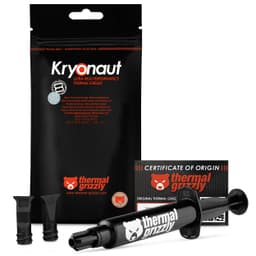
If you're on an AM4 platform with a Ryzen 5000 or older chip, this product won't fit. You'd want to look at contact frame solutions designed for the AM4 socket instead, or simply ensure you have good thermal paste coverage with your existing setup. Thermal Grizzly's Conductonaut Extreme or Kryonaut thermal compounds are worth considering as a standalone upgrade if contact frame compatibility isn't there.
If you're on Intel's LGA1700 or LGA1851 platforms, Thermal Grizzly makes contact frames for those sockets too, but again, not this one. Check the Thermal Grizzly product range for the correct socket-specific frame. And if you're running a Ryzen 7000 chip at modest TDP levels and you're not doing cooler swaps regularly, the stock SAM may genuinely be adequate for your use case. The improvement is real, but it's not always worth the spend depending on what you're doing with the system.
For anyone who wants to go further with thermal optimisation on AM5, pairing this contact frame with a quality thermal compound like Thermal Grizzly's own Kryonaut or Conductonaut, combined with a properly sized cooler for your chip's actual power draw, is the complete picture. The contact frame is one piece of that puzzle, and a good one, but it works best as part of a considered approach rather than a standalone fix.

Full Specifications
| Specification | Detail |
|---|---|
| Product Name | Thermal Grizzly AM5 Contact Sealing Frame |
| Type | Contact Frame and CPU Guard Combination |
| Material | Anodised aluminium |
| Inlay Material | Silicone foam |
| Socket Support | AMD AM5 |
| CPU Compatibility | AMD Ryzen 7000 series |
| Replaces | Standard Attachment Mechanism (SAM) |
| Contact Geometry | Precision-milled inner contour with optimal contact points |
| Alignment | Clearly marked for correct installation |
| Backplate Compatibility | Thermal Grizzly AM5 backplates |
| CPU Guard Function | Yes, silicone foam inlay protects exposed components |
| ASIN | B0CQKDJYNK |
| Price | £21.25 |
What works. What doesn’t.
5 + 3What we liked5 reasons
- Precision-milled aluminium construction is a clear step up from AMD's plastic SAM
- Silicone foam CPU guard protects exposed AM5 components during cooler swaps
- Consistently reported temperature improvements on high-TDP Ryzen 7000 chips
- No moving parts means zero noise addition and essentially unlimited lifespan
- 4.8-star average across 1,450 reviews is genuinely strong owner consensus
Where it falls3 reasons
- Designed specifically for Thermal Grizzly AM5 backplates, which may require additional purchases
- Thermal gains are incremental, not transformative, especially on lower-TDP chips
- AM5 only, no benefit for AM4 or Intel platform owners
Full specifications
4 attributes| Generation | Ryzen 7000 |
|---|---|
| Integrated graphics | none |
| Launch year | 2022 |
| Socket | AM5 |
Frequently asked
5 questions01Will the Thermal Grizzly AM5 Contact Sealing Frame improve my CPU temperatures?+
It can, but the improvement depends on your CPU and workload. Owner reports consistently show temperature reductions on high-TDP chips like the Ryzen 9 7900X and 7950X running sustained all-core workloads. The precision-milled contact geometry improves pressure distribution at the thermal interface, which helps the heat transfer from CPU to cooler. On lower-TDP chips like the Ryzen 5 7600 at stock clocks, the improvement is more modest. This is an optimisation, not a replacement for a properly sized cooler.
02Does the Thermal Grizzly AM5 Contact Sealing Frame add any noise?+
No. There are no moving parts in this product at all, so it adds zero noise directly. Indirectly, if it improves thermal efficiency and your CPU runs cooler, your cooler's fans may not need to ramp as hard under load, which can reduce acoustic output. The noise benefit is indirect but real on systems where the cooler is working near its thermal limit.
03Will the Thermal Grizzly AM5 Contact Sealing Frame affect my RAM clearance or case compatibility?+
No. The frame replaces AMD's stock SAM and sits in the same footprint. It doesn't add any height to the cooler mounting assembly, so your existing cooler will still fit exactly as before. RAM clearance and case compatibility are unaffected. The only compatibility consideration is the backplate: the product is designed to work with Thermal Grizzly AM5 backplates specifically.
04Is the Thermal Grizzly AM5 Contact Sealing Frame difficult to install?+
Owner reports describe the installation as straightforward but requiring care. The frame is clearly marked for correct alignment, which takes the guesswork out of orientation. You remove AMD's stock SAM and fit this in its place. It's not a first-build product, it's better suited to someone who's already comfortable doing cooler swaps and working around the CPU area of a motherboard. The silicone foam inlay protects the CPU components during the process.
05What warranty and returns apply to the Thermal Grizzly AM5 Contact Sealing Frame?+
Amazon offers 30-day returns on most items sold through its platform. Thermal Grizzly as a brand is well-established in the thermal products market and provides manufacturer warranty cover on their products. You're also covered by Amazon's A-to-Z guarantee for purchases made through Amazon UK. Check the product listing for current warranty terms.