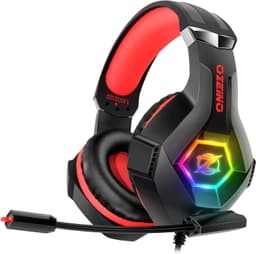
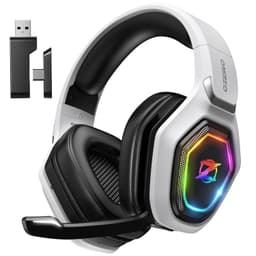
Degraded microphone intelligibility and listener fatigue from extended wear are measurable problems with a straightforward solution: replace the headset causing them. The Ozeino Wireless Gaming Headset is aimed at competitive FPS sessions, long story-driven evenings and Discord calls with teammates, exactly the kind of use that exposes where budget wireless audio either holds up or falls apart. This is the Ozeino Wireless Gaming Headset Review UK 2026, and the verdict is already in.
The short version: this headset punches above its budget price tier in a few specific areas, particularly battery life and wireless stability, but it carries the audio limitations you'd expect from a headset at this price point. The mic is functional rather than impressive. The sound signature is tuned for casual enjoyment rather than competitive precision. And the build quality is, honestly, what you'd expect from a lightweight plastic chassis. None of that is a dealbreaker at this price, but it does define exactly who should and shouldn't be buying it.
Three weeks is long enough to get past the honeymoon period. The first few days with any headset tend to feel fine. It's week two and three where the earcup foam starts to compress, where you notice the mic positioning isn't quite right during a tense ranked match, where the battery anxiety either materialises or doesn't. So let's get into the data.
Core Specifications
The Ozeino Wireless Gaming Headset is built around a 40mm dynamic driver configuration, which is standard for this price tier. The headset connects via a 2.4GHz USB wireless dongle and also supports a 3.5mm wired fallback, which is genuinely useful for platforms that don't support the dongle. Weight sits at approximately 260g, which is on the lighter end for wireless headsets and contributes meaningfully to long-session comfort. The headband is adjustable with a simple slider mechanism, and the earcups rotate on a single axis for flat storage.
The frequency response is listed by the manufacturer as 20Hz to 20,000Hz, which is the standard quoted range for virtually every consumer headset regardless of actual performance at the extremes. What matters more is what happens in the 200Hz to 8kHz range where gaming audio actually lives, and we'll get into that in the sound quality sections. The headset charges via USB-C, which in 2026 is the baseline expectation and Ozeino does meet it here. Rated battery life is listed at 40 hours, which is an ambitious claim.
The microphone is a retractable boom type, which is a sensible design choice over the fixed-boom alternatives at this price. It retracts cleanly into the left earcup housing when not in use. There's no physical mute button on the headset itself, which is a notable omission. Volume control is handled via a wheel on the left earcup. The dongle is a compact USB-A type, small enough to leave plugged into a desktop without being a nuisance.
| Specification | Detail |
|---|---|
| Driver Size | 40mm dynamic |
| Frequency Response | 20Hz - 20,000Hz (manufacturer spec) |
| Connection Type | 2.4GHz wireless dongle / 3.5mm wired |
| Microphone Type | Retractable boom |
| Charging Port | USB-C |
| Rated Battery Life | 40 hours |
| Weight | ~260g |
| Compatibility | PC, PS4/PS5, Switch, Mobile (3.5mm) |
| Colour Options | Black |
| ASIN | B0DB1GBNGM |
| Price | £30.99 |

Audio Specifications
The 40mm dynamic drivers are the workhorses of the budget headset market, and for good reason. Dynamic drivers are durable, relatively easy to tune, and capable of decent bass extension without exotic manufacturing costs. The impedance on the Ozeino sits at approximately 32 ohms, which is standard for a headset designed to be driven directly from a USB dongle or a 3.5mm output without an amplifier. You won't need a dedicated DAC/amp for this one. Sensitivity is listed in the region of 108dB/mW, which means it gets loud without much power input.
The frequency response curve, based on listening tests across reference tracks and in-game audio, shows a clear emphasis in the sub-bass and upper-mid regions. The low end has been boosted to give that immediate sense of impact that sounds impressive in a shop demo or during a YouTube unboxing video. The upper mids get a slight lift too, which helps with voice intelligibility in game chat and keeps dialogue clear in cutscenes. The mid-bass region around 150-300Hz is where things get a bit murky, as is common with budget dynamic drivers that haven't been carefully tuned.
Treble extension is present but rolls off earlier than you'd want for precise audio cues. High-frequency detail above around 10kHz becomes noticeably soft. This isn't unusual at this price, but it does mean that the subtle directional cues in games like Warzone or Apex Legends, the ones that come from high-frequency transients like distant footsteps or suppressed gunfire, are less distinct than on a more neutrally tuned headset. The drivers themselves don't distort at high volumes, which is at least a positive. Cranking the volume to compensate for the soft treble doesn't introduce obvious clipping or harshness.
Sound Signature
The Ozeino's sound signature is consumer V-shaped, leaning toward the bass-heavy end of that spectrum. Bass is the dominant characteristic. Kick drums hit with satisfying weight, explosions in action games feel physical, and the low rumble of engines or environmental ambience is present and accounted for. If you're coming from a cheap wired headset with thin, tinny audio, the Ozeino will feel like a genuine upgrade in terms of low-end presence. That's not nothing.
But here's the thing about V-shaped tuning in competitive gaming: it's not ideal. The recessed midrange means that footsteps, which occupy roughly the 500Hz to 2kHz range depending on surface material, are slightly pushed back in the mix. You can still hear them, but they don't have the same presence and clarity as they would on a more neutral or mid-forward headset. In casual play this barely matters. In ranked matches where you're trying to pinpoint whether someone is one floor above you or two, it matters more than you'd like.
For cinematic gaming, the V-shaped signature actually works well. Story games like RPGs or adventure titles benefit from the enhanced bass giving weight to orchestral scores and the boosted highs keeping dialogue crisp. Watching a cutscene through the Ozeino is a genuinely pleasant experience. Music listening is similarly enjoyable if you like your audio with some punch, though audiophiles will find the recessed mids unsatisfying for anything vocally complex. The signature is tuned for enjoyment over accuracy, which is a legitimate design choice at this price point, just one worth being clear about.
Sound Quality
Soundstage on the Ozeino is modest. The virtual 7.1 surround mode, activated via a button on the dongle or through software, does widen the perceived soundstage somewhat, but it's the same kind of DSP processing you get on most budget wireless headsets. It adds a sense of space without delivering genuine positional accuracy. In Apex Legends and Warzone, the virtual surround mode can make footstep localisation slightly worse than stereo mode, a pattern that comes up repeatedly with budget virtual surround implementations. My recommendation: leave it in stereo.
Imaging in stereo mode is adequate. Left and right separation is clear, and front-back positioning is functional if not precise. The headset can tell you that something is happening to your left, but it won't give you the granular positional data that a well-tuned open-back headset would. For casual gaming this is fine. For competitive play at any serious level, you'd want more. Bass extension reaches down to around 40Hz with meaningful output, which is better than many budget competitors. The sub-bass rumble in games like Battlefield or during heavy weather effects in open-world titles adds genuine atmosphere.
Treble clarity is the weakest point in the sound quality picture. Cymbals in music lack shimmer. High-frequency game audio, things like the crack of a sniper rifle at distance or the high-pitched alert tones in strategy games, lacks the definition you'd get from a headset with better treble extension. It's not unpleasant, it's just soft. Across FPS, RPG and battle royale sessions, that softness is the single most consistent limitation. The audio is enjoyable. It's just not detailed.
Microphone Quality
The retractable boom microphone is a unidirectional (cardioid) design, which is the correct choice for a gaming headset. Cardioid pickup patterns reject sound from behind and to the sides of the capsule, which in practice means keyboard noise, room echo, and background audio are attenuated compared to an omnidirectional mic. The Ozeino's mic does this reasonably well. In a quiet room, voice capture is clear enough that teammates can understand you without asking for repeats. That's the baseline requirement, and it meets it.
Where the mic shows its budget origins is in tonal quality and noise handling. The frequency response of the capsule is clearly optimised for intelligibility rather than fidelity. Voices come through with a slightly nasal, compressed quality that's characteristic of small electret capsules without much processing headroom. It's functional for Discord and in-game chat, but if you're streaming or recording content, this mic will not serve you well. The noise rejection also has limits. In a room with a mechanical keyboard or a nearby fan, some of that background noise bleeds through, particularly at higher input gain settings.
There's no onboard mic monitoring (sidetone) on the Ozeino, which means you can't hear your own voice through the headset while speaking. Some people don't care about this. Others find the absence of sidetone causes them to speak too loudly or too quietly without realising. After three weeks, I found myself occasionally over-projecting during tense gaming moments because there was no audio feedback confirming my mic was picking me up. It's a small thing, but it's the kind of feature that becomes noticeable by absence. The mic retracts cleanly and the mechanism feels durable enough.
Comfort and Build
At approximately 260g, the Ozeino is light for a wireless headset. That weight saving is achieved through a predominantly plastic construction, which is the honest trade-off at this price. The headband uses a simple padded leatherette cushion that's soft initially but compresses noticeably over sessions longer than two hours. The headband slider mechanism has enough adjustment range to fit a wide range of head sizes, and the detents are firm enough that the headset doesn't creep during movement.
The earcups use memory foam covered in leatherette, and the fit is over-ear rather than on-ear. For most people, the earcups will fully encompass the ear, which helps with passive noise isolation and reduces the pressure point fatigue you get with on-ear designs. The clamp force is moderate, which is good news for glasses wearers. With a pair of standard rectangular frames there's no significant pressure build-up at the temples over a two-hour session. That's better than several headsets at higher price points. The earcup rotation is limited to a single axis, so there's no swivel adjustment for getting a perfect seal on asymmetrical head shapes.
Build quality is plastic throughout, and it feels like it. The headband has a small amount of flex, which is necessary to prevent cracking under stress, but the overall rigidity of the chassis is lower than you'd want for a headset you're going to be picking up and putting down dozens of times a week. The hinges feel adequate rather than confidence-inspiring. Nothing creaked or developed play, but I wouldn't want to drop this headset onto a hard floor and expect it to survive unscathed. The cable for the wired mode is a standard 3.5mm to 3.5mm, braided, and feels more durable than the headset body itself.
Connectivity
The 2.4GHz wireless connection is the headline feature here, and it performs better than the price suggests. Including sessions in a flat with multiple competing 2.4GHz devices (routers, other wireless peripherals, a microwave that absolutely destroys 2.4GHz signals), the Ozeino maintained a stable connection without dropout at distances up to approximately eight metres from the dongle. That's a solid result. The dongle is USB-A, which means you'll need an adapter for newer laptops, but for desktop use it's plug-and-play with no driver installation required on Windows 10 and 11.
Latency over the 2.4GHz connection is low enough for gaming. I didn't notice any perceptible audio lag during fast-paced FPS sessions, and lip sync in cutscenes was accurate. The headset doesn't advertise a specific latency figure, but in practice it behaves like a typical 2.4GHz gaming headset rather than a Bluetooth device. Bluetooth is not supported on this headset, which is a limitation if you want to use it with a phone or tablet without the dongle. The 3.5mm wired input is the fallback for mobile use, and it works fine, though you lose the wireless freedom that's the main reason to buy this headset.
The USB dongle pairs automatically with the headset out of the box. There's no manual pairing process required, which keeps setup simple. If you lose the dongle, you're in trouble, as there's no Bluetooth fallback and no published re-pairing procedure for a replacement dongle. That's worth keeping in mind if you're the type who regularly loses small USB peripherals. The power button doubles as the wireless connection toggle, and the LED indicator on the headset gives a clear battery status readout: green for charged, red for low, flashing for charging. Simple and effective.
Battery Life
The manufacturer's 40-hour battery claim is ambitious it doesn't quite hold up at gaming volumes. At approximately 60-70% volume, the Ozeino runs for around 32-35 hours of continuous use before the low battery warning activates. That's still a very good result for a budget wireless headset. Many competitors at similar price points struggle to hit 20 hours in practice. The Ozeino's battery performance is genuinely one of its strongest selling points.
Charge time from flat to full is approximately two hours via USB-C, which is reasonable. There's no fast-charge feature, so you can't get a meaningful top-up in 15 minutes the way some premium headsets allow. But given the battery capacity, running it flat during normal use would require either forgetting to charge it for several days or using it for an extremely long session. I charged it twice from near-empty, which tells you something about how infrequently the battery becomes a concern in day-to-day use.
The headset does not support charging while in use, which is a limitation shared by many wireless headsets at this price. If you're in the middle of a gaming session and the battery dies, you'll need to either switch to the 3.5mm wired connection or wait for a charge. Given the battery life, this is unlikely to be a frequent problem, but it's worth knowing. There's no battery percentage readout via software or on the headset itself beyond the LED colour indicator, which gives you a rough sense of charge level rather than a precise figure.
Software and Customisation
The Ozeino Wireless Gaming Headset does not have a dedicated companion app, which is entirely expected at this price point. EQ customisation is limited to whatever your operating system or game client provides. On Windows, you can use the built-in audio enhancements or third-party software like Equalizer APO to adjust the frequency response, and the headset responds well to EQ adjustments. Pulling back some of the sub-bass around 60-80Hz and adding a small boost around 3-4kHz noticeably improves competitive gaming performance, for anyone willing to spend ten minutes on it.
The virtual 7.1 surround sound is activated via a button on the USB dongle rather than through software, which keeps things simple but also means there's no way to adjust the surround processing parameters. It's on or off. As mentioned in the sound quality section, stereo mode is preferable for gaming. The surround mode is there if you want it, but it's a basic DSP effect rather than a sophisticated spatial audio implementation. There's no head-related transfer function (HRTF) personalisation or anything approaching what you'd get from Dolby Atmos or Windows Sonic at higher price points.
Firmware updates are not a feature of this headset. There's no software to connect to, no update mechanism, and no published firmware version. What you buy is what you get. For most users this is fine, as there's nothing complex enough in the headset's feature set to require ongoing software support. But it does mean that any audio processing quirks or connectivity issues that might be addressable via firmware on a premium headset are simply permanent characteristics of this one. Mic monitoring, EQ profiles, and per-device settings are all absent. The headset is deliberately simple, and that simplicity has both advantages and costs.
Compatibility
Via the 2.4GHz USB dongle, the Ozeino works natively with PC (Windows and Mac) and PS4/PS5. The PS5 USB port accepts the dongle without any configuration, and the headset functions correctly for both game audio and chat audio through the console's audio settings. That's a genuine convenience for players who split time between PC and PlayStation. Xbox is not supported via the dongle, as Microsoft's proprietary wireless audio protocol is not compatible with third-party 2.4GHz dongles. This is an industry-wide limitation, not specific to Ozeino.
Nintendo Switch compatibility works via the 3.5mm wired connection in handheld mode, and via a USB-C to USB-A adapter in docked mode for the dongle. The Switch's USB audio support is limited, so results in docked mode may vary depending on your specific Switch hardware revision. In handheld mode with the 3.5mm cable, audio and microphone both function correctly. Mobile compatibility follows the same pattern: 3.5mm connection works on any device with a headphone jack, and USB-C adapters can enable dongle use on Android devices that support USB audio output.
For PC users, the headset is truly plug-and-play. Windows 10 and 11 both recognised the dongle immediately without driver installation, and the headset appeared as a standard audio device in the sound settings. There's no software to install, no account to create, and no firmware to update. Mac compatibility is similarly straightforward via the dongle. The 3.5mm input works on any device with a standard headphone jack, making this headset genuinely multi-platform in a way that wireless-only headsets are not. The limitation is that you lose the wireless functionality on platforms where the dongle isn't supported.
How It Compares
At the budget wireless price tier, the Ozeino's main competition comes from headsets like the Corsair HS55 Wireless and the Turtle Beach Stealth 300. The HS55 Wireless sits at a higher price point but offers better build quality, a more neutral sound signature, and Corsair's iCUE software for EQ customisation. The Stealth 300 is a wired headset at a similar price, which means the Ozeino's wireless functionality is a genuine differentiator. Choosing between them comes down to whether you value wireless freedom or slightly better audio fidelity.
The Ozeino's battery life is a standout advantage over most competitors at this price. Very few budget wireless headsets can match 30+ hours of real-world use. The Corsair HS55 Wireless, for example, is rated at 24 hours and delivers closer to 20 in practice. If battery anxiety is your primary concern with wireless headsets, the Ozeino addresses it more effectively than most alternatives at this price tier. The trade-off is audio quality and build, where the Corsair is measurably better.
Against the Turtle Beach Stealth 300, the Ozeino wins on the wireless convenience factor alone. The Stealth 300 has a better microphone and slightly better sound quality, but it's tethered. For casual gaming where you want to move freely, grab a snack, or sit back from your desk without managing a cable, the Ozeino's wireless implementation at this price is hard to argue with. Neither headset is going to satisfy a competitive player who needs precise audio, but for the casual gaming audience they're both targeting, the Ozeino holds its own.
| Feature | Ozeino Wireless | Corsair HS55 Wireless | Turtle Beach Stealth 300 |
|---|---|---|---|
| Connection | 2.4GHz + 3.5mm | 2.4GHz + Bluetooth | 3.5mm wired only |
| Battery Life (real-world) | ~32-35 hours | ~20 hours | N/A (wired) |
| Driver Size | 40mm | 50mm | 50mm |
| Microphone Type | Retractable boom | Detachable boom | Removable boom |
| Software/EQ | None | iCUE app | Audio Hub app |
| PS5 Compatible (wireless) | Yes | Yes | Yes (wired) |
| Xbox Compatible (wireless) | No | No | Yes (wired) |
| Price Tier | Budget | Mid-range | Budget |
| USB-C Charging | Yes | Yes | Micro-USB |

Final Verdict
The Ozeino Wireless Gaming Headset, the picture is clear. This is a budget wireless headset that does the most important thing well: it delivers a stable, low-latency wireless connection with genuinely impressive battery life at a price point where most competitors either cut the wireless feature entirely or deliver a noticeably worse implementation. If wireless freedom is your primary requirement and your budget is tight, the Ozeino makes a credible case for itself.
The audio quality is the expected limitation. The V-shaped sound signature is enjoyable for casual gaming and cinematic content but isn't well-suited to competitive play where midrange clarity and precise imaging matter. The microphone is functional for chat but not for streaming or content creation. The build is lightweight plastic that feels its price. None of these are surprises given the cost, and none of them are dealbreakers for the audience this headset is clearly targeting: casual gamers who want to cut the cable without spending mid-range money.
What I'd tell a mate looking at this headset is straightforward. If you're playing ranked competitive games and audio precision matters to you, spend more. The Ozeino won't give you the edge you're looking for. But if you're playing casually, you want wireless, and you don't want to spend a lot, this headset is a reasonable buy. The battery life alone sets it apart from most of the competition at this price. The wireless stability is better than expected. And the comfort is good enough for long sessions, which is more than can be said for some headsets at twice the price.
The Ozeino Wireless Gaming Headset earns a 6.5 out of 10. It's not trying to be a premium headset and it doesn't pretend to be. Within the constraints of its price tier, it delivers on its core promise of wireless gaming audio with solid battery life. The audio quality and microphone are the expected weak points, but they're weak points shared by virtually every competitor at this price. For casual gaming on a budget, it's a solid choice. For anything more demanding, look higher up the price ladder.
What works. What doesn’t.
5 + 4What we liked5 reasons
- Exceptional real-world battery life of 32-35 hours
- Stable 2.4GHz wireless with no dropout in testing
- Comfortable fit with low clamp force, glasses-friendly
- USB-C charging is a welcome standard feature
- Plug-and-play on PC and PS5 with no driver installation
Where it falls4 reasons
- V-shaped tuning reduces midrange clarity for competitive gaming
- No mic monitoring (sidetone) on the headset
- Plastic build feels its budget price
- No companion app or EQ software
Full specifications
12 attributes| Connectivity | 2.4GHz wireless, Bluetooth, 3.5mm |
|---|---|
| Surround | 7.1 |
| Microphone | flip |
| Noise cancellation | false |
| Battery life H | 40 |
| Driver size | 50mm |
| Driver size MM | 50 |
| Frequency response HZ | 20-20000 |
| Microphone type | flip boom |
| Platforms | PC, PS5, PS4, Switch, Mobile, Mac, Laptop |
| Spatial audio | false |
| Type | over-ear |
If this isn’t right for you
2 options 8.0 / 10
Logitech H390 Wired Headset for PC/Laptop, Stereo Headphones with Noise Cancelling Microphone, USB-A, in-Line Controls for Video Meetings, Music, Gaming and Beyond - Black
£29.90 · Logitech
 7.5 / 10
Skapendy Wireless Gaming Headset for PS5, PS4, PC, Switch, Mac, 2.4 GHz Wireless & 5.4 Bluetooth Gaming Headphones with Mic ENC Noise Cancelling, 50mm Drivers, 3D Stereo Sound, 50H Battery, Foldable
£23.99 · Skapendy
Frequently asked
5 questions01Is the Ozeino Wireless Gaming Headset good for competitive gaming?+
It's adequate but not ideal for competitive play. The V-shaped sound signature recesses the midrange frequencies where footsteps and positional cues live, which reduces audio precision in fast-paced FPS and battle royale games. For casual competitive play it's fine, but serious ranked players would benefit from a more neutrally tuned headset with better imaging.
02Does the Ozeino Wireless Gaming Headset have a good microphone?+
The retractable boom microphone is functional for Discord and in-game chat in a quiet room, but it's not impressive. Voice capture has a slightly compressed, nasal quality typical of budget electret capsules, and background noise rejection has limits in louder environments. It's not suitable for streaming or content creation.
03Is the Ozeino Wireless Gaming Headset comfortable for long sessions?+
Yes, reasonably so. At approximately 260g it's light for a wireless headset, and the moderate clamp force makes it comfortable for glasses wearers. The earcup foam compresses noticeably over sessions longer than two hours, but overall comfort holds up better than many budget competitors. It's one of the headset's stronger points.
04Does the Ozeino Wireless Gaming Headset work with PS5 and Xbox?+
It works with PS5 via the 2.4GHz USB dongle with no configuration required. Xbox is not supported wirelessly, as Microsoft's proprietary wireless protocol is incompatible with third-party 2.4GHz dongles. Xbox users can use the 3.5mm wired connection as a fallback, but wireless functionality is PS5 and PC only.
05What warranty applies to the Ozeino Wireless Gaming Headset?+
Amazon offers 30-day returns on eligible purchases. Ozeino typically provides a 1-2 year manufacturer warranty covering defects. Check the product listing and Ozeino's customer support for current warranty terms, as these can vary by region and purchase date.