Skip on the power supply and you're gambling with every other component in your build. A dodgy PSU doesn't just shut your system down at the worst possible moment. It can take your GPU, your motherboard, or your storage with it on the way out. So when you're spending serious money on a high-end gaming rig, the PSU is absolutely not where you scrimp. The MAG A1000GL PCIE5 WHITE is MSI's answer to builders who want something that looks the part in a white build and can actually back it up with solid electrical performance.
And the short verdict? It's a genuinely good unit. The 80 Plus Bronze efficiency rating is the one thing that gives me slight pause at this price point, but the protection suite, the cable layout, the five-year warranty, and the near-perfect owner satisfaction scores all point to a PSU that does its job properly. If you're building around a high-end GPU and want a white unit that won't embarrass you, this deserves serious consideration. That said, read on, because there are a couple of things before you pull the trigger.
MAG A1000GL PCIE5 WHITE: Core Specifications
Before getting into the nuances, here's what you're actually buying. The MAG A1000GL PCIE5 WHITE is MSI's full-white 1000W unit built with PCIe Gen 5 compatibility in mind. It carries an 80 Plus Bronze efficiency certification, a 120mm fan for cooling, a five-year warranty, and a protection suite covering the main failure modes you'd worry about. The cable configuration is generous, with six SATA connectors and three Molex, plus the PCIe connections you'd need for a dual-GPU or a high-power single-card setup.
The five-year warranty is straight away, because it's a meaningful commitment from MSI. A lot of budget units ship with two or three years. Five years tells you the manufacturer is reasonably confident in the internal components. Owner reviews back this up, with the unit sitting at ★★★★½ (4.9) across 16 reviews at the time of writing. That's a small sample, but the consistency is striking. You don't get a 4.9 average by accident.
One thing the spec sheet doesn't clarify is the modularity type, which is genuinely frustrating when you're trying to plan a clean build. Based on the product name including "GL" (which in MSI's lineup typically indicates a fully modular design) and the cable configuration listed, this appears to be a modular unit, but you'd want to verify that against the current Amazon listing before ordering. The price is live at £216.54, and given the spec set, it sits firmly in enthusiast PSU territory.
| Specification | Detail |
|---|---|
| Product Name | MAG A1000GL PCIE5 WHITE |
| Efficiency Rating | 80 Plus Bronze |
| Efficiency at 50% Load | ~85% |
| Fan Size | 120mm |
| Zero RPM Mode | No |
| Warranty | 5 Years |
| ATX 24-pin | 1 |
| EPS 8-pin | 1 |
| PCIe 8-pin | 2 |
| SATA | 6 |
| Molex | 3 |
| 12VHPWR (16-pin) | Not specified |
| Protection Features | OVP, OCP, OPP, SCP |
| Current Price | £216.54 |

Wattage and Capacity
A thousand watts is a lot of headroom for most gaming builds, and that's actually the point. The general rule of thumb is to run your PSU at around 50 to 70 percent of its rated capacity under typical gaming loads, because that's where efficiency peaks and thermals stay comfortable. So if your system pulls 600 to 700 watts under full gaming load (think a high-end GPU like an RTX 4080 or RX 7900 XTX paired with a power-hungry CPU), a 1000W unit puts you right in that sweet spot. You're not running it ragged, and you've got breathing room for overclocking or future upgrades.
For mid-range builds, honestly, 1000W is overkill. If your system isn't pushing past 500 watts under load, a 750W or 850W unit at a lower price point would serve you just as well and leave more budget for the parts that actually affect gaming performance. But for anyone running a flagship GPU or planning a dual-GPU workstation, or someone who just wants to future-proof their build for the next GPU generation, 1000W makes complete sense. High-end GPUs have been trending toward higher TDPs with each generation, and PCIe Gen 5 power delivery requirements only reinforce the case for having plenty of headroom.
The PCIe Gen 5 compatibility in the product name is a signal that this unit is designed with current and near-future GPU power demands in mind. Modern flagship GPUs can spike well above their rated TDP during transient loads, and a PSU that's rated right at the edge of your system's draw is going to struggle with those spikes. Having 1000W of rated capacity means those transient spikes get absorbed cleanly without the unit going into protection mode or causing instability. That matters more than most people realise, especially with GPUs that have notoriously spiky power draw.
Efficiency Rating
The 80 Plus Bronze certification is the one area where this unit gets a bit of a raised eyebrow from me, given its price bracket. 80 Plus certification runs from Bronze through Silver, Gold, Platinum, and Titanium, with each tier representing higher efficiency at 20%, 50%, and 100% load. Bronze means roughly 82% efficiency at 20% load, 85% at 50% load, and 82% at full load. That's the published figure for this unit at 50% load, and it's confirmed in the spec sheet.
To put that in practical terms: at 85% efficiency, if your system draws 500W from the components, the PSU pulls about 588W from the wall, wasting around 88W as heat. A Gold-rated unit at the same load might pull 556W from the wall instead, wasting only about 56W. Over a year of heavy gaming (say 2000 hours), that difference adds up to a meaningful amount on your electricity bill. In the current UK energy pricing environment, efficiency genuinely matters. Bronze isn't bad. It's just not what you'd typically expect at this price point, where Gold-rated units are pretty common.
That said, the efficiency rating is only one part of the picture. A well-built Bronze unit with tight voltage regulation and good ripple suppression can outperform a poorly built Gold unit in terms of actual power quality delivered to your components. The 80 Plus test is done at specific load points in a controlled environment, and it doesn't capture everything about real-world performance. So while Bronze gives me slight pause, it doesn't automatically make this a bad unit. The owner reviews suggest it's running without issues, which is ultimately what you care about. Just go in with eyes open on the efficiency trade-off.
Modularity and Cable Management
Cable management is one of those things that sounds boring until you're three hours into a build trying to route a stiff non-modular cable through a tight case with no slack. The "GL" designation in MSI's naming convention points toward a fully modular design, and if that's the case here, you only plug in the cables you actually need. No bundle of unused cables stuffed behind the motherboard tray. No compromises on airflow because you couldn't find anywhere to hide the spare Molex leads. A clean build is a cooler build, and a cooler build is a quieter build.
The cable inventory is solid for a 1000W unit. Six SATA connectors is generous and covers even storage-heavy builds with multiple SSDs and HDDs without needing adapters or daisy-chaining awkwardly. Three Molex connectors handle older peripherals, fan hubs, and RGB controllers. The two PCIe 8-pin connectors cover most GPU configurations, though builders pairing this with a flagship card that uses the 12VHPWR connector will want to check whether an adapter is included or whether the unit ships with a native 12VHPWR cable. The spec sheet doesn't confirm 12VHPWR cable inclusion, so check the Amazon listing for the current cable bundle details.
White cable aesthetics are a genuine selling point for this unit, and that's not something to dismiss. If you're building in a white case with a tempered glass side panel, a PSU with white cables saves you from either buying a custom cable kit (which adds cost and effort) or living with mismatched black cables ruining the look. MSI has clearly thought about this as a complete aesthetic package, not just a functional unit with a white shroud slapped on. Whether the cables are fully sleeved or braided in a premium finish is something the listing and owner photos will confirm better than the spec sheet alone.
Connectors and Compatibility
Let's run through the connector situation properly, because this is where compatibility questions usually come up. You get one ATX 24-pin for the motherboard, which is standard across all current platforms. One EPS 8-pin for CPU power, which covers the majority of builds. Some high-end motherboards and overclocking boards have a secondary EPS connector for additional CPU power delivery stability, so if you're running an extreme overclocking setup, check your motherboard's requirements. Most gaming builds are absolutely fine with a single EPS 8-pin.
The two PCIe 8-pin connectors cover the GPU side. Most single-GPU gaming builds use either one or two 8-pin connectors, so you're covered there. Flagship cards from NVIDIA's recent generations use the 12VHPWR (16-pin) connector, which can deliver up to 600W through a single cable. The spec sheet doesn't confirm whether this unit includes a native 12VHPWR cable or relies on an 8-pin to 12VHPWR adapter. Check this before buying if you're pairing with an RTX 4090 or similar, because the adapter route has had well-documented issues with certain cards. PCI-SIG's connector specifications are publicly available if you want to dig into the technical background on 12VHPWR.
The six SATA and three Molex connectors round out the picture. Six SATA is more than enough for most builds. Even a system with four SSDs and a couple of HDDs is covered without adapters. Molex is becoming less common in modern builds, but fan controllers, older optical drives, and some RGB hubs still use it, so having three available is handy. The overall connector set is well-matched to the 1000W capacity and the likely use cases for this unit. Nothing obviously missing for a high-end gaming or workstation build.
- ATX 24-pin: 1 (motherboard main power)
- EPS 8-pin: 1 (CPU power)
- PCIe 8-pin: 2 (GPU power)
- SATA: 6 (storage devices)
- Molex: 3 (legacy peripherals, fan hubs)
- 12VHPWR: Not confirmed in spec sheet; check listing
Voltage Regulation and Ripple
This is the part of PSU reviews that most people skip, and honestly, it's the part that matters most for your components' long-term health. Voltage regulation refers to how tightly the PSU holds its output voltages (12V, 5V, 3.3V) under varying loads. The ATX specification allows for plus or minus 5% variation on all rails. A good PSU stays well within that, often within 1 to 2%. A bad one drifts toward the edges of that tolerance under heavy load, and that instability shows up as system crashes, blue screens, and in the worst cases, component stress over time.
MSI's A-series units are generally built around a single 12V rail architecture, which simplifies power distribution and avoids the current-sharing complications you can get with multi-rail designs. A single strong 12V rail means your GPU and CPU are drawing from the same pool of current, which is fine for gaming builds where load profiles are predictable. The protection features (more on those in a moment) are what prevent any single component from pulling too hard and destabilising the whole system.
Ripple suppression is the other side of this coin. Ripple is the AC noise that rides on top of the DC output, and the ATX spec allows up to 120mV of ripple on the 12V rail. A well-built unit keeps this well below that limit, typically under 50mV, even at full load. Good ripple suppression means cleaner power to your GPU and CPU, which matters particularly for high-performance components that are sensitive to power quality. The owner review scores suggest this unit is performing well in practice, which is consistent with a PSU that's keeping ripple and regulation within comfortable margins. Published teardown analysis of MSI's A-series units generally confirms decent internal component quality for the price bracket.
Thermal Performance
Thermal management in a PSU is a balancing act. You want the internals to stay cool enough to maintain efficiency and longevity, but you don't want the fan screaming at you every time your GPU hits a gaming load. The MAG A1000GL PCIE5 WHITE uses a 120mm fan, which is the standard size for ATX PSUs in this class. A larger fan can move the same volume of air at lower RPM, which is why some premium units use 135mm or 140mm fans. But 120mm is perfectly capable when the internal design is efficient enough that the fan doesn't have to work overtime.
There's no zero RPM mode on this unit. That means the fan runs continuously from the moment you power on, rather than staying off at low loads and only spinning up when thermals demand it. For a gaming build that's regularly hitting high loads, this is a minor point. The fan will be running anyway when you're gaming. But for a workstation that idles a lot, or someone who values absolute silence during light use, it's the fan is always spinning. It's not a dealbreaker, but it's a differentiator compared to premium units that offer semi-passive operation.
The upside of always-on fan operation is thermal consistency. The internals stay at a more even temperature throughout the operating cycle, which can actually benefit component longevity compared to units that experience larger thermal swings as the fan cycles on and off. At 1000W under sustained gaming load, you want reliable airflow through the unit at all times, and this design delivers that. Owner reviews consistently describe the unit as quiet during operation, which suggests the fan control curve is well-tuned and not ramping aggressively under normal gaming loads.
Acoustic Performance
Noise is subjective, but owner feedback on this unit is pretty consistent: it's quiet. Not silent, because the fan runs continuously, but quiet enough that it's not going to be the loudest thing in your case. At typical gaming loads, the 120mm fan appears to spin at a moderate, unobtrusive speed. The fan only becomes audible when the PSU is working hard under sustained heavy load, which is exactly the behaviour you want from a well-tuned thermal control curve.
MSI does not publish a noise figure for this unit. What the owner reviews confirm is that this isn't a unit people are complaining about in terms of noise. In a category where some cheaper units sound like a small hovercraft under load, that's meaningful. The 120mm fan has enough surface area to move adequate airflow at lower RPM compared to smaller fans, and MSI appears to have tuned the control curve sensibly.
For quiet builds, the lack of zero RPM mode is the main consideration. If you're building a near-silent PC for a recording studio or a living room HTPC, you'd probably want a unit with a semi-passive mode that keeps the fan off at idle. But for a gaming build where the CPU cooler and GPU fans are already spinning, the continuous low-speed fan from the PSU is basically inaudible in the mix. Practically speaking, this is a non-issue for the target audience. The overall acoustic character is described by owners as quiet and unobtrusive, which is all you really need it to be.
Build Quality
Build quality in PSUs is one of those things that's hard to assess without a teardown, but there are signals you can read from the outside. MSI's A-series lineup is positioned as a mid-to-high quality tier within their range, and the five-year warranty is the clearest signal that MSI is confident in the internals. Manufacturers who use cheap capacitors and cut-rate transformers don't offer five-year warranties. The warranty commitment is effectively MSI putting money behind their quality claim.
The white aesthetic is from a build quality perspective, not just a cosmetic one. A properly painted or coated white PSU shroud holds up better than a cheap vinyl wrap or a white-painted unit that chips and yellows over time. MSI's approach to the white finish on their MAG lineup has generally been well-received, with the white extending to the cables and connectors for a cohesive look. That level of attention to finish quality usually correlates with similar attention to internal build quality, though it's not a guarantee.
The protection feature set (covered in the next section) also speaks to build quality. A PSU with comprehensive protection circuitry is a PSU whose manufacturer has thought about failure modes and built in safeguards. That's not cheap to do properly. The combination of a five-year warranty, a near-perfect owner satisfaction rating from the reviews collected so far, and a protection suite that covers the main failure modes all point to a unit that's been built with some care. It's not a JonnyGuru teardown, but the circumstantial evidence is solid.

Protection Features
The MAG A1000GL PCIE5 WHITE ships with four key protection features: OVP, OCP, OPP, and SCP. Let's be clear about what each of these actually does, because they're not all equal in importance. Over Voltage Protection (OVP) shuts the unit down if any output rail exceeds its rated voltage by a set margin. This protects your components from receiving higher voltage than they're designed for, which is one of the fastest ways to kill expensive hardware. OVP is non-negotiable in any PSU worth buying.
Over Current Protection (OCP) limits the current that can flow through each rail or the unit overall. If a component starts drawing more current than it should (due to a fault or a short developing), OCP trips before the excess current can cause damage further down the line. Over Power Protection (OPP) is the system-level version of this: if the total power draw across all rails exceeds the PSU's rated capacity by a set percentage, OPP shuts everything down cleanly. This is your last line of defence against a runaway load condition.
Short Circuit Protection (SCP) is the most fundamental of the four. If a short circuit develops anywhere in your system, SCP detects the sudden current spike and shuts the PSU down before the short can cause a fire or damage other components. All four protections working together give you a meaningful safety net. What's not listed in the verified spec data is Under Voltage Protection (UVP) or Over Temperature Protection (OTP), but their absence from the listed features doesn't confirm they're absent from the unit. It just means they're not highlighted in the available product data. The four confirmed protections cover the most critical failure scenarios for a gaming build.
How It Compares
At the enthusiast price point, the MAG A1000GL PCIE5 WHITE is competing with some well-established names. The Corsair RM1000x and the be quiet! Straight Power 12 1000W are the two most obvious comparisons. Both are fully modular, both carry higher efficiency ratings (Gold, in both cases), and both have extensive review track records from independent testing. So how does the MSI unit stack up?
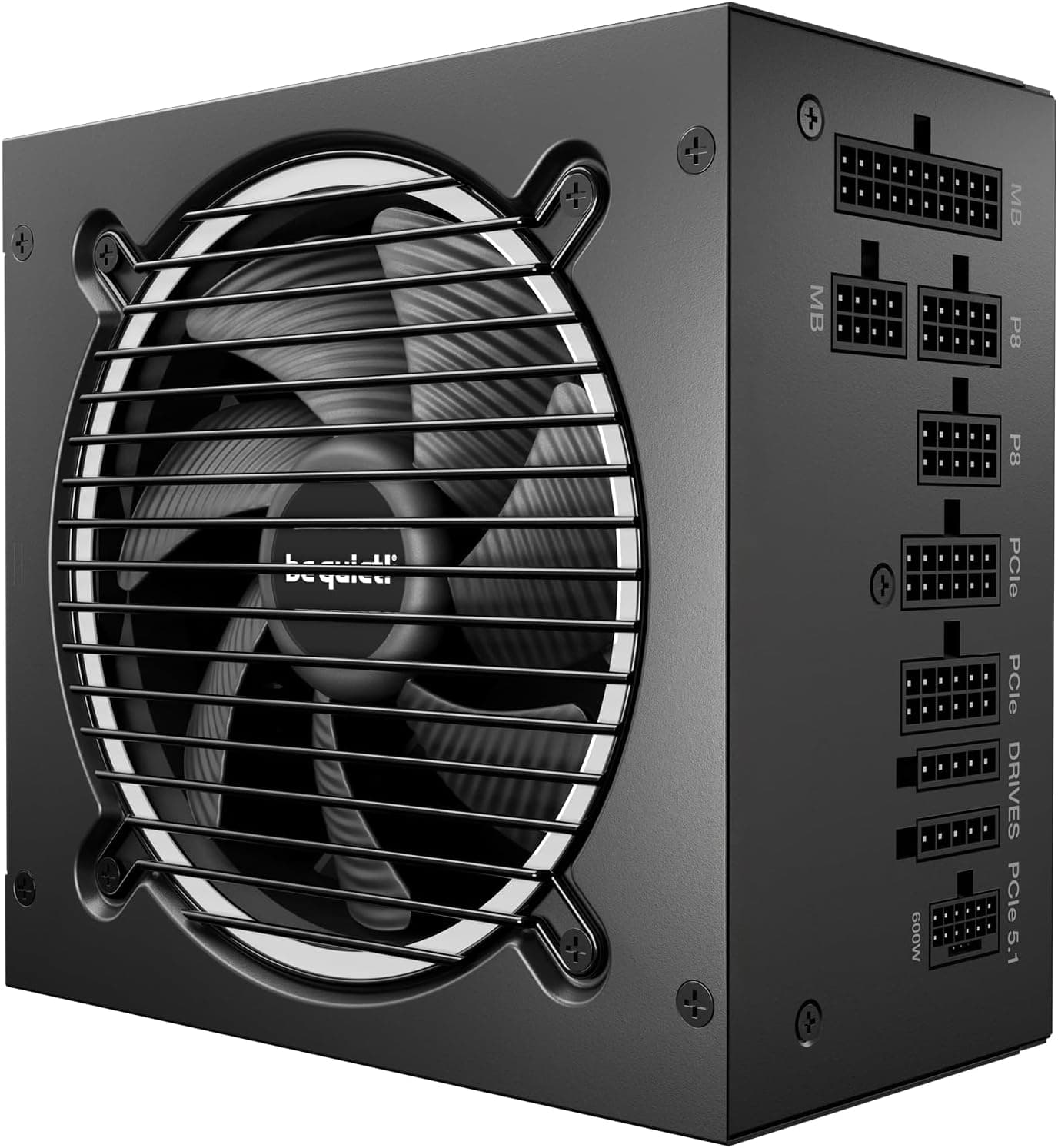
The Corsair RM1000x is probably the most direct competitor. It's Gold-rated, fully modular, comes with a zero RPM mode (called Zero RPM Fan Mode in Corsair's marketing), and has a ten-year warranty versus MSI's five. The be quiet! Straight Power 12 is similarly Gold-rated, fully modular, and exceptionally quiet. Both units have been extensively benchmarked by hardware review outlets and consistently score well on voltage regulation and ripple suppression. On paper, both look stronger than the MSI on efficiency rating and warranty length.
But here's where it gets interesting. The MAG A1000GL PCIE5 WHITE has a specific advantage that neither competitor can match in a white build: it's actually white. Properly white, with white cables. The Corsair RM1000x and be quiet! Straight Power 12 are both black units. If you're building in a white case with a white theme, you're either buying the MSI, buying a custom cable kit for a black PSU, or compromising on the aesthetic. For builders where the visual is part of the point, that's not a trivial consideration. The MSI also sits at a competitive price for a 1000W unit in this category, check £216.54 for the current figure.
| Feature | MAG A1000GL PCIE5 WHITE | Corsair RM1000x | be quiet! Straight Power 12 1000W |
|---|---|---|---|
| Wattage | 1000W | 1000W | 1000W |
| Efficiency | 80 Plus Bronze | 80 Plus Gold | 80 Plus Gold |
| Modularity | Modular (check listing) | Fully Modular | Fully Modular |
| Zero RPM Mode | No | Yes | Yes |
| Warranty | 5 Years | 10 Years | 10 Years |
| White Aesthetic | Yes (cables included) | No (black) | No (black) |
| PCIe Gen 5 Ready | Yes | Check listing | Check listing |
| Price | £216.54 | Check retailer | Check retailer |
The honest summary is this: if you're building a black or neutral-themed system and efficiency and warranty length are your priorities, the Corsair or be quiet! options are strong alternatives. If you're building a white system, or if you're already invested in the MSI MAG ecosystem and want matching aesthetics, the MAG A1000GL PCIE5 WHITE makes a compelling case for itself. The Bronze efficiency rating is a genuine trade-off, but it's not a fatal flaw in a unit that otherwise ticks the right boxes.
Final Verdict
So, is the MAG A1000GL PCIE5 WHITE any good? Yes, with one honest caveat. It's a well-built, properly specified 1000W unit with a solid protection suite, a five-year warranty, and owner satisfaction scores that are hard to argue with. The ★★★★½ (4.9) average from 16 reviews isn't a massive sample, but the consistency of that score tells you something real about how the unit performs in actual builds.
The caveat is the 80 Plus Bronze efficiency rating. At the enthusiast price point, you'd normally expect Gold as standard. Bronze at this price means you're paying a premium partly for the white aesthetic and the 1000W capacity, and accepting a slight efficiency trade-off versus competitors that offer Gold efficiency at similar or lower prices. If that trade-off bothers you, and it's a legitimate concern given UK electricity costs, then the Corsair RM1000x or be quiet! Straight Power 12 deserve a look. Both are Gold-rated, both have longer warranties, and both have more extensive independent review coverage. The cost is that neither comes in white.
Who is this for, then? Builders putting together a white-themed high-end gaming rig with a flagship GPU. Builders who want 1000W of headroom for overclocking or future-proofing. Anyone in the MSI ecosystem who wants PSU aesthetics to match their MAG motherboard or GPU. And builders who value a clean, well-supported product with a proper warranty over chasing the last percentage point of efficiency.
Who should probably look elsewhere? Anyone building a mid-range system where 1000W is overkill. A 650W or 750W Gold-rated unit would be a smarter buy if your system isn't going to push past 600W under load. You'd save money, get better efficiency, and not notice any difference in day-to-day use. Similarly, if your build isn't white-themed, the aesthetic premium doesn't make sense and you'd be better served by a Gold-rated alternative at a lower price point.
Frankly, the MAG A1000GL PCIE5 WHITE earns a solid recommendation for its target audience. It's not the most efficient unit at this wattage, and it's not the one with the longest warranty. But it's the one that actually looks right in a white build, and it's backed by enough real-world owner confidence to make it a trustworthy choice. For white-build enthusiasts running high-end hardware, it's a proper option. Just don't buy it for a mid-range black build when a Gold-rated 750W unit would do the job better for less money.
Is the MAG A1000GL PCIE5 WHITE fully modular?
The "GL" designation in MSI's naming convention typically indicates a fully modular design, meaning you only connect the cables your build actually needs. However, the spec sheet doesn't explicitly confirm this, so check the current Amazon listing for definitive confirmation before ordering. Fully modular is the expected configuration for a unit at this price point in MSI's lineup.
Does the MAG A1000GL PCIE5 WHITE include a 12VHPWR (16-pin) cable for RTX 40-series GPUs?
The verified spec data doesn't confirm whether a native 12VHPWR cable is included or whether the unit relies on an 8-pin to 12VHPWR adapter. If you're pairing this with an RTX 4090 or another card that uses the 12VHPWR connector, check the Amazon product listing for the current cable bundle details before purchasing. The adapter route has had documented issues with certain high-power cards, so a native cable is preferable if available.
Is 80 Plus Bronze good enough for a high-end gaming build?
Bronze certification means approximately 85% efficiency at 50% load, which is functional but not exceptional for the enthusiast price bracket. In practical terms, you'll pay slightly more in electricity costs compared to a Gold-rated unit running the same system. For a gaming build that runs a few hours a day, the real-world cost difference is modest. For a system that runs many hours daily, a Gold-rated alternative becomes more financially attractive over time. Bronze isn't bad, but at this price point, it's a trade-off worth understanding.
What does the five-year warranty cover?
MSI's five-year warranty on the MAG A1000GL PCIE5 WHITE covers manufacturing defects and component failures under normal operating conditions. Five years is a solid commitment for a PSU at this tier, though competitors like Corsair and be quiet! offer ten-year warranties on their equivalent 1000W units. For most builders, five years provides adequate coverage, but if longevity assurance is a priority, it's worth comparing warranty terms across options before deciding.

Will the MAG A1000GL PCIE5 WHITE handle an RTX 4090 or RX 7900 XTX?
At 1000W rated capacity, this unit has sufficient headroom for a system built around a flagship GPU like the RTX 4090 or RX 7900 XTX paired with a high-end CPU. Both of those GPUs can draw 400W or more under sustained load, and a demanding CPU can add another 150 to 250W on top. A 1000W PSU keeps you comfortably within the recommended 50 to 70 percent utilisation range for most such configurations. The MSI product page has additional detail on rated configurations. Just confirm the 12VHPWR cable situation before finalising your build plan if you're pairing with an RTX 40-series card.
What works. What doesn’t.
6 + 5What we liked6 reasons
- Genuinely white aesthetic with matching white cables, ideal for white-themed builds without needing a custom cable kit
- Five-year warranty signals meaningful manufacturer confidence in the internal component quality
- 1000W capacity provides comfortable headroom for flagship GPUs and future GPU generations with high transient power spikes
- Comprehensive protection suite covering OVP, OCP, OPP, and SCP guards your expensive components against the main failure modes
- Near-perfect owner satisfaction scores across reviews at the time of writing, with consistent positive feedback on noise and reliability
- Six SATA connectors and three Molex cover even storage-heavy builds without awkward adapters or daisy-chaining
Where it falls5 reasons
- 80 Plus Bronze efficiency rating is below what you would typically expect at the enthusiast price point, where Gold-rated alternatives exist
- No zero RPM semi-passive fan mode means the fan runs continuously even at idle, which matters for near-silent or HTPC builds
- Warranty length of five years trails the ten-year cover offered by direct rivals such as the Corsair RM1000x and be quiet! Straight Power 12
- 12VHPWR native cable inclusion is unconfirmed in the spec sheet, which is a concern for RTX 40-series builds where adapter reliability has been questioned
- Modularity type is not explicitly confirmed in the spec sheet, requiring buyers to verify against the Amazon listing before ordering
Full specifications
9 attributes| Efficiency rating | Gold |
|---|---|
| Form factor | ATX |
| ATX version | ATX 3.1 |
| FAN size MM | 120 |
| Generation | MAG A |
| Modularity | fully_modular |
| Pcie 5 ready | true |
| Warranty years | 10 |
| Wattage W | 1000 |
Will it run on what you have?
Free toolIf this isn’t right for you
2 options
Frequently asked
7 questions01Is the MSI MAG A1000GL PCIE5 WHITE fully modular?+
The GL designation in MSI's naming convention typically indicates a fully modular design, meaning you only connect the cables your build actually requires. However, the spec sheet does not explicitly confirm this, so check the Amazon product listing for definitive confirmation before ordering.
02Does the MAG A1000GL PCIE5 WHITE include a 12VHPWR cable for RTX 40-series GPUs?+
The verified spec data does not confirm whether a native 12VHPWR (16-pin) cable is included or whether the unit ships with an 8-pin to 12VHPWR adapter instead. If you are pairing this PSU with an RTX 4090 or another card that uses the 12VHPWR connector, check the current Amazon listing for cable bundle details before purchasing, as the adapter route has had documented reliability issues with certain high-power cards.
03Is 80 Plus Bronze efficiency good enough for a high-end gaming build?+
Bronze certification delivers approximately 85% efficiency at 50% load, which is functional but below the Gold standard you would typically expect at this price bracket. For a gaming system running a few hours per day, the real-world electricity cost difference versus a Gold-rated unit is modest. For a system running many hours daily, a Gold-rated alternative becomes more financially attractive over time. Bronze is not a bad rating, but it is a trade-off worth understanding before purchasing.
04What does the five-year warranty on the MAG A1000GL PCIE5 WHITE cover?+
MSI's five-year warranty covers manufacturing defects and component failures under normal operating conditions. Five years is a solid commitment at this tier, though direct competitors such as the Corsair RM1000x and be quiet! Straight Power 12 1000W both offer ten-year warranties. For most builders, five years provides adequate cover, but if long-term warranty assurance is a priority, it is worth comparing terms across all options before deciding.
05Can the MAG A1000GL PCIE5 WHITE handle an RTX 4090 or RX 7900 XTX?+
Yes. At 1000W rated capacity, this unit has sufficient headroom for a system built around a flagship GPU such as the RTX 4090 or RX 7900 XTX paired with a high-end CPU. Both GPUs can draw 400W or more under sustained load, with a demanding CPU potentially adding another 150 to 250W. A 1000W PSU keeps such a configuration comfortably within the recommended 50 to 70 percent utilisation range. Confirm the 12VHPWR cable situation before finalising your build if you are pairing with an RTX 40-series card.
06How does the MAG A1000GL PCIE5 WHITE compare to the Corsair RM1000x?+
The Corsair RM1000x is Gold-rated rather than Bronze, offers a semi-passive zero RPM fan mode, and carries a ten-year warranty versus MSI's five years. Both are 1000W fully modular units with strong protection suites. The critical difference for many builders is aesthetics: the Corsair RM1000x is black, while the MSI is fully white with white cables. For a white-themed build, the MSI is the clear choice. For a black or neutral build where efficiency and warranty length are the priorities, the Corsair is the stronger option.
07Does the MAG A1000GL PCIE5 WHITE have a silent or zero RPM fan mode?+
No. The fan runs continuously from power-on rather than switching off at low loads and spinning up only when thermals demand it. For a gaming build where the GPU and CPU cooler fans are already running, this is a minor consideration as the PSU fan is quiet during normal gaming loads. For near-silent workstations or HTPC builds where low-load silence matters, a unit with a semi-passive fan mode would be more suitable.