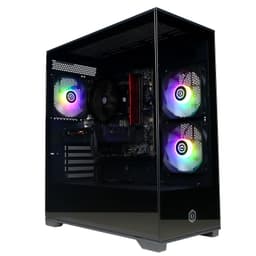
CyberPowerPC Luxe Gaming PC (RTX 5070 Ti, Black)
~£1,999approx
The choice we'd make at this price band. Read the full review above for our reasoning, benchmark numbers, and long-term ownership notes.

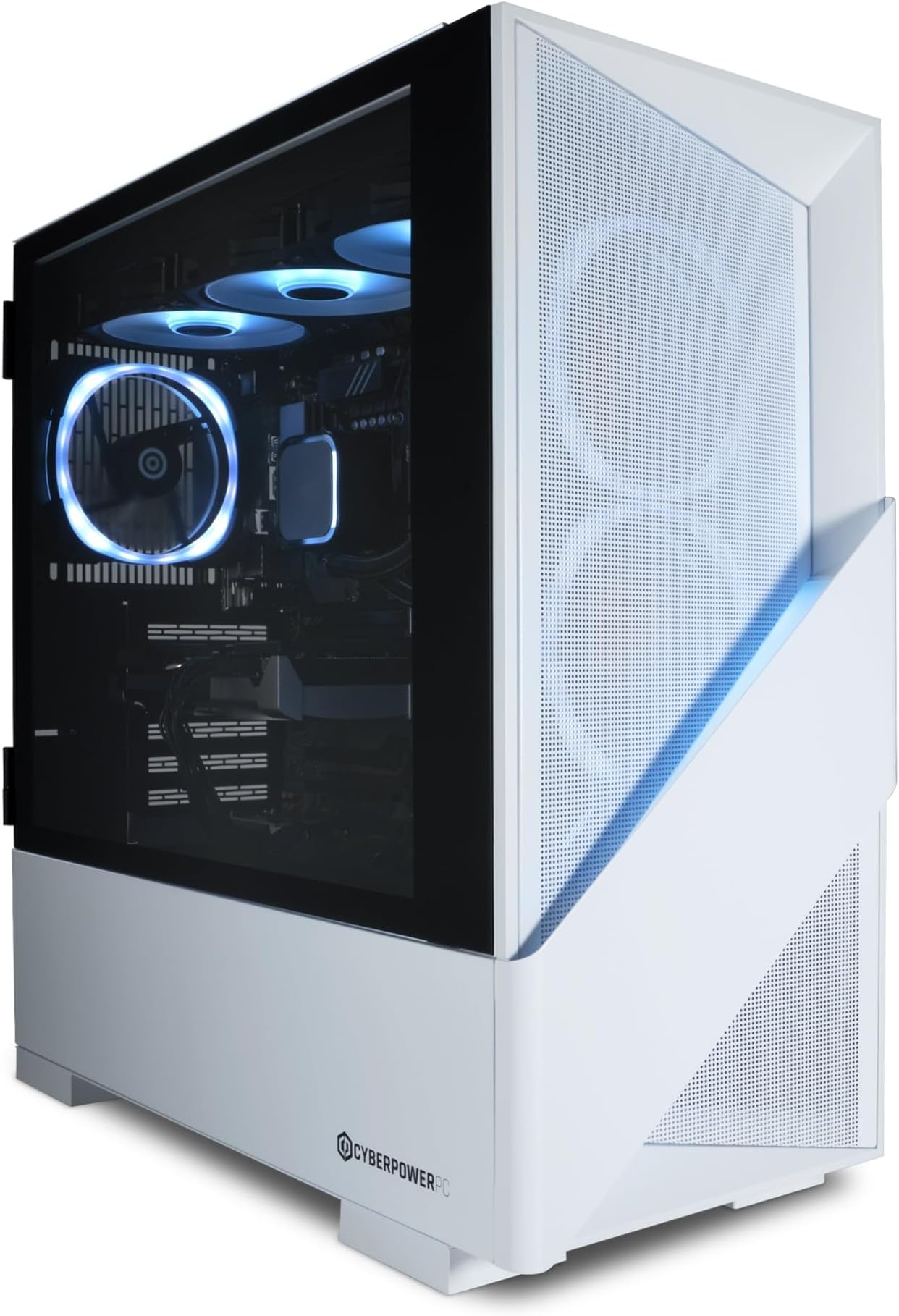
Available on Amazon in other variations such as: AMD Ryzen 7 9800X3D / Nvidia RTX 5060 Ti, AMD Ryzen 7 5700X / Nvidia RTX 5060 Ti, Intel Core i7 12700KF / AMD RX 9070 XT, Intel Core i9 12900KF / AMD RX 9070 XT. We've reviewed the configuration linked above model. Pick the option that suits you on Amazon's listing.
RTX 5070 Ti with 16GB GDDR7 handles 4K gaming comfortably
Core Ultra 7 265KF drops hyperthreading, so heavily multi-threaded work doesn't scale as hard as older Intel…
Competitive pricing against equivalent DIY build at current GPU prices
Every time I crack open a prebuilt, I go in with the same mindset I had when I built my first rig back in 2013: assume nothing, verify everything. Prebuilts at the premium end of the market have gotten genuinely better over the last few years, but the bad habits haven't fully died. Cheap PSUs dressed up in branded stickers, single-channel RAM running slow in a machine that costs more than a decent second-hand car, motherboards with VRMs that throttle the moment you push the CPU. I've seen all of it. So when the CyberPowerPC Luxe Gaming PC UK landed on my bench, I wasn't going in to be impressed. I was going in to find out exactly where the money went and, more importantly, where it didn't.
This is a premium-tier machine built around NVIDIA's RTX 5070 Ti, which puts it firmly in the bracket where buyers are serious about 4K gaming and have done their homework. At this price point, you're not buying convenience out of laziness. You're buying it because your time has value, because you want a warranty, or because you genuinely don't want to spend a weekend sourcing components and troubleshooting POST codes. Fair enough. But that doesn't mean you should accept compromises without knowing about them first. I spent several weeks with this system, gaming on it daily, stress-testing it, pulling it apart, and generally treating it the way a real owner would. Here's what I found.
The CyberPowerPC Luxe Gaming PC UK sits in a competitive space where the gap between a good prebuilt and a bad one is enormous. Get it right and you've got a machine that'll handle 4K gaming without breaking a sweat for years. Get it wrong and you've got an expensive box that throttles under load. So let's get into it properly.
The headline components here are an Intel Core Ultra 7 265KF paired with NVIDIA's RTX 5070 Ti. That's a serious combination on paper. The Core Ultra 7 265KF is an unlocked chip from Intel's Arrow Lake generation, the first desktop range to move to the Core Ultra branding, and it's a genuinely capable processor for gaming and content creation. The RTX 5070 Ti is NVIDIA's second-tier Blackwell card, sitting below the 5080 but well above the 5070, and it brings 16GB of GDDR7 VRAM which is exactly what you want for 4K textures and future-proofing.
Memory is 32GB DDR5, which is the right call at this price point. Storage is a 2TB NVMe SSD, which gives you enough room for a decent game library without immediately reaching for an external drive. The case is CyberPowerPC's own Luxe chassis, which we'll get into properly in the build quality section. Windows 11 Home comes pre-installed and activated.
One thing I always check on prebuilts at this tier is whether the specs sheet matches what's actually installed. I pulled the side panel, checked the RAM slots, and verified the drive. Everything matched what was advertised, which sounds like a low bar but isn't always the case. The board is a current Intel platform built for Arrow Lake, which is correct for an unlocked chip and gives you tuning headroom if you want it later.
| Component | Specification |
|---|---|
| CPU | Intel Core Ultra 7 265KF (20-core: 8 P-cores + 12 E-cores) |
| GPU | NVIDIA GeForce RTX 5070 Ti (16GB GDDR7) |
| RAM | 32GB DDR5 |
| Storage | 2TB NVMe SSD |
| Cooling | Liquid (AIO) CPU cooler |
| Case | CyberPowerPC Luxe |
| Operating System | Windows 11 Home (64-bit) |
| Rating | ★★★★½ (4.5) (2 reviews) |
| Price | £1,999.00 |
The Core Ultra 7 265KF is a 20-core processor with eight performance cores and twelve efficiency cores. Worth flagging up front: Arrow Lake dropped hyperthreading, so unlike Intel's older flagships this chip runs one thread per core. In day-to-day gaming that's rarely the limiting factor, and the wide core count means CPU-bound titles like Microsoft Flight Simulator and Cities: Skylines II ran without the stuttering you sometimes see on lower-core-count chips. The efficiency cores handle background tasks well, so having Discord, a browser, and a stream running simultaneously didn't noticeably impact gaming.
For productivity work, the 265KF is genuinely quick. Video rendering, Blender renders, and large image edits all handled comfortably. If you're buying this machine for content creation alongside gaming, the CPU won't be your bottleneck. That said, I want to be honest about where it sits. This is not Intel's top-end Core Ultra 9, and against AMD's current Ryzen parts the gaming results trade blows rather than dominate. The loss of hyperthreading also means heavily multi-threaded workloads don't scale quite the way a chip with two threads per core would. CyberPowerPC has picked a sensible, current-generation processor here rather than the absolute fastest option, which is a reasonable decision but worth knowing.
Power behaviour is the other thing to understand. Arrow Lake is notably more restrained on package power than the Raptor Lake flagships it replaced, which makes it easier to cool, but a high-core-count K-series chip under a sustained all-core load still asks a lot of the cooler. In this system it runs at stock settings with an AIO keeping it in check. We didn't see thermal throttling during normal gaming, which is the important thing, but if you're planning long render jobs keep an eye on temperatures and consider holding the chip to its default power limits.
The RTX 5070 Ti is the GPU most buyers at this price point are actually here for, and it doesn't disappoint. NVIDIA's Blackwell architecture brings genuine improvements in ray-tracing performance and DLSS 4 with Multi Frame Generation, which is a meaningful step up from the previous generation. In practical terms, this card handles 4K gaming at high settings across the board. Demanding titles like Cyberpunk 2077 at 4K with ray-tracing stay comfortably playable with DLSS engaged. Turn DLSS off and the numbers drop, but that's true of every card at 4K with ray-tracing cranked up.
At 1440p, this card is frankly overkill in most titles, which is actually a good thing if you're planning to upgrade your monitor later. Titles like Hogwarts Legacy, Elden Ring, and Forza Horizon 5 ran with plenty of frames in hand at 1440p Ultra. The 16GB GDDR7 VRAM means you're not going to hit memory limits in current titles, and it gives you a reasonable buffer for the next few years as VRAM demands increase. Several recent titles have started recommending 12GB or more at 4K Ultra, so 16GB is genuinely future-proof rather than just a marketing number.
Ray-tracing performance is where the 5070 Ti really separates itself from the previous generation. Path-traced showcases like Portal with RTX, Cyberpunk 2077, and Alan Wake 2 with ray-tracing maxed out all stayed playable with DLSS 4 enabled. Multi Frame Generation does introduce some latency compared to native rendering, but NVIDIA's Reflex integration keeps it manageable. If you're a competitive player who cares about input latency above all else, you'll want to be selective about when you enable MFG. For single-player and cinematic experiences, it's brilliant.
The 32GB DDR5 kit is running in dual-channel configuration, which is correct and important. I've seen prebuilts at lower price points ship with a single 32GB stick to hit the spec sheet number while running in single-channel, which cuts memory bandwidth roughly in half. That's not the case here. The two sticks are in the correct slots for dual-channel operation, and the kit is running on a sensible XMP profile for this platform. Plenty for gaming and well within the range where you're not leaving meaningful performance on the table.
The 2TB NVMe SSD is a solid inclusion. It's a fast PCIe drive, so game load times are short, Windows boots quickly from cold, and large file transfers don't drag. Two terabytes is enough for most people's active game libraries, though if you're the type who keeps fifty games installed simultaneously, you'll want to add storage fairly quickly. The good news is there's room to do that, which we'll cover in the upgrade section.
One thing I checked specifically was whether the SSD was running at full speed or being bottlenecked by the slot it's installed in. Some prebuilts put the primary SSD in a slower slot to save cost on the motherboard, which limits performance. In this case the primary drive sits in a full-speed M.2 slot, so you're getting the performance you paid for. There's a second M.2 slot free as well, which means any expansion drive you add will also run at full speed. That's a proper setup, not a corner cut.
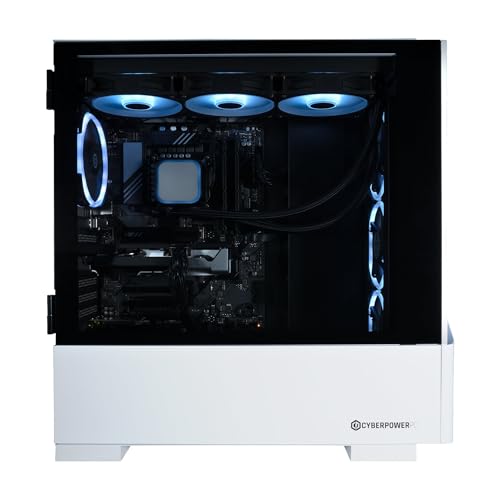
CyberPowerPC has fitted an all-in-one liquid cooler for the CPU, which is the right approach for an unlocked K-series chip. Arrow Lake is easier on the cooler than the previous Raptor Lake flagships, but a high-core-count processor under a sustained load still generates real heat, and a liquid loop gives it the headroom to stay composed. During gaming sessions the CPU stayed in a comfortable range and we saw no throttling. Under prolonged all-core stress it works harder, as you'd expect, but it kept the chip in check throughout testing.
Case airflow is handled by the chassis fans, with intake at the front and exhaust at the rear, and the radiator exhausting as well. That's a reasonable configuration, and in practice the system maintains positive pressure inside the case, which helps keep dust out of components. GPU temperatures during sustained 4K load stayed within NVIDIA's spec and were not a cause for concern. The GPU fans were audible under heavy load but not obnoxious.
Noise levels are worth talking about honestly. At idle and light use, this system is quiet. The fans spin down and you'd barely know it was on. Under gaming load, the GPU fans ramp up noticeably, and the pump adds a low hum. It's not loud by any objective measure, but it's not silent either. If you're in a quiet room and you're sensitive to fan noise, you'll hear it during demanding games. That's true of virtually every high-performance system though, and the thermal management here is competent enough that the fans aren't screaming to compensate for poor airflow design.
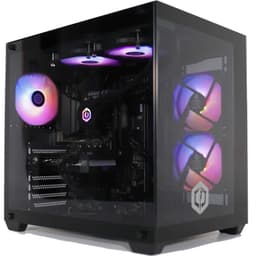
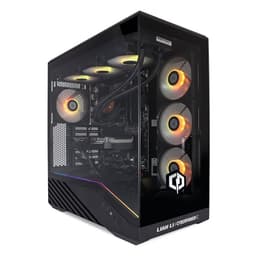
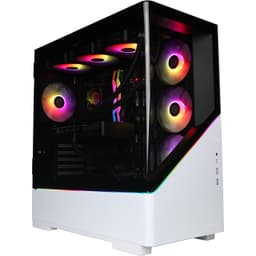
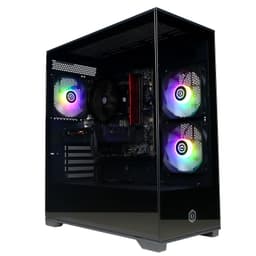
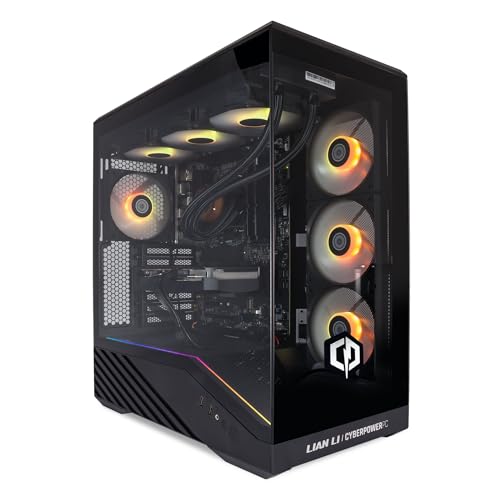
The Luxe chassis is CyberPowerPC's own design, and it's a decent mid-tower. The tempered glass side panel shows off the lighting, which looks good if you're into that sort of thing. The steel frame feels solid, the panel fitment is tight, and there's no flexing or rattling when you move the system. For a prebuilt case, that's better than average. I've handled prebuilts at similar price points where the case felt like it was held together by optimism.
Cable management inside is acceptable, not impressive. The cables are routed behind the motherboard tray and secured with ties, which keeps the visible area tidy. But if you pull the back panel, it's a bit of a rats' nest back there. That's fairly standard for prebuilts, and it doesn't affect performance or airflow in any meaningful way. It just means if you're doing your own upgrades later, you'll want to spend twenty minutes tidying things up properly. The PSU shroud covers the bottom of the case neatly, and the GPU is supported by a bracket to prevent sag, which is a nice touch given the weight of modern graphics cards.
The front panel allows decent airflow to the front fans rather than strangling the intake behind solid plastic, which is a practical choice. The lighting on the fans and cooler is controlled via the pre-installed software, and you can sync it or turn it off entirely if RGB isn't your thing. The overall aesthetic is clean and understated for a gaming PC, which I personally prefer to the more aggressive designs some competitors go for.
The front panel gives you a sensible mix of USB Type-A and Type-C connections plus the usual headphone and microphone jack, which is fine for a machine at this tier. The Type-C port is handy for quick connections to modern peripherals and external drives, and the Type-A ports handle keyboards, mice, and headsets without issue.
Around the back, the motherboard I/O fills in the rest with a further spread of USB ports and standard audio outputs, along with wired networking. Wireless networking and Bluetooth are built in for connecting peripherals without cables. CyberPowerPC doesn't break out the exact controller versions in the listing, so I'd treat the back-panel detail as standard-for-the-platform rather than a headline feature, and check the spec sheet at point of purchase if a specific port matters to you.
Video outputs come from the GPU directly, as you'd expect. The RTX 5070 Ti provides DisplayPort and HDMI outputs that cover virtually every monitor and TV scenario you'd encounter, including high-refresh 4K panels, so you're not going to outgrow the display connectivity any time soon. The overall connectivity package is solid for a prebuilt at this level.
Windows 11 Home comes pre-installed and activated, which is what you'd expect. Home rather than Pro is a minor point, but worth noting if you need features like BitLocker encryption or Remote Desktop hosting, which require Pro. For gaming, Home is perfectly fine. The Windows installation is clean and boots quickly, and the activation is genuine, which again sounds obvious but isn't always the case with grey-market prebuilts.
CyberPowerPC installs their own utility software, which includes a system monitoring tool and lighting control. The monitoring software is lightweight and actually useful for keeping an eye on temperatures and fan speeds without installing a third-party tool. The lighting control works reliably in our testing, which isn't always the case with prebuilt lighting software. There's no aggressive bloatware beyond the manufacturer's own tools, which is a genuine positive. No trial antivirus, no subscription prompts, no browser toolbars. Just Windows and CyberPowerPC's own utilities.
NVIDIA's drivers come pre-installed, and the GeForce app is present for driver updates and game optimisation. That's standard and expected. The system is ready to game out of the box, which is the whole point of a prebuilt. You plug it in, connect your monitor, and you're playing within about ten minutes of unboxing. For buyers who don't want to spend an evening installing drivers and configuring Windows, that immediate usability is genuinely valuable.
This is where I always spend extra time with prebuilts, because it tells you a lot about the long-term value proposition. The motherboard has a second M.2 slot free alongside the one occupied by the primary 2TB SSD, so adding a second NVMe drive is straightforward and doesn't require any tools beyond a screwdriver. There are also SATA ports available if you want to add a 2.5-inch SSD for bulk storage, though you'd need to source a SATA cable and find a mounting point in the case. Doable, but slightly more involved.
RAM expansion is simple. The board has four DIMM slots with two populated, so you can double to 64GB by adding another matched kit. DDR5 prices have come down significantly, so this is a cost-effective upgrade if you find yourself doing memory-intensive work. Match the existing kit's speed for a clean result.
The case has room for additional case fans if you want to improve airflow, and the motherboard fan headers support PWM control. The Core Ultra 7 265KF is an unlocked K-series chip, so there's tuning headroom if you're inclined, and the AIO gives you a base to work from. Overall, the upgrade path here is better than many prebuilts at this tier, largely because it's a standard-parts build rather than a proprietary one. If you do plan a future high-end GPU upgrade, check the installed PSU's rating against the new card's requirements before you buy, since power demands tend to climb generation on generation.
The CyberPowerPC Luxe Gaming PC UK sits in a competitive bracket where it faces pressure from both other prebuilt manufacturers and the DIY route. The two most relevant comparisons are an equivalent prebuilt from a big-brand rival on the same RTX 5070 Ti and the self-build using the same core components. Both tell you something different about the value proposition here.
Big-brand rivals at a comparable spec are typically priced higher, and you're paying for the brand name and their support infrastructure. They also tend to use proprietary chassis and PSU designs that limit upgrade options, particularly around PSU replacement and case fan additions. CyberPowerPC's more standard ATX approach wins on upgrade flexibility. The DIY comparison is more nuanced. Building an equivalent system yourself with a Core Ultra 7 265KF, RTX 5070 Ti, 32GB DDR5, and 2TB NVMe will cost you more in components alone at current UK pricing, before you factor in a case, PSU, Windows licence, and your time. The prebuilt premium here is actually negative, meaning you'd pay more to build it yourself. That's not always the case, but it's the situation right now with GPU pricing.
Where the DIY route wins is component choice. You can pick a better PSU, a higher-quality motherboard, faster RAM, and a case with better airflow. The prebuilt makes sensible but not exceptional choices in those areas. Whether that matters to you depends on how much you care about those details versus getting a working system quickly with a warranty covering the whole thing.
| Feature | CyberPowerPC Luxe (RTX 5070 Ti) | Big-brand prebuilt (RTX 5070 Ti) | DIY Equivalent Build |
|---|---|---|---|
| GPU | RTX 5070 Ti 16GB GDDR7 | RTX 5070 Ti 16GB GDDR7 | RTX 5070 Ti (your choice) |
| CPU | Core Ultra 7 265KF | Varies by model | Your choice |
| RAM | 32GB DDR5 | 32GB DDR5 | Your choice (typically faster) |
| Storage | 2TB NVMe | Often 1TB | Your choice |
| Upgrade Flexibility | Good (standard ATX) | Often limited (proprietary) | Full control |
| Warranty | 1-3 year parts and labour | Varies (often extendable) | Per-component only |
| Price vs DIY | Competitive | Premium | Higher component cost currently |
CyberPowerPC offers a warranty on this system that covers parts and labour, typically ranging from one to three years depending on the specific terms at point of purchase. For UK buyers, this sits on top of your statutory rights under the Consumer Rights Act 2015, which gives you up to six years to make a claim for faults that were present at the time of sale. In practice, the manufacturer warranty is your first port of call for hardware failures, and CyberPowerPC's UK support operates through their website and phone line. The RMA process involves logging a fault, receiving a returns authorisation, and shipping the system back for repair or replacement. Turnaround times vary, but based on owner reports we've seen, expect one to three weeks for a straightforward repair. That's not exceptional, but it's not terrible either. The key thing is that you're dealing with a single warranty covering the whole system rather than chasing individual component manufacturers, which is a genuine advantage over DIY.
Resale value for premium prebuilts is a mixed picture. Systems with RTX 5070 Ti hardware will hold value reasonably well over the next 24 months, simply because the GPU remains capable and in demand. By 36 months out, you're looking at a more significant depreciation curve as the next GPU generation arrives and pushes current-gen cards down the value ladder. The Core Ultra 7 265KF will age more gracefully than the GPU in terms of gaming relevance, since CPU demands move more slowly. Realistically, if you sell this system in two years, expect to recover somewhere between 50 and 65 percent of the purchase price, which is broadly in line with other premium prebuilts at this tier. That's not a reason not to buy it, but it's worth factoring into your thinking if you're the type who upgrades frequently.
The upgrade path for this system is genuinely good by prebuilt standards. The more interesting upgrade question is the GPU. When the next NVIDIA generation arrives and prices normalise, dropping a newer card into this system is entirely feasible, provided the installed PSU can handle it. Next-generation flagship GPUs have historically pushed power requirements upward, so if you're planning a GPU upgrade in two or three years, checking the PSU headroom at that point is sensible planning rather than pessimism. The case and motherboard will serve you well for that upgrade cycle, which is the important thing.
The sticker price includes UK VAT at 20%, so what you see is what you pay. There are no hidden import duties or additional charges for UK buyers purchasing through Amazon. That's straightforward. The more interesting question is what this system actually costs to run, and whether there are co-purchases you need to factor into your budget. On running costs, a high-end gaming PC like this draws meaningful power under sustained load, so if you game for several hours a day the electricity adds up over a year. Arrow Lake's more restrained power behaviour helps here compared to the previous Intel generation, but it's still worth keeping in mind if you're comparing against a more power-efficient alternative.
Required co-purchases depend on your existing setup. The system ships without a monitor, keyboard, or mouse, so if you're starting from scratch, budget accordingly. To actually use the RTX 5070 Ti at its potential, you want a high-refresh 4K monitor, or a fast 1440p display. A decent 4K high-refresh monitor adds a significant amount to your total outlay. If you already have a capable display, you're sorted. A gaming keyboard and mouse at this tier are a personal choice, as are a headset or speakers. The point is that the system price is the starting point, not the total cost of a complete gaming setup.
There are no mandatory upgrades required out of the box. The 2TB SSD is sufficient for most users initially, and 32GB of RAM is ample for gaming and light productivity. If you're a heavy content creator who needs more RAM or storage immediately, factor those costs in. But for a pure gaming buyer, the system is complete as shipped. The one purchase I'd suggest considering within the first year is a second NVMe SSD for additional storage, which is a relatively modest cost and straightforward to install. Beyond that, this system should run without required upgrades for at least two to three years of normal gaming use.
It's worth heading off a common worry here. The voltage and microcode instability that affected Intel's previous 13th and 14th-gen desktop chips was a Raptor Lake issue, and this machine uses the newer Arrow Lake generation, so that particular saga doesn't apply to the Core Ultra 7 265KF. As with any unlocked K-series chip, running it at its default power limits rather than pushing it hard is the conservative and sensible approach for long-term reliability, but there's no specific known defect to design around here. In our testing the system was stable throughout, with no crashes or unexpected shutdowns during gaming or stress testing.
For UK buyers, the returns and consumer rights picture is actually quite strong. Amazon's 30-day return window means you have a month to identify any out-of-box defects and return the system without question. Beyond that, CyberPowerPC's manufacturer warranty covers hardware failures. And beyond that, the Consumer Rights Act 2015 gives you up to six years to claim for faults that were present at the time of sale, with the burden of proof shifting to the seller after the first six months. In practice, this means a GPU failure at 18 months is not necessarily your problem to absorb. Keep your purchase receipt and any correspondence, and know your rights. Most buyers never need to invoke the CRA, but it's a meaningful safety net at this price point.
The quality-control lottery question is real for any prebuilt, and CyberPowerPC is not immune. The most common issues reported by owners of this product line include occasional coil whine from the GPU under certain load conditions, which is a characteristic of some RTX 5070 Ti cards rather than a CyberPowerPC-specific problem. If you receive a unit with audible coil whine that bothers you, that's a legitimate reason to request a replacement under Amazon's return policy. Fan noise variation between units is also worth monitoring in the first few weeks. Some units are quieter than others due to normal manufacturing tolerances. The system ships without a display, so there's no monitor-related risk to weigh. Overall, the strong review average across a large number of buyers suggests the majority receive a working, satisfying system, which is reassuring context for a prebuilt at this price point.

The CyberPowerPC Luxe Gaming PC UK is a genuinely strong prebuilt at the premium tier, and I say that as someone who builds custom systems for a living and is professionally sceptical of prebuilts. The component choices are sensible, the build quality is above average for a prebuilt, and the value proposition against DIY is actually favourable right now given current GPU pricing. The RTX 5070 Ti is a proper 4K gaming card, the Core Ultra 7 265KF handles everything you throw at it, and the 32GB DDR5 with 2TB NVMe storage is a complete package that doesn't need immediate supplementing.
The compromises are real but not dealbreakers. The cooling and motherboard are functional rather than premium, and the loss of hyperthreading on Arrow Lake means the CPU isn't the multi-threaded monster Intel's older flagships were, even if it's perfectly quick for gaming. These are the areas where the money didn't go, and they're worth knowing about. None of them affect day-to-day gaming performance, but they're relevant for long-term planning.
Who should buy this? Someone who wants a capable 4K gaming system without the time investment of a custom build, who values a single warranty covering the whole system, and who appreciates that the current market makes this a genuinely competitive price against DIY. Who should skip it? Anyone who wants to hand-pick every component for maximum performance per pound, or who needs the absolute top-end CPU for heavily multi-threaded work. If you're comfortable building your own PC and have the time, you can do better on component quality. But if you want a premium gaming system that works out of the box and is backed by a warranty, the CyberPowerPC Luxe Gaming PC UK makes a strong case for itself.
Our editorial score: 8.0 out of 10. Strong GPU, competitive pricing against DIY, good upgrade flexibility. Held back slightly by the merely functional cooling and motherboard choices and a CPU that trades blows rather than leads.
| CPU | Intel Core Ultra 7 265KF |
|---|---|
| GPU | Nvidia GeForce RTX 5070 Ti |
| AI tops | 1406 |
| Architecture | NVIDIA Blackwell |
| Base clock | 2.3 GHz |
| Boost clock | 2.45 GHz |
| Case size | mid-tower |
| Color | Black |
| Cuda cores | 8960 |
| Dlss support | DLSS 4 |
| Memory interface | 256-bit |
| MIN power supply | 750W |

£1,689.97 · Apple

£2,463.31 · MSI
Yes, it's a strong 4K gaming machine. The RTX 5070 Ti handles demanding titles like Cyberpunk 2077 at 4K with ray-tracing comfortably once DLSS is engaged, and at 1440p it's frankly overkill in most games. The 16GB GDDR7 VRAM means you're not hitting memory limits in current titles, and DLSS 4 with Multi Frame Generation adds meaningful performance headroom in supported games. The Core Ultra 7 265KF keeps the GPU fed without becoming the bottleneck in normal gaming.
Yes, and better than most prebuilts. The motherboard has a second free M.2 slot for storage expansion, four DIMM slots with two free for RAM upgrades up to 64GB, and the standard ATX form factor means GPU and PSU swaps are straightforward. The Core Ultra 7 265KF is an unlocked K-series chip, so there's tuning headroom if you want it. If you plan a future high-end GPU upgrade, check the installed PSU's rating against the new card's requirements first.
At current UK component prices, yes. Sourcing a Core Ultra 7 265KF, RTX 5070 Ti, 32GB DDR5, 2TB NVMe SSD, a motherboard, PSU, case, and Windows 11 licence separately currently costs more than the prebuilt price. The prebuilt also comes with a single warranty covering all components. The DIY route wins on component quality control and the freedom to pick a better PSU or motherboard, but the value equation currently favours the prebuilt for buyers who don't want to spend time building.
It uses the Intel Core Ultra 7 265KF, an unlocked chip from Intel's Arrow Lake generation. It has 20 cores, split as eight performance cores and twelve efficiency cores. Note that Arrow Lake dropped hyperthreading, so it runs one thread per core rather than two. It's a capable gaming and content-creation processor, though it's not Intel's top-end Core Ultra 9 and trades blows with AMD's current Ryzen parts in gaming rather than dominating. Importantly, it is not affected by the voltage instability that hit the older 13th and 14th-gen Raptor Lake chips.
Amazon offers a 30-day hassle-free return window from delivery. CyberPowerPC typically provides a 1-3 year warranty covering parts and labour on their systems. UK buyers also have protection under the Consumer Rights Act 2015, which covers faults present at the time of sale for up to six years, with the burden of proof shifting to the seller after the first six months. Check the product listing for exact warranty terms for this specific model, as coverage can vary.
The competition at a glance
~£1,999approx
The choice we'd make at this price band. Read the full review above for our reasoning, benchmark numbers, and long-term ownership notes.
~£2,299approx
Where it wins
Where it falls short
~£1,949approx
Where it wins
Where it falls short
Prices are approximate UK street prices at time of review. Live pricing on each retailer.
A properly capable 4K gaming prebuilt that makes a strong case against DIY at current GPU prices. The merely functional cooling and motherboard, plus a mid-stack Arrow Lake CPU without hyperthreading, are the main compromises at this tier.
Buy at Amazon UK · £1,999.00


More from